


Geopolitical Affairs/Sherman Family Korea Emerging Scholar Lecture
Presentations by Sherman Scholar Award Recipients
Since 2017, The Korea Society has presented this annual award to stimulate and support the next generation of U.S. thought leadership on Korea.
Presented to scholars in the U.S. from a wide range of disciplines and backgrounds, the award has recognized pioneering and impactful scholarship in fields such as architecture, political economy, political science, poetry, national identity, medical science, maritime conflict, and technology.
The award recognizes both emergent talents and emerging topics. It enjoys the kind support of Mr. and Mrs. Philip Sherman and family.

Reframing Suicide as a Shared Social Responsibility in Korea
Dr. Peter Jongho Na, Assistant Professor of Psychiatry, Yale School of Medicine
Dr. Na casts suicide not as an individual failure or “extreme choice (극단적 선택),” but as a systemic and cultural crisis requiring a coordinated national response. Drawing on his experience as a psychiatrist, public health researcher, and mental health advocate, he examines the scale and societal costs of suicide in Korea and analyzes key structural drivers such as academic and workplace pressures, poverty and isolation among older adults, and the pervasive stigma surrounding mental illness and treatment.
A central theme is how stigma has sustained silence, denial, and policy inertia. Dr. Na shares his efforts to challenge euphemistic language and foster open public dialogue, while proposing an interdisciplinary roadmap inspired by global models that integrate public health, education, and social welfare reforms. He also highlights the Korean diaspora’s potential role in breaking taboos and advancing cultural and policy change.

The Politics of The Silence of Love in Colonial Korea
Dr. David Krolikoski, Assistant Professor, University of Hawaiʻi
Dr. Krolikoski examined The Silence of Love (Nim ŭi ch’immuk, 1926), the acclaimed collection of eighty-eight poems by Han Yong-un (1879–1944), a Buddhist monk and public intellectual. Although the book is commonly celebrated as a metaphor for colonial subjugation, he argued that its artistic significance lies in Han’s paradigm-shifting use of colonial poetry as a medium of communal expression during a time of national crisis.
He explored how Han used fiction and symbols to collapse the boundary between private and public address, transmuting the individual voice of his poetic speaker into a platform for a community, and placed the collection within the 1920s translation of foreign poetic forms into Korea, with a focus on how Han incorporated elements of the lyric and prose poem into his verse.
The Return of Industrial Policy: Lessons from Korea
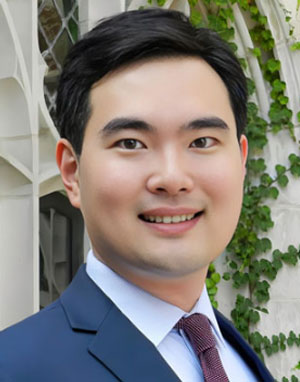
Dr. Munseob Lee, Assistant Professor, University of California San Diego
Industrial policy is making a comeback. Signs of government intervention in support of industry are visible not only in China, but in the U.S., Europe, and Asia. Drawing on Korea’s experience, Dr. Lee offers insights for today’s policymakers, including a close look at the government’s 1973 heavy and chemical industry drive. While that policy yielded positive outcomes for the targeted industries, it also resulted in higher concentration within those sectors.
Lee stresses the need for a thorough evaluation of costs and benefits before implementation, especially given current bipartisan support in the U.S. for major bills aimed at revitalizing industrial policy. As one reviewer stated, “At this critical time Lee revisits the effectiveness of Korean industrial policy during a high development phase to glean useful insights for Korea, U.S., and beyond.” Moderated by Thomas Byrne, then President and CEO of The Korea Society.

National Identity Affirmation and Trust in Korea, Japan and China
Dr. Eunbin Chung, Assistant Professor of Political Science, University of Utah
Legacies of conflict and distrust have made it difficult for East Asian countries to form regional institutions and overcome security dilemmas. Dr. Chung’s research questions two conventional wisdoms: that distrust among states can be overcome through cultural convergence and appeals to a shared identity, and that strong, inward-focused national identities exacerbate inter-state distrust and conflict. She advances the concept that trust can be built among nations when each affirms its own distinctive identity, and that this may be more effective than embracing common identities across countries.
Dr. Katrin Katz, the inaugural award recipient, described Chung’s argument as “breaking new ground in tackling some prevailing beliefs regarding the relationship between national identity and levels of inter-state trust and conflict.”

Korea’s Changing National Story and Democratic Future
Dr. Aram Hur, Assistant Professor and Co-Director, Institute for Korean Studies, University of Missouri
Dr. Hur addressed Korean nationalism, a “rapidly fragmenting and changing” national story, and the danger of democratic rollback. Senior director Stephen Noerper described her selection and address as “incredibly important given the costs of such fragmentation in Korea, but comparatively in the United States of late and by extension to a world seeing rollback in Myanmar, Thailand, Russia and elsewhere.”
Architecture as Kisul in Postwar Korea: Building the Industrial Nation-State
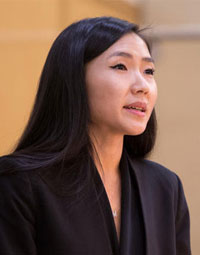
Melany Sun-Min Park, Doctoral Candidate, Harvard University
Ms. Park addressed architecture’s relationship to state-led, large-scale industrial development in postwar Korea, framing architecture as kisul (science-technology). Carter Eckert, Yoon Se Young Professor of Korean History at Harvard University, described her effort as a “brilliantly conceived project combining…histories and cultural issues with an exploration of science/industrialism and aesthetics…in South Korea.” Harvard Professor Yukio Lippit hailed her original “use of archives never tapped for use in any language.”
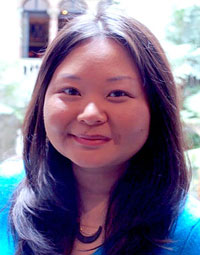
P’ansori Mountain Pilgrimages: Land as Interlocutor in Contemporary Korean Oral Performance and Literature
Dr. Ivanna Sang Een Yi, Visiting Assistant Professor, University of Colorado Boulder
In a presentation both spoken and sung, Professor Yi conceptualized the contemporary practice of p’ansori san kongbu, mountain study, as a form of pilgrimage.
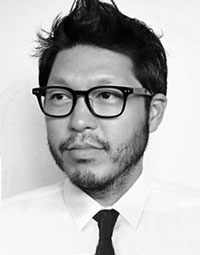
Imagining the Impossible: The DMZ as a Productive Territory
Dongsei Kim, Architect and Assistant Professor, New York Institute of Technology
Professor Kim explored how architecture and landscape architecture investigate the Demilitarized Zone. Through the prism of spatial design and three concrete examples, he argued for reformulating exclusionary border conditions into inclusive spaces that become synergistic and productive for both Koreas.

Maritime Conflict in Northeast Asia and Nationalism in Korea
Dr. Katrin Katz, Northwestern University
The Korea Society celebrated sixty years since its founding with a public and press presentation on September 27 by Dr. Katz, who served on the National Security Council in the George W. Bush administration. Her dissertation addresses maritime conflict in Northeast Asia and the dynamics of nationalism in Korea. Mr. Sherman, whose family supports the award, served as Citi’s representative in Korea in the early 1970s.
Apply for the next lecture
Ph.D. candidates, junior professors, researchers, and professionals are eligible.
Become a member
Get access to exclusive programs and a network dedicated to U.S.–Korea relations.