

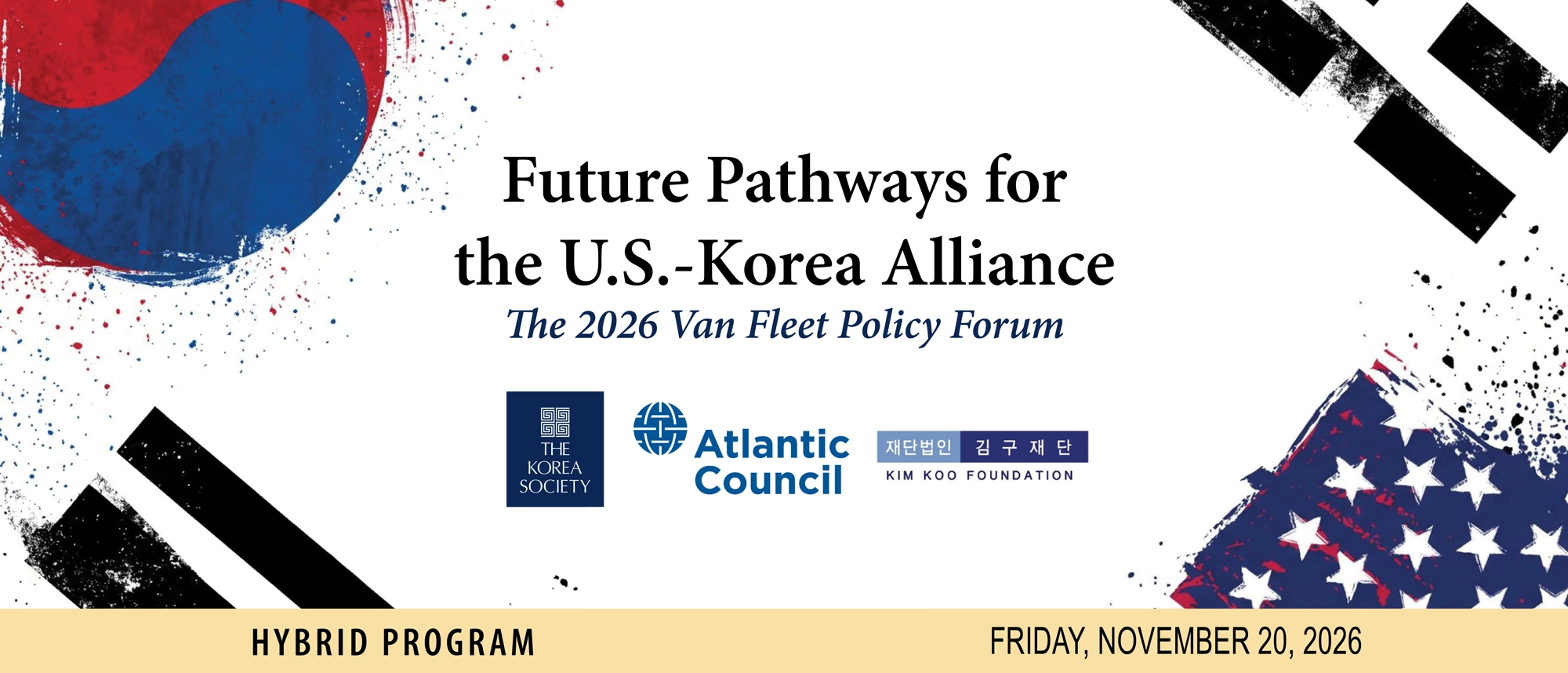
Future Pathways for
the U.S.-Korea Alliance

The 2026 Van Fleet Policy Forum
The 2026 Van Fleet Policy Forum | The Korea Society

Building on the success of last year’s forum—which examined the evolution of alliance cooperation across domains and through history—The Korea Society, in collaboration with the Indo-Pacific Security Initiative in the Atlantic Council’s Scowcroft Center for Strategy and Security, is pleased to announce The 2026 Van Fleet Policy Forum.

Made possible through the generous support of The Kim Koo Foundation, this year’s forum will once again feature an exciting, high-level lineup of thought leaders, senior practitioners, and policymakers in Washington.

This event will be held in person and livestreamed. Please scroll down to request in-person attendance or to register for the livestream. In-person attendance is limited and subject to confirmation by The Korea Society’s Geopolitical Affairs team.

Traditional policy conferences isolate diplomacy, security, and geo-economics into separate silos. In today’s interconnected geopolitical climate, however, these spheres are inextricably fused.

The 2026 Van Fleet Policy Forum will deliver vital, forward-looking insights by examining the alliance through two cross-disciplinary, binational panel discussions anchored in contrasting scenarios set ten years in the future.

  1. Scenario A

    Forging a Future-Ready Strategic Partnership

    It is the year 2036, and the U.S.-ROK Alliance has achieved unprecedented synergies, integrating diplomacy, trade, and technological innovation to deliver profound benefits across both societies and beyond. What does this resilient, gold-standard partnership look like on the global stage, and how was the strategic groundwork laid in the preceding years to achieve it? A binational panel of thought leaders with expertise in diplomacy, security, commerce, and technology will map out the blueprint for a best-case future.

  2. Scenario B

    Compounding Pressures Strain Alliance Cohesion

    By 2036, industrial competition, trade disputes, diverging security strategies, regional security crises, and deteriorating trust has fractured the alliance, causing the two nations to drift from strategic allies into transactional, ad-hoc partners. Washington downgrades its commitment to the Peninsula and Seoul prioritizes defense self-reliance. In the resulting strategic vacuum, an emboldened Russia–North Korea axis and an assertive China dominate a hyper-militarized Northeast Asia, leaving a decoupled alliance dangerously vulnerable to deterrence failure and rapid conflict escalation. What were the warning signs and enabling factors that led to this breakdown? How can it be avoided?

The program will also feature keynote addresses and a special tribute commemorating the 150th anniversary of the birth of independence leader Baekbeom Kim Koo, honoring the enduring legacy of Kim Koo and General Kim Shin in forging the bedrock of U.S.–ROK cooperation.

Confirmed

Confirmed Speakers

  • Steve Biegun

    Former Deputy Secretary of StateUnited States

    Steve Biegun

    Former Deputy Secretary of StateUnited States

    Stephen E. Biegun served as U.S. Deputy Secretary of State from 2019 to 2021, the Department’s second-ranking diplomat, after serving as U.S. Special Representative for North Korea from 2018 to 2019. At State he led the Department’s COVID-19 response, including the return of more than 100,000 Americans stranded abroad, and focused on the Korean Peninsula, U.S.-China relations, and the wider Indo-Pacific. He previously served as Executive Secretary of the White House National Security Council, chief of staff of the Senate Foreign Relations Committee, and national security advisor to the Senate Majority Leader, and early in his career directed a democracy-assistance program in Moscow. He spent two decades in the private sector as a corporate vice president at Ford Motor Company and The Boeing Company. He is the 2026 Rothschild & Co Distinguished International Fellow at the Lowy Institute, serves on the boards of the National Endowment for Democracy and the German Marshall Fund, and is a graduate of the University of Michigan.

  • Wendy Cutler

    Senior Vice PresidentAsia Society Policy Institute

    Wendy Cutler

    Senior Vice PresidentAsia Society Policy Institute

    Wendy Cutler is Senior Vice President at the Asia Society Policy Institute (ASPI), where she leads the Institute’s Washington, D.C. office and its work on trade, investment, innovation, and women’s empowerment in Asia. She joined ASPI in 2015 after nearly three decades as a diplomat and negotiator at the Office of the U.S. Trade Representative, culminating in her service as Acting Deputy U.S. Trade Representative, where she was responsible for the Trans-Pacific Partnership, including the bilateral negotiations with Japan. She was the Chief U.S. Negotiator for the U.S.-Korea Free Trade Agreement (KORUS) and also worked on U.S.-China trade relations, APEC, the WTO Financial Services Agreement, and numerous bilateral agreements with Japan. She began her career working on trade issues at the U.S. Department of Commerce. She holds a master’s degree from Georgetown University’s School of Foreign Service and a bachelor’s degree from The George Washington University.

  • Markus Garlauskas

    Director, Indo-Pacific Security InitiativeScowcroft Center for Strategy and Security, Atlantic Council

    Markus Garlauskas

    Director, Indo-Pacific Security InitiativeScowcroft Center for Strategy and Security, Atlantic Council

    Markus Garlauskas is Director of the Indo-Pacific Security Initiative in the Atlantic Council’s Scowcroft Center for Strategy and Security, where he leads work on geopolitical risk, conflict and nuclear deterrence, U.S. strategy, and cooperation with allies and partners in the Indo-Pacific. A former U.S. government senior executive, he served from 2014 to 2020 as National Intelligence Officer for North Korea on the National Intelligence Council, leading the intelligence community’s strategic analysis and wargaming on North Korea and supporting policy deliberations including the Singapore and Hanoi summits. He previously spent nearly twelve years in Seoul at the headquarters of United Nations Command, Combined Forces Command, and U.S. Forces Korea, including as director of the Strategy Division, and received the Joint Civilian Distinguished Service Award. He holds a B.A. in history from Kent State University and a master’s degree from Georgetown University’s Security Studies Program, where he is now an adjunct professor.

  • Park Jin

    Former Foreign MinisterRepublic of Korea

    Park Jin

    Former Foreign MinisterRepublic of Korea

    PARK Jin formerly served as Korea’s Foreign Minister and four-term Member of National Assembly. He is currently Distinguished Invited Professor at Korea Advanced Institute of Science and Technology and Senior Advisor at the Kim & Chang Law Office as a Member of the New York Bar. Previously, he led the Asia Future Institute (AFI), chaired the Korea-America Association (KAA). Elected to the National Assembly in 2002, he chaired the Foreign Affairs, Trade, and National Unification Committee, passing key laws such as the KORUS FTA and the North Korea Human Rights Act. He also served as Presidential Secretary for Press and Political Affairs under the Kim Young-sam administration. He served as a Navy Lieutenant in Korea.

  • Dr. Syrus Solo Jin

    Elihu Rose Scholar in Modern Military History, Department of HistoryNew York University

    Dr. Syrus Solo Jin

    Elihu Rose Scholar in Modern Military History, Department of HistoryNew York University

    Syrus Solo Jin is the Elihu Rose Scholar in Modern Military History in the Department of History at New York University. A historian of U.S.-East Asian relations, the U.S. military, and the Cold War, he is completing a book on U.S. military-building in early Cold War Asia that traces the origins of America’s global security infrastructure through the experiences of American military advisors and their Asian counterparts. His peer-reviewed research has appeared in Diplomatic History and the Journal of American-East Asian Relations, and he has written on U.S. foreign policy, security, and East Asia for Foreign Policy, The Washington Post, TIME, and the U.S. Institute of Peace. He earned his Ph.D. in history from the University of Chicago in 2025, where he was a Jefferson Scholars Foundation National Fellow, and his bachelor’s degree from Washington University in St. Louis.

  • Dr. Abraham Kim

    PresidentThe Korea Society

    Dr. Abraham Kim

    PresidentThe Korea Society

    Abraham Kim, Ph.D., is President & CEO of The Korea Society, where he leads the organization’s work to strengthen ties between the United States and Korea through policy dialogue, business engagement, and cultural exchange. He brings more than 25 years of experience in public policy, national security, and nonprofit leadership focused on U.S.-Korea relations and Northeast Asia. He previously served as Executive Director & President of the Council of Korean Americans, Executive Director of the Maureen and Mike Mansfield Center at the University of Montana, and Interim President and Vice President of the Korea Economic Institute of America. Earlier, he worked as a policy and risk analyst at Eurasia Group, CSIS, and SAIC. He holds a Ph.D. and M.Phil. in political science from Columbia University, an M.A. from Harvard University, and a B.A. from Boston University.

  • Tami Overby

    PartnerDGA Group Government Relations
    Tami Overby

    PartnerDGA Group Government Relations
    Tami Overby is a Partner at DGA Group Government Relations in Washington, D.C., where she draws on more than three decades of experience in Asia to advise clients on investment and trade issues in Korea and across the region. She was previously Senior Director at McLarty Associates and, before that, Senior Vice President for Asia and President of the U.S.-Korea Business Council at the U.S. Chamber of Commerce, where she represented U.S. business during the Trans-Pacific Partnership negotiations and led the Chamber’s APEC work. Earlier, she served for 14 years as President of the American Chamber of Commerce in Korea, helping expand bilateral trade and supporting the conclusion and ratification of the U.S.-Korea Free Trade Agreement. She serves on the boards of The Korea Society and the U.S.-Asia Institute and on the Advisory Council of the Korea Economic Institute. She holds a B.S. in business administration and management from the University of Arkansas.

Attend in person or watch the livestream.

The 2026 Van Fleet Policy Forum takes place on Friday, November 20, 2026. To register to attend in-person or to view virtually, please register below.

Request to Attend (opens in a new tab)

Date & Time
Location

1400 L St NW, Washington, DC 20005

Format

Please note: In-person attendance is limited and subject to confirmation by The Korea Society’s Geopolitical Affairs team.

Not a member yet? Join The Korea Society

Images