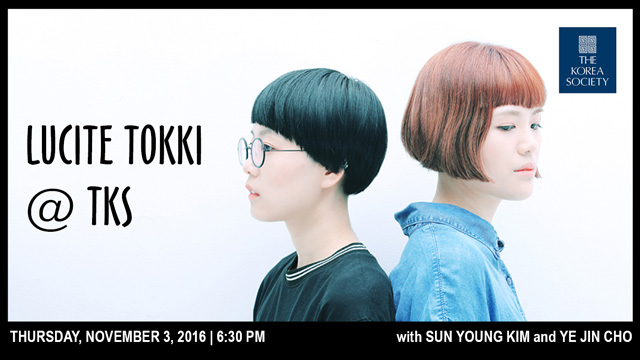
New York-based female alt-pop duo Lucite Tokki celebrate the release of their latest Single. Bandmates Ye Jin Cho and Sun Young Kim bring their unique mood and sound to The Korea Society.
Message from the Artist: It has been a long time since we released our 4th album in 2016, and finally, here’s our new single, “good.” “good” is a sweet, lighthearted, and somewhat quirky love song. We hope this creepy yet breezy love song gives you a little chill this summer.
Admission
The Korea Society Fellow, Patron and Corporate members: FREE with registration
Lucite Tokki Single Release Party
Friday, August 3, 2018 | 7 PM
The Korea Society 350 Madison Avenue, 24th Floor New York, NY 10017
Lucite Tokki is a New York-based female alt-pop duo formed in Seoul 2005. Over a decade later, they have released four full albums and six EPs growing their audience worldwide. With a base of pop, they established their own unique mood and sound by exploring various elements of music.
This program is supported, in part, by public funds from the New York City Department of Cultural Affairs in Partnership with the City Council.
Billboard columnist and Forbes contributor, Tamar Herman, explores the origins of the hallyu wave. From Seo Taiji & Boys in the 1990s to international sensation BTS, how has Kpop evolved? Ms. Herman outlines the elements which distinguish Kpop, notes milestones, and discusses the potential of the global music phenomenon.
Followed by Q&A and reception with Korean food and drinks.
The History of Kpop
Thursday, August 2, 2018 | 6:30 PM
The Korea Society 350 Madison Avenue, 24th Floor New York, NY 10017
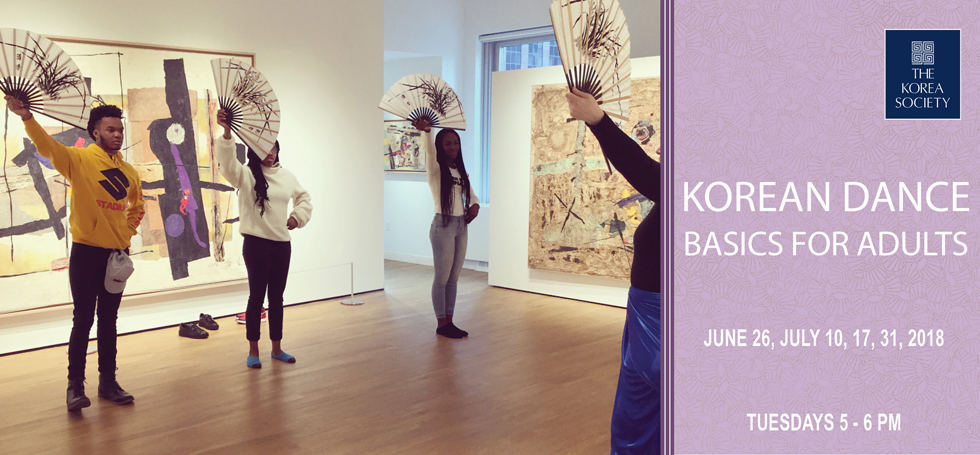
This introductory traditional Korean dance workshop uses gentle movement techniques to establish an appreciation of the dance form. Each week the focus is comprised of applications within the dance syntax such as key body positions and elemental dance phrases to develop an understanding of the dance. The students build an essential understanding of the dance form as beginner dance students or as informed audience members. This 4 week workshop is intended to build groundwork using the dance form to further identify the physical self not just in the dance class but taking that movement in practical ways into daily life.
Class Fee (Limited spaces available) Members & KLP Students FREE Non-Members $75
Dance Level Dancers and non dancers are welcome ALL movement abilities are welcome Chairs will be available All dance and fitness props will be provided for use in the class.
Clothing BODY – Comfortable , loose clothing FEET – Socks or ballet flats (please) No shoes, no bare feet
The Korea Society | 350 Madison Avenue 24th Fl | New York, NY 10017 Entrance between 44th & 45th Streets
Ms. Kriegel is the creative force behind the World Dance Initiative dance collective and teaches Korean dance in New York City to teens and adults. As a performer, Ms. Kriegel dances independently and with community organizations. Promoting traditional dance and working with other artists, Ms. Kriegel aims to share Korean dance with heritage and non heritage audiences, focusing on the details, intricacies and depth of the dance form. While performing, teaching and lecturing regularly on the subject of Korean dance worldwide, Ms. Kriegel has won several gold medals and prizes in Korean dance. For teaching, she received the 2012 T.A.S.K. Korean Dance Teacher’s Award and the 2012 Foundation for Korean Language and Culture in USA Appreciation Award. Ms. Kriegel received honors with fellowships in Korean Studies from Stanford University S.P.I.C.E. program (2012) and The Freeman Foundation Fellowship on Korean Studies (2013). Ms. Kriegel received congressional recognition in 2017 for her work at home and abroad, as well as a fellowship from the Hemerra Foundation for Peace Research in 2018.
This unique concert presents Korean traditional music by artist gamin, performed alongside active New York-based American wind and percussion instrument players Ned Rothenberg, Jeff Fairbanks, and Satoshi Takeishi. Artists play Korean traditional instruments such as piri, the Korean bamboo-oboe as well as saxophone, clarinet, trombone, and shakuhachi, the Japanese flute. This performance encourages the audience to learn about the Korean wind instrument piri and pungnyu, an artistic form of recreation, intrinsic to a tasteful lifestyle and relevant to Koreans’ collective and individual entertainment culture.
Streams of Wind: Piri
Thursday, April 26, 2018 | 6:30 PM
Tickets Members $15 Non-Members $25
Piri (피리) The piri is a cylindrical double-reed bamboo oboe with eight finger holes, one in the back for the thumb and seven in the front. Its large reed and cylindrical bore gives it a mellower sound than that of many other types of oboe. The piri is an essential instrument and popularly used in both folk and classical court music.
gamin gamin is a New York-based distinguished soloist performing traditional Korean music as well as cross-disciplinary collaborations worldwide. Born in Seoul, she began studying piano at the age of six, violin at the age of nine, Korean music (piri major) at age fifteen. In 1998, she received her B.A. in Korean Music from Seoul National University. Her main instrument is the piri, a double reed instrument similar to the oboe. She also plays the taepyeonso (a double-reed horn) and saenghwang (a type of mouth organ). She is a yisuja, official holder of the Important Intangible Cultural Asset No. 46 for Classical Court Music, Classical Piri Music, and Daechita (royal military music). She has also dedicated herself to academic studies, receiving a D.M.A. (Doctor of Musical Arts) in Korean traditional music from Seoul National University. She was a member of the National Gugak Orchestra from 2004 to 2010 as assistant principal piri player. She was the recipient of a residency program grant from the Ministry of Culture, Sports and Tourism of the Republic of Korea in 2011 & 2012 and has toured with lecture concerts at Harvard University, University of Pennsylvania, Dartmouth College, Northeastern University, University of Hartford, among other places. Currently, gamin is a visiting scholar at the James Joo-Jin Kim Program in Korean Studies in University of Pennsylvania.
Jeff Fairbanks Deemed a “rising multi-faceted star if not musical voice on the New York scene” by CriticalJazz, 2016 New York Foundation for the Arts Fellow Jeff Fairbanks has won a number of highly competitive awards for composing, including the USAF Sammy Nestico Award, the Jerome Fund, ASCAP Young Jazz Composer Award, and the BMI Charlie Parker Award. He has won eight grants from the following institutions: the Aaron Copland Fund, the Queens Council on the Arts, and New Music USA (formerly American Music Center). Fairbanks is a native of South Florida. After earning a Master’s degree in Jazz Composition from USF in 2005, he moved to New York to join the BMI Jazz Composer Workshop under Jim McNeely. Now, in addition to leading and writing for Project Hansori and other projects, Jeff freelances as a composer and performer and teaches with the New York Jazz Academy. He lives in Queens, NY with his wife, Heun Choi, and their two children.
Photo by Caroline Forbes Edward Rothenberg Composer/Performer Ned Rothenberg has been internationally acclaimed for both his solo and ensemble music, presented for the past 33 years on 5 continents. He performs primarily on alto saxophone, clarinet, bass clarinet, and the shakuhachi – an endblown Japanese bamboo flute. His solo work utilizes an expanded palette of sonic language, creating a kind of personal idiom all its own. In an ensemble setting, he leads the trio Sync, with Jerome Harris, guitars and Samir Chatterjee, tabla, works with the Mivos string quartet playing his Quintet for Clarinet and Strings and collaborates around the world with fellow improvisors. Recent recordings include this Quintet, The World of Odd Harmonics, Ryu Nashi (new music for shakuhachi), and Inner Diaspora, all on John Zorn’s Tzadik label, as well as Live at Roulette with Evan Parker, and The Fell Clutch, on Rothenberg’s Animul label.
Satoshi Takeishi Satoshi Takeishi, drummer, percussionist, and arranger is a native of Mito Japan. He studied music at Berklee College of Music in Boston, Massachusetts. While at Berklee he developed an interest in the music of South America and went to live in Colombia following the invitation of a friend. He spent four years there and forged many musical and personal relationships. One of the projects he worked on while in Colombia was “Macumbia” with composer/arranger Francisco Zumaque in which traditional, jazz, and classical music were combined. With this group he performed with the Bogota Symphony Orchestra to do a series of concerts honoring the music of the most popular composer in Colombia, Lucho Bermudes. In 1986, he returned to the U.S. where he began work as an arranger in Miami. In 1987, he produced “Morning Ride” for jazz flutist Nestor Torres on Polygram Records. His interest expanded to the rhythms and melodies of the Middle East where he studied and performed with Armenian-American oud master Joe Zeytoonian. Since moving to New York in 1991, he has performed and recorded with many musicians such as Ray Barretto, Carlos “Patato” Valdes, Eliane Elias, Marc Johnson, Eddie Gomez, Randy Brecker, Dave Liebman, Anthony Braxton, Mark Murphy, Herbie Mann, Paul Winter Consort, Rabih Abu Khalil, Toshiko Akiyoshi Big Band, Erik Friedlander, and Pablo Ziegler to name a few. He continues to explore multi-cultural, electronic, and improvisational music with local musicians and composers in New York.
This program is supported, in part, by public funds from the New York City Department of Cultural Affairs in Partnership with the City Council.
Proclaimed by UNESCO in 2003 as part of the Intangible Cultural Heritage of Humanity, p’ansori is a unique genre of Korean musical storytelling. Singer, Jin Wook Hong, performs traditional and contemporary pieces in this style, accompanied by musicians on the gayageum, bass, drums, and keyboard.
6:30 PM | Registration and Reception 7:15 PM | Performance
Korea Society Fellow, Patron, and Corporate members, please register HERE for complimentary tickets.
Jin Wook Hong is a p’ansori singer and an occasional gosu, p’ansori drummer. He began his musical training at the age of twelve, studying with masters, Woo Hyang Sung and Su Mi Kim and later trained as a p’ansori isuja, a successor, for Intangible Cultural Property No. 5. After completing his undergraduate studies at Seoul Institute of the Arts College, Hong relocated to the US to study Music Therapy at Molloy College.
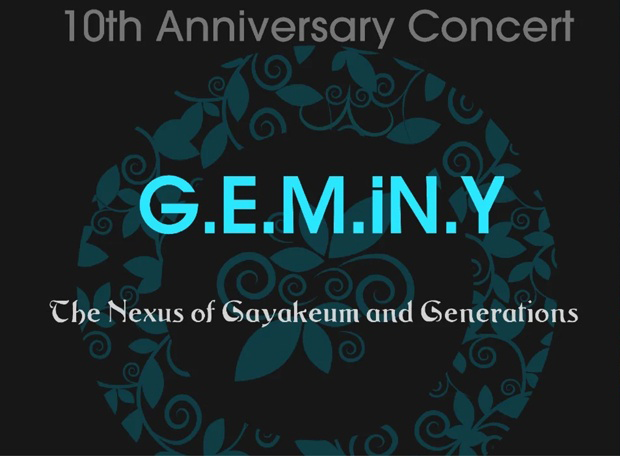
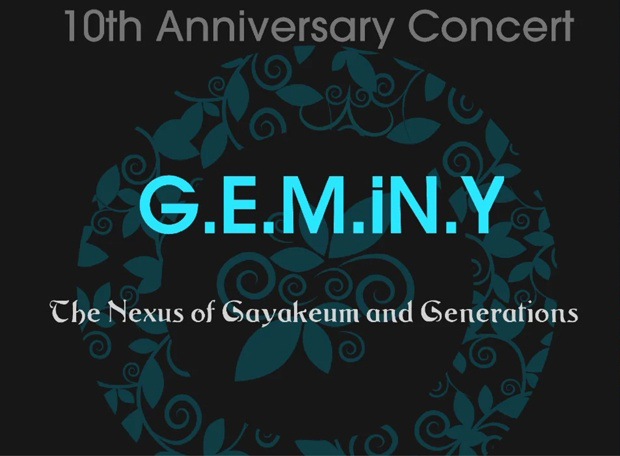
G.E.M.iN.Y, short for Gayakeum Ensemble Music in New York, derives from the Korean phrase, “chaeminaji” meaning to have fun while performing. The ensemble, composed of founder, Rami Seo and 1st, 2nd, and 3rd generation gayakeumists, debuted in the form of a gayakeum orchestra in 2007 with “If This Gayakeum Could Talk.” In addition to performing traditional Korean music on the 12-string gayakeum, G.E.M.iN.Y plays music of all genres, including classical, jazz, crossover, and contemporary, on 18-string and 25-string gayakeums. To celebrate GEMiNY’s 10th year anniversary in 2017, the concert will showcase world music that brings together traditional Korean culture and the diversity of cultures in New York.
Thursday, November 2, 2017 | 6:45 PM
6:45 PM | Registration 7:15 PM | Performance
G.E.M.iN.Y 10th Anniversary Concert: The Nexus of Gayakeum and Generations
Hyo Seon Kim Iris Kim Joanne Booye Kim Sharon Daso Kim Chris Minkyu Park Julia Minji Park Soon Ok Park Dorothea Smith Hyerin Yoon Yeongseo Yoon Inae Yun
Performers from Rami Seo’s World Music Ensemble
가야금: 서라미 Rami Seo 기타: 최호경 Hokyung Choy 피아노: 박상훈 Sanghoon Park 콘트라베이스: 정상욱 Sang ouk Jung 드럼: Peter Manheim
The winners of the prestigious Onnara Gugak Competition visit The Korea Society for a special concert of traditional Korean music. The young masters will perform gayageum sanjo, p’iri sangnyeongsanpuri, jeongga suyangsanga, and the famous Arirang medley. The concert also features chunaengjeonon, a court dance inspired by singing nightingales on a fine spring day.
Young Masters in Concert: Winners of the Onnara Gugak Competition
Tickets: Free for Supporter, Fellow & Patron Members $10 Individual Members $20 Non-members
This performance is presented in collaboration with the Korean Cultural Center New York and the National Gugak Center.
If you have any questions, please contact Luz Lanzot or (212) 759-7525, ext. 309.
ABOUT THE NATIONAL GUGAK CENTER
Gugak, or traditional Korean music, has been passed down through the ages and represents the breath of Korean history and culture. The National Gugak Center is the principal institution engaged in producing and disseminating traditional Korean music and dance. The Center’s Court Music Orchestra, Folk Music Group, Traditional Dance Theater, and Contemporary Gugak Orchestra actively perform to preserve and develop gugak. Also, the Gugak Research Office was established for academic research on Korea n music.
In addition to performance and research, the Center is engaged in education, and provides lectures for teachers, families, and foreign residents in Korea.
The Center’s museum exhibits 5,000 items representing the history of Korean music. The Namwon National Gugak Center for Changgeuk, the Jindo National Gugak Center (known for its training programs), and the Busan National Gugak Center are affiliated branches.
If you have any questions, please contact Luz Lanzot or (212) 759-7525, ext. 309.
This program is supported, in part, by public funds from the New York City Department of Cultural Affairs in Partnership with the City Council.
About the Artists
Lucite Tokki is a Seoul-based female pop duo formed in 2005. The group consists of Sun Young Kim and Ye Jin Cho. They first met in college during a music-writing course. Over a decade later, they have released four full albums and six EPs, and have a worldwide following.
Master percussionist Anji Park leads SamulGwangdae, a group of artists known for their high energy performances combining song and dance. Park trained under Master Sungho Lee and Kwangsoo Lee to learn binari and specializes in kkwaenggwari. Join us for this evening of samulnori that will bring you to your feet!
Percussionists of SamulGwangDae Anji Park Hyunjin Jang Han Bok Kim Chan Sun Shin Dong Joo Lee
Supporting Artists Sungshil Yu, gayageum & vocals JinHee Kim, dancer
Program
1. Invocation (축원) Binari, Introductory Prayer Chant or Shaman Ritual
Among the four major pieces of samulnori, the binari is most akin to a religious ritual, featuring pleas to the spirits for blessings. The piece welcomes the spirits to spread good luck to the audience.
2. Taepyeongmu (태평무)
Taepyeongmu, literally “great peace dance,” functions as a wish for harmony. This artistic dance employs techniques and musical patterns from Gyeonggi-do danggut, a shamanic ritual that honors the village god of Gyeonggi province.
3. Chunghyang Sarangga (가야금병창 춘향가 중 사랑가)
Gayageum byeongchang is a genre in which the gayageum player also performs vocals. The song is the main pillar and the instrument supports as an accompaniment. Chunghyangga is the most famous p’ansori and is considered one of the best musically and as a work of literature. Sarangga is a song depicting the love story of Chunhyang, one of the most well-known Korean folk tales.
4. 설장구&사물놀이 위한 “NORI”
Perhaps the most famous of all samulnori pieces, samul nongak garak, is an arrangement of the representative rhythms from all around Korea, performed in a seated position. Three separate pieces, Yangnam Nongak, Uddari Pungmul, and Honam Udo-gut, performed in the early years of samulnori were later combined into this single piece. This piece highlights the contrasting timbre of the gongs and drums, arranged in a way that embodies the principles of winding, bending, and blending.
If you have any questions, please contact Luz Lanzotor (212) 759-7525 ext 309.
This program is supported, in part, by public funds from the New York City Department of Cultural Affairs in Partnership with the City Council.
About the Artists
Anji Parkearned his Ph.D. in Music from ChungAng University. He is a master of Important Intangible Cultural Asset No. 92, Taepyeongmu. He is the Director of the Park Anji YeonHee Company and an adjunct Professor at ChungAng University, Korea National University of Arts, Sejong University, and Ewha Woman’s University. Master Park is also an instructor at National Gukak High School and National Traditional Arts High School. He is the Chairman of the Korean Traditional Performing Arts Association Samulnori Division, was the recipient of the President’s Prize at the International Samulnori competition in 1994, and currently a member of SamulGwangDae.
SamulGwangDae
Founded in 1988 by Duksoo Kim, Kwangsoo Lee, Yongbae Kim, and Jongsil Choi, SamulGwangDae is dedicated to performing and preserving traditional Korean music and dance. They earned the grand prize at the 1st World Samulnori Competition.
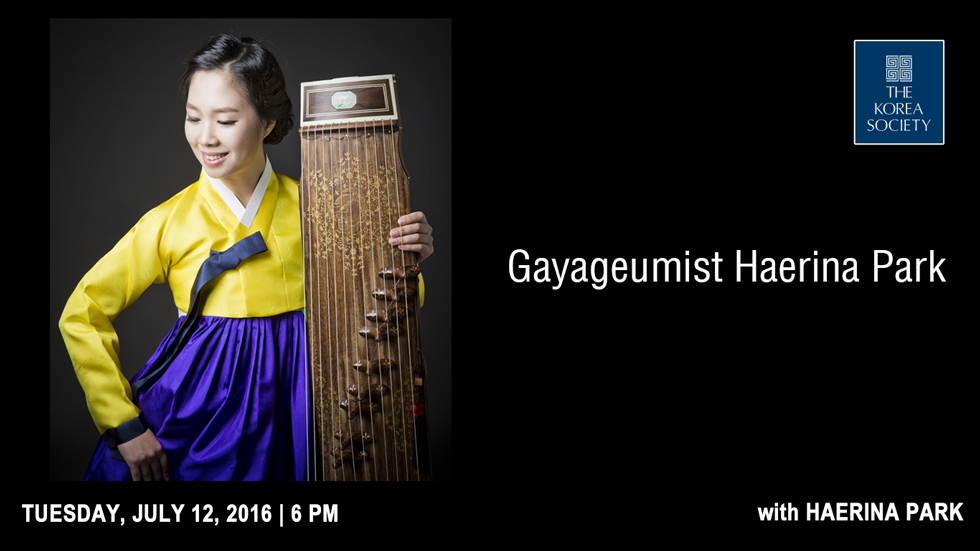
Dr. Haerina Park, professor of Korean Music at Chung-Ang University, performs a diverse program of traditional and modern compositions for the Korean zither. Dr. Park is joined by Chun-Seung Lee on drums (changgu), as well as Hyun-Ju Kim and Sang-A Kim, also on zither (gayageum).
Program
최옥삼류 가야금 짧은 산조 | Gayageum Sanjo (Choi Ok-Sam School)
25현 가야금 독주곡 찬기파랑가 | Changiparangga, Composed by Jeung, Dong-Hee
목각인형의 춤 | Dance of the Wooden Doll, Composed by Choi, Ji-Hye
If you have any questions, please contact Luz Lanzotor (212) 759-7525 ext 309.
This program is supported, in part, by public funds from the New York City Department of Cultural Affairs in Partnership with the City Council.
About the Artist
Haerina Park is currently a professor in the department of Korean Music at Chung-Ang University in Korea. A Korean native, Ms. Park holds a B.A. and Ph.D. from Chung-Ang University and earned her master’s degree from New York University in 2007. Ms. Park has extensive experience on the gayageum and other traditional instruments with several orchestras, including the Traditional Korean Orchestra at the National Theater in Korea, Korea W Philharmonic Orchestra at the Seoul Art Center, and the New Jersey Philharmonic Gala Concert at Carnegie Hall. She is also a representative of Gayastra, a gayageum ensemble orchestra that has released several albums. She trains younger students and published a book called Research on Yoohee-Chang-ga (Korean children’s songs) Before Liberation of Korea (2008), Ms. Park is making strong efforts to develop Korean music education.