Rhythms to Make the Heart Beat Faster

2009 09 30 rhythms to make the heart beat faster icon

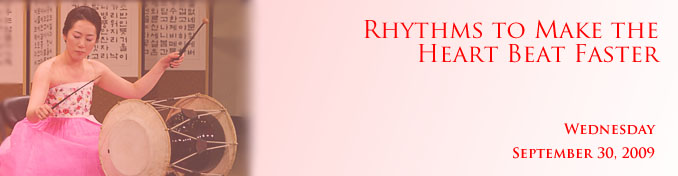
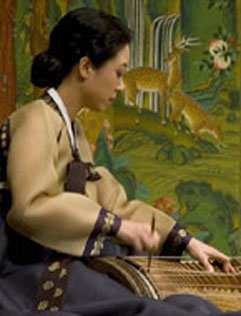
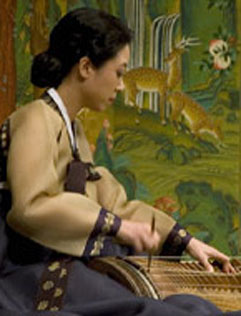
On September 30, 2009, Minji Kim, traditional percussionist, dancer, and a Republic of Korea 2009 Korean Traditional Artist-in-Residence, performed an evening of folk music on the changgo, an hourglass drum at the heart of traditional Korean music. The night’s program began with an introduction by Dr. Ju-Yong Ha, composer and ethnomusicologist, who also provided commentary before each of the three musical selections: a kayagum sanjo, a duet for haegum and changgo, and a solo percussion piece for changgo. Minji Kim was accompanied by Gee Sook Baek on the kayagum and Lee Kyung Kang on the haegum.


Dynamic Korea: Dance and Song 2009

Performed by Chae Hyang Soon Dance Company
dynamic the korea society1

Bring the rhythm and vitality of Korea’s classical dance tradition to your performing arts venue with Chae Hyang Soon Dance Company. The Korea Society is now accepting bookings for the group’s fall 2010 U.S. tour.

Handed down from generation to generation, the movements of Korea’s classical dance tradition reflect the essential rhythms of life in Korea. The exuberant yŏtt’aryŏngch’um (Taffy Peddler Dance) walks audiences through the bustling marketplaces of Korea, while meditative, deeply symbolic performances such as the hwahyŏnmu (Lotus Dance) and sŭngmu (Monk’s Dance) explore the country’s deep Buddhist roots. From the gentle, gliding grace of the opening chaech’ŏnmu (Chosŏn Court Dance) to the thunderous drumming of the closing punggo, the dancers and musicians of the Chae Hyang Soon Dance Company are animated by the strength and energy of the Korean tradition.

dynamic the korea society2Tour Specifications:

Period: September 16-30, 2010
Fee: Available upon request
Contents: 12 performances by 12 performers
Category: Folk Music and Dance / Religious
Time: 90 minutes

For more information, to receive a press kit with DVD or to schedule a performance at your institution, please contact Heewon Kim at The Korea Society at (212) 759-7525, ext. 355 or at heewon.ny@koreasociety.org.

Read more to view a video clip of the performance.

Reinventing Traditional Korean Music

2008 02 28 - Reinventing Traditional Korean Music icon

Komun’go performance and master class

with

Heo Yoon-Jeong
Komun’go Performer and Composer

Thursday, February 28, 2008

Legend has it that when Korean courtiers first played the seven-string komun’go over 1,500 years ago, a black crane appeared and danced to its music. A similar, if less literal magic was in the air as critically acclaimed performer and composer Heo Yoon-Jeong performed a program of traditional komun’go arrangements blended with contemporary sounds and techniques. Taking time between prices, Heo explained the instrument’s acoustic structure and long history.

Korean Dance: Tradition and Creation


Korean Dance: Tradition and Creation

November 8 – 16, 2005

A 16-member troupe from the Seoul Performing Arts Company presented an exquisite program of folk dances as well as contemporary interpretations of ancient court and shamanic dances in five cities from coast-to-coast in the U.S. This tour was organized and funded by The Korea Society in association with the Seoul Performing Arts Company. Several members of the company also presented a workshop for high school students at the Wilshire School in Los Angeles on Tuesday, November 15.

The Seoul Performing Arts Company was established on August 1, 1986 with the founding objective of presenting the indigenous Korean performing arts in new attire and promoting them around the world. The Company has created many productions of musical and traditional Korean song and dance. It has gone on the road in over 45 countries, staging about 850 performances. Its performances at the closing and opening ceremonies of the ’88 Seoul Olympics, the promotional event for the 2001 World Cup, ’99 Winter Asian Games, the 2000 Korea Millennium Grand Gala, and other major international cultural events held in the United States, Japan, and several African and European countries have brought the company to a high standard of polish.

Program DescriptionDrum Dance of Ch’oyong (Ch’oyong Pukch’um)
8 minutes/ 5 dancers
Choreography: Son In-Young
The Drum Dance of Ch’oyong derives from the second dance of a two-dance suite that is said to have originated during the reign of King Hon’gang (r. 875-886), the forty-ninth ruler of the Silla kingdom. The first dance, no longer performed, was an elegant and slow dance in the court-dance tradition-movements in court dances are usually soft and subdued. However, the second dance, while classified as a court dance, stands out from other court dances for several reasons: it is the only dance in which the performers wear masks; it is performed by men rather than women; and its movements are comparatively strong and vigorous. In some historical documents, it is referred to as “the dance of the five directions.” Each direction is represented by a color: north is black, south is red, east is blue, west is white, and the center is yellow. The predominant color of the costume of each of the five dancers is one of the colors associated with the five directions. In 1971, the government of the Republic of Korea designated this dance as Intangible Cultural Asset No. 39. In this version, the drums of the dancers are substitutes for the usual musical accompaniment.

Sword Dance (Tonggyong Kommu)
7 minutes/ 8 dancers
Reconstruction: Eum Ok-Ja
During the Silla dynasty (57 B.C.-935 A.D.) an institution known as hwarang was established. The hwarang were young boys trained in Korea’s cultural and military arts. The oldest reference to a sword dance relates to a hwarang. Beyond legendary origin, the current form of the dance is sometimes attributed to performances in the court and sometimes to village performances. The tempo is slow, the dancers walk around the circle – still manipulating their swords-form a single straight line parallel to the audience, bow, and quietly exit by backing away from the performing area. Although a suggestion of military action has been offered, the strongest impression is that of a kaleidoscopic ensemble that groups and regroups amidst a flurry and swish of sword blades-all with the calm dignity of a regal group of dancers.

Dongnae Crane Dance (Dongnae Hak ch’um)
7 minutes/ 5 dancers
Reconstruction: Lee Sung-Hoon
Designated as Intangible Cultural Property No. 3 by the city of Pusan, the Dongnae Crane Dance reflects the distinctive geographical features of Dongnae. The landscape of this area suggests the shape of a crane, and many place names in the district are related to the crane. As a popular hot springs resort area, Dongnae traditionally has attracted many people of highly refined tastes. This fostered the development of a strong tradition of recreational activities that include singing, dancing and poetry. Yangban enthusiasts are believed to have been responsible for the development of the distinct genre of the crane dance performed in Dongnae, which is viewed as an expression of their appreciation for refined forms of recreation. Above all, however, the distinctive feature of the Dongnae Crane Dance is that it does not mimic the actual movements of a crane but rather attempts to represent these movements in a more abstract and symbolic way.

Improvised Dance (Ipch’um) & Taegum Solo (Taegum Sanjo)
5 minutes/ 1 dancer/ 1 musician
Choreography: Chae Sang-Mook & Kim Hyeon-Ah
This Improvised Dance retains the basic form of a traditional dance in which there is no instrumental accompaniment and most of the movements are improvised. Being a kind of festive dance, it takes mirth and artistic taste for its theme. Its appeal is that the audience feels drawn to participate in the performance by dancing and humming, which further adds to its popularity.

The taegum is a bamboo instrument with a clear and cool sound, which has been played in both court music and folk music since the era of Three Kingdoms period (57 B.C.-935 A.D.). With its wondrous resonance, clear and sometimes thrilling sounds, the taegum has been regarded as a holy instrument that brings peace to the world.

Fan Dance (Puch’aech’um)
6 minutes/ 9 dancers
Choreography: Chae Sang-Mook
Widely regarded as the most unique Korean traditional dance, the Fan Dance originated from a shamanic ritual. This splendid dance with luxurious dresses and brilliant fans of painted blossoms illustrates the beauty of vivid colors and the harmony of group movements within in a confined space. The dance reaches a climax with the dancers forming a large fluttering flower that appears to rotate.

Military Drill Dance (Hullyongmu)
8 minutes/ 8 dancers
Reconstruction: Chong Jin-Wook
This work was created in the 1930’s by Han Sung-Joon, who is considered to be the father of modern Korean dance. It is modeled on the forms of the traditional military drill. It is a striking dance that captures the disposition of the troops, a confrontation scene and the training of the soldiers.

Farmers’ Band (Nongak)
30 minutes/ 13 dancers/ 6 musicians
Choreography: Seo Han-Woo
The Farmers’ Band combines dance and music. It is representative of the joyful comradeship farmers traditionally enjoyed while working in co-operation with each other. In agricultural communities, up until the recent past, it was customary for Korean farmers to pray for peace and abundance by singing and dancing communally after each harvest. The instruments they played on these occasions included a small gong (kkwaenggari), a large gong (), an hourglass-shaped drum (changgo), a barrel drum (puk), and a small handheld frame drum (sogo). There were many variations of this kind of performance, and it also was linked with religious and social customs.



 

Contemporary Korean Choreographers


Contemporary Korean Choreographers

International DUMBO Dance Festival: Contemporary Korean Choreographers

October 19 – 25, 2005

In association with WHITE WAVE, a Brooklyn-based performance, teaching and rehearsal hub, The Korea Society presented the first annual International DUMBO Dance Festival. Marking an exciting departure from the usual presentation of traditional Korean performing arts, the Festival featured seven up-and-coming young Korean choreographers/dancers who are active not just in Korea but worldwide. These artists performed eleven highly varied, contemporary routines that were grouped into two separate programs and performed on six occasions at the John Ryan Theater in Brooklyn from October 19 to October 23.

The Artists and their works

Jung Young-Doo (Korea)

Craving for More
Choreographed by: Jung Young-Doo
Danced by: Jung Young-Doo & Son Yea-Ran
Music by: Lee Kot-Byul (Korean Fiddlist)
Costume by: Doo Dance Theater

We always try to move up and crave for more. How many of us could be satisfied with what we already have? Most of us live anxiously worrying about love, work, dreams to fulfill and so on. The complicated movements paradoxically suggest peace and harmony of life to the audience. By taking a step down from our restless lives, we may be happier. Breathtaking movement by two dancers is a wonderful feat to experience the endless flow of delicate emotion. It will direct the audience to look back on their lives. Craving for More has received awards from the 2004 Yokohama Dance Collection Solo & Duo Competition, the Yokohama Red Brick Warehouse Number1, the Laureat du Prix de L’Ambassade de France pour jeunes choregraphes and the Yokohama Arts Foundation.

Incompatible Yet One
Choreographed by Jung Young-Doo
Danced by Jung Young-Doo, Kim Nam-Keon & Kwak Go-Eun
Music by: Maurice Ravel
Costume by: Sim Young-Sim Jung

Young-Doo’s work has been seen at Seoul International Dance Festival’s Contemporary Korean Dances by Young Artists as well as in Australia, Japan, Hong Kong, Singapore, and Taiwan. His awards include the 2004 Yokohama Dance Collection Solo & Duo Competition Grand-Prize and Special Award.

Lee Tae-Sang (Korea)

Rush
Choreographed by: Lee Tae-Sang
Danced by: Lee Tae-Sang, In Jung-Ju, Byeon So-Yeon & Lee Kyung-Joon
Coustume by: Lee Tae-Sang
Lighting by: Lee In-Yeon

Rush can be compared to a needle in one’s body. In the piece, Lee Tae-Sang expresses the danger and limitation of being in modern society and examines the meaning of identity. Rush was premiered in The 22nd International Modern Dance Festival (Modafe2003).

Lee Tae-Sang was awarded the Best Choreographer at the 2005 Dance Festival for the Critics’ Choice of Young Artists and has been seen at ImPulsTanz in Austria and Dusseldorf Tanzhaus in Germany. Tae-sang Lee has collaborated on works with Akram Khan and Jeremy Nelson.

Lee Kyung-Eun (Korea)

Between
Collaboration by: Lee Kyung-Eun & Saito Eiji
Danced by: Lee Kyung-Eun & Saito Eiji
Prop, Music by: Lee Kyung-Eun & Saito Eiji
Costume by: SSAMZIE

Between is a co-production of Theater ZERO in Korea and the AOYAMA Theatre in Tokyo. It premiered in November, 2004 at the Korea/Japan Dance Festival. It was also presented at the 5th Seoul Performing Arts Festival in Seoul and the Korea/Japan Dance Contact in Tokyo (2005).

Off Destiny
Choreographed by: Lee Kyung-Eun
Danced by: Lee Kyung-Eun
Music by: J. S. Bach
Costume by: Lee Kyung-Eun

Off Destiny was choreographed and developed from Lee Kyung-Eun’s composition workshop at the Montpellier Dance Festival in 2002. The piece is an attempt to use the rhythm within, and external music was used only at critical and necessary moments.

Lee Kyung-Eun was the winner of the choreography contest of The 8th International Solo-Tanz-Theater Festival, Stuttgart and toured 5 major cities with the work. She was also awarded Best Choreographer at the 2003 Dance Festival for the Critics’ Choice of Young Artists. She received 2nd Grand Atelier Choregraphes-Compositeurs at the Royaumont Foundation.

Kim Yun-Jung (Germany)

Farewell Images
Choreographed & Danced by: Kim Yun-Jung
Music by: Tekn Kim
Lighting design by: Eric vanden Dungen
Voices: Kim Hyojung, Ahn Hyejung and Kim Eun-jung

Farewell Images was performed at the Dance Museum (Seoul), Aoyama Theater (Tokyo), Frankfurt Book Fair 2005 and toured cities around Germany including Aachen, Munster and Dusseldorf.

8 Days
Choreographed by: Kim Yun-Jung
Danced by: Kim Yun-Jung, Han Chang-Ho & Lee Youngil
Music by: Kim Tekn
Costume by: Lee Hyemin
Film & stage design by: Ha Sungok
Lighting design by: Lee Boman

8 Days was invited to KUNSTSTIFTUNG NRW (NORD RHEIN WESFALLEN) and Seoul Perfuming Arts Festival and received financial support from the City of Dusseldorf, the Stiftung Kunst und Kultur and LG Electronics.

Kim Yoon-Jung, based in Dusseldorf, Germany, has presented work in Korea with the Whang Mi Sook Dance Company and the Yang Jung Soo Contemporary Dance Company; and in Europe with Mary Fulkerson, Joao da Silva Jr., Charlotte Zerbey, Marcus Grolle and with the Russian choreographer Olga Pona.

CHA Jin-Yeob (England)

Fragments
Choreographed by: Hofesh Shechter
Danced by: Cha Jin-Yeob & Hofesh Shechter
Music by: Hofesh Shechter, Eric Idle and J.S. Bach

Fragments premiered at the Kuopio Dance Festival in Finland, June 2003 and then toured the UK, Italy, Portugal, Switzerland and Poland, where the piece won first place in a choreography competition. It presents an insight into a couple’s life inside the noise of their culture. A rich sound track is the centerpiece through soft and intense moments that investigate the nature of the couple’s relationship under the pressure of inner and outer voices.

Volupte
Choreographed by: Cha Jin-Yeob & Hofesh Shechter
Danced by: Cha Jin Yeob
Music by: Hofesh Shechter

Volupte premiered at The Korean World Dance Stars Festival in July 2005. The work explores the edge, the delicate point, and the fragile moment where the individual loses the world of definitions and dives into an ocean of unexplainable sensation.

Cha Jin-Yeob received the best choreographer award in The Korean Choreography Festival in 2002. She worked with Dance Energy Company in Munich, Germany and for Micha Purucker from 1999 through 2003. Currently, she is a member of Edge, the post graduate company of LCDS, and is also working in London with choreographer Hofesh Shechter.

Nam Young-Ho (France)

Porte D’ame (Gate of Soul)
Choreographed by: Nam Young-Ho
Danced by: Nam Young-Ho and Christelle Delhaye
Music by: Christelle Delhaye
Costume by: Judith Chaperon
Lighting by: Thierry Lenain

This piece was created with the support of the Dance of all Senses Festival, in Falaise, Normandie, the French Ministry for Culture and Communication, the Languedoc-Roussillon Council, the Montpellier City Council, and the Herault Council. Gate of Soul is a peaceful duet for two females, a dancer and a musician (cello), inspired by the philosophy of Tao.

The Rascalou-Nam Dance Company was founded in 1998 in Montpellier, France by co-artistic directors Nam Young-Ho and Francois Rascalou. Since its inception, the company has performed amazing works in both domestic and international arenas. Her work has been invited to the 2005 Montpellier Dance Festival.

Kim Eun-Jeong (Korea)

Monghwan
Choreographed by: Kim Eun-Jeong
Danced by: Kim Eun-Jeong and Han Chang-Ho
Music by: Seo Jung-Min (p’ansori vocalization) and Lee Hwa-Yeon (Korean zither)

Monghwan (Bitter Dream) paints a daydream by depicting a pair of lovers on a yellow mat. As the sound of a love song from the story of Chunhyang and the sorrowful wail of a Korean zither engulf them, they express the border of coexistence between reality and unreality. They navigate as if the broken ship of life floats on the ocean.

Kim Eun-Jeong has perform at Tanz Messe in Dusseldorf, Germany, supported by Korea World Dance Center, Switzerland’s Theater Winterthur 2004 and at Agora Theater in Tokyo, Japan.

The choreographers and dancers were chosen by Young Soon Kim, the curator of the Festival, who also is WHITE WAVE’s artistic director. In picking performers, Kim attempted to achieve something more than just capturing the rhythms and movements of Korea. As all the artists she selected for the Festival either have planted their Korean roots in foreign soil or at least performed extensively abroad, she wanted to highlight how in the process of establishing their careers they have created singular, cross-cultural performances.

Following their performances in Brooklyn, the dancers went on the road for a final performance on October 25 at St. Lawrence University in Canton, New York.