Professor and author Bruce E. Bechtol, Jr. discusses his new release, North Korean Military Proliferation in the Middle East and Africa: Enabling Violence and Instability. In dialogue with Senior Director Stephen Noerper, Bechtol speaks to the DPRK’s ongoing sales of conventional weapons, ballistic missile and WMD systems and technology, as well as collaboration, in the world’s more volatile regions.
Korea at a Crossroads: North Korean Military Proliferation in the Middle East and Africa
Thursday, September 13, 2018 | 12 PM
The Korea Society 350 Madison Avenue, 24th Floor New York, NY 10017
As discussions to denuclearize North Korea develop, a number of vexing problems, seen before in previous negotiations, have resurfaced. How can the United States and South Korea avoid the trappings while still benefiting from the successful elements of the past? To find out, The Korea Society’s associate director for policy Jonathan Corrado sat down with two experts from Ploughshares Fund, Director of Policy Tom Z. Collina and Roger L. Hale Fellow Catherine Killough. They shared insights to challenge the conventional wisdom and inject some fresh air into the conversation.
The Case for Diplomacy: A Closer Look at Denuclearization Talks
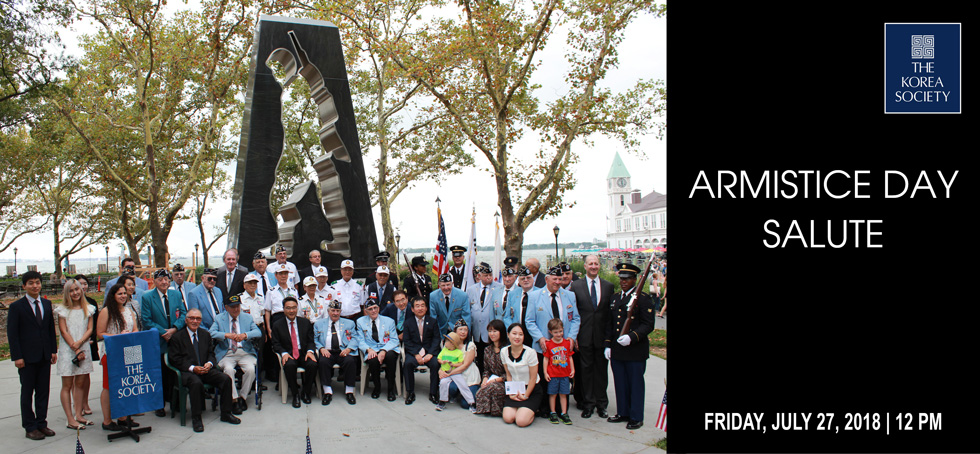
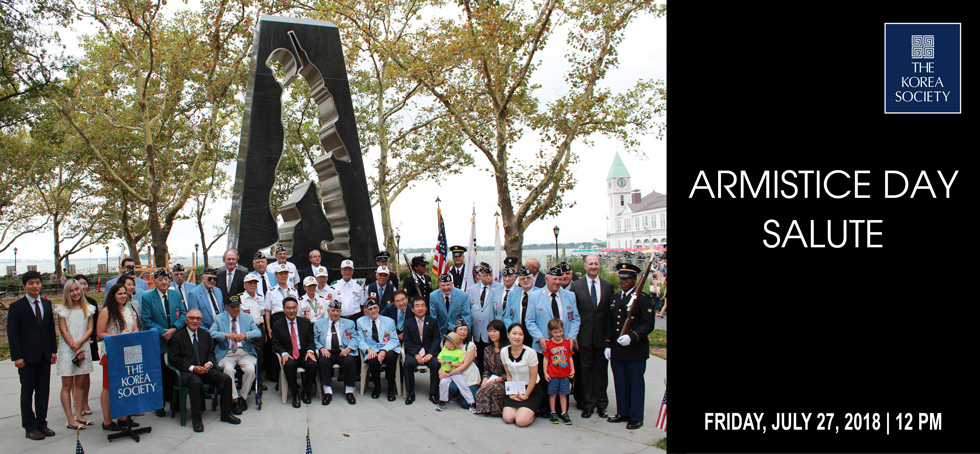
JULY 27, 2018 — NEW YORK — A memorial ceremony for veterans of the Korean War will take place on Friday, July 27, 2018, at 12 noon at the New York Korean War Veterans Memorial in Battery Park. The event, which marks the 65th Anniversary of the signing of the Korean War Armistice Agreement, is hosted by the nonprofit, nonpartisan Korea Society, which promotes awareness, understanding and cooperation between the United States and Korea.
In attendance will be members of the Korean War Veterans Association, Northeast Region, including the Corporal Kivilehan Chapter #66 of Staten Island and the Central Long Island Chapter #6, and their group leaders, Salvatore Scarlato, President of the New York Department of the Korean War Veterans Association, and George Parsons, President of the KWV Staten Island Chapter. Also in attendance will be Rear Admiral J. Robert Lunney, who served as an officer on the U.S. Merchant Marine Ship SS Meredith Victory that rescued 14,000 Koreans from the Chinese army in 1950.
The 20-minute ceremony will commence with the presentation of colors and an invocation. Thomas J. Byrne, President of Korea Society, and Ambassador Hyo-Sung Park, Consul General of the Republic of Korea in New York, will provide welcoming remarks. Retired Congressman Charles B. Rangel will offer the memorial address to veterans.
Congressman Rangel represented districts in New York City during a distinguished 46-year career in the U.S. House of Representatives that included serving as the first African-American Chair of the House Ways and Means Committee. He served heroically in the Korean War as a member of the 503rd Battalion, an all-African-American artillery unit, in the 2nd Infantry Division, and fought in the Battle of Kunu-ri, in which he was injured. He was awarded a Purple Heart, the Bronze Star with Valor for his actions in the face of death, and three battle stars. His Army unit was awarded the Presidential Unit Citationand the Republic of Korea Presidential Unit Citation.
“Now more than ever, as we hope that the Korea conflict is behind us, we should think in terms of the hard work and sacrifice of the American, South Korean, and United Nations troops, who made it possible to come to the peace negotiating table,” Mr. Rangel said.
The ceremony will conclude with the playing of taps and the retiring of the colors.
“As we commemorate the 65th anniversary of the armistice that ended the Korean War, we are especially mindful of the 1.7 million veterans alive in the U.S. And Puerto Rico who made many sacrifices during the Korean conflict, and who were instrumental in fostering and furthering the strong ties between the democracies of the United States and South Korea. Korea Society is proud to conduct this annual ceremony, and salute our veterans in New York and across the country on this special day,” said Thomas J. Byrne, President of Korea Society.
THE KOREA SOCIETY (www.koreasociety.org) is an NYC-based, private, nonprofit, nonpartisan organization celebrating its 61st year dedicated solely to the promotion of greater awareness, understanding, and cooperation between the people of the United States and Korea. In pursuit of its mission, the Society arranges programs that facilitate discussion, exchanges and research on topics of vital interest to both countries in the areas of public policy, business, education, intercultural relations and the arts.
Remarks by Amb. Hyo-Sung Park, Consul General of Korea in New York at the 65th Anniversary of the Signing of the Korean War Armistice Agreement, July 27, 2018, Korean War Memorial in Battery Park
President Thomas Byrne of Korea Society, The Honorable Charles Rangel, Admiral Robert Lunney, Dr. Henry Kang of Global Society of Korea and America, President Sal Scarlato of Korean War Veterans Association Department of New York, President Kun Sil Pak of Korean War Veterans Association of Greater New York President George Parsons of Korean War Veterans Association of Staten Island Honored members of the Korean War Veterans Associations, Distinguished guests, ladies and gentlemen, Good afternoon!
65 years ago today the Korean War ended in an armistice. On this memorable day, on behalf of the Korean government and the Korean people, I would like to convey the message of profound gratitude for your heroic service during the Korean War.
You may well recall the Korean War like it was yesterday, as you still vividly remember the day when you were called upon to defend a country you never knew and people you never met.
With all the rapid vicissitudes of history over the past decades, the Korean War is often referred to as the “forgotten war.” However, we, Koreans, will never forget the sacrifices all of you have made. It is because of the unabashedly proud fact that you fought bravely to keep freedom and democracy alive on the Korean Peninsula.
In this regard, I would like to take this opportunity to specially recognize and show our sincere respect and appreciation for two brilliant Korean War veterans who are here with us today.
During the Korean War, Congressman Rangel fought bravely in the Battle of Kunu-ri as a member of the 503rd Battalion in the 2nd Infantry Division. He was awarded a Purple Heart, the Bronze Star with Valor for his actions in the face of death, and three battle stars. His Army Unit was awarded the Presidential Unit Citation and the Republic of Korea’s Presidential Unit Citation. Thank you so much!
Another gentleman is Rear Admiral Robert Lunney. On Christmas Day in 1950, together with Captain Leonard LaRue, he delivered all 14,000 refugees from a North Korean port in Hungnam to safety on a South Korean island some 500 miles away aboard a freighter designed to hold only 60 people. The United States Maritime Administration called their feat “the greatest rescue by a single ship in the annals of the sea.” Again, thank you very much.
Ladies and Gentlemen,
Great stories that are associated with Korean War Veterans here with us today and those who have sacrificed their lives during the Korean War will continue to serve as a vivid reminder of the Korean War.
Yes, freedom isn’t free. Democracy is worth fighting for. Your shining and courageous deeds that were instrumental in securing freedom and democracy throughout the Korean War deserve our admiration and praise.
This is why we are gathered here today again to remember and honor all Korean War veterans and, especially, all of you.
Ladies and gentlemen,
Today, the very freedom and democracy you have defended are thriving in Korea. Over the past decades, Korea has emerged from the ashes of war to become the world’s 11th largest economy.
In 1953 when the Korean War ended, Korea’s per capita income was a meager $67. Korea’s per capita GDP is expected to exceed $30,000 this year.
Korea is the only country that has transformed from an aid-recipient to an aid-giving country. Korea’s marvelous economic growth – often referred to as the Miracle on the Han River – can be attributed to the Korean people’s hard work and can-do spirit. Equally important is the rock solid alliance between Korea and the United States that has underpinned Korea’s development and prosperity, while serving as the linchpin of peace and stability in Asia and on the Korean peninsula, in particular.
We owe much of our success to you, Korean War veterans, and our American friends, which we very much appreciate.
Distinguished guests, ladies and gentlemen,
As President Lincoln said in his Gettysburg Address about 155 years ago “We, here, highly resolve that these dead shall not have died in vain”.
As we know, more than 50,000 American soldiers made their sacred sacrifices during the Korean War. On the 65th Anniversary of the Signing of the Korean War Armistice Agreement, we are determined once again that these brave Americans shall not have died in vain. While being grateful for their heroic service, we are committed to continuing our best efforts to ensure that peace, prosperity, and democracy will be in full blossom on the Korean peninsula.
This is why our government has been working hard to keep alive the peace momentum which was created on the occasion of the PyeongChang Winter Olympic Games held in South Korea some five months ago.
As you know, the world has recently witnessed the three historic summits – the two inter-Korean summits between President Moon Jae-in and North Korean leader Kim Jong Un in April and May this year, as well as the summit meeting between President Trump and Chairman Kim in Singapore on June 12. Thanks to these historic breakthroughs, the prospects of securing complete denuclearization and a permanent peace regime on the Korean peninsula have greatly improved.
Ladies and gentlemen,
Indeed, compared to last year when the crisis on the Korean peninsula reached unprecedented levels, it feels surreal.
As Albert Einstein said, “Life is like riding a bicycle. To keep your balance, you must keep moving.” Likewise, we need to continue moving forward with a fresh and creative approach so that we can overcome seven decades of confrontation and distrust, thereby ushering in a new era on the Korean peninsula.
It is against such a background that President Moon Jae-in emphasized two weeks ago the importance of declaring a formal end to the Korean War as a milestone toward permanent peace on the Korean peninsula.
Our Foreign Minister Kang Kyung Hwa echoed this view two days ago at the Korean National Assembly. She said that if realized, it would be a political declaration aimed at facilitating the denuclearization of the Korean Peninsula.
Our government will work closely with the United States and other relevant parties to make it happen by the end of this year.
In this regard, I would like to convey a clear and unequivocal message to you regarding some 28,000 American forces stationed in Korea.
President Moon Jae-in has emphasized over and over again that the US forces in Korea is a matter of the South Korea-U.S. alliance, not something that can be discussed in denuclearization talks between North Korea and the United States.
There is no daylight between South Korea and the United States in the firm stance that the US Forces in Korea play an important role in maintaining peace and stability on the Korean Peninsula and in Northeast Asia.
Dear Korean War Veterans,
Your noble sacrifices have made great contributions toward promoting freedom, democracy, peace and prosperity on the Korean Peninsula and beyond. You have also played a meaningful role as a bridge between the United States and Korea.
We recognize and appreciate that your lives hold valuable enduring lessons for us today. We will always do our best to ensure that your sacrifices, your dedication, and your friendship will never be taken for granted or be in vain.
By the same token, we truly hope that you will continue to give your well wishes for Korea, as our two countries proceed with the ongoing process aimed at achieving a permanent peace structure and prosperity on the Korean peninsula.
Once again, I say to you loud and clear that the Korean War is not a forgotten war, neither a forgotten victory. The success of Korea is your legacy. The strength of our alliance is a proud evidence of your great victory, which will only get stronger.
As I conclude my remarks, I wish you and your family continued good health and the best of luck. Thank you. /END/
Dr. Young Yang Chung, created “Unification” for Korean President JungHee Park in 1967.
Korea has existed as two separate states since the 1950-53 Korean War. Talks of unification—and ultimately peace between the two states—have been intensifying since the Olympic Games that were recently held in PyeongChang.
The topic is a familiar one to NYFA Leadership Council Member Young Yang Chung, a textile artist and historian who is the Founder/Director of The Chung Young Yang Embroidery Museum Korea/Seol Won Foundation USA. In the late 1960s, she was commissioned to create an embroidered artwork representing a united Korea for Korean President JungHee Park.
The ten-paneled folding screen features the Rose of Sharon, the national flower of South Korea. Flowers are among the most widely-evoked motifs in traditional Korean embroidery, and over the centuries the Korean people have imbued various types of flowers with special meanings and cultural references. Configured in the shape of the Korean peninsula, the white flowers on the left symbolize South Korea and the red flowers on the right represent the North. The blossoming of the flowers expresses the hope for reunification as well as the strength and fortitude of Korea’s national spirit.
Each flower is embroidered with hand-twisted threads in three to four different thicknesses in order to create realistic visual effects. The flower petals are delicately shaded using long and short stitches, each rendered three-dimensionally with thread and cotton underpadding, a hallmark of traditional Korean embroidery. To create naturalistic textured bark, Chung roughly twisted and knotted threads more than twice as thick as those used for the petals and applied them in straight, irregular satin stitches.
Chung employed an innovative two-handed technique—the right one on the top of the stretched fabric and the left underneath the embroidery frame—to stitch the design onto a silk ground fabric using one-inch long needle and hand-twisted silk threads. The stitching technique was repeated 90 to 100 times per petal. Applying just one square inch of embroidery entails several hours of labor, and a screen this large required more than three years to complete.
It is assumed that the work is still in the collections room in the Blue House, which is the executive office and official residence of the South Korean head of state in Seoul.
“In making this, I thought of my experience going through the Korean War, when I was evacuated from Seoul to the remote countryside. I saw and experienced many hardships as the North Koreans invaded the countryside, harming intellectuals and landowners. I was in elementary school at the time, but this experience remained in my memory when the work was created in the 1960s,” said Chung. “Like all Koreans, I wish for a stable peace between the two sides. While allowing the reunion of families painfully separated by the long-term political division, peace also would allow young artists and creators to travel freely across the peninsula, sharing their experiences and perspectives, inspiring them to improve their own works, and perhaps open up new directions in Korean art,” she added.
– Interview conducted by Amy Aronoff Images: Young Yang Chung, “Unification,” 1960s, wood, silk, and polyester, Photo Courtesy: The Chung Young Yang Embroidery Museum Korea and Young Yang Chung stitching with her own two hands, Photo Credit: John B. Taylor
How do we frame the Trump-Kim summit? What are critical next-steps? Get a Washington insider perspective with Mansfield Foundation President and CEO Frank Jannuzi and National Committee on North Korea Executive Director Keith Luse. Frank and Keith served as senior advisors to US Senate Relations Committee Chairs, and both bring unique contacts and sensibilities to this discussion on dialogue with North Korea and efforts to prevent conflict. Jannuzi and Luse join Korea Society Senior Director Stephen Noerper. This event is conducted in proud partnership with the National Committee on American Foreign Policy (NCAFP).
Admission
The Korea Society Fellow, Patron and Corporate members: FREE with registration
Publications and news appearances by The Korea Society team. |
2/11/26 | THE CHOSUN Daily |
Korea Society Leader Stresses Educating Americans Beyond K-Culture
On his inaugural visit to Korea, newly inducted Korea Society President and CEO Abraham Kim gave an interview with The Chosun Daily detailing his vision for the organization as its first Korean American president in nearly 70 years. Kim highlighted the importance of The Korea Society’s role as a bridge between the U.S. and Korea and affirmed that while economic tensions have grown, the alliance remains strong as ever.
As change rocks the US and South Korea, they offer each other safe harbor The Korea Society President/CEO Tom Byrne published an article in The Hill addressing the resilience of the U.S.-South Korea economic partnership despite the political turbulence in both countries. Byrne highlights growing Korean investment across U.S. industries and calls for expanded cooperation, with an emphasis on shipbuilding, to mirror the success of the CHIPS Act.
From CHIPS to Ships: The Next Step in the U.S.-ROK Alliance The Korea Society President/CEO Tom Byrne published an article in The National Interest proposing a solution to the United States’ lacking presence in the shipbuilding industry. President Byrne asserts that cooperation with allies like South Korea could bolster U.S. shipbuilding capacity, similar to how American manufacturing has benefitted from the CHIPS Act attracting South Korean investment.
Thomas Byrne, President of Korea Society: “We Need to See the Positive Side of Trump’s Second Term” [Translated from Korean by Google] The Korea Society President/CEO Tom Byrne was interviewed by Chosun Ilbo on the topic of President Trump’s second term and how it will impact U.S.-Korea economic relations. While acknowledging South Korea’s concerns regarding trade tariffs, President Byrne posits that the U.S. and Korea have an opportunity to focus more on cooperation in the shipbuilding industry.
Thomas Byrne “entrepreneurship is competitive in the U.S….”No matter who becomes president, I will work hard for companies.” [Translated from Korean by Google] The Korea Society President/CEO Tom Byrne was interviewed by Korea Economic Daily in regards to Korean companies’ concerns about policy risks related to the U.S. presidential election in November. President Byrne noted that America will retain its competitiveness no matter the result of the election and that The Korea Society will continue to highlight the importance of the U.S.-Korea relationship.
[INTERVIEW] U.S. faces ‘K-investment wave’ as Korean firms go global The Korea Society President/CEO Tom Byrne was interviewed by Korea JoongAng Daily on increasing Korean investment in the United States as Korean chipmakers and automakers pledge more than $100 billion in states such as Georgia and Indiana. As Honorary Ambassador for Foreign Investment Promotion for Korea, President Byrne notes that soft power plays a crucial role in securing foreign investment both in and out of Korea, and that the spread of Hallyu will help propel the so-called “K-investment wave.”
US President Biden to hold summit with South Korean President Yoon Korea Society President/CEO Tom Byrne was featured on a Channel News Asia Segment on South Korean President Yoon Seok Yeol’s state visit. Speaking alongside Asia Society Policy Institute Vice President Daniel Russel and Senior Fellow for Korea Studies at the Council on Foreign Relations Scott Snyder, President Byrne notes that the recent improved relations between Japan and South Korea is likely in part propelled by concerns on North Korea’s astounding progress in weapons development and China’s geopolitical ambitions in the region.
INTERVIEW | US-NK summit is unlikely in 2023: Korea Society Korea Society President and CEO Thomas Byrne was the featured expert in a Korea Times article. President Byrne discusses issues related to the US-ROK alliance, including nuclear sharing, stating “the best diplomatic and strategic outcome would be [the] denuclearization of the Korean Peninsula and nuclear weapon non-proliferation regionally and globally.”
Hyundai Lobbies US to Ease EV Rule That Hurts Foreign Carmakers Korea Society President/CEO Tom Byrne was quoted in Bloomberg on the new EV subsidies from the recently-passed Inflation Reduction Act (IRA) and their impact on South Korean company Hyundai Motor and its investments in the U.S. market. President Byrne notes the efforts of Korean trade ministers who are advocating for fair, rules-based treatment under the IRA.
South Korean Entertainment Makes Gains in the Digital Age Korea Society President/CEO Tom Byrne published an Op-ed in the non-partisan political news website RealClearPolitics (RCP) on the broad appeal of the South Korean Entertainment Industry’s exports of K-drama, K-pop, and Korean cinema. President Byrne notes the efforts of South Korean entertainment giant CJ Group to promote these products, and highlights the role such cultural exports play in strengthening U.S.-Korea relations, remarking that K-pop is “one of the key channels of people-to-people diplomacy between the U.S. and South Korea.”
Georgia wins top EV contracts thanks to long South Korea courtship Korea Society President/CEO Tom Byrne was quoted in the Financial Times special report series, “Investing in America” on burgeoning Georgia-South Korea investment ties. President Byrne notes the importance of investment in “technologies that are strategic over a long-term horizon” to shore up U.S. supply chains as well as reduce South Korean companies’ dependence on China.
Biden Struggles to Woo Asian Nations Wary of Upsetting China Korea Society President and CEO Tom Byrne was quoted in Bloomberg on President Biden’s recent visit to a Samsung Electronics Co. semiconductor complex in Pyeongtaek, South Korea as part of his first trip to Asia. When asked by the reporter about the “sleeping elephants” in the US-ROK alliance, President Byrne emphasized the urgent need to shore up semiconductor supply chain resiliency and boost fab manufacturing in the U.S. through passage of the Creating Helpful Incentives to Produce Semiconductors for America (CHIPS) legislation.
Why the international community should move to mass vaccinate North Korea — now In an article first published in The Hill, Korea Society President and CEO Tom Byrne argues that the international community– and the new South Korean president– should urgently work to vaccinate the entire North Korean population. Despite North Korea’s recent provocations, Byrne argues that geopolitical concerns and trust-building measures need to be set aside as “the urgency to effectively control this global pandemic offers the best rationale” for humanitarian vaccine aid by eliminating a potential reservoir for the emergence of an even more lethal variant—and North Korea has the demonstrated organizational capacity to pull this off.
Wonju Seo: Travelogue at the Korea Society The Korea Society’s current exhibition Travelogue by Wonju Seo was featured in the New York Times. The exhibition runs through May 27. Writer Will Heinrich writes on the “subtle textile abstractions in an alluring exhibition high over Midtown.”
In an article for the Diplomat, Korea Society President and CEO Tom Byrne discusses the new wave of South Korea investment into the U.S. and the rise of partnerships between U.S and Korean corporations in technologies such as batteries, semiconductors, and vaccines. “These fields — critical nodes in the most important 21st-century production networks — are quickly coming to define the next era of South Korea-U.S. business ties.”
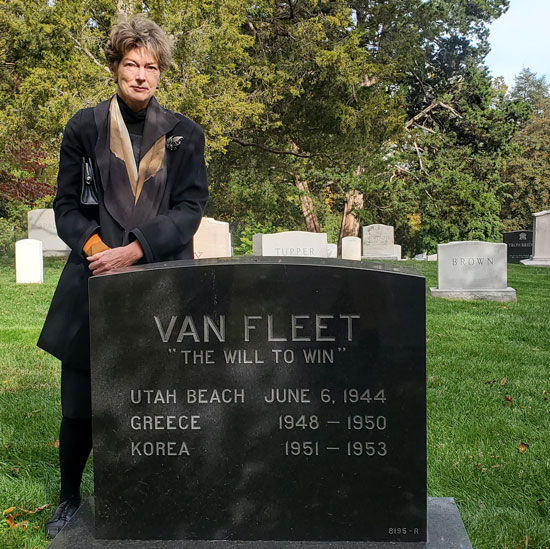
Amb. Kathleen Stephen’s Mention of Korea Society Founder General Van Fleet and The Korea Society Annual Dinner In an article for the Korea JoongAng Daily, Korea Society Board Chair Ambassador Kathleen Stephens’ wide-ranging remarks touch on retired General James Van Fleet and his goal to ” build people-to-people ties between Koreans and Americans” through the establishment of The Korea Society. The Van Fleet Award, one of the most prestigious awards in the field of U.S.–Korea relations, is formally presented to distinguished recipients each year at The Korea Society’s annual dinner. The photo of Ambassador Stephens was taken at Arlington Cemetery on 4 November 2021.
What’s Behind North Korea’s Extreme Vaccine Hesitancy? In an article for the Diplomat, Korea Society President and CEO Thomas Byrne opines on North Korea’s recalcitrance in joining the international Covid-19 vaccination campaign. If North Korea had engaged the international community on security issues and South Korea on economic cooperation decades ago, President Byrne argues, “it would be in a better position today to manage the challenges of the pandemic.”
US never stopped ‘longest war’ in South Korea — and now democracy thrives In an article published by the New York Post, Korea Society President and CEO Tom Byrne remarked on the history of assistance American forces gave in protecting freedom and democracy in South Korea, noting that institution building was also a vital component, and that it took hold in South Korea. But it was the “mutual defense treaty (that) preserved South Korea as an independent nation” in the immediate aftermath of the Korean War.
How will ‘emaciated’ Kim Jong-un ride out a famine in North Korea? With China’s help|
In an article for the South China Morning post, president Tom Byrne and policy director Jonathan Corrado comment on North Korea’s current economic woes and food shortages. President Byrne remarks that, “With no government debt market, Kim is perversely forced to run a harsh austerity policy when any normal country would do the complete opposite in such a historical crisis.” Mr. Corrado attributed the volatility in food prices to “‘a perfect storm of events’ comprising bad weather, a lacklustre harvest, border closures and the government crackdown on the use of foreign currency.”
Issues & Insights Vol. 21, WP 10 — South Korea’s Demographic Advantage is Over: The Regional Context and the Economic and Security Implications In a paper for Pacific Forum’s Issues & Insights, president Tom Byrne and policy director Jonathan Corrado write on the economic and security risks South Korea’s low birth rate poses to its future, writing that “South Korea will have to make tough policy and fiscal choices, unless it can achieve another ‘Miracle on the Han’ —this time overcoming its demographic challenge.”
The Korea Society’s 30th Annual Van Fleet Memorial Golf Tournament was mentioned by Fox News host Jesse Watters, who attended the tournament.
6/24/21 | The National Interest|
Is North Korea On the Precipice of State Failure?|
In an article for the National Interest, Korea Society president and CEO Tom Byrne and policy director Jonathan Corrado remark on North Korea’s stability, writing that while the country remains intact through political repression and outside aid from China, the Kim dynasty could be threatened by the “intensification of the country’s prolonged economic distress that deprives the elite of its economic benefits.”
US to distribute more vaccines to developing world|
In an interview on Bloomberg Quicktake, president and CEO Tom Byrne discusses the potential for a vaccine swap between the United States and South Korea as well as South Korea’s assistance to the U.S. in the early stages of the pandemic and its progress in vaccine rollout.
The U.S. has swapped currencies with South Korea, now it is time to swap vaccines|
In an article for the National Interest, Korea Society president and CEO Tom Byrne proposes that “a U.S.-South Korea vaccine swap would be an all-around win-win policy.”
In an article for the National Interest, President Tom Byrne notes that North Korea submitted a SARS-CoV-2 vaccine order to the UN affiliated vaccine alliance, GAVI, but the country is still waiting for its modest 1.7 million dose allotment, relative to its needs. “North Korea was not among the 104 countries that received vaccine doses as of early April, and they likely won’t arrive in May, either. North Korea is reaping what it has sowed in shunning engagement with the international community”
U.S., S. Korea Should Work Closely on N. Korea: Former Ambassador In an interview on Bloomberg Daybreak: Asia, Korea Society Board Chair Ambassador Kathleen Stephens discusses the future of the U.S.- South Korea partnership in the Biden era, as well as the possibility of pursuing dialogue with North Korea in conjunction with regional partners like China, despite ongoing tensions.
PacNet #5 – North Korea Doubles Down on a Dead End In an article for Pacific Forum PacNet on North Korea’s economic plan announced at the recent party congress, president Tom Byrne and policy director Jonathan Corrado write that, “The plan leaves unanswered the question of the sources of financing. North Korea has scant domestic savings, no access to international credit and has squeezed the foreign currency savings of the donju entrepreneurs and financiers.”
In a letter to the South China Morning Post, Korea Society President and CEO Thomas Byrne calls for the Biden administration to strengthen cooperation with South Korea in its diplomatic approach towards North Korea, including the possibility of resuming summit meetings. President Byrne remarks that “It’s time to combine maximum engagement with maximum pressure, in close coordination between the US and South Korea.”
Letter: North Korea is not quite ready to join the IMF In a letter to the Financial Times, Korea Society President and CEO Thomas Byrne comments on North Korea’s economic outlook, writing that, “Until Pyongyang approaches the IMF, it is safe to observe that there is no hope that North Korea harbours the willingness and ability to reform and reap the economic development benefits of international finance and trade.”
WTO Director Race: The Case for Yoo Myung-hee In an article for the Diplomat, Korea Society President and CEO Thomas Byrne writes on South Korean Trade Minister Yoo Myung-hee’s candidacy for Director-General of the World Trade Organization, pointing out that Trade Minister Yoo “has convincingly presented herself as a fair mediator on the global stage. She is a bridge candidate, who can speak to the U.S. and China, as well as to both developed and developing nations.”
[Special Live] United States Presidential Election 2020 Part II: IMPACT ON S. KOREA-U.S. TIES Korea Society Board Chair Ambassador Kathleen Stephens and Korea Society CEO and President Thomas Byrne join a panel of experts on Arirang TV to discuss the impact of the US presidential election on the Korean Peninsula and Northeast Asia region. Both analyze topics ranging from America’s current political tensions, the US-South Korea security alliance, US-China trade relations, and Trade Minister Yoo Myung-Hee’s candidacy for the World Trade Organization.
Previewing Post-Election U.S.-South Korea Ties In an interview on Bloomberg Daybreak: Asia, Korea Society Board Chair Ambassador Kathleen Stephens discusses U.S.-Korea ties after the upcoming Presidential election, specifically the U.S.-South Korea security and economic relationship, as well as South Korea’s regional relations.
Korean War 70th Anniversary: Remember the lives a ‘Forgotten War’ took In an article published by the New York Post, Korea Society Board Chair Ambassador Kathleen Stephens remarked on the 70th Anniversary of the Korean war and the integral assistance American forces under the UN flag gave in protecting freedom and democracy for South Korea.
70 years since Seoul win in Korean war, UN remains as relevant as ever In a letter to the editor published by the South China Morning Post, Korea Society CEO and President Thomas Byrne remarks on the 70th anniversary of the recapture of Seoul by UN forces on September 25th and South Korea’s enduring commitment to international institutions.
U.S.- South Korea Relations – Narrated by David Strathairn Korea Society CEo and President Tom Byrne was featured in the Documentary “U.S.- South Korea Relations”, part of the Great Decisions documentary series by the Foreign Policy Association.
7/29/20 | The South China Morning Post: THE CORONAVIRUS PANDEMIC |
Coronavirus: Bill Gates predicts ‘substantial’ reduction in death rate by end of year An article published by The South China Morning Post featured an interview between Korea Society President Thomas Byrne and South Korean pandemic expert Dr. Kim Woo Joo, who discussed COVID-19 treatments. “‘If everything goes well, I am hoping that the effectiveness of these drugs will be scientifically proven within three to four months,’ Kim, a professor of infectious diseases at Korea University Guro Hospital, said in an April 16 interview with the president of the Korea Society, Thomas Byrne.”
North Korea Responding to Financial Dearth In a letter to the editor published by The Wall Street Journal, Korea Society president Thomas Byrne explains the economic factors impacting North Korea’s recent foreign policy decisions, writing: “What has likely prompted Kim Jong Un to ‘hit the pause button’ regarding his threats against South Korea isn’t a desire to place North-South reconciliation back on track but financial desperation.”
70 years later, remember the ‘The Forgotten War’ and appreciate the South Korean-American relationship In a new article for New York Daily News, Korea Society president Thomas Byrne writes, “As the 70th anniversary of the start of the Korean War is marked, the two allies remain in a strong position to overcome difficulties. North Korea’s recent provocations have once again highlighted that the U.S.-South Korean alliance is the ballast supporting peace and prosperity in the region. It must not give way.”
South Korea’s Economic Policies Prepared It for the Coronavirus—North Korea’s Did Not|
In a new article for The National Interest, Korea Society president Thomas Byrne writes, “the coronavirus pandemic casts into sharp contrast the fortunes of North and South Korea, showing how differently they have evolved in the seven decades since the Korean War. Pyongyang’s inability to deal with the virus in any way other than to shut its borders and restrict domestic travel has sparked a huge shortfall in government revenue… Meanwhile, Seoul’s timely and effective response to the virus that avoided lockdowns and blockades is held up as a worldwide example, burnishing South Korea’s status as a financial safe haven which allows it to affordably fund stimulus measures with government debt.”
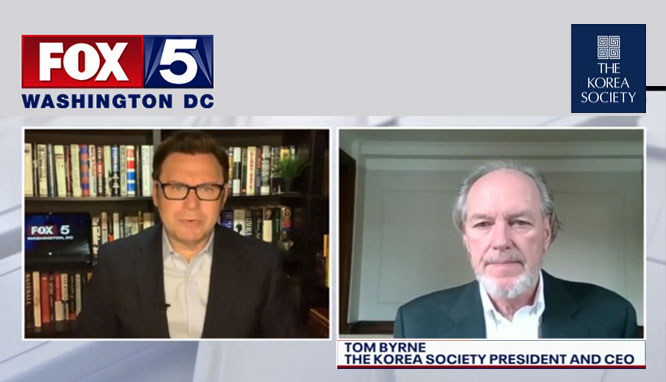
In an interview with Fox 5 DC On the Hill, Korea Society President Tom Byrne discusses the impact of North Korean Chairman Kim Jong Un’s prolonged absence on denuclearization talks and South Korea’s approach to dealing with coronavirus, saying, “Korea not only flattened the curve; they were ahead of the curve.”
The Coronavirus Has Pushed North Korea’s Economy to the Edge
In a new article for Foreign Policy about North Korea’s current economic prospects, Korea Society president Thomas Byrne writes, “North Korea is left to its own devices, facing the coronavirus pandemic without access to credit or emergency financing from the IMF, World Bank, Asian Development Bank, or other governments—let alone access to global capital markets. Nevertheless, there are no indications from Pyongyang that it is ready to throw in the towel on Juche, its policy of self-reliance, and embark on reform and opening. The same obstacles that prevented progress in 1997 prevail today, and nothing has changed institutionally in more than two decades—except the addition of international sanctions.”
During the coronavirus crisis, how is North Korea really handling its ‘zero cases’? In a new article for Fox News about the impact of coronavirus on North Korea, “Thomas Byrne, president of the Korea Society, pointed out that several news items emerged this week, indicating the regime’s economic fallout as well from the pandemic.”
Dr Kim Woo Joo, who led South Korea’s response to Covid-19 and the outbreak of Mers in 2015, said he was ‘not very optimistic’ about the availability of a Covid-19 vaccine in the next 18 months, but said evidence about the effectiveness of remdesivir, an experimental antiviral developed to treat Ebola; AbbVie’s Kaletra, an anti-HIV drug; or other medicines might be possible sooner. ‘If everything goes well, I am hoping that the effectiveness of these drugs will be scientifically proven within three to four months,’ Kim, a professor of infectious diseases at Korea University Guro Hospital, said in an interview on Wednesday with the president of the Korea Society, Thomas Byrne.
South Korea’s opposition had ‘surprisingly big defeat’ in elections: The Korea Society
In an interview with CNBC on South Korea’s National Assembly election on April 15, Korea Society Board Chair Ambassador Kathleen Stephens said, “Korea is benchmarking a lot of good practices for dealing with the coronavirus pandemic. This became the issue in the election and eclipsed some of the other issues that were not playing so well for Moon Jae-in and the ruling party… The citizens came out and said that they appreciate what this government has done, but I think it was a surprise to everybody that the turnout was as strong as it was. Koreans really do value their institutions and their democracy and so they were ready to vote.”
South Korea’s virus response had high degree of transparency and competence In an interview with Bloomberg Daybreak Asia (39:35) on Korea’s response to the coronavirus, Korea Society President Thomas Byrne says, “Korea responds well when there is a crisis, and Koreans really have grit. They responded well to the 1997 IMF financial crisis and they are responding very well now. Everything came together really quickly in the middle of February. The government has orchestrated a good program with the government, the public health institutions, and the citizens all chipping in, all three of them together to manage this crisis.”
Come together In an opinion piece published by Reuters BreakingViews, Korea Society Board Member Bill Rhodes urges the importance of multilateral cooperation to deal with the effects of coronavirus, writing, “it is increasingly likely that the world faces a longer, harder, much more fitful, difficult path to normalcy. We must gird ourselves for the long haul. That requires much greater coordination internationally of our responses to maximize the impact. So far that crucial piece of the puzzle has been missing.”
South Korea’s coronavirus success story underscores how the U.S. initially failed In an article by the Washington Post, Korea Society president Thomas Byrne writes, “No nation’s response has been perfectly effective, but the high degree of transparency and competency of South Korean health officials provides helpful lessons about containment efforts for other countries, and about the nature of this pandemic for the international scientific community.”
No One Knows How Many Virus Cases North Korea Has. It Says Zero In an article for Bloomberg, Korea Society president Thomas Byrne discusses North Korea’s human rights situation and public health system amid ongoing concerns about the potential for the novel coronavirus to spread in the country.
In a new letter to the editor of the South China Morning Post, Korea Society president Thomas Byrne writes, “South Korea is providing other societies with an example of how to respond in a smart and targeted way, while shunning travel bans, with limited exceptions, and avoiding widespread lockdowns whose social costs might outweigh the health benefits.”
PacNet #11 – Two tasks for making US-ROK troop burden sharing sustainable In a new article about the U.S.- Korea military cost sharing deal for Pacific Forum PacNet, Korea Society chairperson Ambassador Kathleen Stephens and president Tom Byrne write, “The time is now for the United States and South Korea to come to terms on a deal that works for both sides. The smooth functioning of the alliance should not be impaired by an accounting impasse that loses sight of the incalculable benefits from 70 years of partnership.”
Kim Jong Un’s New Year Comments Are Ominous (Radio) Korea Society President Thomas Byrne discusses the meaning of Kim Jong Un’s “new way” and the implications of his plenary speech on the Bloomberg Radio program Daybreak Asia.
The U.S. and South Korea: Ways to Bolster an Alliance In a letter to the editor of the New York Times, Korea Society President Thomas Byrne writes that, “The failure of the most recent round of talks between the United States and South Korea on how to equitably share the costs of American troops on the peninsula is dangerous to the future of this crucial alliance, which has kept the peace in Northeast Asia for more than six decades. The alliance has also underpinned South Korea’s prosperity and fostered trade and investment relations increasingly beneficial to America.”
Korea Society Board Chairman Ambassador Thomas Hubbard discusses dynamic aspects of the U.S.-Korea Alliance during a Voice of America Segment. Together with the Council on Foreign Relations’ Scott Snyder, Ambassador Hubbard explores the meaning of Korea’s decision not to suspend an intelligence sharing agreement with Japan and the current state of cost sharing measures for hosting America troops in Korea.
Concerns Mount Over US Demand for S. Korea to Pay More for Defense KBS World Radio ran an article citing an article by president Thomas Byrne and board director General Walter Sharp. “Several former leaders of U.S. troops in South Korea and other American figures are voicing their concern over Washington’s demand for Seoul to quadruple its defense cost-sharing contribution, calling for a “creative solution” to satisfy both allies. In a joint article published in the U.S.-based magazine National Interest on Wednesday, Thomas Byrne, President of the Korea Society, and Walter Sharp, former U.S. Forces Korea Commander, warned that after more than 60 years, the countries’ alliance could be strained over the issue.”
America and South Korea Must Negotiate a Fair Extension of the SMA In an opinion article published by The National Interest, the Korea Society’s president and CEO Thomas Byrne and Board Director General Walter Sharp evaluate the ongoing negotiations to the U.S.-ROK Alliance cost sharing agreement. They write: “It is in the interest of the U.S. and South Korea to negotiate a fair extension of the SMA that does not raise accusations among the Korean population that the U.S. is a mercenary force in their country while also addressing the concerns of the U.S. that its allies shoulder as much of their own defense burden as possible. Much is at stake in maintaining global order. The 66-year U.S.-South Korea alliance has kept the peace and maintained geopolitical conditions for mutual prosperity. South Korea is America’s sixth-largest trade partner and its major corporations are increasingly investing in the U.S.”
Korea Society president Thomas J. Byrne discusses the Korea Society on Asia Today with Jeffrey Bingham Mead. Asia Today with Jeffrey Bingham Mead airs on Radio 1490 WGCH Greenwich, Connecticut USA and WGCH.com.
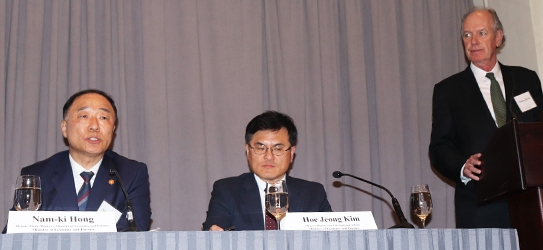
Finance minister holds overseas roadshow on S. Korean economy An article of Yonhap News quoted Korea Society president Thomas Byrne. “South Korea’s finance minister held an overseas roadshow on the country’s economy to some 100 investors in New York amid growing uncertainties about Asia’s fourth-biggest economy. Thomas Byrne, president of the Korea Society, asked about the possibility of Korea entering a deflation given the country’s record-low consumer price level.”
Analysts: U.S. approach ‘inadequate’ to restore South Korea, Japan ties Amb. Thomas Hubbard, chairman of the Korea Society and former U.S. ambassador to South Korea, joined by Sheila Smith, senior fellow for Japan studies at the Council on Foreign Relations in Washington were quoted in an article of UPI. At a Korea Society program on September 12, 2019, Smith said the (U.S) president’s approach to U.S. alliances represents a setback for key partners in Northeast Asia and Amb. Hubbard said past U.S. administrations took a more active approach to handling bilateral relations between Seoul and Tokyo, including during the Bush administration, when he served his term as U.S. ambassador to South Korea.
Tensions Between South Korea And Japan Could Spiral (Radio) Thomas Byrne, President, The Korea Society, joined Rishaad Salamat on Daybreak Asia. He discusses some of the factors behind the deterioration in relations between South Korea and Japan. He goes on to whether the U.S. could do more in helping mediate between the two.
Our allies in Asia must find common ground on North Korea In an oped published by the Washington Post, Korea Society President Thomas Byrne and Board Chairman Ambassador Thomas Hubbard contend that, “The United States has a deep stake in northeast Asia and must play an active and constructive role in fostering healthy Korean-Japanese relations. Korea and Japan are both treaty allies with the United States. Our defense interests are closely linked, and it is crucial that our militaries work together as we face the North Korean denuclearization challenge. The prosperity that the United States, South Korea and Japan share depends on expanding trade ties and maintaining a rules-based economic order free of political interference and tenuous national security concerns. It is urgent that our key allies in northeast Asia find common ground before their deteriorating relations cause irreparable strategic and economic damage.”
An armistice and an alliance worth honoring: Why the strategic partnership between United States and South Korea must remain strong Marking the 66th anniversary of the Armistice that ended the Korean War in an oped for Daily News, Korea Society President writes, “The U.S.-South Korea alliance remains vibrant today and crucial to peace and prosperity in the region thanks to those who fought and died for both countries in the Korean War.”
Payback time In a new article published by Reuters Breaking Views, Korea Society President Thomas Byrne contends that, “Collateral damage from the trade war is piling up in South Korea, whose two largest foreign markets are the United States and China. Exports have fallen for six straight months and the economy is contracting… Significant steps by Seoul to bolster its already strong economic partnership with the United States deserve to be rewarded with more than just words… An exemption from the auto tariffs would be a good place to start. In addition, the United States could return to a predictable, equitable and long-term military cost-sharing agreement with South Korea when it comes up for renegotiation in the year ahead.”
For full article (Subscription required), click here
North Korea has more than sanctions to overcome for foreign investment: report A Korea Society report was featured in a Reuters article about North Korea’s economy. The article says, “While there are no signs that international sanctions imposed on North Korea over its nuclear weapons will be officially lifted soon, researchers at a U.S.-based think tank say North Korea has more fundamental problems to overcome if it wants access to foreign finance… ‘North Korea will require substantial and sustained amounts of external financing, hence the need for it to establish creditworthiness,’ said co-authors Thomas Byrne and Jonathan Corrado.”
Hopes for Improvement in Korea-Japan Relations In an oped for the Dong-A Ilbo, Korea Society Chairman Ambassador Thomas Hubbard explains the integral role that cooperative Korea-Japan relations play in a successful approach to North Korea. Ambassador Hubbard states, “South Korea and Japan are allies that the U.S. has deep relations with. In the defense sector, the interests of the three parties are closely related. We all want peace and security in Northeast Asia. The first response from our military is directed at a challenge from North Korea. Everyone is in agreement on the security of the Korean Peninsula, and it is important for South Korea, the U.S., and Japan to cooperate effectively. Japan knows that peace and stability on the Korean Peninsula is also key to its security. South Koreans should also acknowledge that U.S. troops in Japan are key to fulfilling the U.S. defense commitment.”
5/21/19 | TRT World Now Dr. Stephen Noerper of the Korea Society addressed today’s comments of the North Korean Ambassador to the UN around the UN ship seizure. He appeared on TRTWorld’s noon broadcast.
5/16/19 | The National Interest |
South Korea ‘Probably Doesn’t Like Us Too Much’? That’s Just Not Correct. In an article for The National Interest, Korea Society President Thomas Byrne writes that the US-Korea Alliance “is one of the closest and most strategically important of any that the United States maintains. There is a strong sense in both countries of shared values and appreciation for their mutual prosperity.”
In an opinion article for the South China Morning Post, Korea Society president Thomas Byrne offers a retrospective look at the South Korean Moon presidency at two years, saying that despite the recent impasse in denuclerization negotiations with North Korea, “the diplomatic achievements of the last year are an impressive testament to Moon’s persistence.”
5/1/19 | i24 NEWS | CLEAR CUT PLUS with Michelle Makori Dr. Stephen Noerper of the Korea Society addresses North Korean comments on negotiations with the US and concerns about Huawei among US allies.
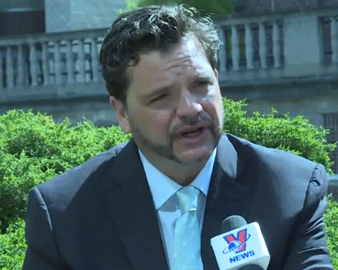
Stephen Noerper, senior director at the Korea Society in New York discuss North Korea issue on Vnews.
For link to the recorded interview (from minute 14’15” to 16’50” and from minute 18’50” to 19’30” ), click here
4/9/19 | Pacific Forum |
PacNet #24: Kim Jong Un’s choice – Economic reform would be a risk well taken by North Korea Economic reform would be a risk well taken by North Korea, according to Korea Society president Thomas Byrne and associate director Jonathan Corrado. In a new article for Pacific Forum PacNet, the authors content that, “Pyongyang’s leadership seems to be more attuned than ever about benefits from economic development, but so far bold action and systemic reform are missing. The cases of China and Vietnam show a path to prosperity if North Korea embraces a pluralistic communist system in which new interest groups coalesce to support reform. Such a transition would likely allow the international community—including the U.S., South Korea, Japan and the international financial institutions, including the IMF, the World Bank, ADB and even the AIIB—to help Pyongyang proceed down that road. Economic benefits from this process could change Pyongyang’s suspicious attitude towards the U.S. and the outside world.”
Episode 8: How It Happened – Two Koreas with Stephen Noerper The history of US and Korea. How did we get here? The story behind the politics of the moment.
The Hanoi Summit – We Asked Stephen Noerper What Happens Next in U.S.-North Korea Relations In an article for The National Interest, Korea Society Senior Director Stephen Noerper writes, “The Hanoi Summit was not the unmitigated disaster many observers termed it. It is step two in a likely long and arduous process that will entail breakoffs, walkaways and other setbacks that accompany denuclearization.”
Judith Miller: Trump’s bad week (it could have been a lot worse) But many Korea experts welcomed Trump’s decision to walk away. “Better no deal than a bad deal,” said Thomas Byrne, the president of the Korea Society. A deal that would not lead to “full, verifiable, irreversible denuclearization,” one that would have accepted North Korea’s status as a nuclear power, would have weakened America’s alliance with South Korea and Japan and proven destabilizing, he said.
In an interview with Vietnam News Agency about the results of the second Trump-Kim summit in Vietnam, Korea Society Senior Director says, “Seoul is playing a critical role as a mediator, pushing the momentum forward. This isn’t 2017 or 2018. The tensions are lower. But we have to find a way to make progress. North Korea has to be more forthcoming to realize what it wants.”
I’m glad that Trump’s tone was ‘realistic’: Former US ambassador
Thomas Hubbard of the Korea Society says it is good that both leaders had positive attitudes ahead of talks at the Trump-Kim summit in Hanoi. Hubbard, a former U.S. ambassador to South Korea, also says that U.S. President Donald Trump is right to not expect an “immediate success” out of this meeting.
U.N. Would Like Full Denuclearization of North Korea (Radio) Thomas Byrne, President, Korea Society, joined Bryan Curtis and Paul Allen on Daybreak Asia. He says that if North Korea is genuinely interested in economic development, they will have to have to make the choice to give up nuclear weapons. He also reacts to initial comments ahead of the summit on Thursday morning.
PacNet #17 – Preserving the US-ROK alliance is critical In a new article for PacNet about the upcoming Trump-Kim summit in Vietnam, Korea Society president Thomas Byrne & board director General Walter Sharp emphasize the importance of the US-South Korea Alliance in the negotiation process. “In any scenario post-Hanoi,” they write, “the steady hand of the alliance will be key. With luck, it will be the cornerstone of a new era of non-hostile engagement & cooperation w/ North Korea.”
North Korea and America’s Second Summit: Here’s What Tom Byrne Thinks Will Happen In a new article for The National Interest, Korea Society President Tom Byrne writes, “Chairman Kim Jong-un declared in his New Year’s speech that 2019 will be the year for economic development. A brighter economic future would be best served by rapid progress in verified denuclearization.”
North Korea and America’s Second Summit: Here’s What Stephen Noerper Thinks Will Happen In a new article for The National Interest, Korea Society Senior Director Stephen Noerper says that the Trump-Kim summit will yield “a limited declaration of some North Korean missile and nuclear capabilities and some acceptance of verification in exchange for a lessening of sanctions, aid package & move towards normalization.”
There was ‘frustration’ in Kim Jong Un’s message: Expert
Thomas Byrne of The Korea Society says North Korean leader Kim Jong Un’s New Year address had an “underlying element of frustration” over a lack of progress in negotiations with the U.S.
The U.S.-South Korea alliance can withstand the current diplomatic pressures In a new The Washington Post oped, Korea Society President Thomas Byrne says, “An alliance that can continue to adapt to changing conditions, amid the crosscurrents of denuclearization, is essential for moving the process forward.”
“I am one American who would like to see South Korea in the lead of this process, bringing North Korea into the world… and perhaps the U.S. advising caution here and there.” – Korea Society Chairman Thomas Hubbard
Kim Jong Un’s Puppy Diplomacy Pays Off With Korea Railway Study Stephen Noerper, senior director at the Korea Society in New York says, “Should South Korea request some sanctions relief aimed at economic aid that is part of inter-Korean easing, the U.S. should be able to live with that… North Korea has to show progress to give Moon the political space he needs to proceed.”
Focus Now on Second Trump-Kim Summit (Radio) Thomas Byrne, President, Korea Society, joined Doug Krizner and Paul Allen on Daybreak Asia, discussing the latest on relations between the U.S. and North Korea, starting with President Trump’s reaction to reports of undeclared nuclear sites.
North Korea: High-Level Engagement Lends Momentum to Talks In an oped for Dong-A Ilbo, Korea Society Chairman Ambassador Thomas Hubbard evaluates the evolving situation on the Korean Peninsula, writing, “Indeed we have come a long way from last year.” Describing this progress, Ambassador Hubbard writes, “A year ago, we were watching the North Koreans carry out increasingly threatening nuclear and missile tests and worried about imminent war on the Peninsula. Now nearly a year has passed without provocative North Korean tests, and far from talking about war, we engaged in an unprecedented flurry of top-level meetings, beginning with President Moon’s meeting with Kim Jong-un at Panmunjom during the Winter Olympics. Thanks to this initiative, and President Trump’s willingness to follow up with his own meeting with Kim in Singapore, we appear to have unprecedented momentum toward progress on the Korean Peninsula.”
To download the English translation of the full article in PDF, click here
10/11/18 | South China Morning Post: United States & Canada | US Ambassador to UN Nikki Haley steps down as Trump lauds her work with North Korea
Asked about the impact of Nikki Haley on the Korean Peninsula by The South China Morning Post, Korea Society President Thomas Byrne credited Haley with assuming a key role at a sensitive time in relations with North Korea. “The US-led resolute response to North Korea’s escalation of provocative launches and nuke tests was effective, as it worked to get North Korea to the negotiating table in 2018,” he said.
9/26/18 | Money Today | Confirmation from North Korea’s willingness to join the IMF
South Korean President Moon Jae-in was asked by Korea Society President Thomas Byrne if North Korea is willing to become a member of International Monetary Fund (IMF). President Moon replied, “based on the premise that a process of denuclearization is either complete or irreversible and as a result, economic sanctions on North Korea are removed, South Korea is willing to take the lead to build infrastructure for economic development in North Korea. I believe the effort will not only help North Korean development, but it will be a new force of growth for the South Korean economy.”
9/26/18 | Kukmin Ilbo | North Korea cannot endure U.S. retaliation. Trust honesty of Kim Jong Un.
When asked by Korea Society President Tom Byrne whether North Korea has expressed willingness to join the International Monetary Fund (IMF), South Korean President Moon Jae-in said, “North Korea has confirmed they are willing to reform by joining several international organizations, such as IMF and World Bank (WB).”
9/19/18 | The Chosun Ilbo. | “Kim Jong Un will eventually denuclearize as he wants to remain in power for the next 40 years,” says Gen. Sharp, Korea Society board director, in an interview with Chosun Ilbo. General Sharp also mentioned that, “filing an accurate report of the North’s nuclear arsenal, destroying intercontinental ballistic missiles or agreeing to a specific time frame for denuclearization would ensure U.S. support.” He also believes it is unlikely the U.S. will withdraw troops from South Korea following a declaration to end the Korean War.
9/18/18 | REUTERS: BREAKINGVIEWS | President Donald Trump’s trade war threatens the possibility of peace in Korea, say Korea Society President Thomas Byrne and Chairman Ambassador Thomas Hubbard in a new Reuters Breaking Views article. The two write, “Capricious auto tariffs on the flimsy pretext of national security only complicates denuclearization negotiations already fraught with mistrust.”
7/26/18 | Bloomberg Opinion | Korea Society President Thomas Byrne explains that Korean War Armistice, “has kept relative peace on the Korean peninsula, underpinned one of America’s most important alliances, & enabled South Korea’s remarkable rise to prosperity.”
Dr. Stephen Noerper speaks to White House and State negotiations with the DPRK.
“Trump is tacking toward viability,” said Stephen Noerper, senior director of the New York-based Korea Society and an adjunct political science professor at Columbia University. “He wants a deal and is comfortable letting Secretary Pompeo usher this through. He is willing to overlook the diatribe that followed the secretary’s Pyongyang visit.”
“Boycotts politicize trade and thus make consumers and corporations worse off,” Thomas Byrne, the president of The Korea Society, told CNBC. “China scores political points, and does not reap economic gains by the use of boycotts. They are in effect de-factor quotas, and in that sense are worse than tariffs. Smaller countries that have faced boycotts of some of their goods and services sold in China, namely South Korea, are often highly dependent on China’s market…”
Trump-Kim Agreement ‘Disappointing,’ Former U.S. Ambassador Says
Thomas Hubbard, chairman of the Korea Society and a former U.S. Ambassador to South Korea, talks about the talks between President Donald Trump and North Korean leader Kim Jong Un. Hubbard speaks with Ramy Inocencio and Haidi Lun on “Bloomberg Daybreak: Australia.” (Source: Bloomberg)
Asked about how the summit is viewed in the US, President of the Korea Society Thomas Byrne said that the 12 June summit in Singapore is unconventional given its top-down nature. The fact that two rounds of more traditional bottom-up negotiations have failed in the past, however, means it is possible this new approach will yield positive results.
6/11/18 Bloomberg TV
Bloomberg Daybreak: Americas’ Full Show
(Minute 49:00 onward) Dr. Stephen Noerper speaks to the Trump-Kim Singapore summit.
Wouldn’t be surprised if Kim Jong Un tries to hang onto nukes
Amb. Thomas Hubbard, Korea Society chairman and former U.S. ambassador to the Republic of Korea, and Rod Hunter, Baker McKenzie partner and former National Security Council senior director, discuss the expectations for the summit between President Trump and North Korea’s Kim Jong Un.
The Korea Society chairman, Ambassador Thomas Hubbard spoke to TBS, This Morning with Alex Jensen radio to discuss his views on the Trump-Kim Singapore summit.
Asked about the upcoming June 12 summit in Singapore between President Donald Trump and Kim Jong-un, Korea Society president Tom Byrne told Fox 5 DC that more important than the timing of the summit is, “What will they agree on? The definition of denuclearization still has to be defined. North Korea’s concerns about the US stopping its hostile attitude have to be defined. That’s more important than the actual date of the agreement.”
5/24/18 Bloomberg Daybreak Asia
Door Open For Future North Korea Summit
Thomas Byrne, President, The Korea Society, discussed President Trump’s cancellation of the summit with North Korea with Doug Krizner and Juliette Saly. He tells them he sees a diplomatic game ahead, explains the Libyan model and gives his analysis of Moon Jae-In’s role in matters.
‘They stood us up’: White House says it cancelled Kim Jong-un meeting because North Korea refused to talk – despite Donald Trump’s earlier claims
Inability to agree on the content of the discussions or what the two sides would agree to likely contributed to Trump’s move on Thursday, said Thomas Byrne, president of the New York-based Korea Society…
Backchannel contacts between Washington and Pyongyang likely to continue
“The State Department has until recently had a point person on North Korea, who is basically the lead in terms of managing that,” Stephen Noerper, Senior Director at the Korea Society said. “A special representative, and that individual communicates directly with the North Korean mission here in New York…”
Summit was probably a bad idea in the first place, says former ambassador
Amb. Thomas Hubbard, former ambassador to the Republic of Korea and chairman of The Korea Society, weighs in on President Trump’s decision to cancel the summit between the U.S. and North Korea.
(Minutes 30:30-36:00) Korea Society Senior Director Dr. Noerper: “Pyongyang wants a security guarantee, economic benefits, and diplomatic normalization. US troops are not on the table at the moment. South Korea is driving this process.”
Thomas Byrne, President, President, The Korea Society, joined Doug Krizner and David Ingles to discuss doubts over the summit between North Korea and the U.S. going ahead. He explains how definitions of denuclearization are now being refined and what each side hopes to gain.
Both Trump and Kim want a summit to happen: Former US ambassador
President Donald Trump and North Korean leader Kim Jong Un want to see the June 12 summit in Singapore go ahead, says Thomas Hubbard of McLarty Associates and former U.S. ambassador to South Korea.
Korea Society contributes data to Wall Street Journal article about military cost sharinge
A new Wall Street Journal article looks at the military cost sharing deal between the US and Korea, and suggests that the US derives tactile benefits like free rent on top of intangible values-based benefits from the arrangement. Korea Society contributed data to the report, resulting in a graph that shows how South Korea’s contribution to host U.S. troops has risen faster than inflation.
Donald Trump hopes for ‘world peace’ as he announces he will meet North Korea’s Kim Jong-un in Singapore in June
Asked about the developing diplomatic process with North Korea by the South China Morning Post, Korea Society President Tom Byrne says, “Even the skeptics, who look at the history of the negotiations with North Korea, look upon this as an opening for a breakthrough. I don’t get a sense that there’s a significant number of people saying it’s just a trap and to stay away.”
The Stars of North Korea Talks Revolve Around Moon
Dr. Stephen Noerper speaks to South Korean President Moon Jae-in’s adroit diolomacy in the summit process.
“Moon spent 10 years in the woods,” says Stephen Noerper, the Korea Society’s senior director for policy. “That gave him a great deal of time to think about North Korea policy.” Some of that thought went into refining the “sunshine” approach: Moon isn’t quite as far left as many in his inner circle. He wanted engagement, but with caution.
Dr. Stephen Noerper appeared on the 6:30 PM national broadcast of CTV, commenting on the lead-up to the Trump-Kim summit, the leading role of Moon Jae-in, and the complex of international actors: South Korea, North Korea, United States, China, Japan and Russia.
5/1/18 CBC NEWS
Trump winning the Nobel Peace Prize? Why experts give him credit for North Korea talks
Dr. Stephen Noerper describes the evolution of the summit process and Kim Jong Un’s desire for economic modernization.
This by-invitation trilateral dialogue, organized by the National Committee on American Foreign Policy, examines relations among the United States, South Korea, and China. The National Committee brings together scholars and former officials from the three nations to address areas of common concern and challenges, to include that posed by North Korea’s nuclear and missile development. The meeting takes place subsequent to the planned third Inter-Korean summit and around the potential historic meeting between President Donald Trump and North Korean leader Kim Jong Un.
Contributions by the Korea Society team in academic and policy journals. |
8/16/2023 |
Biases blind us to the risk of Chinese military intervention in Korea |
In an article published by the Atlantic Council, Biases blind us to the risk of Chinese military intervention in Korea, Korea Society policy director Jonathan Corrado examines the historical record to highlight the cognitive biases that have plagued US intelligence assessments, with a particular focus on failures preceding China’s intervention in Korea over 70 years ago. Corrado warns that the “alchemy of cognitive and organizational biases is uniquely suited to advantage a PRC self-defensive counterattack strategy,” and offers some suggestions for how to avoid those pitfalls.
6/30/2023
Indo-Pacific Strategies and Foreign Policy Challenges The US-China Strategic Competition
In a submission for the 2022 KEI Academic Paper Series, Coauhors Tom Byrne, Claire Callahan, Irene Kyoung, and Salomé Da Silva Duarte Lepez explore South Korea’s aspiration to achieve the status of global vaccine hub as a national strategic policy priority. The paper first outlines the characteristics of a global vaccine hub and a WHO biotechnology hub, touches on collaborative vaccine efforts in Asia, and then discusses the institutional structure of South Korea’s global vaccine hub and the country’s Covid-19 partnerships. The paper provides an overview of global vaccines, including Covid-19 vaccine production, showing where South Korea fits into that ecosystem, and summarizes global vaccine diplomacy efforts. The paper notes the laudable achievements of Operation Warp Speed in the U.S. (and in the presentation, the Vaccine Task Force in the U.K.) in rapidly producing safe and effective vaccines early in the pandemic, although vaccine nationalism inevitably prevailed as global demand exceeded supply. The paper also notes the shortcomings of national and bilateral vaccine diplomacy, as well as multilateral mechanisms, in providing vaccine access and ensuring equity. It concludes that South Korea’s demonstrated capabilities to rise as a global vaccine development, manufacturing, and training hub will help bolster global public health capacities in the future.
To watch the paper presentation program, click here
9/12/2022
How the United States can build a chip alliance in Northeast Asia without decoupling
In an article co-authored with Major Jessica Taylor for Pacific Forum PacNet, Korea Society policy director Jonathan Corrado discusses how the United States can build a chip alliance in Northeast Asia without decoupling. They write that “a successful collaboration will address risks to key points of the semiconductor supply chain by adding rigor to the system, ensuring continued access to supply, and maintaining an environment of innovation… The effort will fall short if the alliance cannot address members’ concerns and respond to the risks posed by the People’s Republic of China without tripping down the slippery slope of technological decoupling.”
Can Korea Join the Quad? How Should the Group Evolve?
In an article for Korea On Point by The Sejong Institute, Korea Society policy director Jonathan Corrado discusses how the timing of Korea’s enhanced engagement with the Quad will be shaped by domestic political factors, changes in the regional security environment, and the preferences of the Quad member countries. He writes, “Korea’s ability to engage in this emerging security group will not merely be a test of its ambitions, but will also serve as a measure of the Quad’s durability and effectiveness.” Corrado uses the results of an expert survey administered as part of a Pacific Forum fellowship to reveal areas of both considerable symmetry and stark differences between U.S. and Korean experts. He concludes that, “It will be important to interrogate these divergences to optimize the Quad’s success.”
Korea Society policy director Jonathan Corrado published an article for Ideology and Economic Policy in North Korea, published by the North Korea Economic Forum (NKEF) at George Washington University’s Institute for Korean Studies (GWIKS). In an article titled, “Rose-Colored Glasses: The Information Ecosystem’s Influence on Generational Variation in Attitudes on North Korea’s Economic Management,” Corrado assesses a generational variation in North Korean attitudes about the government’s economic management, using survey data to find that the younger cohort has become more positive. Corrado’s analysis offers a basis for further investigation, suggesting that the young cohort has become more positive in their views of the leadership’s economic management because their lack of market experience makes them vulnerable to changes in the information ecosystem, including a concerted youth loyalty campaign and a reduction in the availability of foreign information.
Next Generation Perspectives on Korean Peninsula Security
Korea Society policy director Jonathan Corrado writes about “Strengthening US-South Korea Cooperation on Semiconductor Supply Chain Resilience and Innovation” for an edited volume of the Emerging Leaders’ policy papers on Next Generation Perspectives on Korean Peninsula Security published by The National Committee on American Foreign Policy (NCAFP).
Rethinking Intelligence Failure: China’s Intervention in the Korean War
Policy Director Jonathan Corrado published an article titled “Rethinking Intelligence Failure: China’s Intervention in the Korean War” in The International Journal of Intelligence and CounterIntelligence. The article evaluates how the U.S. Intelligence Community and policymakers failed to predict and prepare for China’s entrance into the Korean War and North Korea’s invasion. Diplomatic cables, personal accounts, and declassified national security documents reveal that warnings about possible intervention were undercut by contradicting analysis. Cognitive bias led to faulty assumptions and ambiguous conclusions. The negative effects of bias and politicization were mutually reinforcing, imperiling the efforts of actors who tried in vain to address them. Lessons gleaned from this history shed light on insights for persistent security challenges, such as the relationship between miscalculation and escalation and the difficulty of knowing one’s adversary, as well as America’s present strategic competition with China.
Issues & Insights Vol. 21, WP 10 — South Korea’s Demographic Advantage is Over: The Regional Context and the Economic and Security Implications In a paper for Pacific Forum’s Issues & Insights, president Tom Byrne and policy director Jonathan Corrado write on the economic and security risks South Korea’s low birth rate poses to its future, writing that “South Korea will have to make tough policy and fiscal choices, unless it can achieve another ‘Miracle on the Han’ —this time overcoming its demographic challenge.”
Partners in Democracy: Perspectives on the U.S.-Korea Alliance
The Korea Society and The Association of Former Members of Congress (FMC) are proud to release a new publication Partners in Democracy: Perspectives on the U.S.-Korea Alliance.
This series of essays sheds light on the dynamic partnership between the United States and the Republic of Korea, featuring insights from: Republic of Korea Ambassador to the United States Lee Soo-Hyuck; U.S. Senator Brian Schatz (D-Hawaii); Senator Dan Sullivan (R-Alaska); Representative Ami Bera (D-Calif.); Korea Foundation President Geun Lee; former U.S. Ambassador to the Republic of Korea Kathleen Stephens; General Walter “Skip” Sharp, former Commander, United Nations Command / Combined Forces Command / United States Forces Korea; and Professor Victor Cha, CSIS Korea Chair.
On the significance of the publication, Korea Society president and CEO Tom Byrne said: “By showcasing influential voices from the United States and Korea, this timely series of essays demonstrates the many mutually beneficial aspects of the U.S.-ROK relationship, and outlines the key challenges and opportunities for our partnership going forward. We are confident that it will serve as a helpful tool for policymakers and stakeholders. The Korea Society is proud of its collaboration with FMC on the Congressional Study Group on Korea and looks forward to participating in an even more ambitious agenda in the future.”
7/2/19 National Committee on American Foreign Policy
A TICKING CLOCK OR A GOLDEN OPPORTUNITY? A U.S.-ROK-CHINA TRILATERAL REPORT
A new report written by Korea Society associate policy director Jonathan Corrado for the National Committee on American Foreign Policy highlights a conference discussion on prospects for trilateral and broader multilateral cooperation in addressing Northeast Asian security challenges. The trilateral conference, co-hosted by The Korea Society, provides a useful opportunity to evaluate the year’s most significant geopolitical developments. Stark differences in the tone and content of this year’s dialogue underscore the region’s dynamism and strategic significance. Denuclearizing North Korea remains the major driver of concern. Conference participants explored the ramifications and likelihood of alternate futures, ranging from breakthrough to muddle through to breakdown. Participants also discussed the possibility of North Korean change from within, the opportunity for China to play a greater role in denuclearization talks, methods for preventing an arms race in Northeast Asia, and the future structure of the U.S.-ROK alliance.
PacNet #5 – North Korea Doubles Down on a Dead End In an article for Pacific Forum PacNet on North Korea’s economic plan announced at the recent party congress, president Tom Byrne and policy director Jonathan Corrado write that, “The plan leaves unanswered the question of the sources of financing. North Korea has scant domestic savings, no access to international credit and has squeezed the foreign currency savings of the donju entrepreneurs and financiers.”
PacNet #11 – Two tasks for making US-ROK troop burden sharing sustainable In a new article about the U.S.- Korea military cost sharing deal for Pacific Forum PacNet, Korea Society chairperson Ambassador Kathleen Stephens and president Tom Byrne write, “The time is now for the United States and South Korea to come to terms on a deal that works for both sides. The smooth functioning of the alliance should not be impaired by an accounting impasse that loses sight of the incalculable benefits from 70 years of partnership.”
PacNet #24: Kim Jong Un’s choice – Economic reform would be a risk well taken by North Korea Economic reform would be a risk well taken by North Korea, according to Korea Society president Thomas Byrne and associate director Jonathan Corrado. In a new article for Pacific Forum PacNet, the authors content that, “Pyongyang’s leadership seems to be more attuned than ever about benefits from economic development, but so far bold action and systemic reform are missing. The cases of China and Vietnam show a path to prosperity if North Korea embraces a pluralistic communist system in which new interest groups coalesce to support reform. Such a transition would likely allow the international community—including the U.S., South Korea, Japan and the international financial institutions, including the IMF, the World Bank, ADB and even the AIIB—to help Pyongyang proceed down that road. Economic benefits from this process could change Pyongyang’s suspicious attitude towards the U.S. and the outside world.”
PacNet #17 – Preserving the US-ROK alliance is critical In a new article for PacNet about the upcoming Trump-Kim summit in Vietnam, Korea Society president Thomas Byrne & board director General Walter Sharp emphasize the importance of the US-South Korea Alliance in the negotiation process. “In any scenario post-Hanoi,” they write, “the steady hand of the alliance will be key. With luck, it will be the cornerstone of a new era of non-hostile engagement & cooperation w/ North Korea.”
6/8/18 CSIS | Center for Strategic & International Studies
PacNet #39 – Rapid Denuclearization Made Economic Sense for Libya – and Could for North Korea, Too
The big question is, will Kim Jong Un pivot North Korea towards an economic development track and away from its heavy emphasis on military expenditures? A good test of that would be whether North Korea follows the Libya model. President Donald Trump called off – briefly –
To read the full article, click here | To download the article in PDF, click here
1/10/18 CSIS | Center for Strategic & International Studies
PacNet #3 – Kim Jong Un’s New Year’s Resolution: What It Means
Korea Society President Tom Byrne explains why Kim Jong Un is suddenly warming up to South Korea after giving the Moon administration the cold shoulder for much of 2017. The New Year’s Day gambit is a play to get $ relief and drive a wedge in US-ROK denuclearization policy.
To read the full article, click here | To download the article in PDF, click here
November 3-5, 2017 — Tom Byrne presented at the Beijing Forum held at Peking University on the topic of the “Belt Road Initiative and Global Economic Governance.” The Beijing Forum, co-hosted by the Korea Foundation for Advanced Studies and Peking University since 2004 is an annual academic conference. This year it was held on 3-5 November this year over a three-day period at Diaoyutai State Guest House and Peking University in Beijing, China.
Priscilla Moriuchi, Recorded Future’s Director for Strategic Threat Development, discusses the evolution of North Korea’s cyber strategy, including cryptocurrency theft, sabotage, espionage, and everyday internet usage by Pyongyang’s elites. Priscilla is the former head of the National Security Agency’s East Asia and Pacific cyberthreats office. Today, Priscilla uses a variety of tools to generate unparalleled depictions of North Korea’s state-level online behavior.
Stanford University Center for International and Security Cooperation visiting scholar Katharina Zellweger addresses the current state of humanitarian efforts in North Korea. Having visited North Korea more than seventy times, Ms. Zellweger describes current challenges, transparency and government relations, and the impact of sanctions on humanitarian assistance to North Korea. Ms. Zellweger speaks to her current Hong Kong-based NGO efforts aimed at the disabled and children in institutions in North Korea. Kathi Zellweger speaks with the Korea Society’s Stephen Noerper.
North Korea and Humanitarian Assistance
featuring Katharina Zellweger
Wednesday, April 25, 2018 | 12 PM
The Korea Society Fellow, Patron and Corporate members: FREE with registration