
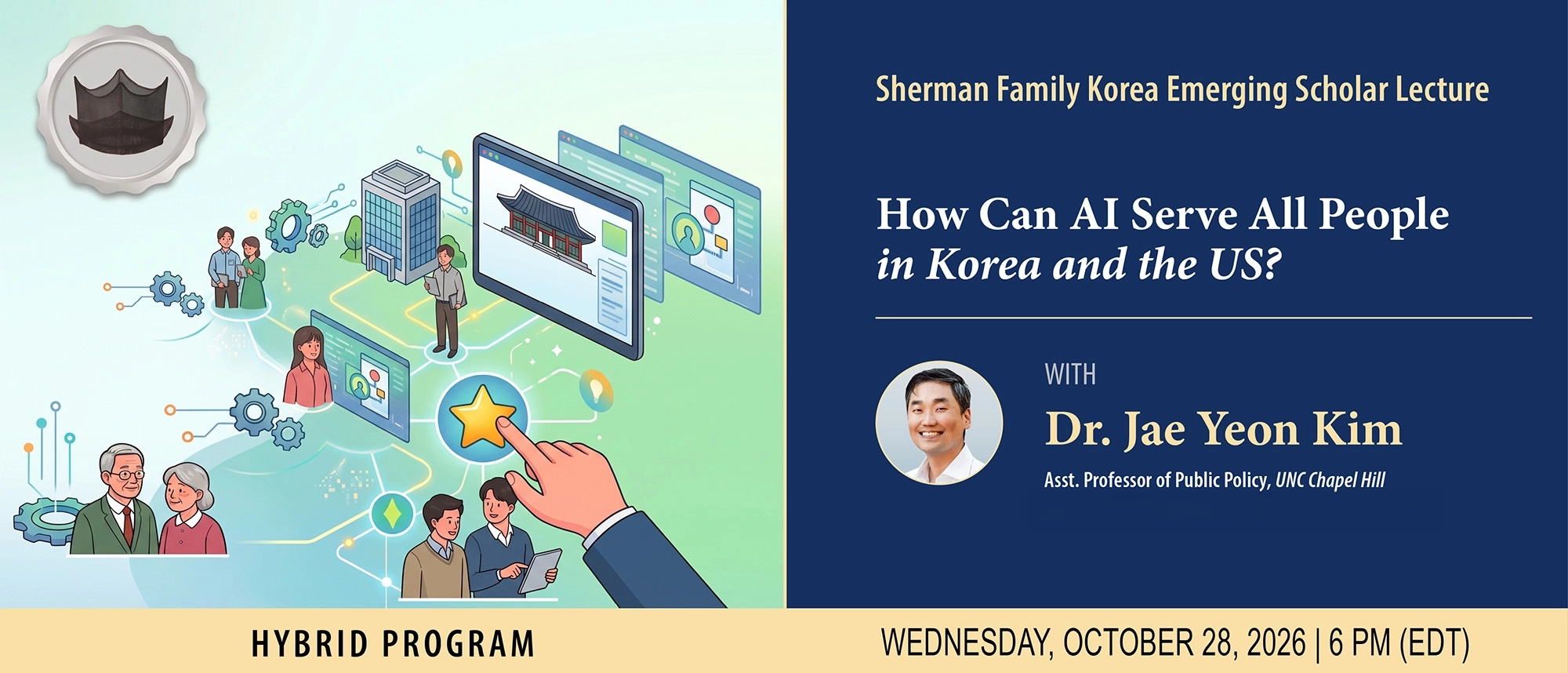

The Korea Society is pleased to announce that the winner of the 2026 Sherman Family Korea Emerging Scholar Lecture Competition is Dr. Jae Yeon Kim, Assistant Professor of Public Policy at the University of North Carolina at Chapel Hill, Fellow at the Civic Power Lab at Harvard Kennedy School, and Better Government Lab Fellow at the University of Michigan’s Ford School of Policy.
Artificial intelligence is rapidly transforming public administration and public policy, but all too often, the discussion is dominated by the latest technological breakthroughs, rather than their potential utility in serving the public. To this point, Dr. Kim argues that the primary challenges facing AI in government are human and organizational rather than technological. Longstanding barriers to public services—such as administrative burdens, complex paperwork, and unequal access—predate artificial intelligence. Without intentional institutional changes, adopting automated systems risks digitizing and accelerating existing inefficiencies rather than resolving them.
Drawing on research in civic technology, policy implementation, and digital service delivery across South Korea and the United States, Dr. Kim outlines a framework for human-centered government. He examines how South Korea—a recognized global leader in e-government—can advance beyond basic automation. By prioritizing citizen needs through human-centered design, civic data, and participatory governance, public institutions can ensure AI reduces administrative friction and expands democratic access for everyone, particularly marginalized communities and future generations who will live longest with these technologies.
Key Points
- Human and Organizational Dynamics – The main hurdles facing public sector AI are organizational and institutional. AI risks automating pre-existing administrative burdens if core public institutions do not adapt.
- Human-Centered Civic Data Infrastructure – Human-centered design, civic data, and participatory governance can modernize public services, strengthen democratic access, and empower citizens to help govern public AI.
- Real-World AI Governance – Public procurement, service delivery, and back-end infrastructure shape citizen experiences just as significantly as frontier AI models.
About the Sherman Family Korea Emerging Lecture Award
The primary goal of the award is to encourage U.S. thought leadership on Korea among a new generation. The award is presented to emerging thought leaders from a wide range of disciplines and backgrounds working in the U.S. Prior awardees have explored topics in the arts, architecture, history, industrial policy, political science, and technology and have included Ph.D. candidates, junior professors (tenure and non-tenure track), researchers and professionals. Click here to view presentations of former award winners.
Speakers
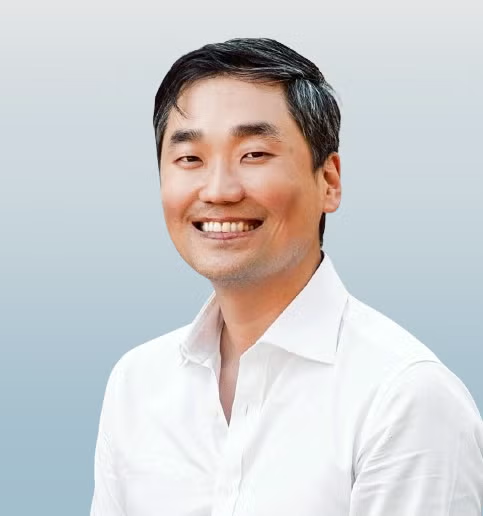 |
Jae Yeon Kim is an Assistant Professor of Public Policy at the University of North Carolina at Chapel Hill, a Fellow at the Civic Power Lab at the Harvard Kennedy School, and a Better Government Lab Fellow at the University of Michigan’s Ford School of Public Policy. He co-founded the Data for Good Roundtables, a safe and brave space where academics and practitioners come together to discuss using data for good.
Previously, Kim worked as a Senior Data Scientist at Code for America, where he collaborated with U.S. government agencies to improve access to safety net programs. Kim also served as an Assistant Research Scientist at the SNF Agora Institute at Johns Hopkins University, where he co-developed the Mapping the Modern Agora project. Kim earned his Ph.D. in Political Science from the University of California, Berkeley.
Combining his professional experience as a data scientist in the U.S. public sector with his academic training as a social scientist, Kim has developed a research agenda focused on policy implementation, government capacity, and technological change. A common thread across his research projects is addressing two major challenges in policy implementation as modern government becomes increasingly complex: (1) helping people navigate bureaucracy and strengthening trust between government and civil society, and (2) helping government agencies buy and use technology more effectively and responsibly.
Kim is currently finishing a book manuscript titled Unseen and Uncounted, which examines how the administrative challenges of identifying and categorizing non-Black minority communities gave rise to new racial group formations during the War on Poverty. He has also begun work on his second book project, tentatively titled Burdens, Profits, and People Power, which investigates how AI exacerbates existing inequalities through administrative burdens, what kinds of businesses profit from these hidden practices, and how people can build power to resist and transform this unjust system.
Kim’s research has appeared in leading journals across public policy and the social sciences and has been recognized with three awards from different sections of the American Political Science Association. His research has been featured in The Washington Post, the Associated Press, and other national and international media outlets. His work has also informed how U.S. state and local governments deliver public services, procure AI systems, and train government officials; how foundations strategically distribute grants for public benefit innovation and civic engagement; and how nonprofits develop their research and evaluation capacity.
