THE KOREA SOCIETY | STRATEGIC PLAN | 2022 – 2026


THE KOREA SOCIETY

STRATEGIC PLAN

2022 – 2026

(March 5, 2025)

DOWNLOAD PDF

VISION:
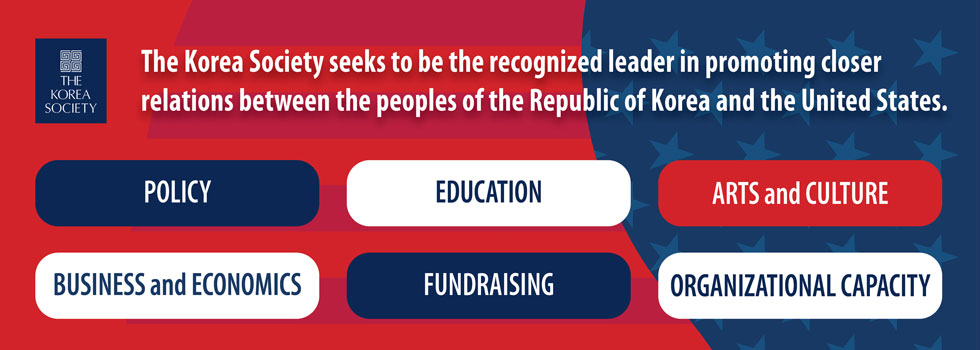
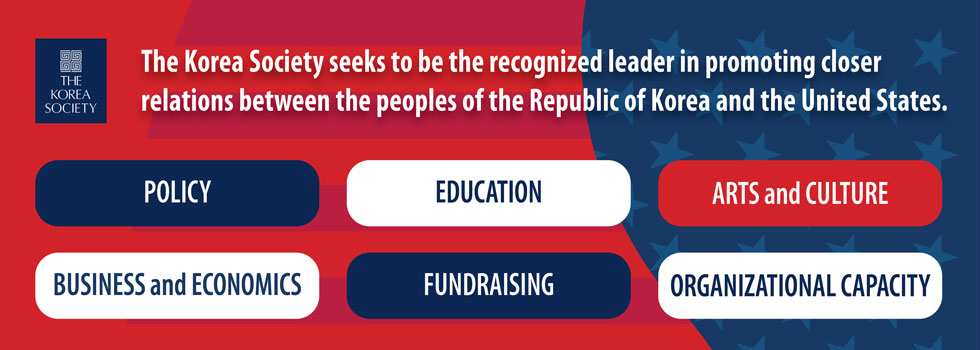
The Korea Society seeks to be the recognized leader in promoting closer relations between the peoples of the Republic of Korea and the United States.
 
MISSION:
The Korea Society is a nonprofit, nonpartisan, 501(c)(3) organization with individual and corporate members that is dedicated to the promotion of greater awareness and understanding in order to strengthen cooperation between the peoples of the United States and Republic of Korea.


STRATEGIC GOALS:


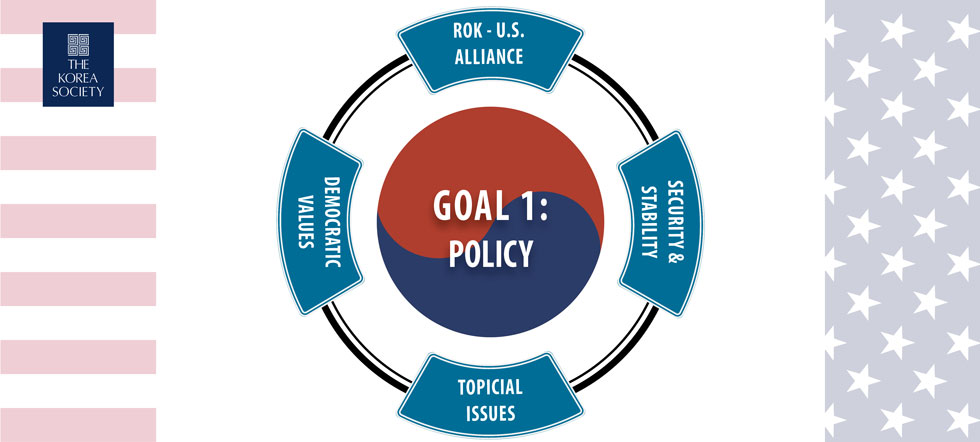
Goal 1: Policy Programs

In the area of Policy, promote and increase interest, knowledge, and discussion of the importance of Korea and the ROK – U.S. Alliance in order to maintain and strengthen the diplomatic and security relationships, all aspects of which are critical for the future of both countries. .

Priorities:

  1) Increase understanding of the importance of the ROK – U.S. Alliance.

2) While prioritizing the security and stability of Northeast Asia, the United States, and beyond, support efforts to promote reconciliation and peaceful reunification, denuclearization, human rights, and economic development in North Korea.

3) Increase understanding of the importance of Korea in its region and beyond.

4) Strengthen and articulate our common democratic values of freedom, human rights, rule of law, and democracy.

Strategies:

  1) Develop a better understanding of our key audiences. Prioritize and focus on audiences that are critical to the Society’s mission, vision, and goals.

2) Conduct Public Policy Programs and Roundtables.

3) Conduct an annual Van Fleet Signature Policy program.

4) Engage with the media to highlight key activities.

5) Conduct programs and events to honor and remember Korean War veterans and those who have served and are serving in Korea.

6) Feature current U.S. and Korean policy makers to discuss matters key to the U.S. – ROK Alliance.

7) Collaborate with like-minded partners to expand impact and outreach.

Key Performance Indicators:

  1) Influence the influencers” indicator:

  – Sustained engagement from government policymakers, think tank experts, researchers and academics, media, and corporate, with key demographics actively engaging, attending in-person programs and consuming digital products.

  2) Public Awareness indicator:

  – Annual survey shows engagement with policy content enhances audience understanding of the priorities (Alliance, NK, Korea in its region, and Common Values).

– Maintaining annual attendance in-person programs and digital product consumption (i.e., over 5,000 registrations for in-person and livestream view, and over 30,000 cumulative YouTube views and podcast downloads)


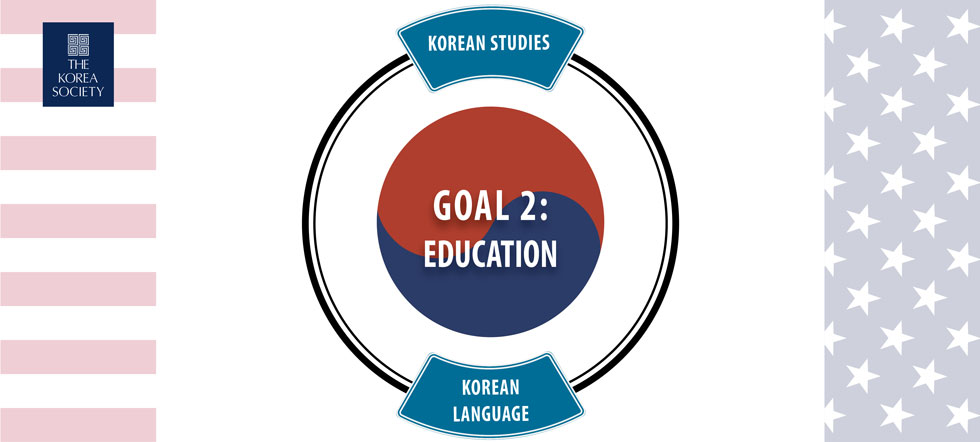
Goal 2: Education Programs

In the area of Education, advance educational opportunities and programs for students and educators in order to promote mutual understanding and appreciation as well as develop and sustain the long-lasting ties between our two nations for generations to come.

Priorities:

  1) Advance Korean Studies in U.S. schools, colleges, universities, and other entities to promote and cultivate an understanding of Korean culture, history, and the importance of the close relationships between the U.S. and the Republic of Korea.

2) Promote the advancement of Korean language learning, meeting the needs of individuals who wish to develop Korean language skills for both professional and personal interests.

Strategies:

  1) Develop a better understanding of our key audiences. Prioritize and focus on audiences that are critical to the Society’s mission, vision, and goals.

2) Conduct post-program surveys of current audiences and execute environmental scans to identify future audiences.

3) Create, maintain, and promote robust and easily accessible educational resources for students, educators and researchers.

4) Offer a range of programming for educators, including the following:

  a) Exploring new and future trends in Korean Studies.
b) Learning about “best practices” in delivering Korean Studies programming.
c) Convening Korean studies experts who explore trends in and ways to promote advancement of Korean language in the U.S.

5) Promote the Sherman Family Korea Emerging Scholar Lecture Award Program to advance thought leadership for a new generation of scholars and professionals.

6) Promote the Project Bridge Youth Ambassador program among educators and students in New York and Montana, as well as sponsors in Korea.

7) Promote study abroad to Korea by offering competitive travel grants for underfinanced, undergraduate students.

8) Increase the diversity and number of the Society’s Korean Language Program offerings.

  a) Capitalize on the popularity of Korean music and entertainment by offering related courses.
b) Attract geographically diverse audiences.
c) Strengthen current language offerings based on knowledge gained through satisfaction surveys and environmental scans.

9) Develop trainings for a broad spectrum of audiences utilizing varied platforms.

10) Attract sponsor/underwriter funding to support grants, awards, and education-related projects.

Key Performance Indicators:

  1) Advance Korean Studies indicator:

a. For Students:
– Increase applications submitted to competitive programs (Project Bridge & Study Abroad) & increase TKS visibility at schools.
– Secure adequate funding to double number of Study Abroad Grants & funding awarded annually.
– Attract interest from and engagement with student clubs.

b. For Teachers, Educators, Researchers and Others:
– Increase number of middle and high school workshops offered locally and attract new virtual audiences.
– Increase Lecture attendance.
– Significantly increase website ‘hits’ on our digital resources.
– Attract at least 5 organizations willing to partner on our resources initiative.

c. For Professionals:
– Increase enrollment in our new Business series among companies.
– Generate income that covers costs.

2) Korean Language Learning indicator:
– Increase overall enrollment.
– Increase participant geographic diversity.
– Generate sufficient revenue to cover, at a minimum, all direct expenses, and ideally all indirect.

3) Audience, Partner and Donor Development:
– Develop post-program surveys for all programs and strive to achieve a minimum 30% online response rate -Attract new sponsors for our PB Study Tour.


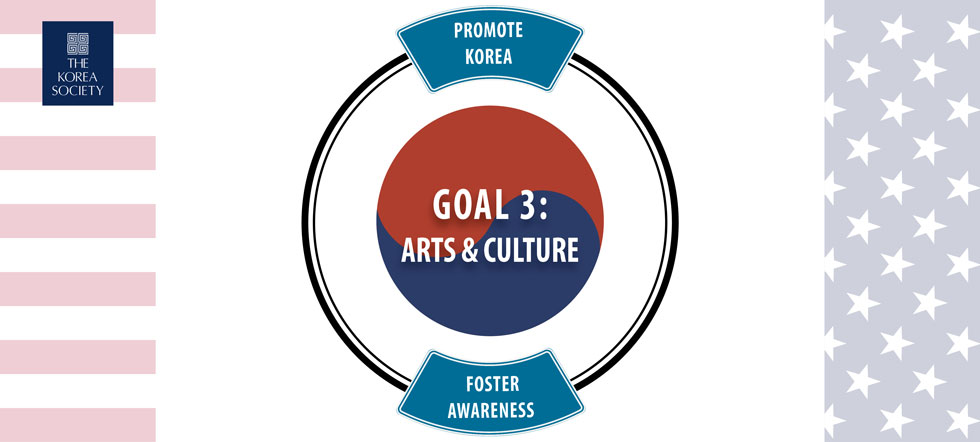
Goal 3: Arts & Culture Programs

In the area of Arts & Culture, promote the diversity and excellence of Korean and Korean-American artists, performers, authors, and other professionals in the broadly defined area of culture.

Priorities:

  1) Promote Korea as a global force in art, literature, culinary art, performing arts, entertainment industry, and sports.

2) Foster awareness of Korean and Korean American artists and professionals; promote their contribution to the cultural scenes in New York City and beyond.

Strategies:

  1) Develop a better understanding of our key audiences. Prioritize and focus on audiences that are critical to the Society’s mission, vision, and goals.

2) Promote contemporary artists with exhibitions and special online programs, including artist-talk programs and art history lecture series.

3) Design literature programs to be conducted both in the event space and online, featuring Korean-American writers and Korean authors, whose books are translated and published in the U.S.

4) Support touring performers and Korean film releases in the U.S. by promoting the events and conducting interviews both in-person and online.

5) Design lecture series to present traditional Korean culture, including cuisine, fashion, and design, to be delivered by scholars and experts.

6) Develop interview series with Korean-American creatives who are working in the U.S. to promote their career and business.

7) Identify possible partners both in Korea and the U.S. to present more diverse programs with greater impact and increase audience numbers.

8) Increase the network of possible presenters and guests for the program from both Korea, the U.S., and around the world.

9) Identify and cultivate a better understanding of potential program funders who can become critical to the Society’s Mission, Vision, and Goals.

10) Identify possible funders for specific arts and culture programs.

Key Performance Indicators:

  1) Program participation indicator:

– Participation and interest to be evaluated through the number of RSVPs and attendance in person and YouTube views (demographic breakdown of general audience and English-Speaking, Younger Generation).

2) Social media indicator:
– Social media outreach expansion to be evaluated via the number of followers and engagement metric from Instagram (demographic breakdown of general audience and English-Speaking, Younger Generation).

3) Korean/Korean-Born/of Korean Descent Artists indicator:
– Survey with past artists and guest speakers regarding the impact TKS program/exhibition had on their career.

4) Donor indicator:
– Potential donors show greater awareness/ support of TKS A&C by engaging with the staff and exploring possible funding opportunities.


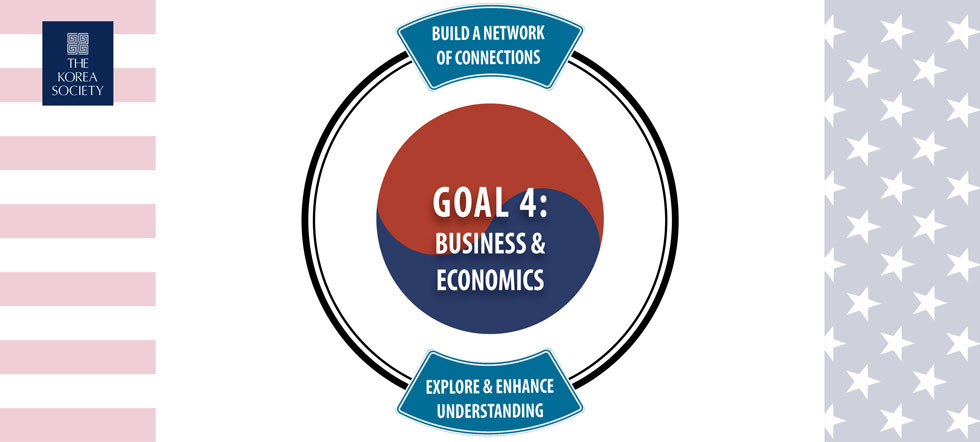
Goal 4: Business & Economics Programs

In the area of Business & Economics, bring greater awareness of and focus on business relationships between the U.S. and the Republic of Korea in order to strengthen economic relations.

Priorities:

  1) Build a network of connections between the Society and leaders in government, business, finance and other fields having a prominence in the U.S. and ROK economic and financial relationship.

2) Explore and enhance understanding of major issues in the evolving landscape of economic, trade, and technology policies affecting the business partnerships between the U.S. and Korea.

Strategies:

  1) Develop a better understanding of our key audiences. Prioritize and focus on audiences that are critical to the Society’s mission, vision, and goals.

2) Liaise and leverage activities with the Policy and Arts & Culture program areas to attract greater interest in and support from the U.S and Korean business communities.

3) Seek new opportunities and relationships with business leaders in U.S. and Korean firms.

4) Conduct high profile programmatic series and explore new areas in the future. Develop specialized program series, namely:

  a) Leadership Interview Series
b) Local Leadership in the Global Context
c) Startup Scene Series
d) U.S.-ROK New Economic Paradigm

5) Global Financial Leaders Forum (GFLF): Feature leaders in the Korean and U.S financial community and cooperating with Maekyung Media Group, Korea Finance Society, and Korea Investment Corporation, to provide insight on market trends and analyze investment strategies.

6) Young Professionals’ Network (YPN): Build upon collaborative partnerships with adjacent organizations to provide a platform for learning and growth, professional development opportunities, mentorship, and networking in all business industries for young professionals in The Korea Society’s local, national, and international audience.

7) Conduct and expand outreach programs and the visibility of TKS to prioritized cities and states with an emphasis of attracting an audience from regional business communities.

8) Prioritize attracting speakers who are critical to the Society’s Mission, Vision, and Goals.

Key Performance Indicators:

  1) Programming influence indicator:
– Increased number of high-level speakers for business and economic programs across programs.
– Participation in programs increases among targeted business audiences (i.e., newly emerging financial industries).
– Increased visibility in print and broadcast media (particularly NYC, D.C., and Seoul) to demonstrate TKS’s influence on topical issues in the broad economic relationship (e.g., Special Measures Agreement).

2) National Network Expansion indicator
– Increase activity with regional business communities in the southeast U.S. in D.C., Georgia, and eventually Texas).
– Increase YPN network programming in NYC.


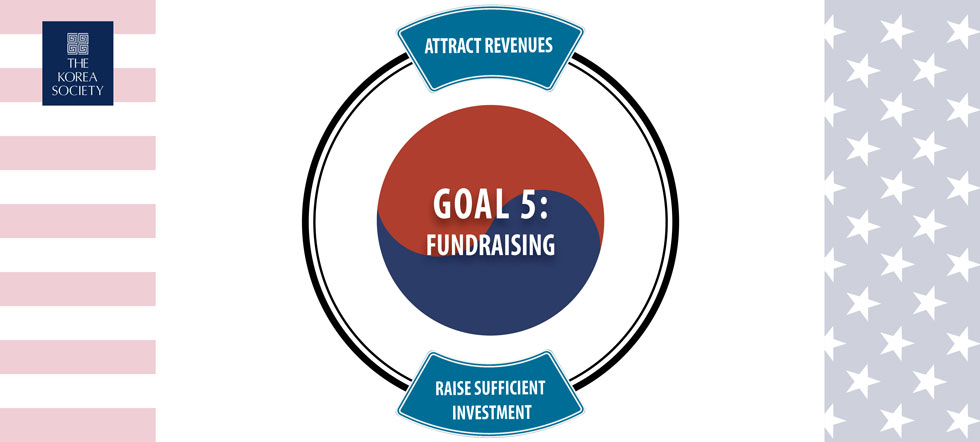
Goal 5: Fundraising

Expand and increase consistent and predictable contributions of foundations, corporations, individuals to The Korea Society’s activities and its finances.

Priorities:

  1) Attract revenues from U.S. and ROK companies, foundations and individuals to support current and planned activities of the Korea Society.

2) Raise sufficient investment income (fundraising, investments, program, event revenue and membership dues) to fund and expand programs and staff.

Strategies:

  1) Ensure that the endowment investment and operational budget policies serve best The Korea Society’s needs.

2) Fundraise in general, but with a focus on special events and Business & Economics programming.

3) Develop a plan to grow endowment through new contributors.

4) Seek earmarked sponsorship for particular Policy, Arts & Culture and Business & Economics programs.

5) Conduct a highly profitable Annual Gala Dinner.

6) Conduct other highly profitable special events, namely the Van Fleet Memorial Golf Tournament and the Annual Membership Party.

7) Maintain a high bar on the selection of the Van Fleet Award recipients.

8) Reach out to U.S. companies more actively.

9) Revise the current membership benefits and levels to attract greater membership.

Key Performance Indicators:

  1) Revenue Growth and Diversification indicator
– Maintain a diverse funding base and increase annual fundraising – total and across categories (program, events, corporate, etc.) – over average of the previous 2 years.

2) Long-term sustainability of operating budget indicator
– Present annual evaluation of income and expenses.

3) Maintain optimal performance of endowment
– Monitor annual endowment portfolio.


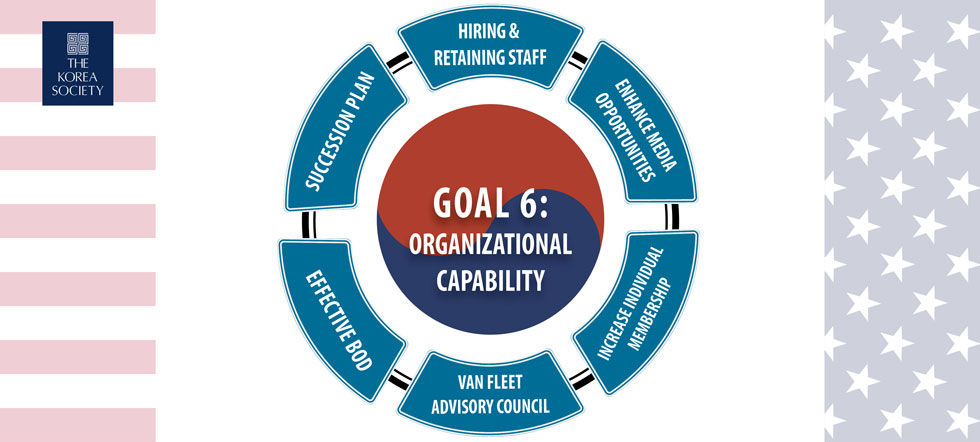
Goal 6: Organizational Capacity

Strengthen and grow TKS to enable it to accomplish the Society’s mission and organizational vision.

Priorities:

  1) Grow organizational capacity through hiring and retaining high performing leadership and staff and use of collaborative planning tools and technology.

2) Develop a process and the organizational structure to further enhance the Society’s ability to utilize digital media opportunities. Across all Korea Society departments enhance the understanding and use of social and digital media presence in order to help better promote all of TKS goals and priorities, to reach key audiences and as appropriate, to generate revenue.

3) Increase individual membership.

4) Establish the Van Fleet Advisory council to guide accomplishment of the above goals in fulfillment of the Society’s mission.

5) Maintain an effective Board of Directors

6) Develop a succession plan for key positions.

Strategies:

  1) Align salary compensation with other similar budget non profit organizations, expand benefit awareness and education among staff.

2) Work to better understand the opportunities in digital media to enhance the Society’s ability to reach a broader, more influential audience.

3) Maintain robust engagement with traditional print and broadcast media in the U.S. and Korea.

4) Enhance the benefit of membership and explore membership levels and strengthen mechanisms to track and renew membership

5) Establish Advisory Councils to support the BOD and TKS.

6) Develop a list of skills needed on each committee and the BOD. Develop a BOD self evaluation methodology.

7) Develop a succession plan for executive officers of The Korea Society (see Article VII of the Bylaws).

Key Performance Indicators:

  1) High performing staff retention indicator :
– Maintain retention of high performing staff.
– Increased staff understanding of fairness and constraints in salary and benefits (staff survey).
– Increase utilization of professional development opportunities.

2) Media coverage effectiveness indicator:
– Steady increase in traditional media coverage and social media audiences, including subscribers (e.g., YouTube) and followers (e.g., Instagram, Facebook).

3) Individual membership growth indicator
– Increased individual membership.

4) President/CEO/Board effectiveness indicator
– President/CEO evaluation by the board shows high functionality as well as expected areas of better performance.
– Board self-evaluation developed shows high functionality as well as skills needed to function more effectively.

5) Advisory Board creation indicator:
– Board advisory council established to advise on strategy, programs, and membership development (meet 2x/year).
– Van Fleet leadership advisory council established as higher level group of advisors that meet 1x/year to expand our networks and donors.


I’m glad that Trump’s tone was ‘realistic’: Former US ambassador

I'm glad that Trump's tone was 'realistic': Former US ambassador

Thomas Hubbard of the Korea Society says it is good that both leaders had positive attitudes ahead of talks at the Trump-Kim summit in Hanoi. Hubbard, a former U.S. ambassador to South Korea, also says that U.S. President Donald Trump is right to not expect an “immediate success” out of this meeting.

There was ‘frustration’ in Kim Jong Un’s message: Expert

Thomas Byrne of The Korea Society says North Korean leader Kim Jong Un’s New Year address had an “underlying element of frustration” over a lack of progress in negotiations with the U.S.

2011: Korea-US/US-Korea Business Councils


2011 James A. Van Fleet Award 
2011 vanfleet award korea-us banner


Hyun Jae-Hyun is chairman of Tong Yang Group, a South Korean conglomerate primarily engaged in financial services and cement manufacturing, in addition to production and sale of home appliances, construction, industrial engineering, information technology, textiles, and leisure. Hyun spearheaded the Group’s radical transformation from a cement-based manufacturer to a finance-based service provider, which now includes investment banking, asset management, and life insurance. Prior to joining Tong Yang in 1977, Hyun served two years as public prosecutor at the Public Prosecutor’s Office in Busan and three years as judge advocate officer in the Korean Navy. Hyun holds a number of civic and professional appointments that include, among others, chairman of Korea-U.S. Business Council, vice-chairman of the Federation of Korean Industries, and member of the Trilateral Commission Pacific Asia Group. From 1996 to 2008, Hyun served as one of three members on the Korean delegation of the Asia-Pacific Economic Cooperation (APEC) Business Advisory Council (ABAC). In 2005, he was appointed chairman of ABAC when Korea was host economy to APEC and duly chaired the APEC CEO Summit that year. Alongside his dedication to work, Hyun is committed to serving his community as chairman of the Youth Hope Foundation, a non-profit organization providing education to underprivileged children. Hyun received his bachelor’s and master’s degrees in law from Seoul National University. He earned his MBA, Class of ’81, from the Stanford Graduate School of Business. Hyun currently lives in Seoul with his wife and four children.


2011 vanfleet award us-korea banner


Bill Rhodes is president and CEO of William R. Rhodes Global Advisors, LLC, and professor-at-large at Brown University. He is also Senior Advisor for Citi, having most recently served as Senior Vice Chairman, Citigroup and Citibank. Mr. Rhodes gained a reputation for international financial diplomacy in the 1980s as a result of his leadership in helping manage the external-debt crisis that involved developing nations and their creditors worldwide. During that period and in the 1990s, he headed the advisory committees of international banks that negotiated debt-restructuring agreements for Argentina, Brazil, Jamaica, Mexico, Peru, and Uruguay. In 1998, when the Republic of Korea experienced liquidity problems, he chaired the international bank group that negotiated the extension of short-term debt of the Korean banking system. Among his many roles, Mr. Rhodes serves as Chairman of the U.S.-Korea Business Council, a Director of The Korea Society, and as a member of President Lee’s Council of Global Advisors.


Read Morehttp://sb6.koreasociety.org/components/com_jce/editor/tiny_mce/plugins/article/img/readmore.png);”>


CITATION


For over 20 years, the U.S.-Korea Business Council and the Korea-U.S. Business Council have facilitated business relations between the United States and Korea and provided crucial mechanisms for Korean and American businesses to form long-term partnerships. Made up of senior executives from Korean and American companies, the Councils have worked together to promote the bilateral relationship at the highest levels, develop trade strategy, and strengthen friendships and mutual understanding.

The Korea-U.S. Free Trade Agreement, a market-opening pact that promises new opportunities for two-way trade and investment, represents the latest effort of a membership devoted to expanding the economic ties between the peoples of the United States and Korea.

When General James A. Van Fleet, for whom this award is named, founded The Korea Society, Korea’s economy had been devastated by war. Today, the Republic of Korea boasts the world’s 15th largest economy and is the United States’ 7th largest trading partner. The members of the Korea-U.S. and U.S.-Korea Business Councils have contributed to an economic miracle that provides innumerable benefits to the peoples of both countries.

Through their steadfast advocacy of two-way trade and investment, the Korea-U.S. Business Council and the U.S-Korea Business Council have made indispensable contributions to the bilateral relationship, and exemplify the leadership, partnership, and creativity of Koreans and Americans working together.

For all these reasons, The Korea Society is delighted to present the 2011 James A. Van Fleet Award to the U.S.-Korea Business Council and the Korea-U.S. Business Council.

Chairman Hyun Jae-Hyun will accept the award on behalf of the Korea-U.S. Business Council.

Chairman William R. Rhodes will accept the award on behalf of the U.S.-Korea Business Council.


The Religious Revolution in Modern Korean History

2009 05 05 ReligiousRevolutionIcon

On May 5, 2009, Don Baker, Associate Professor in the Department of Asian Studies at the University of British Columbia, spoke about the history of Christianity and religion in Korea with Fred Carriere, The Korea Society’s Executive Vice President. The interview is in support of ‘Missionary Photography in Korea: Encountering the West through Christianity,’ an exhibition previously on display at The Korea Society Gallery.

The arrival of the first Western missionaries in Korea in the late 19th century was a pivotal moment in the history of Christianity in Korea and the history of Korea as a whole. The missionaries established new religious identities and stoked early culture clashes. They also documented their mission and the society around them with early cameras. Missionary Photography in Korea: Encountering the West Through Christianity—the largest ever show of Korean missionary photographs in the U.S.—features rare images taken by missionaries in Korea between 1890 and 1940.

Taken by both Protestant and Catholic missionaries, the photographs—on display along with unique supplementary objects such as an original photo album and New Year’s calendars—offer a singular perspective on life in Korea during times of profound change. They illustrate the forging of contemporary institutions and values in the crucible of encounters with American Christian missionaries by Koreans.

The impact of early Western contact on Koreans is evident in the telltale signs of new cultural norms and new religious identities, and clues that these new ways were conflicting with long-held traditions. Less directly evident, but equally important, the images also allow the viewer to surmise how Koreans in turn had a formative impact on the missionaries, which led to intertwined personal histories that became a foundation for subsequent relations between Korea and the United States.

Drawn from four private collections and six academic archives, the images have been digitally restored and printed in a manner that retains, as far as possible, the archival quality of the images.

Purchase the 184-page hardcover exhibition catalog here.

A State of Mind: Life in North Korea

 2005 01 25  StateofMind icon

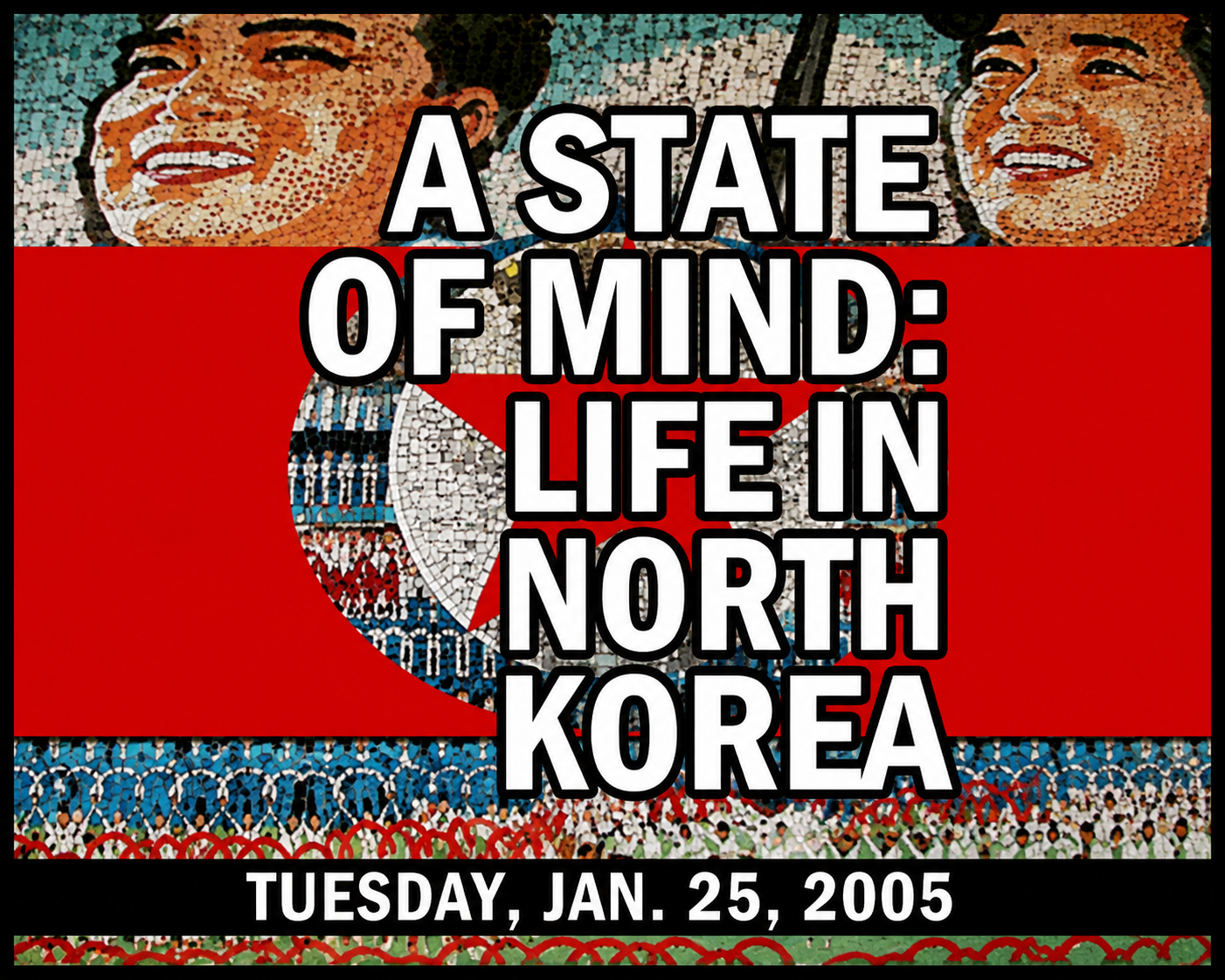
This program featured the screening of a documentary by award-winning producers Dan Gordon and John Battsek, which premiered on the PBS program, Wide Angle, on September 11, 2003. The documentary provides a rare, and surprising, glimpse into the individual and family life underneath the monolithic veneer of North Korean society. A Q&A session with Charles Armstrong, associate professor, Department of History, Columbia University, and Wide Angle Executive Producer Stephen Segaller followed the screening. Ambassador Donald P. Gregg served as the moderator for the program.

Tuesday, January 25, 2005

A State of Mind: Life in North Korea

with

Charles Armstrong
Associate Professor, Department of History, Columbia University,

Stephen Segaller
Executive Producer, Wide Angle

Moderated by

Donald P. Gregg
Ambassador

Make A Donation

The Korea Society
Your support strengthens U.S.–Korea relations

The Korea Society is committed to being the nation’s most trusted platform for U.S.–Korea engagement. Through policy dialogues, business and economic forums, cultural initiatives, and leadership development programs, we bring together leaders, ideas, and institutions to strengthen one of the world’s most important partnerships.

Your support makes this work possible. It enables us to deepen understanding, strengthen connections, and cultivate the next generation of Americans and Koreans who will shape the future of the U.S.–Korea alliance.

Ways to Support

The Korea Society is a 501(c)(3) nonprofit organization. Contributions are tax-deductible to the fullest extent permitted by law.

Give by Check

Please make your check payable to
The Korea Society, Inc. and mail it to:

The Korea Society, Inc.
350 Madison Avenue, 24th Floor
New York, NY 10017

Bank Transfer

For wire or ACH transfer instructions, please contact us.

Donor-Advised Fund

Use your Donor-Advised Fund (DAF) to support The Korea Society. Learn more about DAF giving and how to recommend a grant through your DAF sponsor.

Give from Your IRA (QCD)

If you are age 70½ or older, you may be eligible to make a tax‑advantaged gift directly from your IRA through a Qualified Charitable Distribution (QCD).

Gifts of Stock

Donating appreciated securities may provide significant tax advantages while supporting The Korea Society’s mission. Please contact us for stock transfer instructions and additional information.

Matching Gifts

Many companies match charitable contributions made by their employees. Check with your employer to see if your gift to The Korea Society qualifies for a matching gift and could double—or even triple—your impact.

Membership
Interested in becoming more involved with The Korea Society?

Explore our membership programs and enjoy exclusive benefits while supporting our mission.

1995 Van Fleet Award Honoree

1995 vanfleet icon


1995 vanfleet chulsu-kimy

1995 Van Fleet Award Honoree


CHULSU KIM
DEPUTY DIRECTOR-GENERAL
WORLD TRADE ORGANIZATION


Chulsu Kim joined the World Trade Organization as its deputy director-general on July 1, 1995. Before coming to Geneva, Kim pursued a long and distinguished career with the Korean Government in the field of trade policy making and international trade negotiation.

Kim received a B.A. in political science from Tufts University in 1964 and later an M.A. and Ph.D. in political science from the University of Massachusetts. After completing graduate school, he taught Political Science at Smith College and St. Lawrence University.

For more than 20 years, Kim has been professionally concerned with international trade policy as a Korean government official. In 1973, he joined the Ministry of Trade and Industry (MTI) and subsequently served in various positions. As assistant minister from 1984 to 1990, Kim was Korea’s chief trade negotiator, leading many of Korea’s trade negotiation teams in both bilateral and multilateral consultations.

In 1987, he was selected as chairman of the MTN Negotiating Group in the GATT Uruguay Round and served for four years in that position. As such, he was one of the handful of key officials who, in effect, led the negotiations.

In 1990, Kim was appointed commissioner of the Korean Intellectual Property Office (KIPO), a post which carried the rank of vice minister. While at KIPO, he gained a reputation as a crusader for stronger protection of intellectual property rights-not always a popular cause in Korea.

The next year, he was named president of the Korea Trade Promotion Corporation (KOTRA), a state-run organization that seeks to expand Korea’s international trade. In a departure from tradition, he redirected KOTRA’s trade promotion effort to better serve the needs of Korea’s small and medium-size firms, which had often been neglected in the past.

In February 1993, the newly-inaugurated President Kim Young Sam chose Kim to be his first minister of Trade, Industry and Energy. In that capacity, Minister Kim played a prominent role in formulating and implementing the administration’s “New Economy Plan,” which aims to deregulate and “internationalize” the Korean economy through wide-ranging reforms. He represented Korea at the 1993 and 1994 ministerial meetings of the Asia Pacific Economic Cooperation group (APEC) and at the formal signing of the Uruguay Round Final Act in Marrakesh, Morocco, in April 1994.

In December 1994, Kim resigned from the cabinet, and, shortly thereafter, was appointed to the newly-created post of ambassador for international trade by President Kim Young Sam.

Chulsu Kim was born in Seoul on January, 26, 1941. He is married and the father of two children.


Explore Korea

Explore Korea  icon


RESTAURANTS      TOP

3rd floor


3rd Floor Cafe
315 5th Avenue
New York, NY 10016
212.481.3669
Complimentary appetizers (anju) with purchases of $150 or more


bann1


Bann 
350 West 50th St
New York, NY 10019
212.582.4446
www.BannRestaurant.com 
20% off


barn-joo


Barn Joo 
893 Broadway
New York, NY 10003
646.398.9663
www.Barnjoo.com 
20% discount for Sun-Wed for both lunch and dinner


bon chon1


BonChon Chicken 
325 5th Ave.
New York, NY 10016
212-686-8282
www.bonchon.com 
20% off


chom chom


Chom Chom 
40 West 56th Street
New York, NY 10019
212.213.2299
www.ChomChomNY.com 
10% off


Kunjip


Kun Jip 
9 West 32nd Street
New York, NY 10001
212.216.9487
http://www.KunJip.net 
5% off


maru


Maru 
11 West 32nd St., 3rd Floor
New York, NY 10001
212.273.3413
http://www.maru-nyc.com 
20% off


BOOKSTORES     TOP

social eatz


Koryo Bookstore 
35 West 32nd Street
New York, NY 10001
212.564.1844
  10% off – All book & gift item purchases & dvd rentals


social eatz

Hanyang Bookstore 
136-58 39th Ave.
Flushing, NY 11354
718.353.5528
 10% off – All book & gift item purchases & dvd rentals

320 Broad Ave.
Palisades Park, NJ 07650
201.947.1717
 10% off – All book & gift item purchases & dvd rentals


gyopo bookstore


Gyopo Bookstore 
208 Broad Ave.
Palisades Park, NJ 07650
201.944.8740
 
10% off – All book & gift item purchases & dvd rentals


ENTERTAINMENT      TOP

mk karaoke


MK Karaoke 
11 West 32nd St
New York, NY 10001
212.564.3436
http://www.MKkaraoke.com 
15% off Sun – Thurs


TAEKWONDO      TOP

mk karaoke


West Side Taekwondo 
700 Columbus Avenue @West 95th
New York, NY 10025
212.663.3998
http://www.WestSideTKD.com 
50% off – 4 week trial programs
20% off – All other programs
(excluding Peewee programs for ages 4-5)


BEAUTY      TOP

B Spa Bar


B Spa Bar
At Prive Salon in Soho Grand Hotel
310 West Broadway (Grand St.), NYC 10013
866.620.4490
http://www.bspabar.com 
info @ bspabar.com
20% off any service


Must present ID card with Membership card

The Korea Society
Membership Loyalty Program