
Leadership Development & Education

Leadership Development & Education — The Korea Society
The Korea Society · Leadership Development & Education

Leadership Development and Education

Anchored by three flagship programs, this work delivers bidirectional training — equipping American leaders to advocate for the bilateral partnership and empowering Korean executives and firms to become effective community partners where they operate.

By 2031, this nationwide network will span business, policy, and civic sectors.

About the Department

Anchored by leadership development and education programs, this work delivers bidirectional training across the U.S.–Korea relationship.

The Cross-Cultural Leadership Initiative, the U.S.–Korea Leadership Exchange Program, and Emerging Leaders Mentorship and Training together equip leaders on both sides of the partnership.

American leaders gain the tools to advocate for the bilateral partnership, while Korean executives and firms are empowered to become effective community partners where they operate.

By 2031, this nationwide network will span business, policy, and civic sectors.

Explore

Three flagship programs.

Each builds leadership capacity across the U.S.–Korea relationship — from language and culture to exchange and mentorship.

01

Flagship Program

Cross-Cultural Leadership Initiative

Language and cultural programs that equip leaders to operate effectively across the U.S. and Korea.

02

Flagship Program

U.S.–Korea Leadership Exchange Program

Bidirectional exchange that prepares American leaders to advocate for the partnership and Korean executives to become effective community partners.

03

Flagship Program

Emerging Leaders Mentorship and Training

Mentorship and training that cultivate the next generation of leaders across business, policy, and civic sectors.

Curriculum & Engagement

How participants engage.

A practical curriculum blends history, values, politics, business practices, language, and societal traditions — cultivating essential skills in negotiation, team management, and trust-building.

Executive Education

Advanced programs for leaders steering the bilateral relationship.

Cross-Cultural Workshops

Practical sessions bridging U.S. and Korean professional norms.

Leadership Development

Training in negotiation, team management, and trust-building.

Language & Cultural Programs

Language and cultural fluency for effective engagement.

Community Involvement

Engagement within communities of increasing Korean presence.

Our Vision

By 2031, this nationwide network will span business, policy, and civic sectors — advancing the bilateral partnership through leaders equipped to build trust across borders.
Digital Initiatives

Watch & Listen — The Korea Society

Digital Initiatives

Every program we record — talks, author conversations, policy briefings, and cultural events.

Subscribe @TheKoreaSociety · youtube.com/TheKoreaSociety
The Korea Society Podcast

Programs you can take anywhere.

Selected talks and briefings are released in audio. Subscribe on your platform of choice and never miss an episode.

New series Korea Expert Desk — a video interview series delivering sharp insight for decision-makers. Premiere: South Korea’s New Industrial Defense Strategy.
Filtering by

Business & Economics

Business & Economics — The Korea Society
The Korea Society · Business & Economics

Business & Economics

Two economies. One engine of innovation.

The premier nonpartisan forum for U.S.–Korea economic engagement. As a new generation of investment and innovation moves between our two countries, we convene the policymakers, executives, investors, and founders turning partnership into prosperity for both.

About the Department

Partnership is the strategy. Innovation is the result.

The Korea Society was founded to strengthen the ties between the American and Korean people. Our Business & Economics programs carry that mission into the boardroom, the capital markets, and the innovation economy — where the alliance is now being built as much as it is defended.

This is the most consequential moment in the economic relationship in a generation. Under the U.S.–Korea strategic trade and investment framework, Korea has committed $350 billion to American industry, including $150 billion directed at revitalizing U.S. shipbuilding. The remaining commitment reaches into semiconductors and artificial intelligence, batteries and critical minerals, energy and biotechnology — the sectors that will determine both nations' competitiveness for decades.

These are not transactions. They are shipyards, fabs, plants, laboratories, and supply chains taking root in American communities from the Gulf Coast to the Midwest, built by companies that will hire American workers, train American engineers, and partner with American firms. And the exchange runs both ways: American capital, technology, research, and market access make Korean industry stronger in turn.

Two allies, each better off because of the other. That is the story our programs convene around.

Explore

Four flagship initiatives.

Each convenes a distinct community — policymakers and corporate executives, investors and entrepreneurs, academics and financial leaders. We hold conversations off the record when candor requires it, and on the record when the discussion belongs to the public.

01

Flagship Initiative

U.S.–ROK New Economic Paradigm

Our flagship policy and industry convening. Each program brings thought leaders and decision-makers together to examine the forces reshaping both economies — trade and industrial policy, the $350 billion investment framework, and the strategic industries at its center, from semiconductors and AI to shipbuilding, energy, and critical minerals. The emphasis is practical: where the opportunities are, what the obstacles are, and how both countries move forward together.

Convenes senior policymakers, corporate executives, economists, and industry leaders.
02

Flagship Initiative

Startup Scene: Entrepreneurs of Tomorrow

Year-round programming on entrepreneurship and innovation across the U.S. and Korean ecosystems, spanning first-time founders to serial operators. The initiative culminates in an annual conference and a competition that puts emerging entrepreneurs in front of investors and executives who can back them. Two of the world's most inventive economies, one talent network.

Presented in partnership with Hanwha Life. Convenes founders, venture investors, corporate innovation leaders, and student entrepreneurs.

03

Flagship Initiative

Leadership Interview Series

A digital conversation series with the executives, policy leaders, and cultural figures shaping the relationship. Each interview goes beyond the headlines to the experience, judgment, and conviction behind the decisions — on economics, policy, technology, society, and culture.

Convenes a global audience of members, partners, and the public.

04

Flagship Initiative

Global Financial Leaders Forum

An annual conference presented in collaboration with MaeKyung Media Group and the Korea Finance Society, bringing together leading bankers, investors, and financial policymakers to examine global market trends, cross-border capital flows, and the bilateral initiatives shaping financial cooperation. As record investment moves between the two markets, this is the room where the capital side of the partnership is worked out.

Convenes institutional investors, bank and asset management leadership, regulators, and financial policymakers.

Recent Program Highlights

A year of convenings.

Programming spanned flagship forums, closed-door roundtables, and public conversations connecting leaders and innovators from both countries.

3

Flagship forums, each anchored by a keynote and panel discussions

2

Exclusive executive roundtables

6

Fireside chats

2

Lectures

3

Standalone panel discussions

Our Impact

From dialogue to partnership to prosperity.

Innovation, accelerated.

Semiconductors, AI, advanced manufacturing, energy, and biotechnology advance faster when the people building them are in the same room. We put them there.

Investment, understood.

Historic capital is moving between our two countries. Our programs give executives, investors, and policymakers the clarity to deploy it well — and the relationships to deploy it together.

Emerging talent, elevated.

Founders and early-career leaders share the stage with the executives and investors who can open the next door. The next generation of the partnership is in the room, not waiting outside it.

Communities, connected.

Our programs build durable professional networks across the Pacific — relationships that continue long after the room clears, in both countries and across American communities where Korean industry is putting down roots.

The Measure of Our Work

Two nations, each made stronger by what they build with the other.

Annual Gala

The Korea Society Annual Gala
|

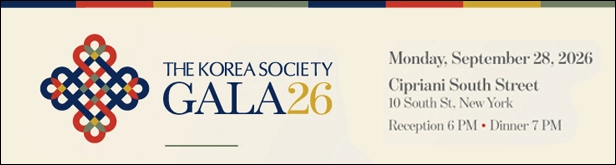
The Annual Gala is The Korea Society’s signature gathering—an evening that brings together leaders from government, business, diplomacy, and the arts to celebrate the enduring partnership between the United States and Korea.

Each year, the gala honors individuals and institutions whose contributions have strengthened the U.S.–Korea relationship, and gathers our community in support of the Society’s mission.

This Year

The 2026 Annual Gala

Join us for the year’s premier celebration of the U.S.–Korea partnership. Visit the gala site for program details, honorees, tickets, and sponsorship opportunities.

Visit the gala site →
2026 Annual Dinner Gala
Get Involved
Support the Annual Gala

Tables, tickets, and sponsorships help sustain The Korea Society’s mission year-round. Explore ways to take part in this year’s gala or to support the Society as a member.

Van Fleet Memorial Golf Tournament

Van Fleet Memorial Golf Tournament
|

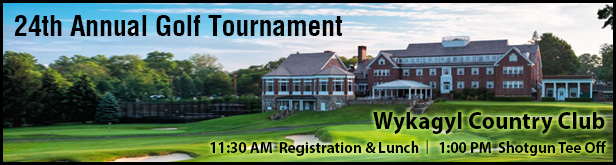
Held annually in memory of General James A. Van Fleet—the first president of The Korea Society—the tournament brings together members, supporters, and friends for a day on the course in support of the Society’s mission.

Now in its fourth decade, the tournament remains one of the Society’s most enduring traditions, welcoming players each year for friendly competition and camaraderie.

Most Recent

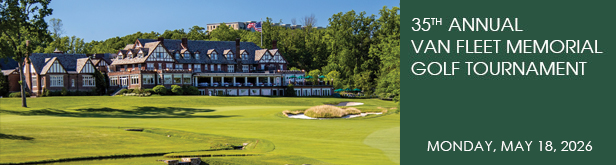
35th Annual Tournament

See details, sponsors, and highlights from the most recent Van Fleet Memorial Golf Tournament.

View the 35th tournament →
35th Annual Van Fleet Memorial Golf Tournament
Get Involved
Support The Korea Society

Proceeds from the Van Fleet Memorial Golf Tournament help sustain the Society’s mission year-round. Make a gift or join as a member to take part in the work.

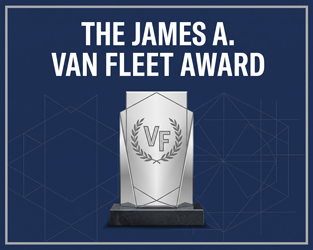
The James A. Van Fleet Award

The James A. Van Fleet Award
|

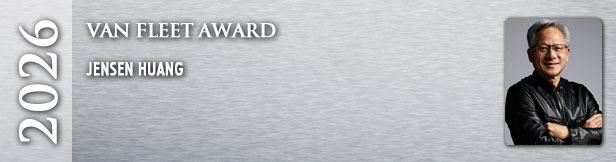
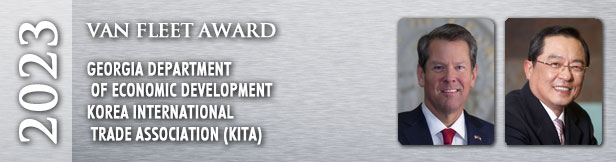
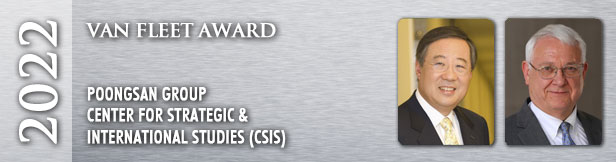
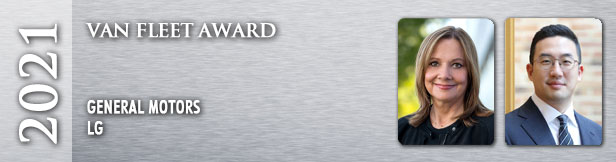
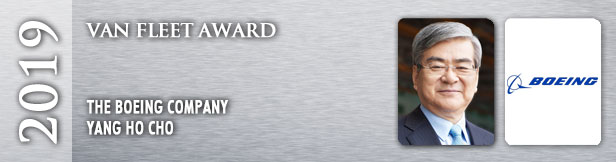
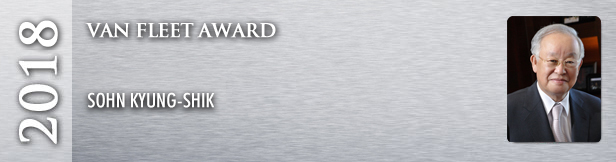
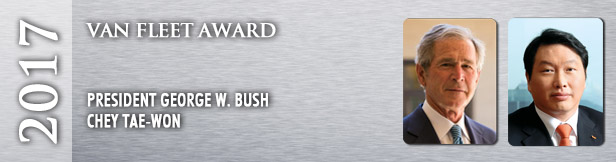
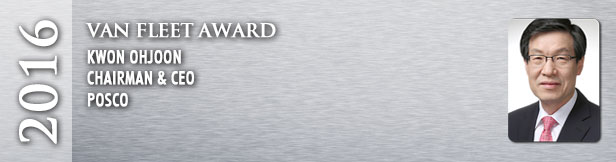
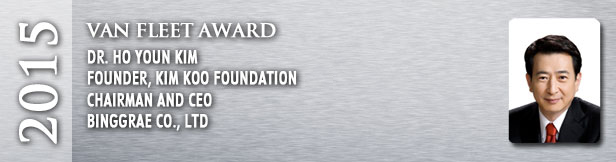
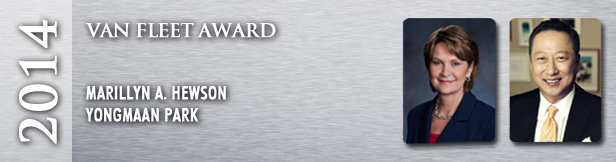
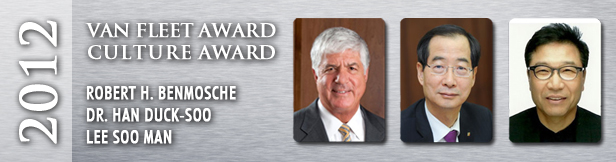
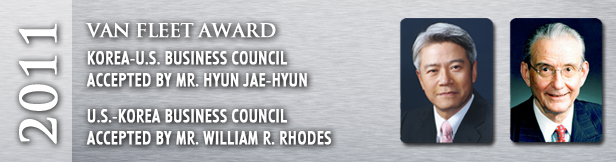
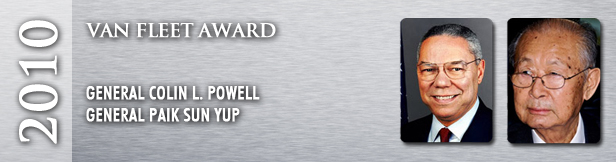
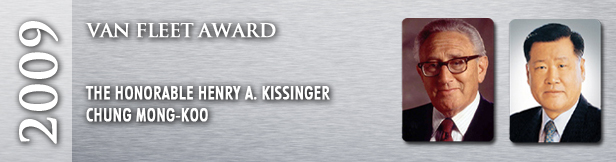
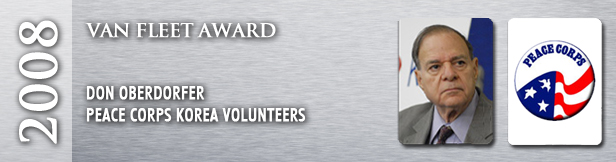
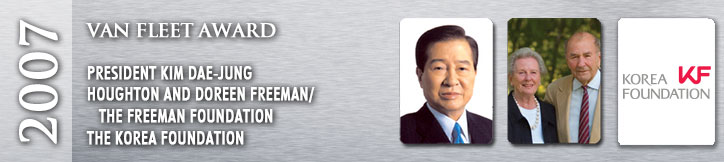
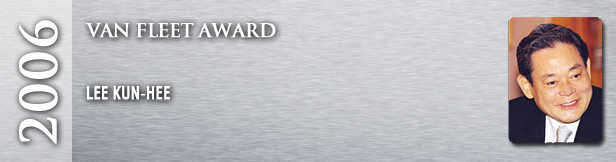
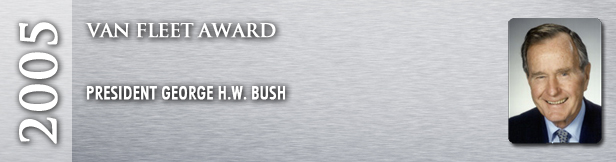
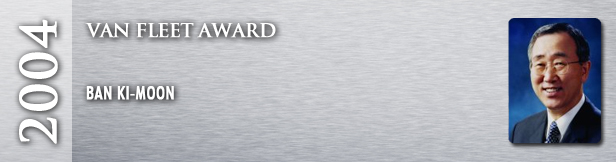
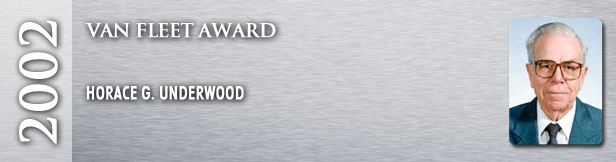
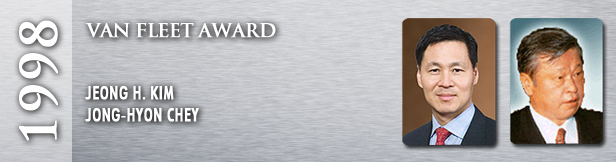
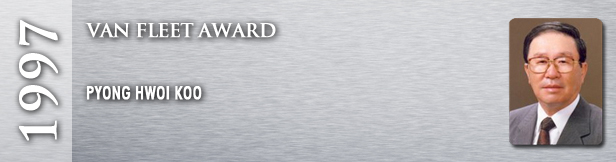
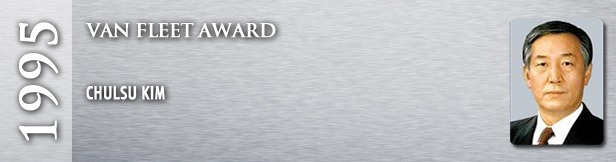
The General James A. Van Fleet Award is one of the most prestigious honors in the field of U.S.–Korea relations. Presented by The Korea Society annually since 1992, it recognizes distinguished Koreans and Americans who have made outstanding contributions to the partnership between the two nations.

The award is formally presented to each year’s recipient at The Korea Society’s Annual Dinner.

About the Award

Given annually “to one or more distinguished Koreans or Americans in recognition of their outstanding contributions to the promotion of U.S.–Korea relations.”

The award is named for General James A. Van Fleet, commander of the U.S. Eighth Army at the height of the Korean War in 1951. Beginning in 1957, General Van Fleet served as the first president of The Korea Society.

Each year, the award is presented to its recipient at The Korea Society’s Annual Dinner.

Most Recent

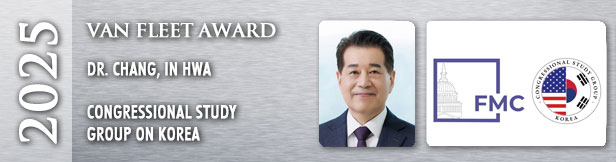
2025 Van Fleet Award Honorees

Meet the most recent recipients of the General James A. Van Fleet Award and read about their contributions to the U.S.–Korea relationship.

View 2025 honorees →
2025 Van Fleet Award Honorees
The Annual Dinner
Where the award is presented

The Van Fleet Award is conferred each year at The Korea Society’s Annual Dinner—the organization’s signature celebration of the U.S.–Korea partnership.

Signature Events

Signature Events — The Korea Society
The Korea Society · Signature Events

Signature Events

Alliances are written by governments. They are sustained by people who know one another.

Once a year in New York, on a fairway in the fall, in a boardroom in Nashville, The Korea Society puts the people who carry the U.S.–Korea relationship in the same room. What happens there is not ceremony. It is infrastructure.

Overview

Trust is built in the room, not on paper.

Treaties are negotiated. Trade agreements are signed. But the relationship between the United States and Korea has always run on something no document can create: leaders who trust each other enough to pick up the phone.

For nearly seventy years, The Korea Society has been where that trust is formed. Our signature events convene the people who shape this partnership — executives and ambassadors, artists and scholars, first-generation founders and fourth-generation Americans — and give them reason to know one another before the moment they need to.

We convene across government, business, civil society, academia, generations, sectors, and regions. When the relationship is strong, these gatherings compound it. When the relationship is tested, they are what holds.

The Four Pillars

Four rooms. One relationship.

From a flagship gala to the fairway to America's newest Korea communities, each gathering builds trust in a different register.

01

Signature Event

Van Fleet Award & Annual Gala

The highest honor in the U.S.–Korea relationship, presented in New York each fall.

Named for General James A. Van Fleet, our founder, the Van Fleet Award recognizes the individuals and institutions who have most advanced the partnership between our two nations. Its recipients are heads of state, industry leaders, and cultural figures whose work has changed what the two countries can accomplish together. The Annual Gala that surrounds it is the year's convening moment: an evening where policy, commerce, and culture sit at the same tables, and where the alliance is celebrated in front of the people with the standing to advance it.

02

Signature Event

Van Fleet Memorial Golf Tournament

Thirty-five years of conversations that don't happen in conference rooms.

Some relationships are built on a stage. Others are built over five hours, eighteen holes, and no agenda. For more than three decades, our tournament has given American and Korean leaders the rarest thing in a busy calendar: unstructured time together. The result is a quieter kind of diplomacy. Channels open here that are still open years later, when they are needed most.

03

Regional Engagement

Regional Partnerships

The alliance no longer lives only in Washington and Seoul.

Korean investment is reshaping communities in Tennessee, Georgia, and across the American South — places where a Korean corporate presence is new, and where local understanding has not yet caught up with local economic stakes. We go there. We build the relationships with mayors, chambers, universities, and community leaders that turn investment into partnership. That groundwork is not visible on an ordinary day. It is decisive on a difficult one, when a single misunderstanding can put billions of dollars and years of goodwill at risk.

04

Community

Membership & Community

Not an audience. A standing network.

Our individual and corporate members are the connective tissue of everything above. They fill the rooms, open the doors, mentor the next generation into the relationship, and sustain the programming that runs all year long. Membership is how a one-night connection becomes a decade-long collaboration — and how the alliance passes from the generation that built it to the generation that will carry it.

Our Charge

Institutions keep the alliance official. People keep it alive. Our charge is to make sure they know each other before the moment they need to.

The Korea Society · New York · Est. 1957

Get Involved

Take your seat at the table.

Our signature events are made possible by members, sponsors, and partners who understand that the U.S.–Korea relationship is too consequential to leave to chance.

QCD

The Korea Society
Qualified Charitable Distribution (QCD) Instructions

Donors who are age 70½ or older may instruct their IRA custodian to make a Qualified Charitable Distribution (QCD) directly to The Korea Society.

A QCD may count toward a donor’s Required Minimum Distribution (RMD) and, when IRS requirements are met, is generally excluded from the donor’s taxable income.

Organization Information

Please provide the following legal information to your IRA custodian to facilitate your contribution.

Legal Name
The Korea Society
Federal Tax ID (EIN)
52-1714111
Mailing Address
350 Madison Avenue, 24th Floor
New York, NY 10017
Transfer Instructions

By Check

Please make your check payable to The Korea Society, Inc. and mail it to:

The Korea Society, Inc.
350 Madison Avenue, 24th Floor
New York, NY 10017

ACH / Wire Transfer

For direct transfers from your financial institution, please contact us and we will be happy to provide our banking information.

Important Tax Information for QCDs

To comply with IRS requirements for Qualified Charitable Distributions:

No Goods or Services

A QCD must be a 100% charitable contribution. No goods or services—including Gala tickets, meals, admission, or other benefits—may be provided in exchange for the contribution.

Gala Contributions

If your QCD is intended to support The Korea Society’s Annual Gala, the contribution will be recorded as a pure charitable donation rather than a ticket or sponsorship purchase so that no goods or services are provided in return.

Acknowledgment

Once the contribution is received, The Korea Society will provide a written acknowledgment confirming the amount of the contribution and that no goods or services were provided in exchange.

Please Notify Us of Your Contribution
Tell us about your QCD so we can acknowledge it properly

To help us identify and properly acknowledge your QCD, please contact us when initiating the transfer.

Helen Cho
Financial Controller, The Korea Society
350 Madison Avenue, 24th Floor, New York, NY 10017
Phone: (212) 759-7524

Please consult your IRA custodian, tax advisor, or financial advisor regarding your individual eligibility for a Qualified Charitable Distribution and its tax treatment.

Geopolitical Affairs

Geopolitical Affairs — The Korea Society
The Korea Society · Geopolitical Affairs

Geopolitical Affairs

A go-to platform and hub for timely, credible policy insights on the critical issues shaping the U.S.-Korea relationship, South Korea, the Korean Peninsula, and the Indo-Pacific.

We build and empower communities of practitioners — connecting thought leaders and stakeholders from policy, industry, academia, media, and civil society.

About the Department

The Korea Society's Geopolitical Affairs Department cultivates dialogue and action on pivotal developments affecting the U.S.-Korea relationship.

We serve as a trusted platform and hub for timely, credible policy insights, empowering our audiences and participants to better understand the crucial security, diplomacy, political, and geoeconomic issues shaping the U.S.-Korea relationship, the Korean Peninsula, and the Indo-Pacific.

We inform both general audiences and decision-makers, equipping the U.S. and Korea to navigate uncertainty, reduce risk, and seize on new synergies.

We build and empower communities of practitioners by hosting programs, building networks, offering perspectives, and providing engagement opportunities for diverse U.S. and Korean stakeholders from policy, industry, academia, media, and civil society organizations.

We convene thought leaders and policymakers for discussions, balancing rapid-response content with deeper examinations of Korea's historical, political, and societal dynamics.

Explore

Four pillars of our work.

Each organizes our programming across the relationship, the region, the peninsula, and the next generation of leaders.

Our Charge

We inform both general audiences and decision-makers — equipping the U.S. and Korea to navigate uncertainty, reduce risk, and seize on new synergies.

Rapid Reaction:
An Olive Branch for North Korea?

Join The Korea Society for a rapid reaction discussion exploring recent shifts in Korean Peninsula security and diplomacy. Featuring Ambassador (ret.) Joseph Yun, this program will examine President Donald Trump’s decision to modify joint military exercises with South Korea and his revelation of ongoing communication with North Korean leader Kim Jong Un. The program is moderated by policy director Jonathan Corrado.

The session will draw lessons from past negotiation cycles, assess how the geopolitical climate has evolved since Trump and Kim last met, dissect the implications of North Korea’s new “hostile states” policy, examine South Korea’s shifting role as a diplomatic pacemaker, and explore how the surrounding geopolitical situation—such as the expanding Russia-North Korea alliance and The Iran War—is reshaping dynamics in Northeast Asia. Ambassador Yun will also share insights from his multi-decade career managing Korean Peninsula relations.

This program is made possible by the generous support of our individual and corporate members and the Korea Foundation.


Speaker

Joseph “Joe” Yun

Ambassador (ret.) Joseph “Joe” Yun most recently served as Chargé d’Affaires ad interim at the United States Mission in the Republic of Korea. His previous diplomatic assignments include serving as U.S. Special Presidential Envoy to negotiate amendments to the Compact of Free Association (COFA), which governs the relationship between the United States and the Federated States of Micronesia, the Marshall Islands, and Palau. The negotiations concluded in October 2023 and were approved by Congress and enacted in March 2024.

Amb. Yun’s other senior diplomatic assignments include serving as U.S. Special Representative for North Korea Policy (2016-18), U.S. Ambassador to Malaysia (2013-16), and Principal Deputy Assistant Secretary of State for East Asian and Pacific Affairs (2011-2013). His earlier Foreign Service overseas assignments were in Hong Kong, Medan, Paris, Bangkok, and Seoul.

Outside the U.S. government, Amb. Yun has been Senior Advisor with The Asia Group, a DC-based strategic consulting firm, and served at the U.S. Institute of Peace, an independent and non-partisan federal institute working on peace and reconciliation issues throughout the globe. He holds a M. Phil. degree from the London School of Economics and a B.S. from the University of Wales.