Contributions by the Korea Society team in academic and policy journals. |

8/16/2023 |
Biases blind us to the risk of Chinese military intervention in Korea |
In an article published by the Atlantic Council, Biases blind us to the risk of Chinese military intervention in Korea, Korea Society policy director Jonathan Corrado examines the historical record to highlight the cognitive biases that have plagued US intelligence assessments, with a particular focus on failures preceding China’s intervention in Korea over 70 years ago. Corrado warns that the “alchemy of cognitive and organizational biases is uniquely suited to advantage a PRC self-defensive counterattack strategy,” and offers some suggestions for how to avoid those pitfalls.
6/30/2023
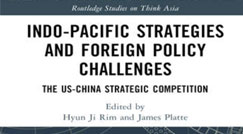
Indo-Pacific Strategies and Foreign Policy Challenges
The US-China Strategic Competition
In a new Routledge book titled Indo-Pacific Strategies and Foreign Policy Challenges: The US-China Strategic Competition, Korea Society policy director Jonathan Corrado contributes a chapter, “Strengthening Indo-Pacific Chip Supply Chain: Opportunities and Obstacles for a Tech Alliance.”
10/27/2022
South Korea as a Global Vaccine Hub
In a submission for the 2022 KEI Academic Paper Series, Coauhors Tom Byrne, Claire Callahan, Irene Kyoung, and Salomé Da Silva Duarte Lepez explore South Korea’s aspiration to achieve the status of global vaccine hub as a national strategic policy priority. The paper first outlines the characteristics of a global vaccine hub and a WHO biotechnology hub, touches on collaborative vaccine efforts in Asia, and then discusses the institutional structure of South Korea’s global vaccine hub and the country’s Covid-19 partnerships. The paper provides an overview of global vaccines, including Covid-19 vaccine production, showing where South Korea fits into that ecosystem, and summarizes global vaccine diplomacy efforts. The paper notes the laudable achievements of Operation Warp Speed in the U.S. (and in the presentation, the Vaccine Task Force in the U.K.) in rapidly producing safe and effective vaccines early in the pandemic, although vaccine nationalism inevitably prevailed as global demand exceeded supply. The paper also notes the shortcomings of national and bilateral vaccine diplomacy, as well as multilateral mechanisms, in providing vaccine access and ensuring equity. It concludes that South Korea’s demonstrated capabilities to rise as a global vaccine development, manufacturing, and training hub will help bolster global public health capacities in the future.
Click here to read.
To watch the paper presentation program, click here
9/12/2022
How the United States can build a chip alliance in Northeast Asia without decoupling
In an article co-authored with Major Jessica Taylor for Pacific Forum PacNet, Korea Society policy director Jonathan Corrado discusses how the United States can build a chip alliance in Northeast Asia without decoupling. They write that “a successful collaboration will address risks to key points of the semiconductor supply chain by adding rigor to the system, ensuring continued access to supply, and maintaining an environment of innovation… The effort will fall short if the alliance cannot address members’ concerns and respond to the risks posed by the People’s Republic of China without tripping down the slippery slope of technological decoupling.”
Click here to read.
To download the article as PDF, click here

7/29/2022
Can Korea Join the Quad? How Should the Group Evolve?
In an article for Korea On Point by The Sejong Institute, Korea Society policy director Jonathan Corrado discusses how the timing of Korea’s enhanced engagement with the Quad will be shaped by domestic political factors, changes in the regional security environment, and the preferences of the Quad member countries. He writes, “Korea’s ability to engage in this emerging security group will not merely be a test of its ambitions, but will also serve as a measure of the Quad’s durability and effectiveness.” Corrado uses the results of an expert survey administered as part of a Pacific Forum fellowship to reveal areas of both considerable symmetry and stark differences between U.S. and Korean experts. He concludes that, “It will be important to interrogate these divergences to optimize the Quad’s success.”
The article is available here.

5/5/2022
Ideology and Economic Policy in North Korea
Korea Society policy director Jonathan Corrado published an article for Ideology and Economic Policy in North Korea, published by the North Korea Economic Forum (NKEF) at George Washington University’s Institute for Korean Studies (GWIKS). In an article titled, “Rose-Colored Glasses: The Information Ecosystem’s Influence on Generational Variation in Attitudes on North Korea’s Economic Management,” Corrado assesses a generational variation in North Korean attitudes about the government’s economic management, using survey data to find that the younger cohort has become more positive. Corrado’s analysis offers a basis for further investigation, suggesting that the young cohort has become more positive in their views of the leadership’s economic management because their lack of market experience makes them vulnerable to changes in the information ecosystem, including a concerted youth loyalty campaign and a reduction in the availability of foreign information.
The volume is available here.

12/2021
Next Generation Perspectives on Korean Peninsula Security
Korea Society policy director Jonathan Corrado writes about “Strengthening US-South Korea Cooperation on Semiconductor Supply Chain Resilience and Innovation” for an edited volume of the Emerging Leaders’ policy papers on Next Generation Perspectives on Korean Peninsula Security published by The National Committee on American Foreign Policy (NCAFP).
The volume is available here.

7/14/2021
Rethinking Intelligence Failure: China’s Intervention in the Korean War
Policy Director Jonathan Corrado published an article titled “Rethinking Intelligence Failure: China’s Intervention in the Korean War” in The International Journal of Intelligence and CounterIntelligence. The article evaluates how the U.S. Intelligence Community and policymakers failed to predict and prepare for China’s entrance into the Korean War and North Korea’s invasion. Diplomatic cables, personal accounts, and declassified national security documents reveal that warnings about possible intervention were undercut by contradicting analysis. Cognitive bias led to faulty assumptions and ambiguous conclusions. The negative effects of bias and politicization were mutually reinforcing, imperiling the efforts of actors who tried in vain to address them. Lessons gleaned from this history shed light on insights for persistent security challenges, such as the relationship between miscalculation and escalation and the difficulty of knowing one’s adversary, as well as America’s present strategic competition with China.
The article is available here.
7/2/21 |
Pacific Forum |
Issues & Insights Vol. 21, WP 10 — South Korea’s Demographic Advantage is Over: The Regional Context and the Economic and Security Implications
In a paper for Pacific Forum’s Issues & Insights, president Tom Byrne and policy director Jonathan Corrado write on the economic and security risks South Korea’s low birth rate poses to its future, writing that “South Korea will have to make tough policy and fiscal choices, unless it can achieve another ‘Miracle on the Han’ —this time overcoming its demographic challenge.”
For PDF, click here

4/2021
Partners in Democracy: Perspectives on the U.S.-Korea Alliance
The Korea Society and The Association of Former Members of Congress (FMC) are proud to release a new publication Partners in Democracy: Perspectives on the U.S.-Korea Alliance.
This series of essays sheds light on the dynamic partnership between the United States and the Republic of Korea, featuring insights from: Republic of Korea Ambassador to the United States Lee Soo-Hyuck; U.S. Senator Brian Schatz (D-Hawaii); Senator Dan Sullivan (R-Alaska); Representative Ami Bera (D-Calif.); Korea Foundation President Geun Lee; former U.S. Ambassador to the Republic of Korea Kathleen Stephens; General Walter “Skip” Sharp, former Commander, United Nations Command / Combined Forces Command / United States Forces Korea; and Professor Victor Cha, CSIS Korea Chair.
On the significance of the publication, Korea Society president and CEO Tom Byrne said: “By showcasing influential voices from the United States and Korea, this timely series of essays demonstrates the many mutually beneficial aspects of the U.S.-ROK relationship, and outlines the key challenges and opportunities for our partnership going forward. We are confident that it will serve as a helpful tool for policymakers and stakeholders. The Korea Society is proud of its collaboration with FMC on the Congressional Study Group on Korea and looks forward to participating in an even more ambitious agenda in the future.”
Click here to read.
To download the article as PDF, click here
7/2/19
National Committee on American Foreign Policy
A TICKING CLOCK OR A GOLDEN OPPORTUNITY? A U.S.-ROK-CHINA TRILATERAL REPORT
A new report written by Korea Society associate policy director Jonathan Corrado for the National Committee on American Foreign Policy highlights a conference discussion on prospects for trilateral and broader multilateral cooperation in addressing Northeast Asian security challenges. The trilateral conference, co-hosted by The Korea Society, provides a useful opportunity to evaluate the year’s most significant geopolitical developments. Stark differences in the tone and content of this year’s dialogue underscore the region’s dynamism and strategic significance. Denuclearizing North Korea remains the major driver of concern. Conference participants explored the ramifications and likelihood of alternate futures, ranging from breakthrough to muddle through to breakdown. Participants also discussed the possibility of North Korean change from within, the opportunity for China to play a greater role in denuclearization talks, methods for preventing an arms race in Northeast Asia, and the future structure of the U.S.-ROK alliance.
To read the full article, click here
To download the article as PDF, click here
1/29/21 |
Pacific Forum |
PacNet #5 – North Korea Doubles Down on a Dead End
In an article for Pacific Forum PacNet on North Korea’s economic plan announced at the recent party congress, president Tom Byrne and policy director Jonathan Corrado write that, “The plan leaves unanswered the question of the sources of financing. North Korea has scant domestic savings, no access to international credit and has squeezed the foreign currency savings of the donju entrepreneurs and financiers.”
For full article, click here
For PDF, click here

3/11/20 |
Pacific Forum |
PacNet #11 – Two tasks for making US-ROK troop burden sharing sustainable
In a new article about the U.S.- Korea military cost sharing deal for Pacific Forum PacNet, Korea Society chairperson Ambassador Kathleen Stephens and president Tom Byrne write, “The time is now for the United States and South Korea to come to terms on a deal that works for both sides. The smooth functioning of the alliance should not be impaired by an accounting impasse that loses sight of the incalculable benefits from 70 years of partnership.”
For full article, click here
For PDF, click here
4/9/19
Pacific Forum |
PacNet #24: Kim Jong Un’s choice – Economic reform would be a risk well taken by North Korea
Economic reform would be a risk well taken by North Korea, according to Korea Society president Thomas Byrne and associate director Jonathan Corrado. In a new article for Pacific Forum PacNet, the authors content that, “Pyongyang’s leadership seems to be more attuned than ever about benefits from economic development, but so far bold action and systemic reform are missing. The cases of China and Vietnam show a path to prosperity if North Korea embraces a pluralistic communist system in which new interest groups coalesce to support reform. Such a transition would likely allow the international community—including the U.S., South Korea, Japan and the international financial institutions, including the IMF, the World Bank, ADB and even the AIIB—to help Pyongyang proceed down that road. Economic benefits from this process could change Pyongyang’s suspicious attitude towards the U.S. and the outside world.”
For full article, click here
For PDF, click here
2/25/19
Pacific Forum |
PacNet #17 – Preserving the US-ROK alliance is critical
In a new article for PacNet about the upcoming Trump-Kim summit in Vietnam, Korea Society president Thomas Byrne & board director General Walter Sharp emphasize the importance of the US-South Korea Alliance in the negotiation process. “In any scenario post-Hanoi,” they write, “the steady hand of the alliance will be key. With luck, it will be the cornerstone of a new era of non-hostile engagement & cooperation w/ North Korea.”
For full article, click here
For PDF, click here

6/8/18
CSIS | Center for Strategic & International Studies
PacNet #39 – Rapid Denuclearization Made Economic Sense for Libya – and Could for North Korea, Too
The big question is, will Kim Jong Un pivot North Korea towards an economic development track and away from its heavy emphasis on military expenditures? A good test of that would be whether North Korea follows the Libya model. President Donald Trump called off – briefly –
To read the full article, click here | To download the article in PDF, click here
1/10/18
CSIS | Center for Strategic & International Studies
PacNet #3 – Kim Jong Un’s New Year’s Resolution: What It Means
Korea Society President Tom Byrne explains why Kim Jong Un is suddenly warming up to South Korea after giving the Moon administration the cold shoulder for much of 2017. The New Year’s Day gambit is a play to get $ relief and drive a wedge in US-ROK denuclearization policy.
To read the full article, click here | To download the article in PDF, click here
11/3-5/17
Beijing Forum

November 3-5, 2017 — Tom Byrne presented at the Beijing Forum held at Peking University on the topic of the “Belt Road Initiative and Global Economic Governance.” The Beijing Forum, co-hosted by the Korea Foundation for Advanced Studies and Peking University since 2004 is an annual academic conference. This year it was held on 3-5 November this year over a three-day period at Diaoyutai State Guest House and Peking University in Beijing, China.