A Korean Actor on the World Stage: Ahn Sung-ki

ahnsk2.jpg

A Discussion
 
with

Ahn Sung-ki

 
moderated by Hyangsoon Yi, University of Georgia.
 
Wednesday, August 27, 6:30PM
6:00 PM-7:00 PM ♦ Registration and Reception
7:00 PM-8:30 PM ♦ Discussion and Q&A
The Korea Society
950 Third Avenue, Eighth Floor, New York City
(Building entrance on SW corner of Third Avenue and 57th Street)

Ahn Sung-ki, the “people’s actor” of Korea, will speak about his long and rich acting career as well as his own life story that very nearly coincides with the history of contemporary Korean cinema. Given his experience as a veteran actor who has appeared in an exceptionally wide range of genres and roles, Ahn is uniquely qualified to provide an insider’s perspective on the remarkable evolution of South Korean cinema from its fumbling beginnings into one of the most vibrant cultural forces in Asia. From his vantage point as president of the Korean Actors’ Guild, Ahn also will address the relationship between actors and the national film industry, inter-Asian cinematic projects, and the “globalization” of Korean cinema.

This discussion, part of the New York Korean Film Festival 2008 (August 22-31), will be followed by a reception.

(Walk-in registration will incur an additional charge of $5)
For more information or to register for the program, contact Yuni Cho at (212) 759-7525, ext. 323 or email.

 
Tour organized by Hyangsoon Yi, with the generous support of the Korea Foundation.
 
Co-sponsored by yKAN ykan_s.gif


New York Korean Film Festival Opening Reception


Join us for an exciting week of film, shorts, panels and parties at the largest celebration of Korean cinema in the United States. The New York Korean Film Festival showcases dynamic and exciting currents in contemporary Korean cinema and this year looks back on the career of award-winning actor Ahn Sung-ki with a special retrospective. You are invited to come kick off this year’s Festival at a star-studded reception and screening at one of New York City’s newest and most celebrated spaces, TheTimesCenter.

The New York Korean Film Festival, running from August 22 through August 31 at Cinema Village in Union Square and BAMcinématek in Brooklyn, is a program of The Korea Society.


Thursday, August 21, 2008 | 6:00 PM

The New York Times Building
The Times Center
242 West 41st St.
(between 7th and 8th)
New York, NY

For more information, please call (212) 759-7525, ext. 355


6:00 PM
Cocktail Reception with special guests:
Hwang Jin-Yi director Chang Youn-hyun 
and actor Yoo Ji-tae

7:30 PM
Hwang Jin-Yi Film Screening
Starring Song Hye-kyo and Yoo Ji-tae

For a full schedule of events, visit www.koreanfilmfestival.org.


 Community Partners:

aaaa.jpgaafilmlab.jpgcapa.gifGenArtPulse.com
kacf_s.pngykan_s.gif kcs-korcommunityserv.jpg


The Kyopo Project


Exhibition

kyopoproject-gallery.jpgThrough Friday, August 15, 2008

Kyopo (교포) is a Korean term for people of Korean descent who reside permanently outside of the Korean Peninsula. The Kyopo Project is a collection of images created by photographer CYJO to highlight the diversity of the global kyopo community.

Emigration from Korea to other countries in Asia began as a trickle in the mid-nineteenth century, and accelerated during the first half of the twentieth century as the depredations of Japanese colonial rule increased. A second wave of emigrants began leaving for the Western Hemisphere, particularly the United States, in the mid-1960s. Kyopo hail from virtually every country in the world, but the vast majority reside in just three countries: China, the U.S. and Japan. Today, kyopo number approximately 6.5 million—one for every ten Koreans residing in the Korean Peninsula.

This exhibition features a series of 171 full-length portraits of kyopo from around the world. It shows each subject in their analogical plenitude, as Roland Barthes would say, and betrays/displays the intimate relation of the photographer to the portraits. The subjects are posed frontally, with their eyes returning the camera’s and the viewer’s gaze. Thus, each subject connects with and mirrors the others, while also reflecting their inherent differences. Ranging in age from teenagers to a septuagenarian, they are novelists, actors, teachers, comedians, athletes, executives and retirees. The striking diversity of the group—the subjects do not appear to have much in common other than their Korean ancestry—challenges the idea of a monolithic, authentic Korean identity and stimulates exploration of what it means to be Korean. The exhibition also poses the question of how kyopo negotiate the sometimes conflicting expectations and sensibilities arising from their intrinsic bicultural identity.

Asian Diasporas: New Conceptions, New Formations, a collection of essays co-edited by Rhacel Salazar Parreñas and Lok Siu, will be available for purchase at The Korea Society during the exhibition.


For inquiries about the exhibition in The Korea Society Gallery, contact Jinyoung Kim at (212) 759-7525, ext. 316 or email .

This exhibition was made possible in part by support from the Joh Foundation, Andy S. Ree, Asian/Pacific American Institute at New York University, Gie Kim, Alexander Brodsky, the Network of Korean-American Leaders (NetKAL), Bomsinae Kim, P.J. Kim and Hoon-jung Kim. Additional thanks to Timothy Archambault, Stephan Valter, Joseph and Linda Kang Chong, Kevin and Clara Kim, Younmee Shin, Min Yang, Charles No and all The Kyopo Project  participants. 

Read more about The Kyopo Project:


ChelseaNow
KoreAmJournal.com
Korea Daily May 22, 2008 (Coverage of exhibit in Korean)
PBS 13 Sunday Arts News June 28, 2008 (video)
Asians in America Magazine, June 2008


ImageExhibiting Korea 2007
A New, Monthly Series of Gallery Talk Programs at The Korea Society

The Kyopo Project

with


Cindy Hwang
Photographer


Thursday, November 15, 2007 at 6:30 PM

The Korea Society Auditorium


Millions of Koreans live outside of Korea; many of them have never even set foot in their home country. In Korean, they’re known as kyopo. And the Kyopo Project, organized by photographer Cindy Hwang, tells their story.


Begun in November of 2004, the Kyopo Project is a collection of over 100 portraits-both photographic and literary-of overseas Koreans from around the world. The stories and images of these kyopo, fully integrated into countries as far afield as the U.S., Canada, Denmark and Brazil, reveal an emerging, dynamic identity that defies received wisdom on kyopo in both Korea and around the world.

 
At an enlivening and inquisitive gallery talk, Cindy Hwang will display sections of the Kyopo Project, and discuss how today’s trans-national kyopo communities are reshaping their host countries and Korea.

Photo: Daniel Dae Kim, Photo © CYJO

About the Presenter

Cindy Hwang is a freelance photographer in New York City. Her photos often seek to capture the inherent beauty of her subjects through traditional and interpretive portraiture. Much of her work included in the Kyopo Project focuses on capturing the collective persona of a cultural diaspora and the inherent synergies produced by subjects during the documentation process. Hwang is a graduate of the University of Maryland and the Fashion Institute of Technology in New York. A fashion industry expert, her clients include Guess Watches, Equilend, Elle International, Angelo Filomeno and Jessica Corr.


Questions, registration? call Jinyoung Kim, senior program officer for arts, 212-7597-525 ext 316 or emailThis e-mail address is being protected from spam bots, you need JavaScript enabled to view it .


Exhibiting Korea
A New, Monthly Series of Gallery Talk Programs at The Korea Society

Exhibiting Korea, a new monthly series of presentations on the fine arts, film, fashion and architecture of the Korean Peninsula, is debuting this April. Series programs will address contemporary trends in cultural expression in Korea, and take audiences back to important movements they might have overlooked. These gallery talks, given by top experts, critics and artists, will put the colors and shapes of modern Korea on display-and explain the cultural and historical contexts behind them. Please join us.

Other Programs in this Series
(all held at The Korea Society Auditorium, 6:30 PM)

Date

Title

Speaker

April 5, 2007

How Did Korea Become a “Land of Apartments”?

Valérie Gelézeau

May 24, 2007

The Forgotten Legacy of the Minjung Art Movement in South Korea

Soyang Park

June 7, 2007

The Modern Boy and Modern Girl in Colonial Korea: 1910-45

Yeon-Shim Chung

July 12, 2007

Film Screening of A Petal and Q&A with actress Lee Young-Lan

Lee Young Lan

October 25, 2007

Dressed to Kill: Women’s Fashion and Body Politics in North Korea

Suk-Young Kim

November 15, 2007

The Kyopo Project

Cindy Hwang


Classic Movie Night: Films From the North


South Korean films continue to set box-office records across Asia and win laurels in international film festivals. Meanwhile, little attention is given to the cinema from the other half of the peninsula. From May 12 to 14, 2008, three films from the DPRK’s canon will be screened as a special presentation in the Classic Movie Night series.

The films—Hong Gil DongBellflower, and My Look in the Distant Future—have been rarely seen outside the former Eastern Bloc. Cinema in the DPRK is an original expression of social realism and a primary vehicle for conveying state ideology. Even so, the tales—of peasant farmers struggling against feudal lords, anti-Japanese resistance fighters, and ordinary citizens loyal to their hometowns—are also told with genuine artistry.

6:00 PM Opening Reception for the Series 
Introduction by Professor Charles Armstrong, Director, Center for Korean Research, Columbia University

Classic Movie Night continues to the themes of critical realism in Korea on Thursday, May 15th with The Ball Shot by a Midget.


Monday, May 12 – Wednesday, May 14, 2008 | 6:00 PM

The Korea Society
950 Third Ave., 8th Floor
New York, NY 10022

Admission:
$7 Members / $12 Non-members
All three movies: $18 Members / $30 Non-members

For more information, please contact Yuni Cho at (212) 759-7525, ext. 323 or email


Monday, May 12 6:30 HONG KIL DONG
Tuesday, May 13 6:30 BELLFLOWER
Wednesday, May 14 6:30 MY LOOK IN THE DISTANT FUTURE


HONG KIL DONG (104 min) 1986

홍길동

Monday, May 12 | 6:30 PM

Directed by Kim Kil-in 
Starring Ri Yong-ho, Ri Gwon and Ri Ri-youn

Mixing Hong Kong-style kung fu with a socialist ethos, the Robin Hood-esque Hong Kil Dong took the Bulgarian box office by storm in the late 1980s. Forever barred from privilege, the eponymous protagonist-the illegitimate son of a nobleman-wanders Korea helping farmers fend off feudal exploitation. But when Korea is invaded by Japanese ninja, he must unite with his perennial enemies to defend the fatherland.


BELLFLOWER (83 min) 1987
도라지꽃

Tuesday, May 13 | 6:30 PM

Directed by Jo Kyong-sun
Starring O Mi-ran, Kim Ryong-jo, Song Yon-ok and Kim Hye-son 

As the most popular North Korean production of the 1980s, Bellflower earned lead actress O Mi-ran the honorific title “People’s Actor.” O’s character, Jin Song Rim, strives to turn her humble mountain hometown of Pyokgye-ri into a model socialist village. Released when the economic foundations of the DPRK were starting to tremble, Bellflower praises the spirit of workers who accept their roles and work for the betterment of the nation.


MY LOOK IN THE DISTANT FUTURE (102 min) 1997
먼 후날의 나의 모습

Wednesday, May 14 | 6:30 PM

Directed by Jang In-hak
Starring Kim Myong-mun and Kim Hye-gyong

 Reeling from famine in the mid-1990s, North Korea mobilized tens of thousands of urban residents for emergency agricultural work in the countryside. My Look in the Distant Future depicts that dire period with an optimistic gloss. Sent to the countryside, a young, urban loafer finds inspiration in a stalwart village leader and decides to become a model worker.


Inside North Korea with the New York Philharmonic


Exhibition

April 24–May 16, 2008

Opening Reception
Wednesday, April 30, 2008

The Korea Society is pleased to present Inside North Korea with the New York Philharmonic, an exhibition of photographs by award-winning photographer Mark Edward Harris that document the concert by the New York Philharmonic orchestra in the Democratic People’s Republic of Korea on February 26, 2008.

In these fascinating and often-stunning photographs, Harris offers a portrait of the historic event, encompassing both the concert itself and all the other major activities of the nearly 300-member delegation—artists, staff, accompanying patrons, guests and press corps. The exhibition captures multiple aspects of the New York Philharmonic orchestra’s two-day visit to Pyongyang, the capital of the Democratic People’s Republic of Korea. Most notably, the photographs afford an inside view of this previously unimaginable influx of Americans—the largest group since the days of the Korean War over half a century ago—and insights into the inhabitants of this reclusive country.

The exhibition is accompanied by Harris’ book, Inside North Korea, published by Chronicle Books in 2007, which features photographs from previous visits to the Democratic People’s Republic of Korea. These photographs document life in Pyongyang and scenes from along the northern border with China, the highly militarized DMZ and the tightly controlled economic and tourist zones. The book, which includes short essays, extended captions and a foreword by noted North Korea expert Bruce Cumings, will be available for purchase at The Korea Society during the period of the exhibition.

  • Voice of America News (Coverage of exhibit in Korean)
  • FrictionTV (Video with President of The Korea Society, Evans Revere, and photographer Mark Edward Harris)

Following its run at The Korea Society, Inside North Korea with the New York Philharmonic will be available for travel to colleges, universities, galleries and non-profit institutions across America.


Reinventing Traditional Korean Music

2008 02 28 - Reinventing Traditional Korean Music icon

Komun’go performance and master class

with

Heo Yoon-Jeong
Komun’go Performer and Composer

Thursday, February 28, 2008

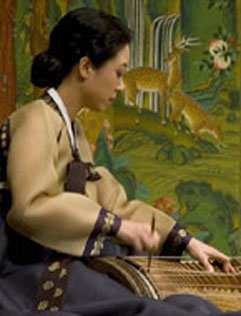
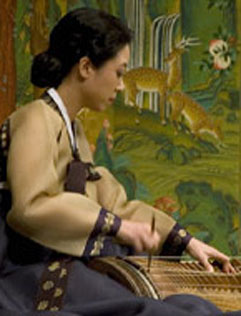
Legend has it that when Korean courtiers first played the seven-string komun’go over 1,500 years ago, a black crane appeared and danced to its music. A similar, if less literal magic was in the air as critically acclaimed performer and composer Heo Yoon-Jeong performed a program of traditional komun’go arrangements blended with contemporary sounds and techniques. Taking time between prices, Heo explained the instrument’s acoustic structure and long history.

Toy Stories: Souvenirs from Korean Childhood

Toy Stories: Souvenirs from Korean Childhood

Toy Stories: Souvenirs from Korean Childhood


Exhibition

January 31–April 18, 2008

Toys are always more meaningful than the simple playthings they appear to be. They can embody the fantasies, values, obsessions and anxieties of a generation. With Toy Stories: Souvenirs from Korean Childhood, The Korea Society put on display over 90 children’s toys from South Korea in the 1970s and ‘80s. On loan from the Hyeon Tae-Joon Collection in Seoul, the toys—flamboyantly colored action figures, robots, miniature tanks and paper dolls—captured a society in economic and social flux and a generation with rising hopes for the future.

The exhibition debuted on January 31 with an opening reception. Guests admired lines of action figure heroes which, reflecting the economic circumstances of the period, were often bland knock-offs of foreign models. Plastic robots ornamented with futuristic weapons captured viewers’ attention just as they had drawn in a generation of Korean boys, treating them to a sneak preview of a fantastic future where science made anything possible. Korean girls’ futures were more limited, circumscribed by the miniature kitchen and hospital utensils and paper dolls that encouraged them to dream only of becoming housewives or nurses.

Many of the items in the exhibit were modeled on cartoon characters popular in Korea during the period, and in particular, characters drawn from Robot Taekwon V, Korea’s first feature-length animated movie. Throughout its run, Toy Stories: Souvenirs from Korean Childhood was complemented by programs that explored the importance of animation and Robot Taekwon V to Korean youth culture.

On February 7, Aaron Han Joon Magnan-Park, a professor in the department of film, television and theater at the University Notre Dame, gave a gallery talk titled “Our Toys Our Selves: Robot Taekwon V and South Korean Identity.” Magnan-Park explained how Robot Taekwon V cemented children’s loyalty to an emerging South Korean identity by using a state-sanctioned style of taekwondo to fight off invidious foreign enemies. On March 18, The Korea Society screened Robot Taekwon V for an audience of animation enthusiasts.


Thursday, January 31, 2008 at 5:30 PM

ImageFilm Screening: Robot Taekwon V
Animation feature-film,
Directed by Kim Cheong-gi,
produced by Yu Hyon-mok.
Running time: 79 minutes

When an army of giant mecha attack, young martial-arts champion Kim Hoon must pilot Robot Taekwon V to defend the planet! Inspired by Mazinger Z, a Japanese anime popular in 1970s Korea, Robot Taekwon V was the country’s first full-length animated feature and the first to be digitally restored (1976).


  • Gallery Talk

Thursday, February 7, 2008

Our Toys Our Selves: Robot Taekwon V and South Korean Identity
with
Aaron Han Joon Magnan-Park
Professor of Film, Television and Theatre, University of Notre Dame


Children growing up in South Korea in the1970s faced an overwhelming barrage of cultural influences from the United States and Japan, the nations that, for Koreans, defined the prevailing images of the successful modern industrialized state during the Cold War era. President Park Chung-Hee was determined to bring South Korea into their ranks and, as a means of achieving this goal, adopted an export-driven industrialization policy that laid the economic foundations for the country’s rise to its present status as the 11th largest economic power in the world.

However, merely emulating the American and Japanese models of economic and technological progress could not instill within the Korean population a long-term self-sacrificing work ethic. Rather, the nation needed a Korean-specific hero who could create a vision of a forward-looking, technologized South Korea independent of the type of technological advances that the United States and Japan could already provide.

Kim Cheong-gi’s 1976 animation feature-film Robot Taekwon V signaled a significant contribution in advancing the image of an independent South Korea through the persona of a Korean-specific robot that effectively stands guard against enemies of superior numbers and with access to advanced technology.

This presentation illustrated how the Korean-specific features of Robot Taekwon V encouraged South Korean audiences to celebrate a Korea-centric paradigm of heroism that negated the United States and Japan and more importantly, exorcised the North Korean threat.

About the Presenter

Aaron Han Joon Magnan-Park is an assistant professor in the Department of Film, Television and Theatre at the University of Notre Dame. He specializes in pan-Asian cinema, sound theory, international action cinema and post-colonial theory. He has previously taught at Victoria University of Wellington in New Zealand, Illinois State University, Wesleyan University, University of Iowa, American University of Paris and the University of Paris IV-Sorbonne.


Film Panel: Finishing the Game


When Bruce Lee died, he left behind 12 minutes of footage from his final film. The upcoming movie Finishing the Game imagines what would have happened if bumbling studio executives had tried to find a passable stand-in for Lee to finish the film. The answer is hilarity. 

Starring Roger Fan (Better Luck Tomorrow), Sung Kang (The Fast and the Furious: Tokyo Drift), Monique Curren (Maria Full of Grace) and MC Hammer, Finishing the Game was an official selection of the 2007 Sundance Film Festival. Now yKAN and The Korea Society are presenting the film’s director and lead actors for a film panel at The Korea Society (950 Third Avenue, on the corner of 57th Street) on September 26, 2007 from 7:00 to 9:00 PM, followed by a reception at Opia. 

The panel will feature Finishing the Game director Justin Lin, and actors Roger Fan and Sung Kang, discussing their recent film and their experiences as Asian American artists in Hollywood. 


Wednesday, September 26, 2007 | 7:00 PM

The Korea Society
950 Third Avenue., 8th Floor
New York, NY 10023
(SW corner on 57th)

Free admission with RSVP


The film opens in New York at the IFC Center on October 5th, 2007.

Finishing the Game – a film by Justin Lin
English – Color 88 minutes

October 5 – New York – IFC Center
October 19 – San Francisco – Embarcadero Center Cinema
October 19 – Berkley – Shattuck Cinema
October 26 – Los Angeles – NuArt Theatre
October 26 – San Diego – Ken Theatre
October 26 – Minneapolis – Lagoon Cinema
November 16 – Philadelphia – Ritz @ The Bourse
November 16 – Seattle – Varsity Theatre


For more information on the film, visit these links:

http://youoffendmeyouoffendmyfamily.com
http://www.myspace.com/finishingthegame


Co-Presented with yKAN.


Is the Korean Wave Dead? The Next Phase of Korean Pop Culture

2014 04 08 korean-cinema  icon2

Recent years have seen a wave of Korean pop culture—known as hallyu—sweep across Asia as consumers from Thailand to Japan became ardent fans of Korean TV dramas, movies and music acts. No pop culture phenomenon lasts forever, however, and recently released statistics suggest that exports from Korea’s entertainment industry are now declining. Is the Korean wave finally ebbing? If so, why? And what can be done about it?

These questions were put to Michael Huh, vice president of ImaginAsian TV and Kim Yong-hwa, director of the recent Korean comedy 200 Pound Beauty, at a panel discussion moderated by The Korea Society’s film blogger Samuel Jamier.

Huh characterized the current trend as a market correction. When Korean pop culture first caught the world’s attention—especially Korean TV dramas, which are the most profitable segment of Korea’s entertainment exports—the industry responded with hasty exuberance. Korean producers rushed to create new dramatic series in order to capture the momentum. In the process, they might have neglected the fundamentals of their genre, and soon many Korean dramas featured formulaic narratives and focused on the drawing power of a limited number of stars. It should be no surprise then, he added, that viewers’ interest is waning.

The panelists agreed that Korean film companies would be wise to improve their marketing strategies, as they often lack clear plans on how to promote their cultural products abroad. Huh pointed to the recently released film The Host as evidence. The Host did phenomenally well with South Korean audiences he said, and had all the qualities necessary to be an international hit. But The Host’s distributors didn’t have a specific target audience in mind when they released it in the U.S., and as a result their marketing efforts fizzled and The Host was less successful in the American market than it could have been.

Kim shared Huh’s belief that the current downward trend was more of a normal fluctuation than a disaster. He described the state of the industry as basically healthy, but suggested it is facing long-term troubles. Presently, a small number of hit movies are subsidizing the production of many more mediocre films. While this keeps the industry afloat, it contributes to a blockbuster mentality that might sink it in the long run.

Kim said that the Korean entertainment industry’s emerging success in the late 1990s was derived, paradoxically, from its inability to compete with Hollywood blockbusters on equal terms when it came to production budgets or special effects. As a result, Korean directors were forced to focus relentlessly on the quality and originality of their stories and audiences responded. Now that the industry’s appeal is softening, Kim believes Korean directors have an excellent opportunity to refocus on their storylines and surprise their audiences all over again. Indeed, he added, Korean directors are already experimenting with new cinematic formulas that augur well for the future—such as the upcoming D-War, a sci-fi epic that blends Korean folklore with non-Korean actors.


Thursday, August 23, 2007 | 6 PM
Registration and reception @ 6 PM
Presentation and Q&A @ 6:30 PM


The Korea Society

950 Third Avenue, 8th Floor
New York, NY 10022

Admission:
$10 Members / $15 Non-members


Panelists:

Kim Yong-Hwa (Movie Director, 200-Pound Beauty)
Michael Huh (Vice-President, ImaginAsian TV)
Robert Cagle (Assistant Professor of cinema studies, University of Illinois at Urbana-Champaign)
Samuel Jamier (Moderator, The Korea Society Film Blog)

Recent years have seen a wave of Korean pop culture (hallyu) sweep across Asia as Korean movies, music and TV have kept audiences rapt. But now production costs are soaring, a backlash against Korean content is brewing in some of its most lucrative Asian markets and the domestic screen quota system, which nurtured the country’s entertainment talent, is being dismantled. Is the Korean Wave receding?

Join the discussion as some of the top producers of Korean pop culture discuss the state of their industry and where it’s headed next.

Presented in conjunction with the New York Korean Film Festival, presented by Helio (August 21 – September 2, 2007).


Korean Funerary Figures: Companions for the Journey to the Other World

funerary-ft.jpgExhibition

July 26, 2007 – December 18, 2007


  • “… eye-catching.” – New York Times Art Review,
    “Korea’s Extraordinary Send-Offs for Ordinary People”, August 17, 2007 link
  • “… the artifacts… are truly treasures.” – Japan Times Review,
    “Little Friends for the Other World”, October 11, 2007 link

Death is an aspect of the human condition that touches every culture in every age, and almost all cultures envelop death in a rich artistry as a way of managing the trauma it causes. In nineteenth and early twentieth century Korea, artisans carved joyful wooden figurines depicting acrobats, clowns and mystical animals-which are called kkoktu-to place on the funeral biers of the departed. A collection of 72 kkoktu will be brought to the U.S., for the first time ever, for an exhibition in The Korea Society Gallery. Organized jointly with the Seoul-based Ockrang Cultural Foundation, Korean Funerary Figures: Companions for the Journey to the Other World will run at The Korea Society Gallery from July 26 to November 20, 2007.

The kkoktu are archaeological treasures in their own right. Their costumes and poses reflect the realities of rural Korean village life during a period that left few written records. More importantly, the kkoktu open a window on a timeless, characteristically Korean attitude towards death. Though the gaiety depicted in many of the figurines may seem incompatible with mourning, what they are intended to express is a deep desire that the deceased loved one will enter the next world surrounded by joy. The figurines also embody a sophisticated appreciation of the fleeting nature of all experience.

The show’s opening reception will be held on July 26 at 5:30 PM at The Korea Society Gallery. To provide a cultural context for the exhibition, immediately following the reception, Dr. Laurel Kendall of the American Museum of Natural History will give a Gallery Talk on the shamanic rituals for the dead beginning at 6:30 PM.


“Journey to the Grave, Dance to Paradise: Shamanic Rituals for the Dead”
with Laurel Kendall of the American Museum of Natural History.


ockranglogo.jpg

The Ockrang Cultural Foundation was established by Dr. Ockrang Kim, who also is the founder of the Dongsoong Art Center. In her capacity as chairperson of the Foundation, Dr. Kim has been providing support for culture and the arts since 1992. Under the guiding concept of promoting a contemporary renewal of the cultural traditions of Korea, the Foundation is engaged in a diverse array of projects. Its efforts are directed toward finding ways to support more creative and innovative forms of artistic expression rather than the conventional forms typically supported by the government and large corporations in Korea. In this way, the Foundation is seeking to develop a new methodology for promoting a more authentic Korean culture by funding opportunities for artists to conduct original cultural research and to devote themselves to creative activities. Currently, the diverse projects the Foundation is pursuing include the Ockrang Drama Prize, the Ockrang Documentary Award given in collaboration with the Seoul Women’s Film Festival, the Ockrang-Asian Cultural Council Fellowship awarded in collaboration with U.S.-based Rockefeller Foundation, the Ockrang Kkoktu Museum with its research program, and several other scholarship programs.

‘전통의 현대적 창조’라는 설립이념 아래 다양한 사업들을 펼쳐오고 있는 옥랑문화재단은 동숭아트센터 설립자인 김옥랑 이사장에 의해 1992년에 설립되었습니다. 정부와 대기업 중심의 획일화된 문화예술 지원에서 보다 다양한 문화예술 지원의 통로를 구축하고자 노력해 왔으며, 문화예술 연구 및 창작 활동 공간 지원을 통해 한국적인 문화의 메소드(method)개발을 위해 노력하고 있습니다. 현재 새로운 희곡과 작가를 발굴하는 옥랑희곡상, 여성영화제와 함께하는 다큐멘터리 옥랑상, 미국 록펠러재단과 연계하는 Ockrang-ACC Fellowship, 옥랑꼭두박물관(나무꼭두연구), 장학금사업등 다양한 사업을 펼쳐나가고 있습니다.