Audio Resources
Traditional Thought & Values in Korea
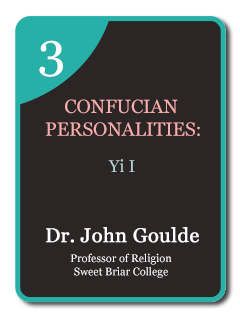
On August 10, 2010, Dr. John Goulde, professor of religion and director of the Asian Studies Program at Sweet Briar College, spoke at The Korea Society to middle- and high-school teachers as part of the New York City Department of Education’s After School Professional Development Program. Dr. Goulde specializes in the sociology, religion, and culture of North and South Korea. He received a bachelor’s degree from Seoul National University and completed his graduate work at Harvard University. In this first of two lectures, Dr. Goulde addresses traditional thought and values in Korea.
History of Korea Part 1
On August 4, 2008, Dr. Charles Armstrong, director of the Center for Korean Research at Columbia University, presented a two-part overview of Korean history at The Korea Society in New York. In this first lecture, he provides a general introduction to contemporary Korea before delving into Korean history, starting with the founding myth of Tangun and progressing up to the late nineteenth century when Korea opened up to modern diplomatic relations with Japan and the West.
History of Korea Part 2
On August 4, 2008, Dr. Charles Armstrong, director of the Center for Korean Research at Columbia University, presented a two-part overview of Korean history at The Korea Society in New York. In this second lecture, Dr. Armstrong discusses modern Korean history, beginning in 1876 with Korea’s first formal diplomatic treaty with Japan.
The Case of Arirang: How the Anthem of Korean Resistance Became a Japanese Pop Hit
On November 6, 2007 The Korea Society hosted a lecture titled “The Case of Arirang: How the Anthem of Korean Resistance Became a Japanese Pop Hit” by E. Taylor Atkins, an associate professor of history at Northern Illinois University.
The Korean Economy in the New Industrial Revolution
On April 3rd, 2007, Yoo Jang-hee, a professor of international studies at Ewha Women’s University, delivered a lecture titled “The Korean Economy in the New Industrial Revolution” to a group of American educators touring Korea as part of The Korea Society’s 2007 Spring Fellowship in Korean Studies program. Professor Yoo spoke about Korea’s role in the increasingly knowledge-based global economy. Surveying Korea’s advantages-such as its highly trained workforce and advanced information infrastructure-and what he sees as its disadvantages-low levels of R&D funding and an unproductive education system-Yoo concluded that the Korean government needs to resume pro-growth policies and encourage private-sector initiatives in order to compete in this world’s new industrial revolution.
The Problem of North Korea in the Era of Terrorism
On April 2nd, 2007, The Korea Society sponsored a lecture titled “The Problem of North Korea in the Era of Terrorism” by Professor Ahn Byong-Man, chairman of the Korea Fulbright Foundation. The lecture, which took place in Seoul as part of The Korea Society’s Korea Fellowship for Educators program, addressed the unique security challenges that North Korea poses to the world community and recounted previous American and South Korean attempts to ease tensions with the North.
The Origins of Koreans and Their Culture
On July 25th, 2005, The Korea Society hosted a lecture titled “The Origins of Koreans and Their Culture” with Mark Byington, a post-doctoral fellow in Korean Studies at Harvard University. The lecture—which was given as part of The Korea Society’s continuing education program for teachers—addressed the important early sources of Korean language, art, religion and custom.
Tales of Korea
Cathy Spagnoli, a professional storyteller from Seattle, narrates seven tales of Korea. Spagnoli has traveled extensively through India, Pakistan, Thailand, Japan and Korea gathering indigenous stories and music. During her numerous trips to Korea, she has met with an extensive network of storytellers and collected a wide range of stories that beautifully illustrate Korean culture.
TALES OF KOREA, PART 1
The seven tales in this selection are appropriate for younger students (grades 1-5), and include: Grain of Millet, Green Frog, The Two Brothers, A Trick or Two, Princess Pyongkang and Ondal, Abandoning the Old Ones, and The Serpent’s Revenge. This selection gives a glimpse of Korea and Korean values through the art of storytelling. For example,”Grain of Millet” demonstrates delightfully how cleverness with a little luck can turn into fortune. Other popular Korean themes presented include: filial piety, geomancy, diligence, kindness rewarded vs. greed punished, and revenge vs. gratitude. All of these stories are fun to listen to and are fun to learn from. For example, students gain insight into another culture through Korean animal sounds (Korean dogs bark “mong, mong,” not “bow wow”), and learn a few vocabulary words from a talking turtle.
Part 1A includes: Grain of Millet, Green Frog, The Two Brothers, A Trick or Two.
Part 1B, includes: Princess Pyongkang and Ondal, Abandoning the Old Ones, The Serpent’s Revenge.
TALES OF KOREA, PART 2
The twelve tales in this selection are appropriate for older students (grades 6-12). Several of these stories are folktales illustrating long-held Korean values of cleverness, filial piety, friendship and fidelity. Others present mathematical brainteasers. Some are true-to-life and based on history, from the pages of the diary of a 16th century admiral, to the poetry of war crimes committed on the peninsula during the 20th century, to the autobiographical account of a Korean American immigrant. What all of these tales share is the wit, verve and love of all things Korean.
Part 2A, includes: Kim Sondal & the River, The Farmer & the Tokaebi, The Stone Bell, A Faithful Dog, A Cup of Rice, The Extra Won.
Part 2B, includes: Admiral Yi Sun-shin, A Wise Monk, “Suni’s Thimble” by Itsuko Ishikawa, Sad Memories, A Silent Debate, Quiet Odyssey, excerpts from the book by Mary Paik Lee.