


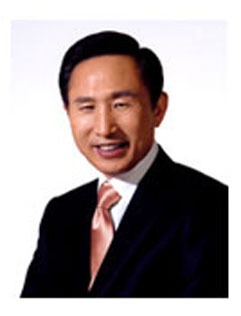
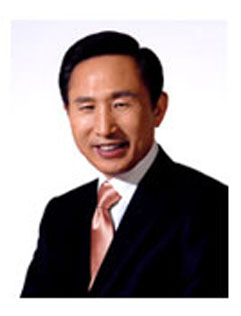
 On September 21, 2009, His Excellency LEE MYUNG-BAK, 17th President of the Republic of Korea, spoke in New York at a program presented by The Korea Society, Asia Society, and the Council on Foreign Relations.

On September 21, 2009, His Excellency LEE MYUNG-BAK, 17th President of the Republic of Korea, spoke in New York at a program presented by The Korea Society, Asia Society, and the Council on Foreign Relations.
 On September 9, 2009, Don Southerton, author, Korean business expert, and president and CEO of Bridging Culture Worldwide, shared his insights into the Korean car industry with the members of The Korea Society, and explained how Hyundai and Kia Motors made their amazing drive to the top of the market.

Though once described by Mao Zedong as being as close as “lips and teeth,” the sixty-year history of the Sino-DPRK alliance has been littered with instances of tension and conflict. According to James Person, this history accounts for Pyongyang’s deep mistrust of China and its interest in developing a relationship with the United States, despite appearances to the contrary. Newly obtained documents from the archives of North Korea’s former communist allies shed light on past and present challenges to the Sino-DPRK alliance. Based on his research, Person believes new opportunities will emerge for the United States to engage with Pyongyang as 2012—the year by which the DPRK leadership has promised to deliver to its people a prosperous nation—approaches.
Wednesday, June 24, 2009
with
James Person

At the leading edge of the digital revolution, both the U.S. and South Korea have been radically transformed by widespread Internet use. Not only has this revolution changed the way people live and do business, it has also expanded the spectrum of illegal activity. Cybercrime has many faces: from computer hacking and online piracy of copyrighted content, to spam, spyware and malware, or any of a host of other issues unimaginable a few decades ago. How is the law faring against this ever elusive opponent?
Joseph DeMarco will share his perspective on the Internet revolution, evolving trends in cybercrime, and how developments on both sides of the law have forever affected the way businesses, individuals and criminals interact in the global economy. DeMarco will explain how American and Korean experiences of these problems are similar, in what ways they differ, and how each country can learn from the other in addressing the challenges presented by the darker side of the digital revolution.
Thursday, May 28, 2009
with
Joseph V. DeMarco
Partner
DeVore & DeMarco LLP
On Sunday, March 1, 2009, Evans J.R. Revere, president of The Korea Society, hosted a panel discussion entitled “The Obama Administration and Korea: What’s in the Cards?” on an episode of Asian America TV on New York’s NYC-TV-25. Joining Revere was Jeffrey Shafer, vice chairman of Global Banking for Citi, and Professor Donald Zagoria of the National Committee on American Foreign Policy. The panel discussed the challenges facing the Obama Administration with regards to the United States’ relationship with South and North Korea.
Korea Society Fellow, Patron, and Corporate members,
please register HERE for complimentary tickets.
{gallery}How I Became a North Korean{/gallery}
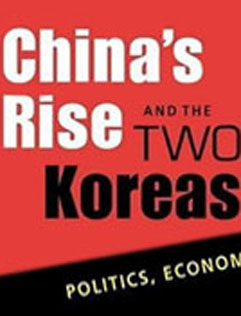
Entrenched relationships are being redefined across the Pacific, with China now South Korea’s number one trading partner and destination for foreign investment and tourism. What are the implications of this regional sea change for politics and security in East Asia?
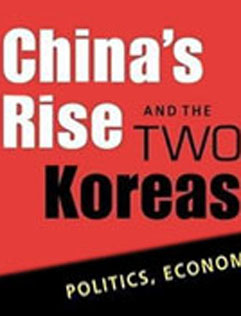
Join us as Scott Snyder, author of China’s Rise and the Two Koreas: Politics, Economics, Security (Lynne Rienner, 2008), discusses the transformation of the Sino-South Korean relationship since the early 1990s with John Delury, director of the China Boom Project. Snyder considers the strategic significance of recent developments in China’s relationship with both North and South Korea and also assesses the likely consequences of those developments for U.S. and Japanese influence in the region. His meticulous study lends important context to critical debates regarding China’s foreign policy, Northeast Asian security, and international relations more broadly.
with
Scott Snyder
Author, China’s Rise and the Two Koreas: Politics, Economics, Security
Director, Center for Korea Policy at The Asia Foundation
Moderated by:
John Delury
Director, China Boom Project, Asia Society
Associate Director, Center on U.S.-China Relations, Asia Society
Co-sponsored by the Asia Society Center on U.S.-China Relations
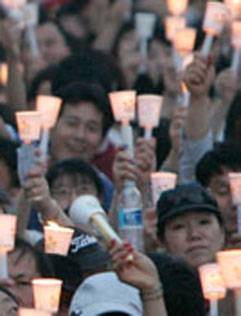
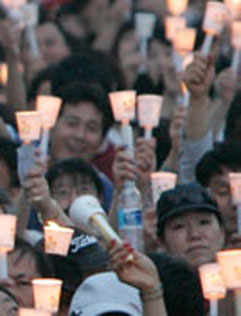
The largest demonstrations in decades and political turmoil have beset South Korea since President Lee Myung-bak took office just a few months ago. Lee assumed the presidency riding a wave of voter support and with the promise that he would revitalize both the South Korean economy and the U.S.-ROK relationship. The take-charge approach that was the hallmark of his successful tenure as mayor of Seoul and his strong background in business were touted as harbingers of a new era in Korean presidential leadership. Lee also promised to take a fresh approach to dealing with North Korea, holding out the prospect of closer ties while also placing new demands on Pyongyang. Despite the promise of his new presidency, Lee’s approval rating has plummeted dramatically since his inauguration. Lee’s management of the reopening of Korea’s market to U.S. beef has become a lightning rod for opposition to his presidency. But the current discontent in South Korea appears to be about much more than beef imports.
What is the crisis really all about? What are its implications for political stability in the ROK? Is anti-Americanism behind the outburst of Korean popular animosity? What does the current crisis portend for the U.S.-Korea Free Trade Agreement? What does it mean for U.S.-Korea relations? A distinguished panel of experts featuring Charles K. Armstrong, Scott Snyder, David Straub and Youngshik Daniel Bong will convene at The Korea Society to address these questions, and more, as we assess the first months of Lee Myung-bak’s presidency and take a hard look at what has been a remarkable period in Korea’s domestic politics.
Monday, June 23, 2008
with
Charles K. Armstrong
Director, Center for Korean Research, Columbia University
Scott Snyder
Senior Associate, The Asia Foundation/Pacific Forum CSIS
Youngshik Daniel Bong
Assistant Professor, American University
David Straub
Pantech Fellow, Shorenstein APARC, Stanford University

New Beginnings Project: Post-Election Prospects for U.S.-ROK Relations
During a press conference held in New York at The Korea Society, three members of the New Beginnings project delivered a summary of their just released report on the post-election prospects for U.S.-ROK relations.
The New Beginnings project was launched in January, 2008 under the joint auspices of The Korea Society and Stanford University’s Shorenstein Asia-Pacific Research Center. With the inauguration of a new administration in South Korea and presidential elections scheduled in the U.S. for later in the year, 2008 affords great potential for Seoul and Washington to renew and refocus their alliance. In recognition of this potential, the project’s objective is to formulate recommendations on ways to improve bilateral relations for the consideration of the two nations’ leaders.
The members of the project who participated in the press conference were Michael H. Armacost, Shorenstein Distinguished Fellow, former U.S. ambassador to Japan and the Philippines and former undersecretary of state for political affairs; Thomas C. Hubbard, former U.S. ambassador to South Korea; Evans J.R. Revere, president of The Korea Society; Gi-Wook Shin, director of the Shorenstein Asia-Pacific Research Center; and David Straub, a former director of Korean and Japanese affairs at the State Department.
Even though the U.S. and ROK have overcome diplomatic turbulence as well substantive differences over their respective approaches to North Korea in recent years, it was noted that obstacles to closer engagement still remain. In particular, concern was voiced that anti-trade sentiment in the U.S. Congress would delay progress in implementing the KORUS Free Trade Agreement. On the other hand, a note of optimism was struck on the prospects for Korea’s inclusion in the visa waiver program, a step that all agreed would enhance the vitality of the alliance by facilitating more person-to-person contacts.
With some of the highest rates of broadband and wireless Internet penetration in the world, Korea and Japan are home to thriving online communities that affect politics, shape public opinion, and forge new forms of social bonding. In Korea, the net has empowered citizen journalism and created a new national pastime of “massively multiplayer online games.” According to the Washington Post, more blogs are written in Japanese than in English, despite the fact that English speakers outnumber Japanese speakers by five to one. Both countries are bastions of participatory Internet use, but what accounts for subtle differences in user attitudes and behavior? In addition to exploring the challenges and lessons learned by people blogging about Korean and Japanese society and politics, the panel discusses how the peculiarities of Japanese and Korean political and online cultures affect participatory democracy in those countries, and whether these experiences will be a bellwether for the global community.
This program takes place in conjunction with the ongoing, two-year, Ethical Blogger project conducted by Brown University’s Watson Institute, the Carnegie Council for Ethics in International Affairs, Demos, NYU’s Center for Global Affairs, and Oxford University’s Reuters Institute for the Study of Journalism.
Introductory remarks by Devin T. Stewart, Director, Editor, Global Policy Innovations program, Carnegie Council for Ethics in International Affairs
Thursday, April 10, 2008
with
David Weinberger
Author, Fellow, Harvard Berkman Center for Internet & Society
Wendy H.K. Chun
Associate Professor of Modern Culture and Media, Brown University
Tobias Harris
Publisher, ObservingJapan.com; freelance blogger and journalist
Stuart Thorson
Professor of Political Science, Maxwell School of Citizenship and Public Affairs, Syracuse University
Samuel Jamier
Senior Program Officer, Contemporary Issues & Corporate Affairs, The Korea Society
Moderated by
Daniel B. Levine
The Korea Society

A Panel Discussion
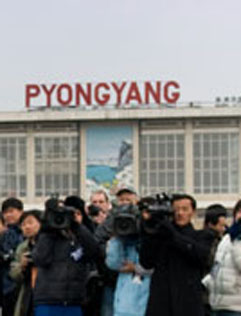
When the New York Philharmonic became the first American orchestra to play in North Korea on February 26, 2008, decades worth of Cold War reality was stood on its head. With the stars and stripes standing on stage, the 1500 North Koreans in the audience stood at attention as the musicians launched into America’s national anthem.
A month later, four of those who orchestrated and covered the concert-Zarin Mehta, president and executive director of the New York Philharmonic; Daniel Wakin, culture reporter for the New York Times; Chuck R. Lustig, director of foreign news for ABC News; and Evans J.R. Revere, president of The Korea Society-gathered on a panel to share their behind-the-scenes observations of the event.
Mehta described how, hearing about the initial invitation to play in Pyongyang from a South Korean reporter, he laughed it off. When the offer was made formally, Mehta was wary. The Philharmonic is exacting about the arrangements for its concerts and the North Koreans are notoriously recalcitrant negotiators. Once preparations began, however, he found that the North Koreans were so eager to have the orchestra play that they made all necessary accommodations willingly.
When the orchestra members arrived in Pyongyang, the North Koreans provided them and the accompanying press entourage with lavish accommodations. “I thought they were consciously trying to counter the common tropes of North Korea reporting, that it’s cold, dark and food is scarce,” said Wakin. “There was lots of food, the hotel was overheated and the lights were on everywhere.” As he was constantly being observed by official minders, however, Wakin added that he was never quite sure what about his surroundings was real and what wasn’t.
Lustig, who had made several previous visits to the country, found the officials he worked with to be accommodating as well. He felt that the North Koreans he and his crew dealt with genuinely wanted the event to be a success.
The high point of the event, for all the panelists, was watching the North Korean audience react to the New York Philharmonic’s performance. Uncertain or hesitant at first, eventually the audience was transparent in expressing their appreciation of the music. Wakin said that tears welled up in his minder’s eyes when the orchestra played Arirang. “I felt like at that point I really hit reality,” he said.
Read the Press Release
Tuesday, April 1, 2008
The New York Philharmonic
A Panel Discussion
with
Zarin Mehta
President and Executive Director, New York Philharmonic
Daniel J. Wakin
Culture Reporter, The New York Times
Chuck R. Lustig
Director of Foreign News, ABC News
Moderated by
Evans J.R. Revere
President, The Korea Society