Bojagi : Cloth, Color & Beyond by Chunghie Lee


The exhibition features internationally recognized Korean textile artist Chunghie Lee’s contemporary Bojagi works. Once commonly employed in everyday life for carrying, covering and storing objects, Bojagi now has become one of the most widely recognized and appreciated of all traditional Korean textile arts. Chunghie Lee’s work integrates traditional Bojagi motifs into innovative designs with vivid color compositions. Evoking the artistic inspiration of the countless anonymous women who made Bojagi through the ages, Lee’s art retains a meaningful link to the past. Lee has been teaching at Rhode Island School of Design since 1999 and her works are in permanent collections in numerous museums, including Victoria & Albert Museum, London, U.K. and the Museum of Art & Design, New York, USA.


March 14 – May 31, 2013


Gallery Opening
Thursday, March 14, 2013
6:30 PM

The Korea Society
Gallery Open Daily, M-F, 10 AM-5 PM

NYCulture current inverted white logo

This program is supported, in part, by public funds from the New York City Department of Cultural Affairs in Partnership with the City Council.


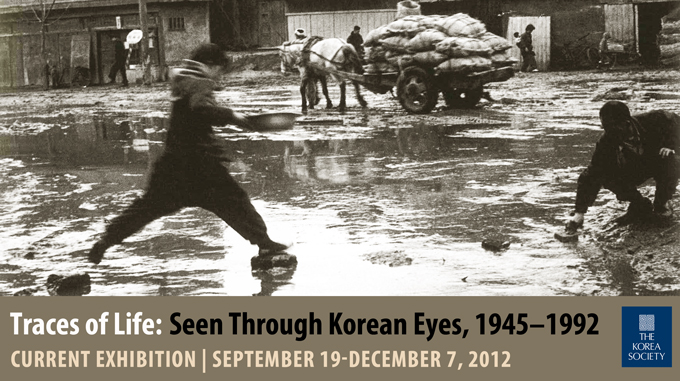
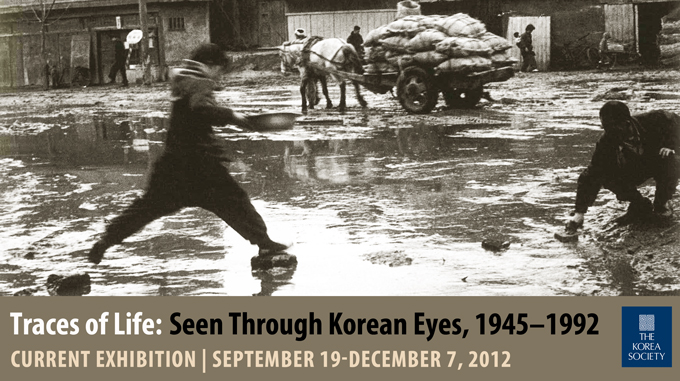
Traces of Life: Seen Through Korean Eyes, 1945-1992

Experience the captivating imagery in this collection of photographs by some of the pioneers of modern Korean photography. The fifty-four photographs showcase the first generation of Korean realists who played a pivotal role in the development and enrichment of Korean photography as an art form. The exhibition marks the first time these original black and white photographs have been mounted in the United States and fills a chasm not only in the visual archive of modern Korean photography but also in the visual vernacular of the period.

Traces of Life: Seen Through Korean Eyes, 1945–1992 reveals everyday life through exuberant visual diversity and documents anthropologically important aspects of Korea’s nearly forgotten recent past. The photographs offer a counter-narrative of ordinary lives during this turbulent period of Korean history. These photographs are documentary, but at the same time aesthetically charged, illustrating and illuminating the traces and trails of Korean life as seen through Korean eyes.

The selected photographs are on loan from one of the first public photography museums in Korea, Dong-Gang Museum of Photography, and from several of the photographers and their estates. The thirteen photographers represented in the exhibition are Koo Wangsam, Lim Eungsik, Lee Haesun, Lee Hyungrok, Kim Hanyong, Han Youngsoo, Chung Bumtae, Choi Minsik, Joo Myungduk, Hong Suntae, Yuk Myungshim, Kim Kichan, and Kim Soonam.

This exhibition is the product of a joint effort between The Korea Society and an independent curator, Chang Jae Lee. Traces of Life will be on view in the Korea Society Gallery from September 19 through December 7, 2012. This exhibition, along with other exhibitions created by The Korea Society, is available for loan to universities and museums and other qualifying institutions in the United States. Please click below for booking information or contact Jinyoung Jin.


September 19-December 7, 2012


This program is supported, in part, by public funds from the New York City Department of Cultural Affairs in Partnership with the City Council.


2012 09 19  gallery-opening catalogue english Catalog Available:
Edited by Chang Jae Lee
Published by Noonbit Publishing Co., September 2012
pp. 136 (in English 110 pp. including 54 plates, in Korean 26 pp.)
Foreword by Jinyoung Jin (TKS Gallery Director), introduction by David R. McCann (Korea Foundation Professor of Korean Literature at Harvard University), contributing essay by Sun Il (Curator of the Seoul National University Museum), and curatorial essay and afterword by Chang Jae Lee (Curator of Traces of Life).

 PURCHASE


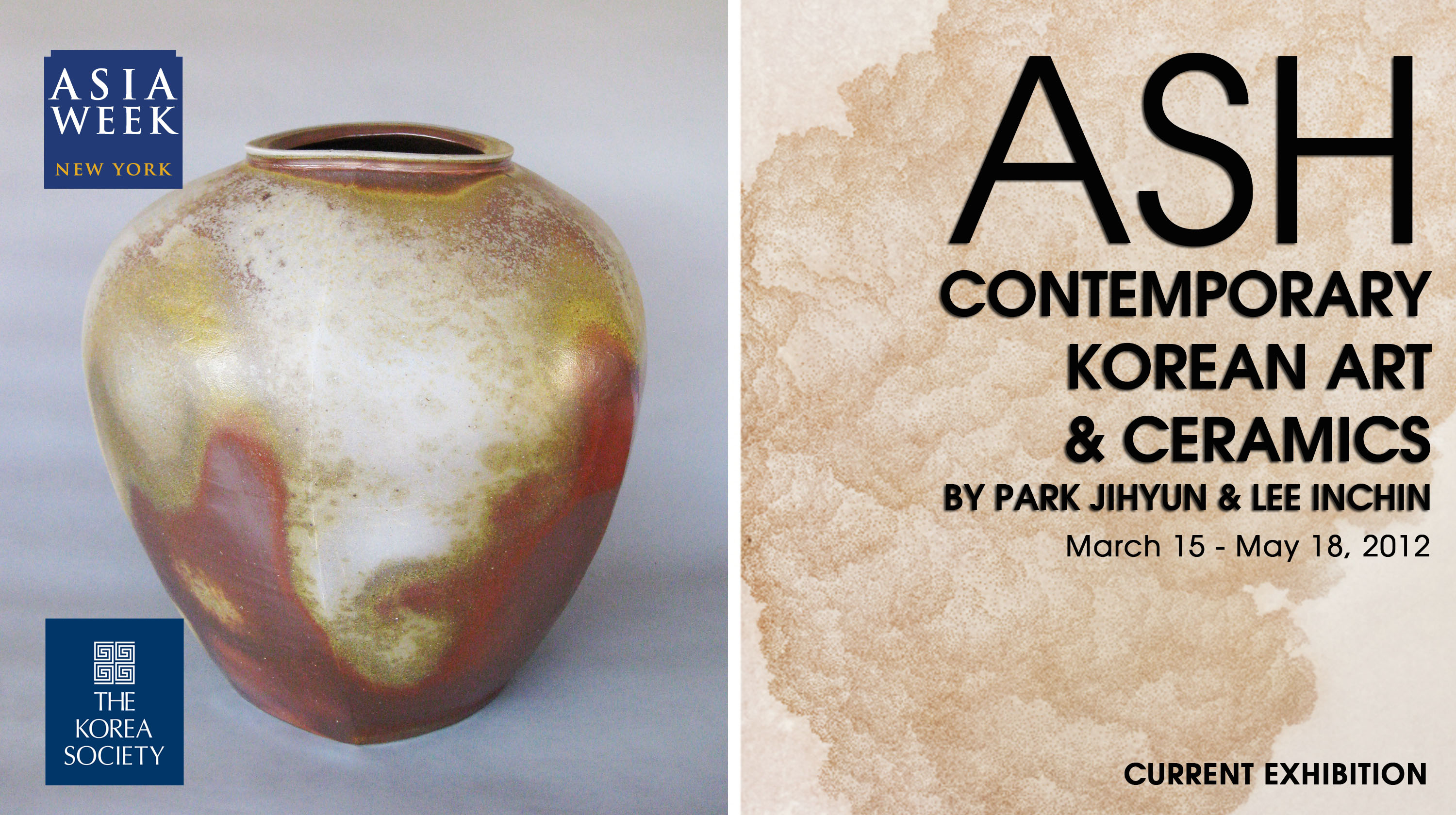
ASH: Contemporary Korean Art & Ceramics by Park Jihyun & Lee Inchin


Kick off Asia Week New York 2012 (March 16-24) with the works of internationally recognized artists Park Jihyun and Lee Inchin. Using incense to burn thousands of tiny holes onto rice paper, Park practices reverse-pointillism, puncturing the paper’s fragile surface with tiny marks and thereby subtracting rather than adding dots of paint and color. Lee’s masterful employment of the traditional wood-firing kiln and ash yield ceramics with a spectrum of colors ranging from yellow to bright orange, red-brown to black. Lee’s ceramics and Park’s incense work harness the creative and destructive power of fire, smoke, and ash. Curated in cooperation with Jiyoung Koo and KooNewYork.


March 15-May 18, 2012

Gallery Opening
Thursday, March 15, 2012
6 PM


ASH: Contemporary Korean Art & Ceramics by Park Jihyun & Lee Inchin

2012 03 15  ash icon


Kick off Asia Week New York 2012 (March 16-24) with the works of internationally recognized artists Park Jihyun and Lee Inchin. Using incense to burn thousands of tiny holes onto rice paper, Park practices reverse-pointillism, puncturing the paper’s fragile surface with tiny marks and thereby subtracting rather than adding dots of paint and color. Lee’s masterful employment of the traditional wood-firing kiln and ash yield ceramics with a spectrum of colors ranging from yellow to bright orange, red-brown to black. Lee’s ceramics and Park’s incense work harness the creative and destructive power of fire, smoke, and ash. Curated in cooperation with Jiyoung Koo and KooNewYork.


March 15-May 18, 2012


Gallery Opening
Thursday, March 15, 2012
6 PM

RSVP


The Korea Society
950 Third Avenue@57th Street

Social Graphics: The Art of Jeski

Social Graphics: The Art of Jeski salutes the award-winning efforts of artist and social activist Jeseok Yi, who has wowed the design and non-profit communities with his thoughtful and often satirical works. Featuring fourteen of Korean-born Jeski’s works for organizations like the Red Cross, Salvation Army, World Vision, City Harvest New York, the American Disability Association and the Global Coalition for Peace, the exhibition provides sharp and insightful commentary on war, global warming, pollution, and other social concerns. Jeski stresses simplicity in messaging and encourages interaction between the design and the real world. His social graphics illustrate the power of creativity to inform, educate, and change society for the better. His efforts are a reminder of the vibrancy of Korean civil society, the strength of its NGOs, and Korea’s contribution to international efforts aimed at peace and social justice. 


September 8-November 4, 2011

with Jeski
Artist and Social Activist


The Writings of Lee UFan

The Korea Society presents the writings of celebrated artist, poet, and philosopher Lee UFan, in conjunction with the Guggenheim Museum’s retrospective exhibition, Lee UFan: Marking Infinity (June 24-September 28, 2011). Born in Korea in 1936, Lee has been an artistic and intellectual force in Korea, Japan, and Europe for more than four decades, articulating a unique aesthetic and philosophical stance grounded in modernity critique and Post-Minimalist practice. Lee, the author of seventeen books, has written seminal essays on contemporary art, Asian culture, and democracy that offer a powerful voice to our current cultural discourse. The Korea Society’s summer exhibition will present photographs and work with Lee’s poetry, criticism, and essays.

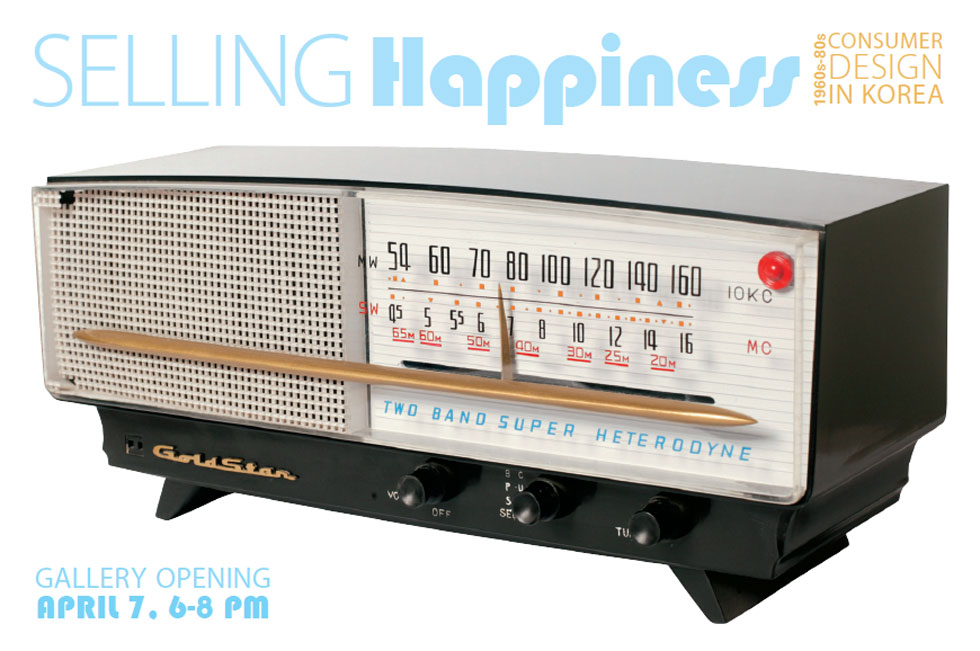
Selling Happiness: 1960s-80s Consumer Design in Korea

During Korea’s drive for economic modernization, commercial artists created goods and advertisements that were visually appealing and richly detailed. After the war, Korea transformed itself economically, yet rapid growth was accompanied by dramatic social changes and political concerns surrounding authoritarianism. By the late 1980s, Korea had embraced democracy and a newly prosperous society clamored for fresh goods manufactured for domestic consumption. With the 1988 Olympic games, Korean products and adverts grew more global in orientation.

Koreans look upon these items with some nostalgia, as they stand in sharp and, at times, amusing contrast with today’s products, which range from remarkable paper-thin flatscreens to Motortrend’s Car of the Year. Presented with the support of the Korea Craft and Design Foundation, this exhibition features early consumer products, advertisements, and social commentary from a transitional and controversial era when the seeds of Korean design saw fertile ground.


ABOUT

This exhibition is the first in the United States to focus on items associated with Korea’s export-led growth era. It features products and designs from the 1960s, 70s, and 80s, including Korea’s first domestically manufactured radio (the Goldstar A-501), Korea’s first black-and-white television (the VD-19), rice dispensers, cookers, and other kitchen items—even the popular “Italy towel,” employed in homes and bathhouses for a rigorous scrub.


10,000 Threads: The Collected Works of Quilt Master Kim Haeja

2011 02 22  10000 threads icon

February 22—March 31, 2011

Traditional Korean quilting, with its unique “nubi” line-stitching, is elevated to a high art under the masterful hands of award-winning artisan Haeja Kim. A designated holder of an Important Intangible Cultural Property award by the Korean government for her efforts at preserving Korea’s artistic heritage, Kim meticulously line-stitches layers of batting and fabric into fine garments and coverings. The tiny stitches are employed over each article in a deceptively simple pattern, with smaller stitching highly valued and the mark of a true expert.

Nubi textiles are thought to have originated among Buddhist monks, who valued its strength, simplicity, and insulation against Korea’s frigid winters. Lay people employed it for traditional dress and soldiers for defense against the cold and added physical protection. However, the hand-craft of nubi largely disappeared in modern times with the introduction of the sewing machine.

The items selected for this special showing are grouped in three parts:

Children’s Clothing—February 22–March 4
Adult Clothing—March 7–18
Children’s Ceremonial Clothing—March 21–31

ABOUT THE ARTIST

Master Kim has been breathing new life into the art ever since she surprised visitors to the Korea Annual Traditional Art Exhibition two decades ago with 3mm-5mm nubi stitchwork—a feat, not seen for a century, that won the Prime Minister’s Award. Today, she is much sought after as a teacher and master of the form. In her humble and elegant rural studio, surrounded by attentive student apprentices, she displays a unique dedication to craft, hand-processing her fabrics with natural dyes like indigo, safflower, and charcoal. Her work has been exhibited in Korea, Japan, China, and France. This exhibition at The Korea Society represents Kim’s first major U.S. showing.


Korean Architecture and Design in Convergent Flux


New York City’s first cross-disciplinary exhibition of Korean architecture, landscape design, and urban planning celebrates both globalizing and hybridized conditions in contemporary Korean society. In cooperation with Harvard Graduate School of Design.

Tuesday, December 7, 2010

5 PM | Members Preview

6 PM | Public Reception


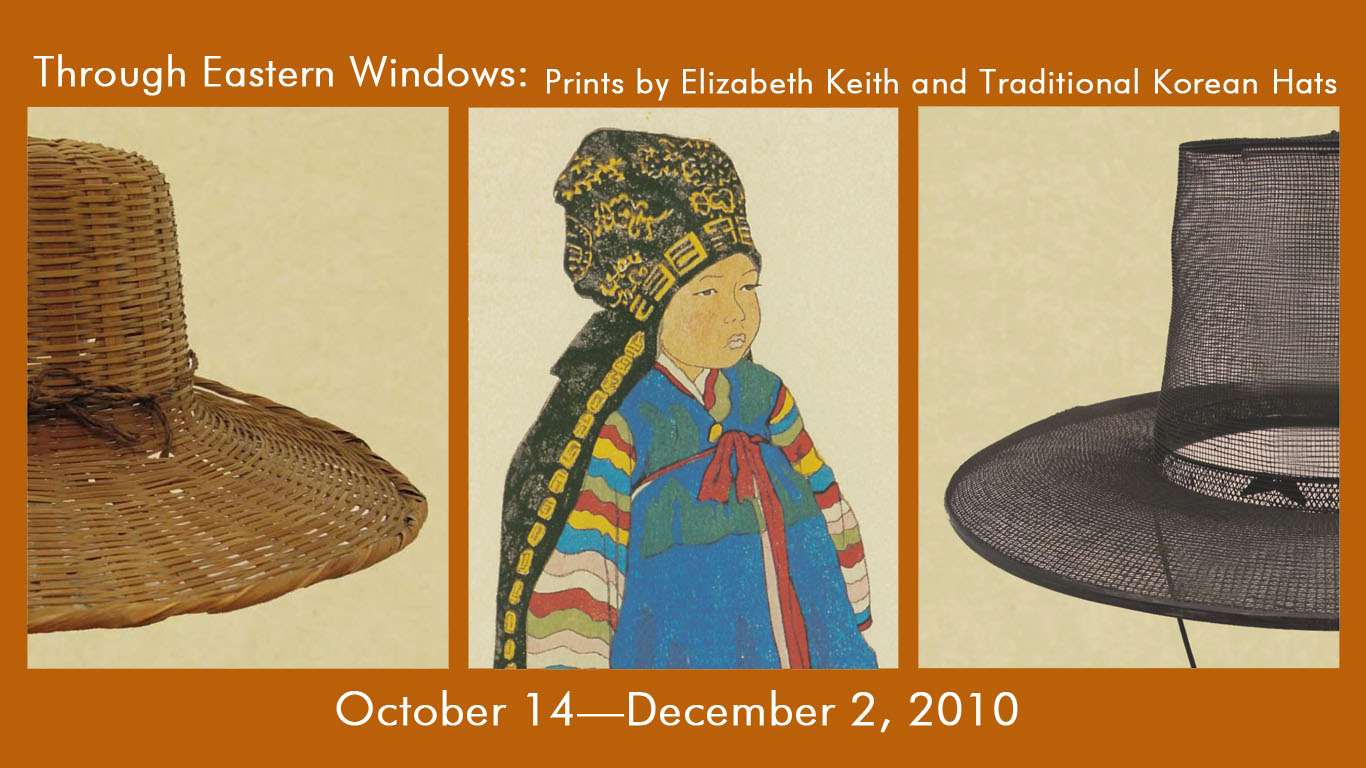
Through Eastern Windows: Prints by Elizabeth Keith and Traditional Korean Hats

Elizabeth Keith, an intrepid traveler and visionary artist, first ventured to Asia almost a century ago, where she filled travel journals with lively, realistic sketches of Korea and other destinations. At the encouragement of a Japanese publisher, she translated her sketches and watercolors into etchings and woodblock prints. As author of Eastern Windows (1928) and Old Korea (1946), Keith sought to capture a “vanishing Korea,” and her work remains especially relevant today as a view into the Korea of her age.

Accompanying the woodblock prints, etchings, and watercolors on display is an array of traditional hats from the period. From horsehair to bamboo, the materials employed by the contemporaneous Korean artisans add context and texture to Keith’s work. The hats served to connote the wearer’s status, a theme also examined in Keith’s work.

The headpieces are on loan from the Chung Young Yang Embroidery Museum, Korean Art and Antiques, and the collection of Lea Sneider.

The Elizabeth Keith woodblock prints, etchings and watercolor are on loan from the collection of Young-Dahl Song. The attendant photos and postcards are from the collection of Norman Thorpe.

Thursday, October 14