New York Korean Film Festival Opening Reception


Join us for an exciting week of film, shorts, panels and parties at the largest celebration of Korean cinema in the United States. The New York Korean Film Festival showcases dynamic and exciting currents in contemporary Korean cinema and this year looks back on the career of award-winning actor Ahn Sung-ki with a special retrospective. You are invited to come kick off this year’s Festival at a star-studded reception and screening at one of New York City’s newest and most celebrated spaces, TheTimesCenter.

The New York Korean Film Festival, running from August 22 through August 31 at Cinema Village in Union Square and BAMcinématek in Brooklyn, is a program of The Korea Society.


Thursday, August 21, 2008 | 6:00 PM

The New York Times Building
The Times Center
242 West 41st St.
(between 7th and 8th)
New York, NY

For more information, please call (212) 759-7525, ext. 355


6:00 PM
Cocktail Reception with special guests:
Hwang Jin-Yi director Chang Youn-hyun 
and actor Yoo Ji-tae

7:30 PM
Hwang Jin-Yi Film Screening
Starring Song Hye-kyo and Yoo Ji-tae

For a full schedule of events, visit www.koreanfilmfestival.org.


 Community Partners:

aaaa.jpgaafilmlab.jpgcapa.gifGenArtPulse.com
kacf_s.pngykan_s.gif kcs-korcommunityserv.jpg


Classic Movie Night: Films From the North


South Korean films continue to set box-office records across Asia and win laurels in international film festivals. Meanwhile, little attention is given to the cinema from the other half of the peninsula. From May 12 to 14, 2008, three films from the DPRK’s canon will be screened as a special presentation in the Classic Movie Night series.

The films—Hong Gil DongBellflower, and My Look in the Distant Future—have been rarely seen outside the former Eastern Bloc. Cinema in the DPRK is an original expression of social realism and a primary vehicle for conveying state ideology. Even so, the tales—of peasant farmers struggling against feudal lords, anti-Japanese resistance fighters, and ordinary citizens loyal to their hometowns—are also told with genuine artistry.

6:00 PM Opening Reception for the Series 
Introduction by Professor Charles Armstrong, Director, Center for Korean Research, Columbia University

Classic Movie Night continues to the themes of critical realism in Korea on Thursday, May 15th with The Ball Shot by a Midget.


Monday, May 12 – Wednesday, May 14, 2008 | 6:00 PM

The Korea Society
950 Third Ave., 8th Floor
New York, NY 10022

Admission:
$7 Members / $12 Non-members
All three movies: $18 Members / $30 Non-members

For more information, please contact Yuni Cho at (212) 759-7525, ext. 323 or email


Monday, May 12 6:30 HONG KIL DONG
Tuesday, May 13 6:30 BELLFLOWER
Wednesday, May 14 6:30 MY LOOK IN THE DISTANT FUTURE


HONG KIL DONG (104 min) 1986

홍길동

Monday, May 12 | 6:30 PM

Directed by Kim Kil-in 
Starring Ri Yong-ho, Ri Gwon and Ri Ri-youn

Mixing Hong Kong-style kung fu with a socialist ethos, the Robin Hood-esque Hong Kil Dong took the Bulgarian box office by storm in the late 1980s. Forever barred from privilege, the eponymous protagonist-the illegitimate son of a nobleman-wanders Korea helping farmers fend off feudal exploitation. But when Korea is invaded by Japanese ninja, he must unite with his perennial enemies to defend the fatherland.


BELLFLOWER (83 min) 1987
도라지꽃

Tuesday, May 13 | 6:30 PM

Directed by Jo Kyong-sun
Starring O Mi-ran, Kim Ryong-jo, Song Yon-ok and Kim Hye-son 

As the most popular North Korean production of the 1980s, Bellflower earned lead actress O Mi-ran the honorific title “People’s Actor.” O’s character, Jin Song Rim, strives to turn her humble mountain hometown of Pyokgye-ri into a model socialist village. Released when the economic foundations of the DPRK were starting to tremble, Bellflower praises the spirit of workers who accept their roles and work for the betterment of the nation.


MY LOOK IN THE DISTANT FUTURE (102 min) 1997
먼 후날의 나의 모습

Wednesday, May 14 | 6:30 PM

Directed by Jang In-hak
Starring Kim Myong-mun and Kim Hye-gyong

 Reeling from famine in the mid-1990s, North Korea mobilized tens of thousands of urban residents for emergency agricultural work in the countryside. My Look in the Distant Future depicts that dire period with an optimistic gloss. Sent to the countryside, a young, urban loafer finds inspiration in a stalwart village leader and decides to become a model worker.


Lee Chang-Dong and Moon So-ri present “Oasis”


With Director Lee Chang-Dong and Actress Moon So-ri


Wednesday, May 5, 2008 | 7:00 PM

Asia Society
725 Park Avenue (at 70th Street)
New York, NY 10021

Admission:
$10 Members / $12 Non-members


OASIS (133 min) 2002
오아시스

Kundo Cover Kundo Screenshot

Lead actress Moon So-ri will join director Lee for audience Q&A after the screening.

Jong-du Hong (Sol Kyung-gu) is just out of prison for manslaughter and decides to call on the family of the victim. They send him away, but not before he has met the victim’s daughter Gong-ju (Moon So-ri), a young woman disabled by cerebral palsy. Both victims of family abuse these two misfits form a fragile but supportive relationship.


Reinventing Traditional Korean Music

2008 02 28 - Reinventing Traditional Korean Music icon

Komun’go performance and master class

with

Heo Yoon-Jeong
Komun’go Performer and Composer

Thursday, February 28, 2008

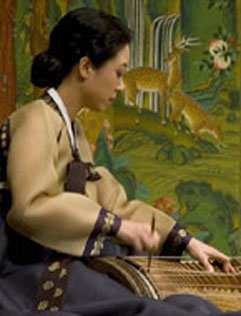
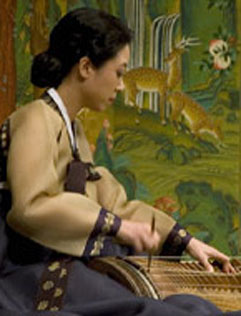
Legend has it that when Korean courtiers first played the seven-string komun’go over 1,500 years ago, a black crane appeared and danced to its music. A similar, if less literal magic was in the air as critically acclaimed performer and composer Heo Yoon-Jeong performed a program of traditional komun’go arrangements blended with contemporary sounds and techniques. Taking time between prices, Heo explained the instrument’s acoustic structure and long history.

Film Panel: Finishing the Game


When Bruce Lee died, he left behind 12 minutes of footage from his final film. The upcoming movie Finishing the Game imagines what would have happened if bumbling studio executives had tried to find a passable stand-in for Lee to finish the film. The answer is hilarity. 

Starring Roger Fan (Better Luck Tomorrow), Sung Kang (The Fast and the Furious: Tokyo Drift), Monique Curren (Maria Full of Grace) and MC Hammer, Finishing the Game was an official selection of the 2007 Sundance Film Festival. Now yKAN and The Korea Society are presenting the film’s director and lead actors for a film panel at The Korea Society (950 Third Avenue, on the corner of 57th Street) on September 26, 2007 from 7:00 to 9:00 PM, followed by a reception at Opia. 

The panel will feature Finishing the Game director Justin Lin, and actors Roger Fan and Sung Kang, discussing their recent film and their experiences as Asian American artists in Hollywood. 


Wednesday, September 26, 2007 | 7:00 PM

The Korea Society
950 Third Avenue., 8th Floor
New York, NY 10023
(SW corner on 57th)

Free admission with RSVP


The film opens in New York at the IFC Center on October 5th, 2007.

Finishing the Game – a film by Justin Lin
English – Color 88 minutes

October 5 – New York – IFC Center
October 19 – San Francisco – Embarcadero Center Cinema
October 19 – Berkley – Shattuck Cinema
October 26 – Los Angeles – NuArt Theatre
October 26 – San Diego – Ken Theatre
October 26 – Minneapolis – Lagoon Cinema
November 16 – Philadelphia – Ritz @ The Bourse
November 16 – Seattle – Varsity Theatre


For more information on the film, visit these links:

http://youoffendmeyouoffendmyfamily.com
http://www.myspace.com/finishingthegame


Co-Presented with yKAN.


Is the Korean Wave Dead? The Next Phase of Korean Pop Culture

2014 04 08 korean-cinema  icon2

Recent years have seen a wave of Korean pop culture—known as hallyu—sweep across Asia as consumers from Thailand to Japan became ardent fans of Korean TV dramas, movies and music acts. No pop culture phenomenon lasts forever, however, and recently released statistics suggest that exports from Korea’s entertainment industry are now declining. Is the Korean wave finally ebbing? If so, why? And what can be done about it?

These questions were put to Michael Huh, vice president of ImaginAsian TV and Kim Yong-hwa, director of the recent Korean comedy 200 Pound Beauty, at a panel discussion moderated by The Korea Society’s film blogger Samuel Jamier.

Huh characterized the current trend as a market correction. When Korean pop culture first caught the world’s attention—especially Korean TV dramas, which are the most profitable segment of Korea’s entertainment exports—the industry responded with hasty exuberance. Korean producers rushed to create new dramatic series in order to capture the momentum. In the process, they might have neglected the fundamentals of their genre, and soon many Korean dramas featured formulaic narratives and focused on the drawing power of a limited number of stars. It should be no surprise then, he added, that viewers’ interest is waning.

The panelists agreed that Korean film companies would be wise to improve their marketing strategies, as they often lack clear plans on how to promote their cultural products abroad. Huh pointed to the recently released film The Host as evidence. The Host did phenomenally well with South Korean audiences he said, and had all the qualities necessary to be an international hit. But The Host’s distributors didn’t have a specific target audience in mind when they released it in the U.S., and as a result their marketing efforts fizzled and The Host was less successful in the American market than it could have been.

Kim shared Huh’s belief that the current downward trend was more of a normal fluctuation than a disaster. He described the state of the industry as basically healthy, but suggested it is facing long-term troubles. Presently, a small number of hit movies are subsidizing the production of many more mediocre films. While this keeps the industry afloat, it contributes to a blockbuster mentality that might sink it in the long run.

Kim said that the Korean entertainment industry’s emerging success in the late 1990s was derived, paradoxically, from its inability to compete with Hollywood blockbusters on equal terms when it came to production budgets or special effects. As a result, Korean directors were forced to focus relentlessly on the quality and originality of their stories and audiences responded. Now that the industry’s appeal is softening, Kim believes Korean directors have an excellent opportunity to refocus on their storylines and surprise their audiences all over again. Indeed, he added, Korean directors are already experimenting with new cinematic formulas that augur well for the future—such as the upcoming D-War, a sci-fi epic that blends Korean folklore with non-Korean actors.


Thursday, August 23, 2007 | 6 PM
Registration and reception @ 6 PM
Presentation and Q&A @ 6:30 PM


The Korea Society

950 Third Avenue, 8th Floor
New York, NY 10022

Admission:
$10 Members / $15 Non-members


Panelists:

Kim Yong-Hwa (Movie Director, 200-Pound Beauty)
Michael Huh (Vice-President, ImaginAsian TV)
Robert Cagle (Assistant Professor of cinema studies, University of Illinois at Urbana-Champaign)
Samuel Jamier (Moderator, The Korea Society Film Blog)

Recent years have seen a wave of Korean pop culture (hallyu) sweep across Asia as Korean movies, music and TV have kept audiences rapt. But now production costs are soaring, a backlash against Korean content is brewing in some of its most lucrative Asian markets and the domestic screen quota system, which nurtured the country’s entertainment talent, is being dismantled. Is the Korean Wave receding?

Join the discussion as some of the top producers of Korean pop culture discuss the state of their industry and where it’s headed next.

Presented in conjunction with the New York Korean Film Festival, presented by Helio (August 21 – September 2, 2007).


Producing a Film across Seoul and New York: Making West 32nd


Hollywood makes lots of legal thrillers, but none of them speak so directly to the Korean American experience as the newly released West 32nd. While in New York for the film’s premiere at the Tribeca Flim Festival, co-writer and director Michael Kang and stars Grace Park and Jun Sung Kim came to The Korea Society for a freewheeling panel discussion on how the film was made and what this unique, Korean American statement means to its creators.

West 32nd is more than a Grisham-esque story of murder and deception among gangsters in New York’s Koreatown, said Kang. It’s a drama about one’s connection to, and separation from, one’s culture. The lead character, John Kim (John Cho), is a pro-bono lawyer assigned to defend a Korean American teenager framed for a gangland murder. With the help of the boy’s sister, Lila Lee (Grace Park), Kim delves deep into Koreatown’s underworld where he’s manipulated by gangster Mike Juhn (Jun Sung Kim). Though Kim is the model of second-generation immigrant success, he can’t speak Korean and as the mystery deepens, despite the fact he’s Korean, he’s increasingly out of his element.

With a predominately Korean American cast, West 32nd’s themes of identity seeped into the production process. The film’s characters alternate between Korean and English dialog, and Kang said that he wanted both languages to sound authentic. Many sections of dialog required extensive re-writing and finding bilingual actors was a major challenge. Once Park and Kim signed onto the project, language was still a problem. Both actors said they had to rehearse their Korean to appear perfectly fluent. 

Whatever the travails, they were glad to have done West 32nd. Though both have played many roles in Hollywood and Korea, this was the first project that allowed them to give portray Korean American characters in a multi-dimensional way.


Wednesday, May 2, 2007 | 6:30 PM

The Korea Society
950 Third Ave., 8th floor
New York, NY 10022


 Join Michael Kang, the Korean American filmmaker and Humanitas Award- winning director, along with actors Grace Park and Jun Kim as they discuss their new film, at the Tribeca Film Festival. Moderated by William Phuan, program associate at Asian Cinevision, the conversation will include personal, behind-the-scenes production stories, career advice for Asian American film talent and information on the prospects for marketing Asian American films internationally.


WEST 32ND

Directed by Michael Kang 
Starring John Cho, Jun Sung Kim, Grace Park and Jane Kim

West 32nd stars John Cho (Harold & Kumar Go to White Castle) as an ambitious young lawyer who takes on a pro bono case to exonerate a 14 year-old boy from a first-degree murder charge. The case takes him into a seamy underworld he never knew existed, right in the heart of midtown Manhattan. West 32nd also stars Grace Park (Battlestar Galactica) and marks Korean actor Jun Kim’s first American film role. Based on co-writer Edmund Lee’s coverage of Korean organized crime in New York for The Village Voice, West 32nd is the eagerly awaited follow-up to Kang’s debut film The Motel.

Presented by Tribeca Film Festival, Asian Cinevision and The Korea Society.


 Sponsored by AZN, ACV, AsianAve.com, yKan


Hong Sang-Soo Tribute


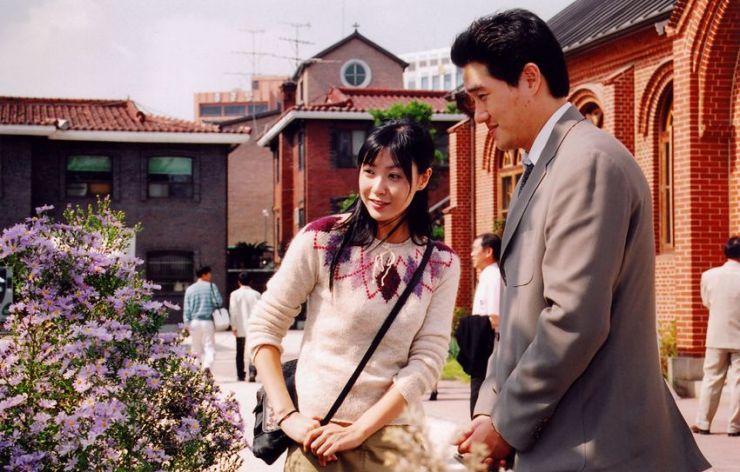
The Korea Society co- presents a ‘Hong Sang-Soo tribute’ with BAM Cinematek, featuring the celebrated Korean director’s three latest films that have won over critics and audiences alike worldwide – Woman is the Future of ManTale of Cinema and Woman on the Beach.

“One of the most exciting and authentically individual filmmakers to emerge on the world stage recently…. Wreathed in a profound melancholy, Hong’s films lyrically explore the limits of subjectivity, both its pathos and its dangers, often through different viewpoints that don’t so much cancel one another out as add another tile to the mosaic of existence.” – Manohla Dargis, The New York Times 


Monday, April 16 – Saturday, April 21, 2007

BAM Cinematek
30 Lafayette Avenue
Brooklyn, NY 11217
Get Directions to BAM

Buy Tickets 


WOMAN IS THE FUTURE OF MAN (88 min) 2004
여자는 남자의 미래다

Monday, April 16 | 4:30 PM

With Yu Ji-Tae, Kim Tae-Woo, Sung Hyun-Ah. Two male college friends reunite and spontaneously decide to look up a woman with whom they were both separately involved. “The men’s self-immolating behavior is what’s saddest in the Hong universe, thanks largely to his duplicitous manner with narrative. You can rarely grip the shape of the entire film until past the halfway marker. When you do, the tragedy of soured lives is beyond the point of no return.” – The Village Voice


TALE OF CINEMA (89 min) 2005
극장전

Friday, April 20 | 2 PM, 4:30 PM, 6:50 PM, 9:15 PM

With Lee Ki-Woo, Uhm Ji-Won. A young man bumps into a female friend; the ensuing evening involves drinking, sex, and a suicide pact. Turns out it’s only a film (within a film), but life imitates art, which in turn imitates life… “Tale expands on Hong’s preoccupations with a renewed conceptual depth. While it may be a tough film to love, it is also Hong’s finest work to date, marking a bold new direction just when Hong is most in need of a fresh start.” – Michael Sicinski, Cinema Scope


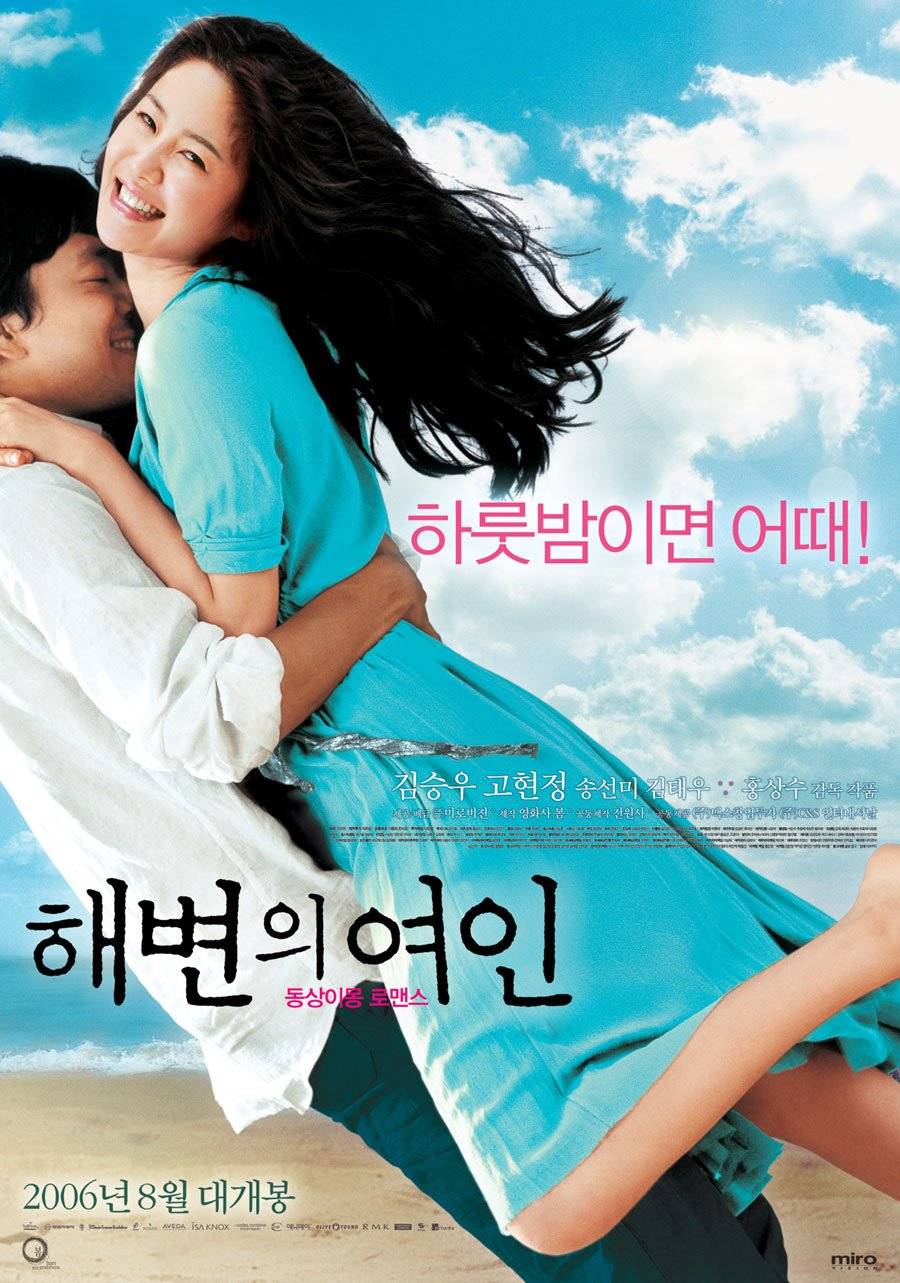
WOMAN ON THE BEACH (126 min) 2006
해변의 여인

Saturday, April 21 | 3 PM, 6 PM, 9 PM

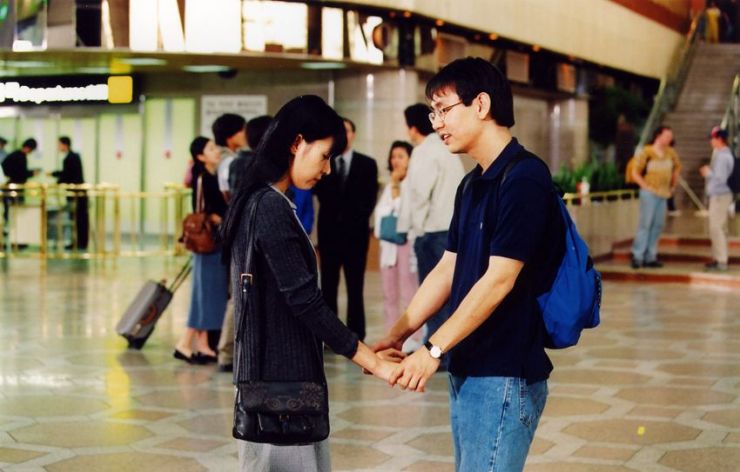
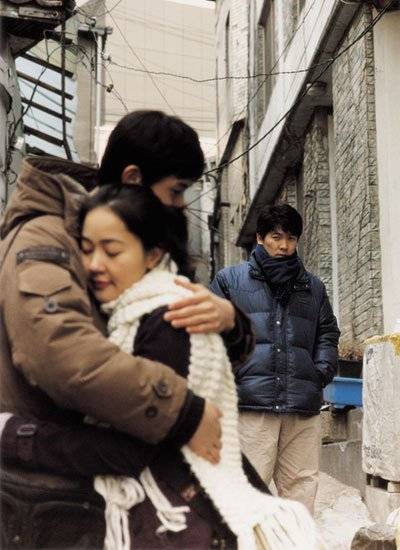
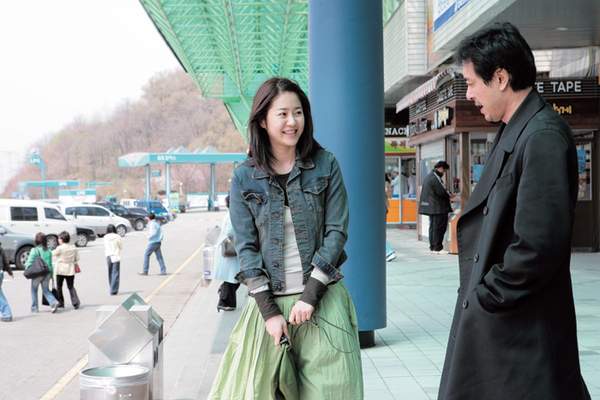
With Go Hyun-Jung, Kim Seung-Woo, Kim Tae-Woo, Song Seon-Mi. A filmmaker, writing his latest script at a seaside resort town, becomes involved with two women. As ever, Hong is comically and painfully lucid in outlining the jealousy and self-absorption that fuel his male characters’ drunken acting out. In the scene that is at the heart of this film, he does so literally with the help of a diagram-a fitting gesture for a filmmaker so obsessed with the geometry of human relationships.


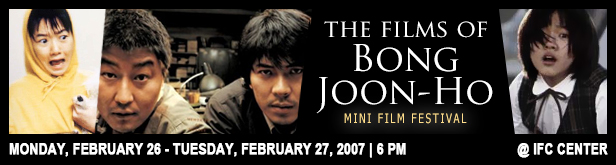
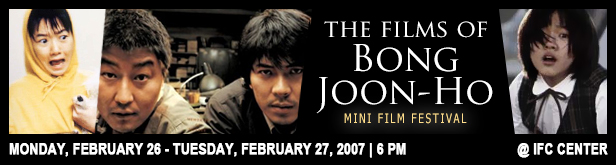
Bong Joon-Ho Mini Film Festival


A special line-up of acclaimed South Korean director Bong Joon-Ho’s box-office mega-hits will include showings of Barking Dogs Never Bite and Memories of Murder, and shorts Incoherence and Sink and Rise. Bong will attend the screening of his latest film, The Host, for a Q&A afterwards.

Bong Joon-Ho took the 2006 Cannes Film Festival by storm with his smart, terrifying new monster movie The Host. In anticipation of the film’s release, this a mini-fest of his maximal career presents a special line-up of Bong’s signature cinema — black comedies, gritty crime dramas and horror thrillers with a comic book feel — and Bong himself in person for the closing screening of The Host


Monday, February 26 – Tuesday, February 27, 2007

IFC Center
323 Sixth Ave (Ave of the Americas), New York, NY 10014
Get Directions to the IFC Center


Monday, February 26 7:00 BARKING DOGS NEVER BITE 9:15 MEMORIES OF MURDER
Tuesday, February 27 6:00 SINK AND RISE & INCOHERENCE 8:30 THE HOST


THE HOST (119 min) 2006
괴물


Tuesday, February 27 | 8:30 PM
Director Bong Joon-ho in person!

Starring: Song Kang- Ho, Park Hae-Il, Bae Du-Na, Byeon Hie-Bong, Ko Ah-Sung. Toxins from a U.S military base flow into Korea’s Han River, causing the birth of a mutant creature which terrorizes Seoul. When it grabs a little girl, her dysfunctional family must band together to save her. The Host is like a mutant hybrid spawned from the improbable union of Little Miss Sunshine and Godzilla, for the film is a family comedy and political satire in which an unnaturally evolved tadpole just happens to loom (very) large. Bong expertly balances absurd humor against tense thrills, and domestic drama against mass mayhem, reasserting South Korea’s place at the pinnacle of genre-busting cinema – and most of all he surprises at every turn in a film where, despite a realistic social milieu, almost anything seems possible.

Awards:
Best Director, 5th Korea Film Festival
Best Film, 5th Korea Film Festival
Best Sound, 5th Korea Film Festival
Best CG, 5th Korea Film Festival
Best Picture, 5th Korea Film Festival
Cannes Film Festival
New York Film Festival
Toronto International Film Festival
DHL Audience Choice Award for Best Feature, Hawaii International Film Festival
Pusan International Film Festival
Best Special Effects and Orient Express Award for Best Asian Film, Sitges International Film Festival of Catalonia (Spain) 2006


MEMORIES OF MURDER (127 min) 2003
살인의 추억


Monday, February 26 | 9:15 PM

Starring: Song Kang-Ho, Kim Sang-Kyung, Park Hae-Il. South Korea was rocked to its foundations when struck by its first serial killer, who raped and murdered ten women in a small village in Kyonggi Province between 1986 and 1991. Director Bong Joon-Ho (Barking Dogs Never Bite) has taken the investigation and combined it with best-of-career performances from Song Kang-Ho (JSASympathy for Mr. Vengeance) and Kim Sang-Kyung (Turning Gate), to make Korea’s most highly-acclaimed film of 2003, a master work that is itself like a memory of a dream: heartbreaking, mysterious, stunningly beautiful, and unspeakably sad.

A comedy, of sorts, of procedural errors that would be hilarious were it not so tragic, the film is a haunting look at a nation finding itself inevitably slipping back to an earlier, uglier era when an authoritarian government could freely violate the rights of private citizens in the name of the law.

Awards:
Best Films, Grand Bell Awards
Best Actor (Song Kang-Ho), Grand Bell Awards
Best Director (Bong Joon-Ho), Grand Bell Awards
Silver Seashell, San Sebastian International Film Festival
FIPRESCI Prize, San Sebastian International Film Festival
Best New Director (Bong Joon-Ho), San Sebastian International Film Festival 2003
Asian Film Award, Tokyo International Film Festival
Grand Prix, Cognac Festival Du Film Policier
Premiere Award, Cognac Festival du Film Policier
Prix Mediatheques, Cognac Festival du Film Policier
Special Prize of the Police, Cognac Festival du Film Policier
Best Screenplay Award, Audience Award, Torino Film Festival (Italy)


BARKING DOGS NEVER BITE (106 min) 2000
플란다스의 개

Monday, February 26 | 7:00 PM

Starring: Bae Du-Na, Lee Sung-Jae. American Beauty hopped up on laughing gas, Barking Dogs Never Bite‘s plot is choreographed as intricately as a triple-time minuet. Its director says it’s about corruption and innocence (and it is), but the story plays as a wild comedy focusing on two of the greatest characters to appear onscreen in decades: Lee Sung-Jae, a part-time lecturer who learns he’ll do anything to achieve a coveted position as a professor and Bae Doo-Na, a female member of an apartment building’s custodial staff who yearns to do something brave. A shaggy-dog story about the mysteries of pregnancy, the length of toilet paper, lost dogs, and good stew, this movie is a bedtime story for urban sophisticates, scored to a be-bop soundtrack. The director’s debut feature, and one of the few independent Korean films, it gleefully mixes razor-sharp acting, goofy physicality, black comedy, and genuine warmth. It’s the kind of movie that audiences live for, and that gives marketing departments nightmares.

Awards:
Best Editing, Slamdance Film Festival 2001
International Film Critics Federation Award of Young Asian
FIPRESCI Award for young Asian filmmakers, 25th Hong Kong International Film Festival
Special award presented to composer Cho Sung-Woo for his soundtrack for Barking Dogs Never Bite, Buenos Aires International Film Festival (Argentina) 2001.
Best Newcomer Award to Producer Cho Min-hwan for Barking Dogs Never Bite, Munich Film Fest (Germany) 2001


SINK & RISE (95 min) 2004 and INCOHERENCE (30 min) 1994
Part of TWENTIDENTITY

Tuesday, February 27 | 6:00 PM

Bong contributed Sink and Rise to this omnibus film made for the 20th anniversary of the Korean Academy of Film Arts; screening with the director’s early short black comedy.

SINK & RISE
Taken from Twentidentity, a 20-part omnibus film made by alumni of the Korean Academy of Film Arts on the occasion of the school’s 20th anniversary, Bong’s contribution is Sink and Rise, a whimsical work set alongside the Han River that can be seen as a warm up for the director’s third feature The Host.  

INCOHERENCE
A short black comedy that criticizes society with his Bong Joon-Ho’s unique sense of humor, Incoherence was invited to international film festivals in San Diego and Hong Kong, giving Bong his first taste of artistic recognition.





Korean Dance: Tradition and Creation


Korean Dance: Tradition and Creation

November 8 – 16, 2005

A 16-member troupe from the Seoul Performing Arts Company presented an exquisite program of folk dances as well as contemporary interpretations of ancient court and shamanic dances in five cities from coast-to-coast in the U.S. This tour was organized and funded by The Korea Society in association with the Seoul Performing Arts Company. Several members of the company also presented a workshop for high school students at the Wilshire School in Los Angeles on Tuesday, November 15.

The Seoul Performing Arts Company was established on August 1, 1986 with the founding objective of presenting the indigenous Korean performing arts in new attire and promoting them around the world. The Company has created many productions of musical and traditional Korean song and dance. It has gone on the road in over 45 countries, staging about 850 performances. Its performances at the closing and opening ceremonies of the ’88 Seoul Olympics, the promotional event for the 2001 World Cup, ’99 Winter Asian Games, the 2000 Korea Millennium Grand Gala, and other major international cultural events held in the United States, Japan, and several African and European countries have brought the company to a high standard of polish.

Program DescriptionDrum Dance of Ch’oyong (Ch’oyong Pukch’um)
8 minutes/ 5 dancers
Choreography: Son In-Young
The Drum Dance of Ch’oyong derives from the second dance of a two-dance suite that is said to have originated during the reign of King Hon’gang (r. 875-886), the forty-ninth ruler of the Silla kingdom. The first dance, no longer performed, was an elegant and slow dance in the court-dance tradition-movements in court dances are usually soft and subdued. However, the second dance, while classified as a court dance, stands out from other court dances for several reasons: it is the only dance in which the performers wear masks; it is performed by men rather than women; and its movements are comparatively strong and vigorous. In some historical documents, it is referred to as “the dance of the five directions.” Each direction is represented by a color: north is black, south is red, east is blue, west is white, and the center is yellow. The predominant color of the costume of each of the five dancers is one of the colors associated with the five directions. In 1971, the government of the Republic of Korea designated this dance as Intangible Cultural Asset No. 39. In this version, the drums of the dancers are substitutes for the usual musical accompaniment.

Sword Dance (Tonggyong Kommu)
7 minutes/ 8 dancers
Reconstruction: Eum Ok-Ja
During the Silla dynasty (57 B.C.-935 A.D.) an institution known as hwarang was established. The hwarang were young boys trained in Korea’s cultural and military arts. The oldest reference to a sword dance relates to a hwarang. Beyond legendary origin, the current form of the dance is sometimes attributed to performances in the court and sometimes to village performances. The tempo is slow, the dancers walk around the circle – still manipulating their swords-form a single straight line parallel to the audience, bow, and quietly exit by backing away from the performing area. Although a suggestion of military action has been offered, the strongest impression is that of a kaleidoscopic ensemble that groups and regroups amidst a flurry and swish of sword blades-all with the calm dignity of a regal group of dancers.

Dongnae Crane Dance (Dongnae Hak ch’um)
7 minutes/ 5 dancers
Reconstruction: Lee Sung-Hoon
Designated as Intangible Cultural Property No. 3 by the city of Pusan, the Dongnae Crane Dance reflects the distinctive geographical features of Dongnae. The landscape of this area suggests the shape of a crane, and many place names in the district are related to the crane. As a popular hot springs resort area, Dongnae traditionally has attracted many people of highly refined tastes. This fostered the development of a strong tradition of recreational activities that include singing, dancing and poetry. Yangban enthusiasts are believed to have been responsible for the development of the distinct genre of the crane dance performed in Dongnae, which is viewed as an expression of their appreciation for refined forms of recreation. Above all, however, the distinctive feature of the Dongnae Crane Dance is that it does not mimic the actual movements of a crane but rather attempts to represent these movements in a more abstract and symbolic way.

Improvised Dance (Ipch’um) & Taegum Solo (Taegum Sanjo)
5 minutes/ 1 dancer/ 1 musician
Choreography: Chae Sang-Mook & Kim Hyeon-Ah
This Improvised Dance retains the basic form of a traditional dance in which there is no instrumental accompaniment and most of the movements are improvised. Being a kind of festive dance, it takes mirth and artistic taste for its theme. Its appeal is that the audience feels drawn to participate in the performance by dancing and humming, which further adds to its popularity.

The taegum is a bamboo instrument with a clear and cool sound, which has been played in both court music and folk music since the era of Three Kingdoms period (57 B.C.-935 A.D.). With its wondrous resonance, clear and sometimes thrilling sounds, the taegum has been regarded as a holy instrument that brings peace to the world.

Fan Dance (Puch’aech’um)
6 minutes/ 9 dancers
Choreography: Chae Sang-Mook
Widely regarded as the most unique Korean traditional dance, the Fan Dance originated from a shamanic ritual. This splendid dance with luxurious dresses and brilliant fans of painted blossoms illustrates the beauty of vivid colors and the harmony of group movements within in a confined space. The dance reaches a climax with the dancers forming a large fluttering flower that appears to rotate.

Military Drill Dance (Hullyongmu)
8 minutes/ 8 dancers
Reconstruction: Chong Jin-Wook
This work was created in the 1930’s by Han Sung-Joon, who is considered to be the father of modern Korean dance. It is modeled on the forms of the traditional military drill. It is a striking dance that captures the disposition of the troops, a confrontation scene and the training of the soldiers.

Farmers’ Band (Nongak)
30 minutes/ 13 dancers/ 6 musicians
Choreography: Seo Han-Woo
The Farmers’ Band combines dance and music. It is representative of the joyful comradeship farmers traditionally enjoyed while working in co-operation with each other. In agricultural communities, up until the recent past, it was customary for Korean farmers to pray for peace and abundance by singing and dancing communally after each harvest. The instruments they played on these occasions included a small gong (kkwaenggari), a large gong (), an hourglass-shaped drum (changgo), a barrel drum (puk), and a small handheld frame drum (sogo). There were many variations of this kind of performance, and it also was linked with religious and social customs.