
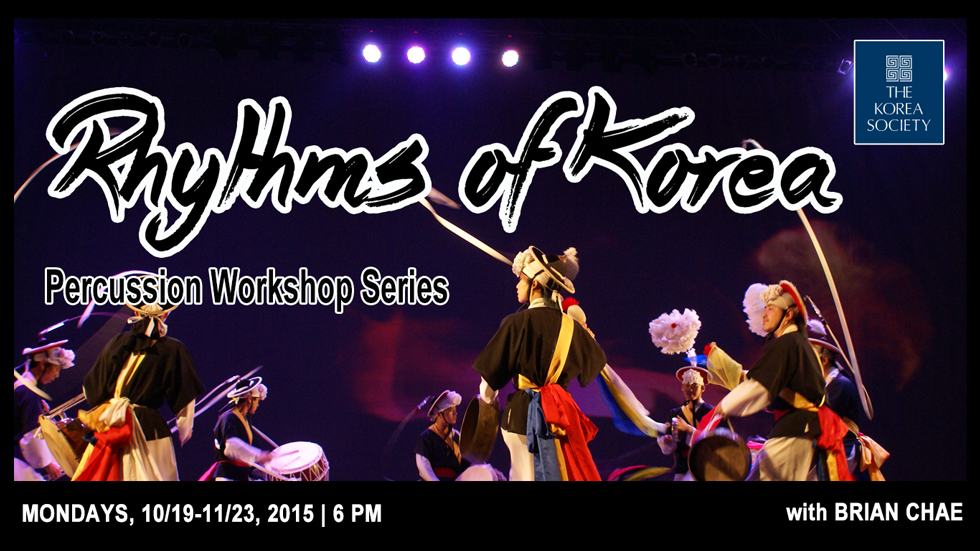
Rhythms of Korea: Percussion Workshop Series

Try your hand at the rhythms of Korea in this new drumming series! Participants explore Korea’s percussion heritage through six sessions of hands-on instruction guided by percussionist Brian Chae.

This workshop series focuses on samulnori, a type of pungmul or folk music. Samulnori means “four objects play.” The four objects are: kwaenggwari (small gong), jing (large gong), janggu (hourglass-shaped drum) and buk (barrel drum). Samulnori comes in many forms and varies depending on the region in which it is practiced. Participants will enjoy playing the janggu and buk drums!

Join us on Monday nights to experiment with the traditional beats of Korea!

All are welcomed to participate in this workshop series. Drumming or dance experience is not required. All ages, body types, abilities, and genders are encouraged to join!


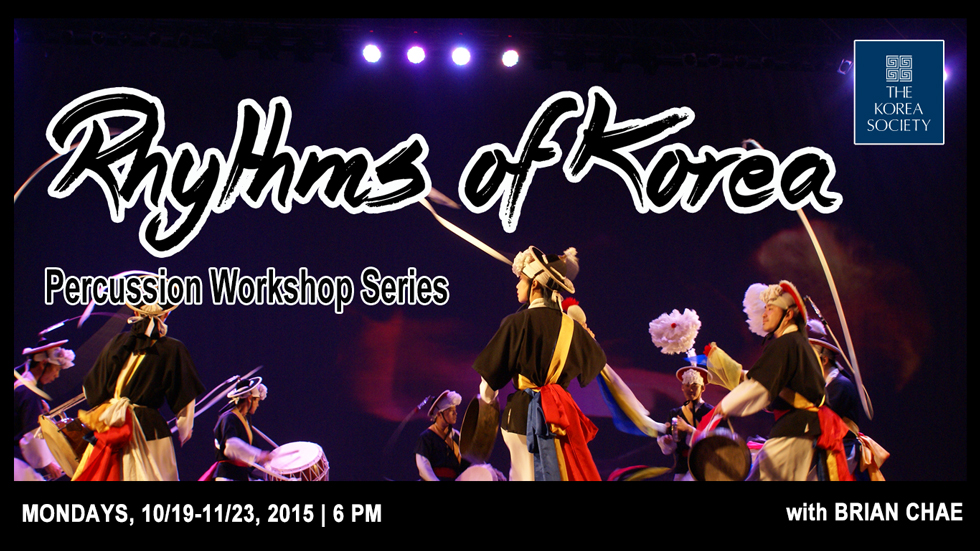
Rhythms of Korea 
Percussion Workshop Series

 with

Brian Chae

12-Hour Workshop Registration

Mondays, October 19, 26 – November 2, 9, 16, 23, 2015  | 6 PM – 8 PM

Members & Students: $150
Non-members: $180


If you have any questions, please contact Luz Lanzot or (212) 759-7525, ext. 309.


  NYCulture logo

This program is supported, in part, by public funds from the New York City Department of Cultural Affairs in Partnership with the City Council.


About the Instructor

Brian Chae has practiced samulnori and pungmulnori since 2010 at New York University through the Korean drumming group NYU Rhythmic Impulse (NYURI). He continued his studies of samulnori at Yonsei University in Seoul through another group, Tte. He has instructed college students and adults as the former president of NYURI, as well as elementary school students at Flushing Town Hall for Korean Cultural Day Camp. Mr. Chae also participates in annual New York City events such as the Korea Parade, JiShinBalbKi, and The Korea Society’s Student Night at the Metropolitan Museum of Art. He continues to participate in Korean cultural events in New York City in order to spread awareness and interest in Korean percussion in the greater New York City area. He is also an active participant within NYURI, where he continues to teach Korean percussion to college students.


Minhwa: Korean Folk Painting Workshop with Seongmin Ahn

2015 06 03-17  minwha iconLearn about Minhwa, Korean folk painting, from artist Seongmin Ahn in this 3 week course. Minhwa commonly refers to a genre of Korean folk art from the late Chosŏn era (17th–19th C.) and, as a popular form, conveys freshness and vitality, in contrast with the more scholarly and stern Muninhwa-style favored by the yangban, or aristocratic class. The use of vibrant primary colors and exaggerated painting styles were indicative of the taste of the middle-class, who wanted to imitate the yangban love of art, but with a touch of flamboyance. Flowers were a favorite motif and, in this workshop, you will paint peonies using distinctive Minhwa’s decorative painting techniques. Beginners, as well as all levels of experience, are welcome.


 This workshop meets for a total of 7.5 hours over three sessions:

Wednesdays, June 3, 10 and 17  | 6 – 8:30 PM


Advance ticket purchase is required for this event. Space is limited.

Members: $150, Non-Members: $180

Materials included.


If you have any questions, please contact Fran Bonham or (212) 759-7525, ext. 315.


The Korea Society | 950 Third Avenue, 8th Floor

(@57th St) | New York, NY 10022


Korean Folk Painting Workshop with Seongmin Ahn


2015 06 03-17  minwha iconLearn about Minhwa, Korean folk painting, from artist Seongmin Ahn in this 3 week course. Minhwa commonly refers to a genre of Korean folk art from the late Chosŏn era (17th–19th C.) and, as a popular form, conveys freshness and vitality, in contrast with the more scholarly and stern Muninhwa-style favored by the yangban, or aristocratic class. The use of vibrant primary colors and exaggerated painting styles were indicative of the taste of the middle-class, who wanted to imitate the yangban love of art, but with a touch of flamboyance. Flowers were a favorite motif and, in this workshop, you will paint peonies using distinctive Minhwa’s decorative painting techniques. Beginners, as well as all levels of experience, are welcome.


 This workshop meets for a total of 7.5 hours over three sessions:

Wednesdays, June 3, 10 and 17  | 6 – 8:30 PM


Advance ticket purchase is required for this event. Space is limited.

Members: $150, Non-Members: $180

Materials included.


If you have any questions, please contact Fran Bonham or (212) 759-7525, ext. 315.


The Korea Society | 950 Third Avenue, 8th Floor

(@57th St) | New York, NY 10022


Lucky Pouches

2015 04 06  art-workshop-pouches iconCreate a lucky pouch (bok jumeoni), during this 4 week, 8 hour workshop with artists Wonju Seo and Karen Ahn. Using two traditional art forms, bojagi (patchwork) and maedeup (knotting), participants will make their own unique and lucky silk pouch. These bags were originally made as a substitute for pockets, since hanbok, Korean traditional clothes, have no pockets.

 2015 01 27  pouches image002015 01 27  pouches image02


This workshop meets for a total of 8 hours over four sessions:

Mondays, April 6, 13, 20, and 27 | 6 – 8 PM

Advance ticket purchase required for this event. Space is limited.

If you have any questions, please contact Claudia Y. Pak or (212) 759-7525, ext. 321.


Members |  $160

Non-members | $190


nysca 200px white

Lucky Pouches   is made possible by the New York State Council on the Arts with the support of Governor Andrew Cuomo and the New York State Legislature.   

East Meets West Workshop

2014 06 04  essay  icon3


July 25th is the deadline for this year’s Donghwa Cultural Foundation “East Meets West” International Essay Competition. Learn what it takes to win at from the staff of The Korea Society and past competition awardees at this special workshop. The Competition is open to all high school and college students, and prizes include $1,000 or a round-trip ticket to Korea, as well as special awards from the Consulate General of Korea in New York, the Korean Cultural Service New York, and The Korea Daily. Read more about it at the Donghwa Cultural Foundation.


Wednesday, June 4, 2014 | 6:00 PM

The Korea Society | 950 Third Avenue, 8th Floor

(@57th St) | New York, NY 10022

Register now


The Art of Maedeup, Korean Traditional Knotting

2014 05 21  maedeup icon

In this knotting workshop, artist Karen Ahn teaches the Garakji (ring) knot, a versatile knot frequently used to make jewelry—including necklaces, earrings, and cufflinks. Maedeup, the traditional Korean art form of knotting silken cords, consists of over 35 intricate knots—with colorful names such as “dragonfly” and “plum blossom”—skillfully made into beautiful ornaments and accessories.

 2014 05 21  maedeup 012014 05 21  maedeup 02 2014 05 21  maedeup 00


Wednesday, May 21, 2014 | 6:00 – 8:00 PM

If you have any questions, please contact Claudia Y. Pak or (212) 759-7525, ext. 321.

 Advance ticket purchase required for this event. Space is limited.

Members |  $25

Non-members | $40

 Materials included.

Bojagi: Korean Patchwork

2014 04 21  bojagi icon2

Create a Hot-bo (single layer Bojagi) which can either be displayed as art or used as a decorative household item, such as a window screen or table runner, during this 4 week, 12-hour workshop with artist Wonju Seo. Using silk material and the ssam-sol (filet stitchs), participants will sew their own unique designs.

Bojagi, or bo for short, refers to square hemmed cloth comprised of fabric remnants of various sizes and colors, sewn together in patchwork designs, which Koreans used to wrap, store, or carry things with during the Joseon dynasty (1392–1910). Bojagi were not only practical and versatile items in the daily lives of Koreans, but also very beautiful, attesting to the artistry that Koreans sought even in the most mundane aspects of their everyday lives. Hot-bo, specifically refers to unlined, single layer Bojagi which were made with silk, ramie, and hemp for wrapping and storing daily items such as blankets and clothes.  As time went by, the patchwork itself became a highly creative and artistic craft, and today people make Hot-bo for artistic and decorative purposes.

 2014 04 21  bojagi image002014 04 21  bojagi image01

This workshop meets for a total of 12 hours over four sessions:

Mondays,  April 21, 28, May 5, and 12, 2014 | 12:30 – 3:30 PM

If you have any questions, please contact Claudia Y. Pak or (212) 759-7525, ext. 321.


Members |  $295

Non-members | $325

Participants are requested to bring their own fabric scissors and rulers. 


nysca 200px white

Art Workshop Bojagi: Korean Patchwork Cloth is made possible by the New York State Council on the Arts with the support of Governor Andrew Cuomo and the New York State Legislature.   

The Art of Ooh-Ree Floral Design

2014 04 02  floral-design  icon

With Spring just around the corner, learn the basics of Korean flower arranging in this introductory course. Traditionally, flowers in Korea have been associated with specific characteristics. Former New York Botanical Garden instructor Claire Won Kang introduces this Korean language of flowers to convey unique expressions in floral design. Through demonstration and hands-on design using Korea’s traditional color palette, Oh-bang-saek (black, blue, red, white, and yellow), master the concepts of harmoniously balancing flowers and space to create a beautiful yet simple arrangement which can be taken home.


Wednesday, April 2, 2014

2:00 PM – 4:00 PM

No prior floral design experience necessary.

Advanced ticket purchase required for this event by March 27. Space is limited.

$140 Members / $155 Non-members

Fees include all materials for the flower arrangement.


The Art of Maedeup, Korean Traditional Knotting

2014 02 26  maedeup icon

Maedeup, the traditional Korean art form of knotting silken cords, consists of over 35 intricate knots—with colorful names such as “dragonfly” and “plum blossom”—skillfully made into beautiful ornaments and accessories. In this introductory workshop, learn how to make the dongsimgyeol knot, also known as the  “one mind” or “binding two hearts forever” knot since it was used to decorate the letter containing a marriage pledge between the bridegroom’s family and bride’s family. Variations of this knot and various applications, including bookmarks, pendants, and accessories to cell phones, ipads, or purses, will be demonstrated.


Wednesday, February 26 , 2014 | 6 – 8 PM

Advanced ticket purchase required for this event. Space is limited.

$25 Members / $40 Non-members / $25 Students

Materials included.


Art Workshop: Traditional Korean Pillow

2013 12 09  KoreanPillowMaking icon

Learn Korean hand sewing while making traditional Korean pillows which are cylindrical with broad, flat surfaces at each end, covered in intricate embroidery or patchwork. For centuries, Koreans believed that pillow decorations could influence the sleeper’s dreams and that auspicious ones could make wishes come true.

In this class, taught by contemporary bojagi artist Wonju Seo, participants will apply bojagi patterns and technique to create two auspicious traditional pillows: one with an intricate pinecone pattern and the other a colorful patchwork design.


 2013 12 09  image002013 12 09  image01


Monday, December 9, 2:00-4:00 PM

Monday, December 16, 2:00-4:00 PM


Members $200, Non-Members $230

Fees include all materials to make two pillows. Participants are requested to bring their own fabric scissors and triangle rulers. Space is limited.


For those unable to attend both sessions, you may attend only the first session on December 9.

Members $115, Non-Members $135

Fees include all materials to make one pillow. Participants are requested to bring their own fabric scissors and triangle rulers. Space is limited. 


nysca 200px white

Art Workshop: Traditional Korean Pillows with Wonju Seo is made possible by the New York State Council on the Arts with the support of Governor Andrew Cuomo and the New York State Legislature.