

Next Steps in Korea-Japan Relations


2016 09 08  korea-japan-relation  icon2

Pacific Forum CSIS executive director Brad Glosserman and Council on Foreign Relations fellow and director Scott Snyder, authors of The Japan-South Korea Identity Clash, address progress and potential in Korea-Japan relations in a session co-presented with the Japan Society. North Korea has conducted a fourth nuclear test, a long range missile test and multiple intermediate and short range missile launches this year. As a result, South Korea and Japan have accelerated their cooperation bilaterally, and trilaterally with the United States. The logjam of blocked Korea-Japan relations given territorial and historical memory disputes appears to have given way to the necessity for and practicality of security cooperation. However, this process has been slower and more fitful than many expected. Despite their proximity, their deeply intertwined histories and the convergence of many interests, there are considerable misperceptions in each country about the other. Glosserman and Snyder root many of these problems in the competing sense of national identity in each country. Glosserman and Snyder opine on constraints and opportunities, as well as shared concerns over North Korea’s provocations and China’s growing reach.

Next Steps in Korea-Japan Relations

Brad Glosserman          
Executive Director of the Pacific Forum CSIS in Honolulu

Scott Snyder             
Senior fellow for Korea studies and director of the program on U.S.-Korea policy at the Council on Foreign Relations (CFR)


The Korea Society and Japan Society  Member Tickets: $15 

Non-Member Tickets: $20

Explorer, YPN and above attend this program for FREE with RSVP


12:00 PM | Arrivals & Registration 
12:30 PM | Discussion


If you have any questions, please contact Nikita Desai or (212) 759-7525, ext. 355.


About the Speakers

Brad Glosserman is Executive Director of the Pacific Forum CSIS in Honolulu, a nonprofit, foreign policy research institute affiliated with the Center for Strategic and International Affairs (CSIS) in Washington, D.C. The Pacific Forum has provided policy-oriented analysis and promoted dialogue on regional security, political, economic and environmental issues in the Asia-Pacific region since 1975. He oversees all aspects of Pacific Forum activities.

Mr. Glosserman is co-editor of Comparative Connections, the Pacific Forum’s triennial electronic journal, and writes, along with Pacific Forum President Ralph Cossa, the regional review. He is the author of dozens of monographs on U.S. foreign policy and Asian security relations and other articles have appeared in scholarly journals throughout the region, along with numerous chapters to books on regional security. The Japan-South Korea Identity Clash, his study (with Scott Snyder) of national identity in Japan and South Korea and its impact on US alliances was published by Columbia University Press in May 2015, and he recently completed a study (with Carl Baker) on the future of US alliances in Asia. He is wrapping up a manuscript on the impact of the March 11, 2011 “triple catastrophe” on Japan. He is the editor (with Tae-hyo Kim) of The Future of U.S.-Korea-Japan Relations: Balancing Values and Interests (CSIS Press 2004). His opinion articles and commentary regularly appear in media around the globe. He is a frequent participant in US State Department visiting lecture programs and speaks at conferences, research institutes and universities around the world. He is also the English-language editor of the journal of the New Asia Research Institute (NARI) in Seoul.

Prior to joining Pacific Forum, Mr. Glosserman was, for 10 years, a member of The Japan Times editorial board, and he continues to serve as a contributing editor for the newspaper. He periodically lectures at the Management Center of Innsbruck (MCI). Mr. Glosserman has a JD from George Washington University, an MA from Johns Hopkins University’s School of Advanced International Studies (SAIS) and a BA from Reed College.


Scott Snyder is senior fellow for Korea studies and director of the program on U.S.-Korea policy at the Council on Foreign Relations (CFR), where he had served as an adjunct fellow from 2008 to 2011. Prior to joining CFR, Snyder was a senior associate in the international relations program of The Asia Foundation, where he founded and directed the Center for U.S.-Korea Policy and served as The Asia Foundation’s representative in Korea (2000-2004). He was also a senior associate at Pacific Forum CSIS. Snyder has worked as an Asia specialist in the research and studies program of the U.S. Institute of Peace and as acting director of Asia Society’s contemporary affairs program.  Snyder was a Pantech visiting fellow at Stanford University’s Shorenstein Asia-Pacific Research Center during 2005–2006, and received an Abe fellowship, administered by the Social Sciences Research Council, in 1998–99. He has provided advice to NGOs and humanitarian organizations active in North Korea and serves as co-chair of the advisory council of the National Committee on North Korea.

Snyder has authored numerous book chapters on aspects of Korean politics and foreign policy and Asian regionalism and is the author of The Japan-South Korea Identity Clash: East Asian Security and the United States (with Brad Glosserman, 2015), China’s Rise and the Two Koreas: Politics, Economics, Security (2009), Paved With Good Intentions: The NGO Experience in North Korea (co-editor, 2003), and Negotiating on the Edge: North Korean Negotiating Behavior (1999).

Snyder is the co-editor of North Korea in Transition: Politics, Economy, and Society (Rowman and Littlefield, October 2012), and the editor of Middle-Power Korea:Contributions to the Global Agenda (Council on Foreign Relations, June 2015), Global Korea: South Korea’s Contributions to International Security (Council on Foreign Relations, October 2012) and The U.S.-South Korea Alliance: Meeting New Security Challenges (Lynne Rienner Publishers, March 2012). He served as the project director for CFR’s Independent Task Force on policy toward the Korean Peninsula. He currently writes for the blog, “Asia Unbound.”

Snyder received a BA from Rice University and an MA from the regional studies East Asia program at Harvard University and was a Thomas G. Watson fellow at Yonsei University in South Korea.


Of Interest:


Defense white paper looks at N. Korea missiles, China intrusions

Japan, South Korea inch towards better bilateral ties


 Co-organized with:

 2016 03 03  korea-japan-relations  JPS-logo


National Korean War Veterans Armistice Day Memorial Ceremony

2016 07 27  Armistice-Day  icon2

JULY 25, 2016  — NEW YORK — The Korea Society, a 59-year-old organization that promotes awareness, understanding and cooperation between the United States and Korea, hosted a memorial ceremony for veterans of the Korean War on Wednesday, July 27, 2016, at noon at the New York Korean War Veterans Memorial in Battery Park in lower Manhattan. The event, which marked the 63rd anniversary of the signing of the Korean War Armistice Agreement, was organized in collaboration with the Global Society of Korea and America, a nonprofit organization that promotes good relations between Korea, the Korean-American community, and the United States.

The 40-minute ceremony commenced with the presentation of the colors by the New York State Veteran Corps of Artillery, followed by the singing of the national anthems of the Republic of Korea and the United States by a Juilliard student. Thomas J. Byrne, President of The Korea Society, welcomed the guests and Ambassador Gheehwan Kim, Consul General of the Republic of Korea in New York, provided the memorial address to veterans who are members of the Korean Veterans Association, Northeast Region; the Corporal Kivilehan Chapter #66 of Staten Island; and the Korean War Veterans Association Central Long Island Chapter #6.

Remarks were also given by Korean War veteran Salvatore Scarlato, President of the New York Department of the Korean War Veterans Association, and a memorial prayer was said by Father Samuel Kim, Prior of St. Paul’s Abbey, Newton, N.J. This Benedictine monastery was home to Brother Marinus Leonard LaRue, the late merchant marine captain who in the Korean War evacuated 14,000 refugees from Hungnam, North Korea, in what has been called one of the greatest rescues by a single ship in maritime history. The ceremony concluded with the playing of taps by a West Point bugler and the retiring of the colors.

“It is important to honor the sacrifices our veterans make for the protection of the free world,” said Thomas Byrne, Korea Society President. “As we commemorate the anniversary of the armistice ending the Korean War, it is imperative to remember the importance of our special relationship with South Korea. U.S.-South Korean military, economic, and people-to-people relations today are broader, deeper, and stronger than ever.”

“Many in the vibrant Korean-American community would not be here today without the sacrifice of the South Korean and American veterans, as well as those from 20 other member nations of the United Nations who had committed themselves to support South Korea,” said Henry Kang, President of the Global Society of Korea and America.

“The United States entered the Korean War to preserve liberty and democracy in the world, and our commitment to the Korea still stands today,” said Korean War veteran Salvatore Scarlato.


REMARKS

Thomas J. ByrneAmb. Gheewhan KimHenry KangFr. KimProclamation

Thomas J. Byrne
President
The Korea Society


The Korea Society a 59-year-old organization that promotes awareness, understanding and cooperation between the United States and Korea, is honored to host, along with the Global Society of Korea and America, this memorial ceremony for veterans of the Korean War. Today marks the 63rd anniversary of the signing of the Korean War Armistice, which ended hostilities in 1953.

We are grateful for the participation of the consulate of the Republic of Korea in New York City; the New York State Veteran Corps of Artillery; the New York Department of the Korean Veterans Association, Northeast Region; the Corporal Kivilehan Chapter of Staten Island and the Korean War Veterans Association Central Long Island Chapter. We also thank the Juilliard School, the West Point Hellcats band, and Father Samuel Kim, Prior of St. Paul’s Benedictine Abbey in Newton, N.J.

This Benedictine monastery was home to Brother Marinus Leonard LaRue, the late merchant marine captain who in the Korean War evacuated 14,000 refugees from Hungnam, North Korea, in what has been called one of the greatest rescues by a single ship in maritime history.

It is important to honor the sacrifices our veterans make for the protection of the free world. We should never forget the commitment made by veterans of 21 countries from the United Nations and those veterans from South Korea, who held three-quarters of the front line in the year before the armistice.

President Obama in his National Korean War Veterans Armistice Day Proclamation noted that “nearly 1.8 million Americans joined in the fight and faced down communism.” They helped to provide the Republic of Korea with a new birth of freedom, democracy and prosperity.

As we commemorate National Korean War Veterans Armistice Day, it is important to note that while the armistice ceased hostilities, it did not achieve, as the language of the document recommended to the governments concerned, a “final peaceful settlement.” Peaceful relations on the Korean peninsula not only remain elusive, but are under the cloud of a heightened threat from North Korea. It is, therefore, imperative to remember the importance of our special relationship with South Korea.

For more than six decades, the U.S.-ROK alliance has served as an anchor of stability and prosperity on the Korean Peninsula and in the Asia-Pacific region. This is possible because U.S.-South Korean military, economic and people-to-people relations today are broader, deeper, and stronger than ever.


Amb. Gheewhan Kim
Republic of Korea Consul General to New York


I am pleased and honored to commemorate the 63rd Korean War Armistice Day with you here at Battery Park. I thank the Korea Society and New York Korean War Veterans Association for preparing the event today.

Today 63 years ago was the day the Korean War ended. The Korean War was one of the most fierce wars that claimed 178,566 lives and wounded 555,022 soldiers from Korea, the United States and 15 other participating countries. Civilian causalities near 4 million in the course of 3-year warfare.

Taking this opportunity, I thank 900,000 Korean soldiers and 1.95 million multinational soldiers under the United Nations flag for their services and sacrifices. Without them, Korea today would not exist. Also, my thanks go to 10 million Korean and American veterans, who served to defend Korea, and 3.5 million US soldiers who were stationed in Korea after the Korean War Armistice in 1953.

Thanks to you all, Korea has been transformed in 63 years into a mature democracy and 11th largest economy in the world. Korea and the United States has been and remain the strongest allies, defending together shared values of freedom, human rights, rule of law, and market economy.

Again, North Korea is currently posing nuclear and missile threats. This is a provocation not only to Korea, but also to the whole region of Asia-Pacific. North Korea is misguided by young leader, Kim Jongun, to pursue nuclear weapons for the regime’s security, leaving North Korean people starving and suffering in miserable conditions.

North Korea cannot continue taking this horrible and isolated path. It needs to turn back, give up nuclear weapons and open up to new opportunities of peace and prosperity together.

Korea, the United States, and International Community are pressing North Korea hard with sanctions, which are strong and unprecedented. China and Russia have also joined implementing these strong sanctions.

Denuclearization of North Korea would not be an easy task, but I am sure this process will be all the more worthwhile, because this will help to avoid the scourge of nuclear war and to bring meaningful dialogue on peace and unification eventually. Along this path, the services and sacrifices of Korean War veterans will be remembered as evidence of strong alliance and partnership between Korea and the United States.

Once again, thank you, Korean War veterans. I wish you all good health and happiness. Thank you.


Henry Kang
President
Global Society of Korea and America


Thanks to Ambassador Kim Gheewhan, Mr. Thomas Byrne, Father Samuel Kim, Honor Guards, Soloist Seiyoung Kim, Bugler Sergeant Jeremy Wissner and all of our distinguished guests!

And special kudos to my dear friend, Korean War Veteran Sal Scarlato and all his fellow Korean War Veterans!

On behalf of the Global Society of Korea and America, it is our great honor to be a part of the 63rd National Korean War Veterans Armistice Day commemoration ceremony.

When the Korean War broke out, I was a 10-year-old boy, so I clearly remember you. I was among the tens of millions of Korean people who owe you their lives. How can I find the words to express the enormous gratitude I and my fellow Koreans have for your sacrifice?

As young men, you came to rescue the people whom you had never met and brought them a victory and freedom.

On the foundation of your sacrifice and the continued Alliance, Korea has become one of the world’s largest economies and a vibrant democracy. And, the Korean-American community in the U. S. is thriving and keeping pace with mainstream.

Today, at this time of increasing threats from North Korea, we all stand in front of the Korean War Veterans Memorial. Don’t we all see the brilliant sun rays shining through on the soldier’s head and illuminating the plaque of the monument?

Isn’t it a light of hope for Korea’s peaceful unification and prosperity that transcends hatred and conflict?

Let us remember the last words of a dying soldier:- “You all the living! Your today is the life that I so eagerly wanted to live. Never let my death be fruitless nor a vain sacrifice.”

Let us all together consolidate and dedicate our awakening efforts to his and all other sacrificed soldiers’ unfinished works!

Now is the time.

God bless America and Korea!

God bless you all!

Thank you!


Comments and memorial prayer by Fr. Samuel Kim, prior of St. Paul’s Abbey


Good afternoon. My name is Fr. Samuel Kim. I am a Benedictine monk at St. Paul’s Abbey. Thank you for your invitation to attend this memorial event and to the veterans of the Korean War.

I would like to tell you about our brother, Marinus LaRueu. During the Korean War, he was Captain Leonard LaRue of the merchant ship, SS Meredith Victory. In December of 1950, in the Heungnam evacuation, he took 14,000 Korean civilian refugees aboard his ship and transported them to South Korea. During the three-day journey, five babies were delivered by the first mate. Despite the hazardous conditions, frigid weather, and overcrowding, no one suffered injury or death.

After the war, in 1954, Leonard LaRue joined the missionary Benedictines at St. Paul’s Abbey, where he died peacefully in 2001. I truly appreciate the humanitarian act performed by Brother Marinus and his crew. During the Korean war, I know many other acts of courage and kindness were done to help the people of Korea. So today I want to express my gratitude to all of you, the veterans, for your hard work and the sacrifices you made for Korea. As a Benedictine monk, I will pray for you and your loved ones. Thank you.

Let us pray.

O Lord, we thank You for the sacrifices our Korean War Veterans made for us and for peace. We gather here to commemorate and honor those who unselfishly served in order to give South Koreans liberty and assure greater freedom in our world. We humbly ask You to bless the men and women of our military today and all people who seek Your perfect kingdom, where no sword is drawn but the sword of righteousness, and no strength is known but the strength of love. Guide us on the path to unity and harmony. Protect the United States of America and Korea at this time when there is so much discord and unrest in our world. In Your mercy, grant that all the nations of the world may be united in fellowship for the promotion of Your glory and the good of all mankind.

Amen.


NATIONAL KOREAN WAR VETERANS ARMISTICE DAY, 2016
BY THE PRESIDENT OF THE UNITED STATES OF AMERICA

A PROCLAMATION

In 1950, when Communist armies from the North stormed across the 38th parallel, brave American men and women though weary of combat in the wake of World War II stepped forward to defend their brothers and sisters on the Korean Peninsula. Over the course of 3 years, through unforgiving weather and severe danger, nearly 1.8 million Americans joined in the fight and faced down Communism pushing the invading armies back and protecting a people on the other side of the world. As we mark the 63rd anniversary of the Military Armistice Agreement that brought an end to this war, we pause to honor the strength and resilience of our Korean War veterans, whose spirits and stories serve as an inspiration to continue advancing freedom’s cause.

Rising from occupation and ruin, the Republic of Korea today shines as a thriving, modern country, whose people can take comfort in knowing that the commitment of the United States to their stability and security will never waver. Fifty million South Koreans now live in freedom, reaching for their dreams and pursuing opportunities in a vibrant democracy and dynamic economy always realizing they have a partner who will stand shoulder-to-shoulder with them in defense of peace and prosperity. Our lasting friendship and unbreakable alliance are sustained by the beliefs we hold in common and the values we cherish.

As we pay tribute to the Americans who gallantly helped forge this bond, we know our solemn responsibilities to our fallen and their loved ones persist long after the battle ends. More than 7,800 Americans are still missing from the Korean War, and we will not stop working to live up to our obligations to their families. We owe all our service members an enormous debt of gratitude. To honor the full weight of the sacrifices made by those who serve, we must uphold our Nation’s promise to our veterans when they return home, and fulfill our commitment to all who wear the uniform in our name.

On National Korean War Veterans Armistice Day, we pay tribute to the American patriots who fought for freedom and democracy throughout the Korean War, leaving behind everyone they loved to secure the blessings of liberty for a country they never knew and a people they had never met. For the heavy price they paid, we will forever honor the legacy of their service and uphold the ideals they secured through this hard-won victory. NOW, THEREFORE, I, BARACK OBAMA, President of the United States of America, by virtue of the authority vested in me by the Constitution and the laws of the United States, do hereby proclaim July 27, 2016, as National Korean War Veterans Armistice Day. I call upon all Americans to observe this day with appropriate ceremonies and activities that honor our distinguished Korean War veterans.

IN WITNESS WHEREOF, I have hereunto set my hand this twenty-fifth day of July, in the year of our Lord two thousand sixteen, and of the Independence of the United States of America the two hundred and forty-first.

BARACK OBAMA


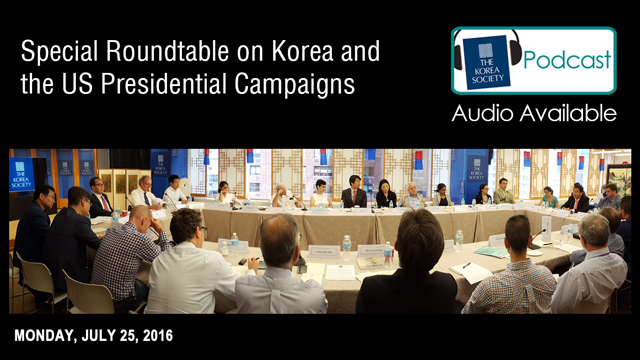
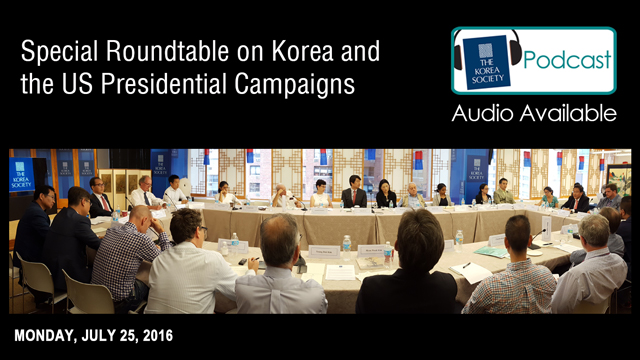
Special Roundtable on Korea and the US Presidential Campaigns

2016 07 25  roundtable  icon

In July 25, 2016 – The general theme of the round table will be Korea, the US Presidential Campaigns, and Rising Tensions on the Peninsula.

We welcome Sang Sin LEE, a research fellow from the Korea Institute for National Unification; the Hon. Jin PARK, President. Asia Future Institute; President Jinwook CHOI of the Korea Institute for National Unification (KINU); and Professor Hyun-Wook KIM of the Korea National Diplomatic Academy.

Dr. Jin Park will speak to Korea and the Clinton and Trump campaigns, President Choi to ROK policy toward the DPRK, Professor Kim to ROK-US relations, and Dr. Lee to ROK public perceptions of North Korea.

Special Roundtable on Korea and the US Presidential Campaigns 

Sang Sin Lee        
A research fellow from the Korea Institute for National Unification

Hon. Jin Park        
President, Asia Future Institute

Jinwook Choi       
President, Korea Institute for National Unification (KINU)

Hyun-Wook Kim   
Professor, Korea National Diplomatic Academy


If you have any questions, please contact Nikita Desai or (212) 759-7525, ext. 355.


Progress in US-Korea Relations

2016 06 02  US-Korea-Relations  icon2

In the wake of recent security challenges on the Korean Peninsula and in advance of the US Presidential elections, USC Korean Studies Institute director and noted professor David Kang discusses the progress, pitfalls, and potential in US-ROK relations. Moderated by the Society’s Stephen Noerper and co-hosted by the Global Society of Korea.

Progress in US-Korea Relations  

David Kang          
USC Korean Studies Institute Director

In conversation with Stephen Noerper, Senior Director for Policy and Corporate Programs at The Korea Society


Member Tickets: $10

Non-Member Tickets: $20

Explorer, YPN and above attend this program for FREE with RSVP


5:30 PM | Arrivals & Registration 
6:00 PM | Discussion


If you have any questions, please contact Nikita Desai or (212) 759-7525, ext. 355.


Of Interest:

A Brilliant Rivalry: Victor Cha and David Kang

An Overview of Korea – Full


About the Speakers

David C. Kang  is Professor of International Relations and Business at the University of Southern California, with appointments in both the School of International Relations and the Marshall School of Business. At USC he is also director of the Korean Studies Institute. Kang’s latest book is East Asia Before the West: Five Centuries of Trade and Tribute (Columbia University Press, 2010). He is also author of China Rising: Peace, Power, and Order in East Asia (Columbia University Press, 2007); Crony Capitalism: Corruption and Development in South Korea and the Philippines (Cambridge University Press, 2002), and Nuclear North Korea: A Debate on Engagement Strategies (co-authored with Victor Cha) (Columbia University Press, 2003). Kang has published numerous scholarly articles in journals such as International Organization and International Security, and his co-authored article Testing Balance of Power Theory in World History was awarded “Best article, 2007-2009,” by the European Journal of International Relations. Kang has also written opinion pieces in the New York Times, the Financial Times, the Washington Post, and the Los Angeles Times, as well as writing a monthly column for the Joongang Ilbo in Korean. He received an A.B. with honors from Stanford University and his Ph.D. from Berkeley.


Stephen Noerper   (moderator) serves as a Korea Society senior director and adjunct fellow with Pacific Forum CSIS. He writes on US policy in Asia. Professor Noerper teaches at Columbia University beginning this fall and was an associate professor of international relations at New York University. He taught at American University, Waseda University, the National University of Mongolia, and Asia Pacific Center for Security Studies and was a State Department analyst. Dr. Noerper publishes widely and appears in major media.


Fault Lines in a Rising Asia

2016 05 25  fault-lines  icon

In his new release, Fault Lines in a Rising Asia, ambassador, scholar, and analyst Chung Min Lee addresses the downsides of Asia’s rise and the conventional narrative that surrounds it. Dr. Lee examines Asia’s economic ascent in contrast with the dangerous, diverse and divisive security challenges that persist.

Fault Lines in a Rising Asia  

Chung Min Lee        
Nonresident Senior Associate, Asia Program, Carnegie Endowment for International Peace


FREE with RSVP


2:30 PM | Arrivals & Registration 
3:00 PM | Discussion


If you have any questions, please contact Nikita Desai or (212) 759-7525, ext. 355.


About the Speakers

Chung Min Lee   is a nonresident senior associate in Carnegie’s Asia Program. He works on security issues in Northeast Asia, including strategic developments on the Korean peninsula.

Lee is also a professor of international relations at Yonsei University’s Graduate School of International Studies (GSIS) and was appointed by South Korean President Park Geun-hye as ambassador for national security affairs in June 2013. Lee served as dean of the GSIS from 2008 to 2012 and Yonsei’s Underwood International College from 2010 to 2012. He also served as ambassador for international security affairs from 2010 to 2011 and as a member of the president’s foreign policy advisory council from 2009 to 2011.

Lee has taught at the Graduate Research Institute for Policy Studies in Tokyo, the University of Sydney, Murdoch University, and the Lee Kuan Yew School of Public Policy at the National University of Singapore. He was a policy analyst at the RAND Corporation from 1995 to 1998 and a visiting research fellow at the National Institute for Defense Studies in Tokyo from 1994 to 1995. Prior to that, Lee served as a research fellow at Yonsei’s Institute of East and West Studies, the Sejong Institute in Seoul, and the Institute for Foreign Policy Analysis in Cambridge, Massachusetts.

He has written extensively on Asian and Korean security issues and is the author of an upcoming book on Asia’s strategic fault lines that explores the implications of political and military developments in the region. His current research is focused on examining how China’s key neighbors such as Russia, India, Vietnam, the two Koreas, and Japan are responding to China’s rise. In addition, he is also working on assessing declassified intelligence estimates on the Pakistani, North Korean, and Iranian nuclear programs.


North Korea’s 7th Party Congress and its Implications

2016 05 23  north-korea-congress  icon2

Join the Hyundai Motor–Korea Foundation Center for Korean History and Public Policy, the National Committee on North Korea, and The Korea Society for a discussion of North Korea’s recent Seventh Party Congress and its implications. Panelists will assess the event’s implications for North Korea’s ruling institutions and personnel, discuss what it might portend for Pyongyang’s domestic policies and external relations, and look at the Party Congress in its historical context. Held for the first time since 1980, North Korea’s Party Congress invoked symbols of continuity with both the country’s recent policies and its earlier practices under Kim Il Sung.

North Korea’s 7th Party Congress and its Implications  

PLEASE NOTE THIS PROGRAM IS TAKING PLACE AT THE WILSON CENTER IN WASHINGTON, DC BUT WILL BE STREAMED LIVE AT THE KOREA SOCIETY.        

1:30 PM | Arrivals & Registration 
2:00 PM | Simulcast Streaming & Discussion


To mark our annual gala and lead-in to our 2017 60th anniversary, we are offering all FREE ADMISSION to this event. Please RSVP Here.


Panelists

James F. Person
Coordinator, Hyundai Motor-Korea Foundation Center for Korean History and Public Policy, Woodrow Wilson International Center for Scholars

Chad O’Carroll
Founder and Chief Correspondent, NK News

Michael Madden
Visiting Scholar, U.S.-Korea Institute at SAIS; Founder and Editor, North Korea Leadership Watch


Moderated by

Dr. Alexandre Mansourov
Adjunct Professor of Korean Studies, U.S.-Korea Institute at SAIS


The Korea Society thanks co-sponsors the Hyundai Motor-Korea Foundation Center for Korean History and Public Policy and the National Committee on North Korea.  

2016 05 23  ncnk logo high quality

 2016 05 23  hyundai-motor-korea-foundation

If you have any questions, please contact Nikita Desai or (212) 759-7525, ext. 355.


The Legacy of General James Van Fleet

2016 05 17 VanFleet icon

Joseph McChristian, president of the Van Fleet Foundation, discusses the life and legacy of Korean War commanding general James Van Fleet. McChristian, Van Fleet’s grandson, examines his grandfather’s “will to win,” love for the peoples of Korea, and deep commitment to the US-Korea alliance.

The Legacy of General James Van Fleet


with

Joseph McChristian
President of the Van Fleet Foundation

Welcome by Dr. Stephen Noerper, Senior Director 


 All members and non-members must register HERE for FREE Admission

12:00 PM | Registration 
12:30 PM | Discussion


If you have any questions, please contact Nikita Desai or (212) 759-7525, ext. 355.


About the Speaker

General Van Fleet’s grandson, Joseph A. McChristian, Jr., currently serves as the President of the Van Fleet Foundation. As part of a military family, his youth was spent living and travelling in many countries. Following a family tradition, and a personal dream, he graduated from the US Military Academy at West Point as a Distinguished Graduate in 1965. His military career included service as both Commander and staff officer of Armor and Military Intelligence units in combat and during peacetime. He also served as an Assistant Army Attaché at the US Embassy in Cambodia, as an Instructor at the Cambodian Senior Officer’s Staff College, and as Assistant Professor of Military Science at Princeton University. Airborne and Ranger qualified and a veteran of two combat tours in Vietnam, his decorations include three Bronze Star Medals, the Air Medal, the Joint Service Commendation Medal and the Army Commendation Medal. Upon leaving active duty in the military, Mr. McChristian pursued a business career in the financial industry with Citicorp, American Express, and then with Price Waterhouse where he worked as a Principal Consultant in Corporate Finance Emerging Markets advising clients in the former Soviet Union, Eastern Europe and West Africa. In 1989 Mr. McChristian established The McChristian Companies, a corporation through which he acquired and turned around two distressed manufacturing companies in the US, founded several joint ventures in the former Soviet Union, and started, with his son, an Internet services practice in the US. Mr. McChristian was a George Olmsted Scholar. He received a Master of Arts degree in Economics and Finance from the Institute of Political Studies, University of Paris, France, and continued graduate studies in Economics at Princeton University. He is also an Honor Graduate of the US Army’s Military Intelligence Officers Advanced Course. He speaks Russian, is fluent in Greek, and is bi-lingual in French. In addition to his work with the Van Fleet Foundation he is active in local government and several community service organizations where he lives in South Florida.


Engaging North Korea

2016 04 14  engagingnorthkorea  icon2

Stephan Haggard, author of Hard Target: Engaging North Korea, provides an assessment of a North Korea that is undergoing substantial economic and social change under the Kim Jong Un regime, in conversation with Korea Society president Thomas Byrne.

Engaging North Korea  

Stephan Haggard         
Author of Hard Target: Engaging North Korea

Thomas Byrne           
President of The Korea Society


YPN and Explorer Level Members Register HERE for free admission.

12:00 PM | Registration 
12:30 PM | Discussion


If you have any questions, please contact Nikita Desai or (212) 759-7525, ext. 355.

About the Speakers

Stephan Haggard  is the Lawrence and Sallye Krause Professor of Korea-Pacific Studies; director, Korea-Pacific Program; and Distinguished Professor of Political Science at the School of Global Policy and Strategy at UC San Diego. He works on the political economy of developing countries, with a particular interest in Asia and the Korean peninsula. His current research focuses on the relationship between inequality, democratization, and authoritarianism in developing countries. Haggard has written extensively on the political economy of North Korea with Marcus Noland, including Famine in North Korea: Markets, Aid, and Reform (2007) and Witness to Transformation: Refugee Insights into North Korea (2011). Haggard and Noland co-author the “North Korea: Witness to Transformation” blog at the Peterson Institute for International Economics. Haggard is the editor of the Journal of East Asian Studies and a member of the Council on Foreign Relations. He earned his PhD from UC Berkeley.


Thomas Byrne   (moderator) joined The Korea Society as its President in August of 2015. He came to the Society from Moody’s Investor Services, where he was Regional Manager, Spokesperson, and Director of Analysis for the Sovereign Risk Group in the Asia-Pacific and Middle East regions. Before moving to Moody’s in 1996, he was the Senior Economist of the Asia Department at the Institute of International Finance in Washington DC. Mr. Byrne has an MA degree in International Relations with an emphasis on economics from The Johns Hopkins School of Advanced International Studies. Before his graduate work, he served in South Korea for three years as a US Peace Corps volunteer.


Of Interest:


Kim Koo Professional Series

2016 04  kim-koo  professional-series  icon3

The Kim Koo Professional Series at the Korea Society brings together senior New York professionals for a timely discussion of events on the Korean Peninsula and in East Asia. Influence makers from business, media and international organizations join in dialogue with senior scholars and other thought leaders in Asian affairs. Established with the generous support of the Kim Koo Foundation, the series honors the late Kim Koo, Korean independence leader and last provisional president. Classes have welcomed participants from Park Avenue and Wall Street, the United Nations and its supporting missions, and major media, to include the Associated Press, Arirang TV, Bloomberg, Forbes, and Thomson Reut ers.

2016 04  kim-koo  professional-series  logoSpeakers have included Columbia University Korea Foundation Professor Charles Armstrong, Lazard Asset Managing Director Nicholas Bratt, Pacific Forum CSIS President Ralph Cossa, American Enterprise Institute Wendt Chair Nicholas Eberstadt, USC Distinguished Professor Stephan Haggard, Mansfield Foundation President Frank Jannuzi, Fletcher School Kim Koo-Korea Foundation Professor Sung-Yoon Lee, National Committee on North Korea Executive Director Keith Luse, Columbia University Visiting Professor Stephen Noerper, former Commander General (ret.) Walter “Skip” Sharp, University of Central Lancashire Professor Hazel Smith, and BowerGroupAsia Managing Director Sue Mi Terry. Discussants include former class participants, adding synergy among scholars and practitioners. The emerging Kim Koo Professional Series alumni network is rich and growing.

Through the series, Kim Koo fellows advance both their knowledge on Korea and contemporary Asia, as well as their professional networks. All sessions take place at the Korea Society, celebrating sixty years since its founding as the nation’s premier American non-profit dedicated to educating Americans on Korea.


Korea-Japan Relations: Potential and Progress

2016 03 03  korea-japan-relations  icon

Frayed relations between Korea and Japan appear to be on the mend with the late December announcement aimed at drawing the comfort women issue to a close. In conveying his apology to President Park, Prime Minister Abe voiced hope for a new era in relations with South Korea. The US hailed the step forward by its key allies in Northeast Asia. Meanwhile, China’s step-up of military activity in the South China and East China Sea and North Korea’s January nuclear test and February missile test heightened shared concerns and underscored the need for bilateral cooperation. Korea Society Chairman Thomas Hubbard, discusses recent progress in Korea-Japan relations with Council on Foreign Relations Senior Fellow Dr. Sheila Smith in this timely and forward-looking session, co-organized with the Japan Society.  

Korea-Japan Relations: Potential and Progress  

Ambassador Thomas Hubbard      
Senior Director, Asia Practice, McLarty Associates

Dr. Sheila Smith        
Senior Fellow for Japan Studies, Council on Foreign Relations and author of Intimate Rivals: Japanese Domestic Politics and a Rising China


Welcome by Thomas Byrne, President of The Korea Society & Ambassador Motoatsu Sakurai, President of Japan Society


The Korea Society and Japan Society Member Tickets: $10

Non-Member Tickets: $20

12:00 PM | Registration 
12:30 PM | Discussion


If you have any questions, please contact Nikita Desai or (212) 759-7525, ext. 355.


About the Speakers

Ambassador Thomas Hubbard   is Chairman of The Korea Society and senior director at McLarty Associates, where he specializes in Asian affairs. A career foreign-service officer for nearly forty years, he served as U.S. Ambassador to the Republic of Korea from 2001 to 2004, and before that as Ambassador to the Philippines from 1996 to 2000. He served seven years in Japan and was deputy chief of mission and acting ambassador in Malaysia. He held key Washington postings, including assistant secretary for East Asian and Pacific affairs. Ambassador Hubbard was a principal negotiator of the 1994 Agreed Framework aimed at ending North Korea’s nuclear weapons program and headed the first senior-level U.S. government delegation to North Korea. He was also President Clinton’s envoy to promote human rights and democracy in Burma. Ambassador Hubbard sits on numerous advisory boards. He received his BA in political science from the University of Alabama and has been awarded honorary doctorates by the University of Maryland and the University of Alabama.


Dr. Sheila Smith    is an expert on Japanese politics and foreign policy, is senior fellow for Japan studies at the Council on Foreign Relations (CFR). She is the author of Intimate Rivals: Japanese Domestic Politics and a Rising China (Columbia University Press, 2015) and Japan’s New Politics and the U.S.-Japan Alliance (Council on Foreign Relations, June 2014). Her current research focuses on how geostrategic change in Asia is shaping Japan’s strategic choices. In the fall of 2014, Smith began a new project on Northeast Asian Nationalisms and Alliance Management . Smith is vice chair of the U.S. advisors to the U.S.-Japan Conference on Cultural and Educational Exchange (CULCON), a bi-national advisory panel of government officials and private sector members. She teaches as an adjunct professor at the Asian Studies Department of Georgetown University and serves on the board of its Journal of Asian Affairs. She earned her MA and PhD degrees from the department of political science at Columbia University.


 2016 03 03  korea-japan-relations  JPS-logo