


Learn about:
-
Leaders featured on Korea’s currency
-
Neo-Confucianism
-
Admiral Yi Soon-Shin
-
Effects of Ming China’s collapse on Korean society
-
Introduction of Catholicism
-
New religious movement of Tonghak
- Japanese imperialism
Learn about:
Leaders featured on Korea’s currency
Neo-Confucianism
Admiral Yi Soon-Shin
Effects of Ming China’s collapse on Korean society
Introduction of Catholicism
New religious movement of Tonghak

It isn’t a surprise that Korea and Japan adopted Confucianism in different ways. Discover which country used it for bureaucracy and governance, and which country preferred it for academic study.

Meet the prominent scholars of Confucianism during the Chosŏn period.

Yi Hwang: one of two pillars of Neo-Confucianism during the Chosŏn period–a scholar, educator, and strict interpreter of Zhu Xi.
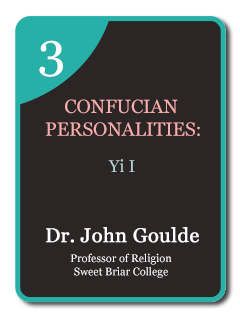
Yi I: philosopher, politician, writer, and promoter of the village contract and local government; opponent of central government.

Chong Yak-yong: innovative thinker of Neo-Confucianism with influences from Western thought; looked into how Confucianism can solve social problems.

Master Korean phonetics in 30 minutes! Learn how Korea’s alphabet was created then practice the consonant and vowel sounds.
Dr. Mark Peterson, Professor of Korean Studies, Brigham Young University Master Korean phonetics in 30 minutes! Learn how Korea’s alphabet and phonetic system was created then practice the consonant and vowel sounds.

Sijo is a unique form of Korean poetry. Explore sijo’s rubric and its contribution to world literature. Recite a few verses of exemplary sijo and write your own!

The new kingdom of Chosŏn began with the adoption of Confucianism. Explore this kingdom through poetic correspondence between loyalists and reformers, as well as King Sejong’s cultural achievements.
History of the Early Chosŏn Kingdom
August 21, 2014
The Korea Society
350 Madison Avenue, 24th Floor
New York, NY 10017


On January 22, 2011, dozens of families joined The Korea Society to celebrate sŏllal, Korean New Year. Participants enjoyed a day of fun-filled family activities such as storytelling, the New Year’s bow (sebae), traditional games such as yutnori, kite-making, and other crafts. As a bonus, tasty Korean treats such as param ttŏk, mujigae ttŏk, and sik‘ye were sampled by all. Unforgettable memories were made at The Korea Society! We hope to see everyone next year!
This event was a part of CelebrASIA New Year Festivities for Families. Members of collaborating institutions (Japan Society, Asia Society, China Institute, and the Rubin Museum of Art) can purchase member-discounted tickets for this event by providing a promotional code. To purchase tickets using the promotional code, please contact Luz Lanzot or call 212-759-7525 ext. 309.

This program is supported, in part, by public funds from the New York City Department of Cultural Affairs in Partnership with the City Council.


