


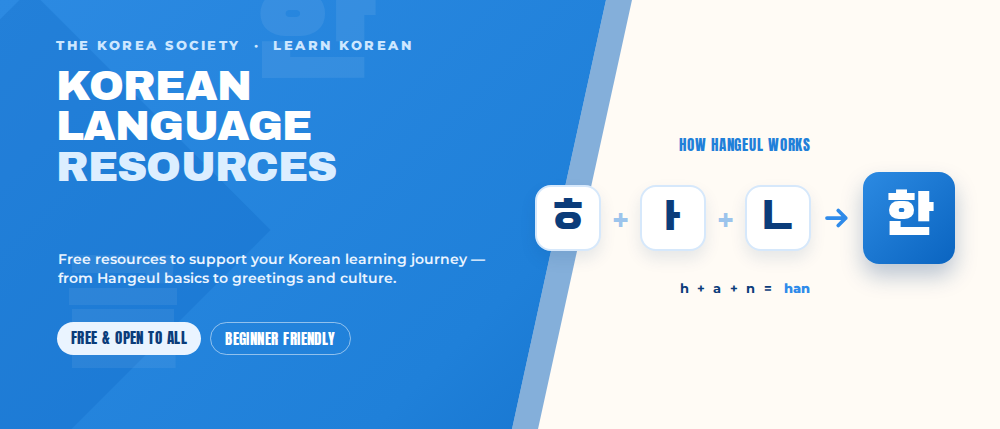
Are you learning Korean? This page offers free Korean language resources open to the public to support your Korean learning journey. If you’d like to take your Korean learning to the next level, join our 2026 Fall Korean Language Class below.
Creation of Hangeul
Hangeul (한글) is the Korean writing system created under the leadership of King Sejong the Great during the Joseon Dynasty. It was designed to make reading and writing Korean more accessible to ordinary people.
Before Hangeul
Before Hangeul was created, Koreans primarily usedClassical Chinese characters (Hanja) for writing. However, Chinese characters were difficult to learn and did not easily represent the sounds and grammatical structure of the Korean language.
As a result, many ordinary people had difficulty learning to read and write.
King Sejong and the Creation of Hangeul
King Sejong wanted to create a writing system that ordinary people could learn and use more easily.
A new writing system was completed around 1443, and King Sejong introduced it as Hunminjeongeum (훈민정음), meaning approximately “the proper sounds for the education of the people.(백성을 가르치는 바른 소리)”
The Proclamation of Hangeul
In 1446, the Hunminjeongeum Haerye was published. This important document explained the principles behind the new writing system and how the letters should be used.
For this reason, 1443 is generally associated with the creation of Hangeul, while 1446 marks its official promulgation and publication.
What Makes Hangeul Unique?
One of the most remarkable features of Hangeul is its systematic design. The shapes of several consonants were based on the shape or position of the speech organs used to pronounce them.
For example:
- ㄱ (g/k) reflects the shape of the tongue when making the sound.
- ㄴ (n) reflects the shape of the tongue touching the upper gum.
- ㅁ (m) represents the shape of the mouth.
- ㅅ (s) represents the shape of the teeth.
- ㅇ (ng/silent) represents the shape of the throat.
Korean vowels were also developed from a set of basic elements representing heaven, earth, and humanity.
Another distinctive feature is that letters are combined into syllable blocks rather than written simply in a linear sequence.
For example: ㅎ + ㅏ + ㄴ → 한
Why Is Hangeul Important?
The creation of Hangeul was more than the creation of a new writing system. It was an important cultural and social development that made it easier for Koreans, including ordinary people who had previously had limited access to literacy, to read and write in their own language.
Today, Hangeul is the official writing system of the Korean language, and October 9 is celebrated as Hangeul Day (한글날) in South Korea to commemorate its creation and promulgation.
Before learning Korean Vowels and Consonants, please read theRomanization Guide.
About Romanization: Korean words may be written differently in English because several Romanization systems are used. Although the spellings may differ, the Korean pronunciation remains the same.
Examples:
김밥 → Kimbap / Gimbap
불고기 → Pulgogi / Bulgogi
태권도 → Taekwondo / Taegwondo
Korean Vowels
| Vowel | Romanization | Approximate Pronunciation |
|---|---|---|
| ㅏ | a | “a” as in father |
| ㅑ | ya | “ya” as in yard |
| ㅓ | eo | Similar to “uh” in sun |
| ㅕ | yeo | “yuh” as in young |
| ㅗ | o | “o” as in go |
| ㅛ | yo | “yo” as in yoga |
| ㅜ | u | “oo” as in food |
| ㅠ | yu | “you” as in you |
| ㅡ | eu | Similar to “oo” but with unrounded lips |
| ㅣ | i | “ee” as in see |
| ㅐ | ae | Similar to “e” in bed |
| ㅒ | yae | Similar to “ye” in yes |
| ㅔ | e | “e” as in bed |
| ㅖ | ye | “ye” as in yes |
| ㅘ | wa | “wa” as in water |
| ㅙ | wae | Similar to “we” in ウェ / “way” |
| ㅚ | oe | Similar to “we” in wet |
| ㅝ | wo | “wo” as in wonder |
| ㅞ | we | “we” as in well |
| ㅟ | wi | “wee” as in week |
| ㅢ | ui | A combination of ㅡ (eu) + ㅣ (i); similar to “ui” |
Korean Consonants
| Consonant | Romanization | Approximate Pronunciation |
|---|---|---|
| ㄱ | g/k | Similar to g in go / k in ski |
| ㄴ | n | “n” as in no |
| ㄷ | d/t | Similar to d in do / t in stop |
| ㄹ | r/l | Between r and l |
| ㅁ | m | “m” as in me |
| ㅂ | b/p | Similar to b in boy / p in spy |
| ㅅ | s | “s” as in see |
| ㅇ | ng / silent | ng as in sing; silent at the beginning of a syllable |
| ㅈ | j | “j” as in jam |
| ㅊ | ch | “ch” as in chair |
| ㅋ | k | Strong k sound as in key |
| ㅌ | t | Strong t sound as in tea |
| ㅍ | p | Strong p sound as in pie |
| ㅎ | h | “h” as in hello |
Double Consonants (Tense Consonants)
| Consonant | Romanization | Approximate Pronunciation |
|---|---|---|
| ㄲ | kk | Tense k sound, similar to a stronger “k” |
| ㄸ | tt | Tense t sound, similar to a stronger “t” |
| ㅃ | pp | Tense p sound, similar to a stronger “p” |
| ㅆ | ss | Tense s sound, similar to a stronger “s” |
| ㅉ | jj | Tense j sound, similar to a stronger “j” |
Note: These are called tense consonants because they are pronounced with greater tension in the speech muscles. They are not simply “double” versions of the basic consonants.
Basic Korean Greetings
| Korean (한글) | Romanization | Meaning |
|---|---|---|
| 안녕하세요 | Annyeonghaseyo | Hello |
| 안녕 | Annyeong | Hi / Bye (casual) |
| 감사합니다 | Gamsahamnida | Thank you |
| 고맙습니다 | Gomapseumnida | Thank you |
| 죄송합니다 | Joesonghamnida | I’m sorry |
| 미안합니다 | Mianhamnida | I’m sorry |
| 괜찮아요 | Gwaenchanayo | It’s okay / I’m fine |
| 네 | Ne | Yes |
| 아니요 | Aniyo | No |
| 안녕히 가세요 | Annyeonghi gaseyo | Goodbye (to someone leaving) |
| 안녕히 계세요 | Annyeonghi gyeseyo | Goodbye (when you are leaving) |
| 잘 지내세요 | Jal jinaeseyo | Take care / Hope you’re doing well |
| 만나서 반가워요 | Mannaseo bangawoyo | Nice to meet you |
| 잘 부탁드립니다 | Jal butakdeurimnida | I look forward to working with you / Please take good care of me |
| 좋은 아침이에요 | Joeun achimieyo | Good morning |
| 좋은 하루 보내세요 | Joeun haru bonaeseyo | Have a nice day |
| 좋은 저녁 보내세요 | Joeun jeonyeok bonaeseyo | Have a nice evening |
| 오랜만이에요 | Oraenmanieyo | Long time no see |
| 어떻게 지내세요? | Eotteoke jinaeseyo? | How are you? |
| 잘 지내요 | Jal jinaeyo | I’m doing well |
| 이름이 뭐예요? | Ireumi mwoyeyo? | What is your name? |
| 제 이름은 ___예요 | Je ireumeun ___yeyo | My name is ___ |
| 어디에서 왔어요? | Eodieseo wasseoyo? | Where are you from? |
| 저는 ___에서 왔어요 | Jeoneun ___eseo wasseoyo | I’m from ___ |
| 네, 맞아요 | Ne, majayo | Yes, that’s right |
| 아니요, 괜찮아요 | Aniyo, gwaenchanayo | No, it’s okay |
| 실례합니다 | Sillyehamnida | Excuse me |
| 잠시만요 | Jamsimanyo | Just a moment / Excuse me |
| 다시 말씀해 주세요 | Dasi malsseumhae juseyo | Please say that again |
| 천천히 말씀해 주세요 | Cheoncheonhi malsseumhae juseyo | Please speak slowly |
Korean Romanization Charts: HERE
Korean Language & Culture Quiz Answer
These quizzes were originally shared on The Korea Society’s social media accounts. Try answering the questions yourself first, then check the answers and read the explanations to learn more. It’s a fun way to practice your Korean and build your knowledge of Korean language and culture!
When you are at a restaurant, how do you order food?
a. Wait for them to come to you
b. Ring the table bell
c. Raise your hand
Answer
Answer: B and C In Korea, at many restaurants, servers usually do not check on tables frequently like in some Western countries. Instead, customers actively call the staff when they are ready to order.
B. Ring the table bell — Many Korean restaurants have a call bell on the table that you press to get the server’s attention.
C. Raise your hand — If there is no bell, it is common to raise your hand or call out politely to the staff.
If you need something, what do you say to get the waiter’s attention?
a. 안녕하세요 (annyeonghaseyo)
b. 어서 오세요 (eoseo oseyo)
c. 저기요 (jeogiyo)
Answer
Answer: C 저기요 (jeogiyo)
In Korea, 저기요 is a common and polite way to call a waiter or get someone’s attention at a restaurant. It is similar to saying “Excuse me” in English.
a.안녕하세요 (annyeonghaseyo) = “Hello”
b.어서 오세요 (eoseo oseyo) = “Welcome” (what staff say to customers)
c.저기요 (jeogiyo) = “Excuse me” / “Over here”
So if you need service at a restaurant, you would say:
저기요!
Do people talk on the phone while riding transit in Korea?
A. Yes! Talking on the phone is common and no one cares.
B. No. Most people avoid phone calls on transit.
Answer
Answer: B. No. Most people avoid phone calls on transit.
Explanation:
In Korea, people generally try to avoid talking on the phone while riding public transportation, especially on buses and subways. Speaking loudly on the phone can be considered disruptive or impolite because passengers usually value a quiet environment.
If someone needs to take a call, they often speak quietly, keep the conversation brief, or move to a less crowded area. Many people prefer texting or messaging apps instead of making phone calls while on transit. This reflects a broader Korean social etiquette of being considerate of others in shared spaces.
What can you say when you need to get past someone in a crowd?
A. 저기요 (jeogiyo)
B. 실례합니다 (sillyehamnida)
C. 안녕 (annyeong)
Answer
Answer: B. 실례합니다 (sillyehamnida)
Explanation:
실례합니다 means “Excuse me” and is used when you need to politely get someone’s attention, pass by someone, or apologize for a small interruption. For example, when walking through a crowded subway or a busy street, you can say “실례합니다” to politely ask people to make space.
- 저기요 (jeogiyo) = “Excuse me / Hey” — used to get someone’s attention, such as calling a server at a restaurant or starting a conversation.
- 안녕 (annyeong) = “Hi / Bye” — a casual greeting used with friends or people close to you.
So, when you need to move through a crowd, “실례합니다” is the most appropriate and polite expression.