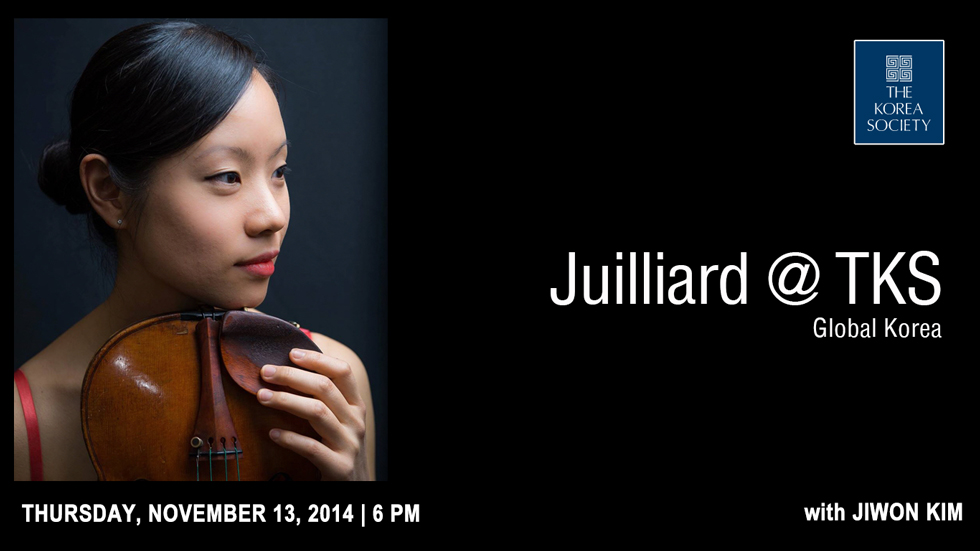
Celebrate Korea as a center of excellence for classical arts with Juilliard violinist Jiwon Kim. Ms. Kim recently premiered Roberto Sierra’s Duo Concertante for violin and viola as part of the Summergarden series at the Museum of Modern Art (MoMA). She has performed at Carnegie Hall, Alice Tully Hall, and Avery Fisher Hall and with the New Juilliard Ensemble, Juilliard Orchestra, and Sejon Soloists. Ms. Kim performs works by Bach (Violin Sonata No. 2 in A Minor, BWV 1003), Ysaÿe (Violin Sonata No. 4 in E Minor, Op. 27, No. 4 “Fritz Kreisler”) and Corigliano (The Red Violin Caprices). Jiwon and sister Hyewon Kim, a cellist, perform together Gliere’s Huit Morceaux for violin and cello, Op. 39.
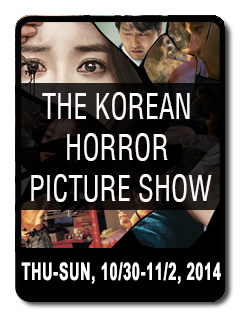
This Halloween, we’re exploring the dark corners of Korean cinema with a selection of six genre-bending titles that will transport you to the world of gut-wrenching fear! The world of ghosts, wicked stepmothers, psychopathic serial killers, and webtoons that predict murder! The nihilistic and violent world where revenge is the only purpose of existence and a dish best served often with copious amounts of blood! Featuring canonical thrillers of Korea’s top auteurs Park Chan-wook (STOKER) and Kim Jee-woon (THE LAST STAND) and the pure horror films of directors Kim Yong-gyun and the Jung brothers, this program puts the spotlight on a generation of filmmakers with a taste for intense.
Curated by Subway Cinema and co-presented with The Korea Society.
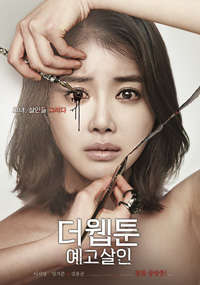
South Korea. Dir. Kim Yong-gyun. 2013, 104 mins. With Lee Si-young, Um Ki- joo. A blockbuster hit in South Korea, this pulse-pounding thrill ride follows a successful web-comic artist (Lee Si-young) who becomes a prime suspect when her cartoons start to prefigure a series of gruesome real life murders. Bursting with out-of-left-field plot twists and imaginative visual flourishes—including dazzlingly inventive transitions from manga-style animations to flesh-and-blood crime scenes—Killer Toon is Korean horror at its most creepily atmospheric.
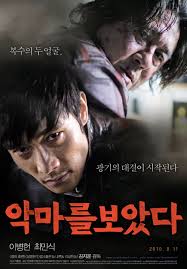
South Korea. Dir. Kim Jee-woon. 2010, 141 mins. With Choi Min-sik, Lee Byung-hun. Splatter maestro Kim Jee-woon pushes K-horror to its limits in this shock-to-the-senses thriller. Hell bent on revenge, a government intelligence agent (Lee Byung-hun) hunts down the psychopath (Oldboy star Choi Min-sik) who murdered his pregnant wife—only instead of killing him outright, instigates a grisly game of cat and mouse, which drags them both through the darkest realms of depravity. This utterly berserk chamber of horrors is leavened by Kim’s wickedly twisted sense of humor and cool, ultra-stylish eye for violence.
Dir. Park Chan-wook. 2005, 112 mins. 35mm. With Lee Yeong-ae, Choi Min-sik, Kim Shi-hoo, Kwon Yea-young. The third and final film of Park’s Vengeance Trilogy, Lady Vengeance follows the story of Lee Geum-ja, a woman imprisoned for a crime she did not commit. Lee seeks revenge on the true murderer, who blackmailed her to take the blame for his crime and kidnapped her daughter. Lady Vengeance features a breakout performance by Lee Yeong-ae in the title role (an American remake starring Charlize Theron has been announced).
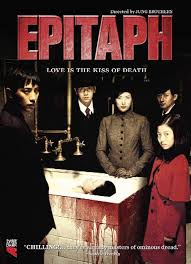
South Korea. Dir. Jung Beom-sik and Jung Sik. 2007, 98 mins. With Jin Goo, Kim Tae-woo, Kim Bo-kyung. Three bewitching tales of ghosts, medical horrors, and necrophilia comprise this uniquely unnerving horror anthology. Set in 1942, it chronicles mysterious goings-on at a hospital, where a young doctor falls in love with a corpse, a girl is haunted by spirits, and physicians are involved in a series of murders. Packed with breathtaking imagery (including a recurring, creepy crawly motif involving snails), this elegantly moody omnibus film from up-and-coming auteurs the Jung brothers is a supernatural brainteaser that maintains a carefully controlled sense of unease.
Dir. Park Chan-wook. 2002, 129 mins. 35mm. With Song Kang-ho, Shin Ha-kyun, Bae Doona, Lim Ji-Eun. The first film in Park’s Vengeance Trilogy, Sympathy for Mr. Vengeance trails a punky deaf-mute who desperately attempts to secure money for a kidney transplant his ailing sister badly needs. Because his blood type is incompatible and no donors are available, he turns to a group of black-market organ dealers who offer to find a matching kidney in return for one of his, plus ten million won. When the dealers rip him off, Ryu conspires with his girlfriend, a political activist, to kidnap his former boss’ young daughter and ransom her for the ten million won.
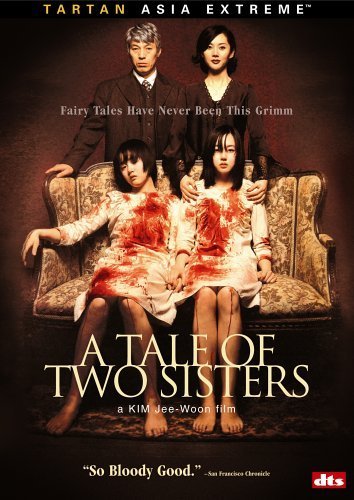
South Korea. Dir. Kim Jee-woon. 2003, 115 mins. With Im Soo-jung, Moon Geun-young, Yeom Jeong-ah. This harrowing psychological thriller set a new standard for Korean horror in its hauntingly dreamlike evocation of sustained dread. Based on a Korean folktale, it follows two teenage sisters, just released from a mental institution, whose dysfunctional relationship with their icy stepmother manifests itself in a series of horrific incidents, which blur the line between fantasy and reality. The highest grossing K-horror film of all time, A Tale of Two Sisters unleashes a nonstop torrent of blood-splattered, retina-searingly surreal imagery up until the final twist.
This retrospective is made possible by the New York State Council on the Arts with the support of Governor Andrew Cuomo and the New York State Legislature.
Author Euny Hong discusses, with The Wall Street Journal Online’s columnist Jeffrey Yang, her first nonfiction book, The Birth of Korean Cool, which mixes stories from her childhood in Korea with in-depth reporting and exclusive interviews with government officials and cultural icons. The result is an entertaining look at how South Korea made an unprecedented leap into the 21st century to become a global leader in business, technology, education, and pop culture. The book will be available for sale and a reception and book signing will follow.
Lea Sneider has a passion for folk art: the ceramics, woodwork, paintings, and sculpture used and enjoyed in everyday life. While accompanying her husband, Richard L. Sneider, to his appointment as U.S. Ambassador to Korea in 1974, Mrs. Sneider became an avid explorer of the art galleries and museums of Seoul, Daegu, and Busan. She sought out scholars of the rich tradition of Korean folk art, a field largely unexplored in the West at the time.
After returning to the United States, Mrs. Sneider became an art dealer, curator, and influential mentor, as three of her former assistants went on to become East Asian art teachers in leading US universities: Princeton, Chicago and Brigham Young. Sneider, together with Robert Moes, former Curator of Asian Art at the Brooklyn Museum, produced the first-ever exhibition of Korean folk art in the West, Auspicious Spirits: Korean Folk Paintings and Related Objects, which opened in New York in 1983 and traveled across the country. “The work in Auspicious Spirits has the magic that has come to be expected from Asian art of the first quality,” wrote the New York Times.
This exhibition pays tribute to Lea Sneider, a great patron of Korean art and longtime board member of The Korea Society, with pieces from her personal collection.
October 14—November 21, 2014
Gallery Reception
Wednesday, October 15, 2014 | 5-7 PM
The Korea Society Gallery
This program is supported, in part, by public funds from the New York City Department of Cultural Affairs in Partnership with the City Council.
K-pop performers from Korea’s major labels are well known throughout the globe. Now, artists signed to Korea’s independent music labels are gradually attracting international recognition. Like a breath of fresh air, Lucite Tokki (루싸이트 토끼), a Seoul-based female pop duo, creates unique and honest music. Musicians Kim Sun Young and Cho Ye Jin compose pieces reflective of their evolving emotions and musical tastes. Join us to welcome Lucite Tokki for their first international performance, followed by a Q&A session.
Po Kim’s artistic career was characterized by an ever-evolving style, and an eagerness to seek out new areas of inspiration. His paintings, often large in scale, were bold and compelling, bursting with life, energy, and emotion. This work distinguished Kim as one of the premier Korean-American artists of his time. When the artist died earlier this year, he left behind a strong legacy in his paintings, the innumerable artists he inspired, and the gallery in New York and museum in Korea which bear his name.
Po’s life as an artist began in Korea, where he founded the Department of Fine Arts at Chosun University. Incarcerated and tortured during the Korean War, Kim left Korea in 1955 to accept a fellowship at the University of Illinois. He moved to New York City a few years later, and his artistic life flourished here over the next six decades.
This exhibition, through personal objects, photographs, catalogues, and paintings, seeks to provide viewers a deeper sense of an artist who found great inspiration in his identities as a Korean, an American, and a New Yorker. The objects are on loan from The Sylvia Wald and Po Kim Art Gallery, an institution dedicated to the art of its founders and their personal mission of intercultural dialogue between the artistic communities of New York and the world.
August 28—September 26, 2014
OPENING RECEPTION | Gallery Talk
The Legacy of Po Kim
Wednesday, September 3, 2014 | 6 PM
Po Kim was a pioneering force in the Korean American art community. When the artist died earlier this year, he left behind a strong legacy in his paintings, the innumerable artists he inspired, and the gallery in New York and museum in Korea which bear his name. The evening’s panel features NYU’s Alexandra Chang, Hunter College’s Midori Yamamura and former curator at the Jane Voorhees Zimmerli Art Museum’s Mr. Jeffrey Wechsler. The panelists will discuss Mr. Kim’s life; the hardships and turmoil he endured, his long illustrious career as artist and teacher, his evolving style, his influences, and his contributions and impact on the art world.
The Korea Society Gallery
This program is supported, in part, by public funds from the New York City Department of Cultural Affairs in Partnership with the City Council.
Of Interest:
We cordially invite you to the special concert,”In Flight”, on Saturday, September 20th at 7:30 PM at the Sylvia Wald and Po Kim Art Gallery.
In celebration of the life and artistic legacy of Po Kim, The Sylvia Wald and Po Kim Art Gallery presents “In Flight,” a special concert of paintings and music. Professor Richard Miller (Columbia University) and the New York University String Quartet perform works by Mozart, Haydn, Bach and Villa-Lobos, as well as the premiere of a piece by Professors Youngmi Ha (New York University) and Jingfei Li (Shanghai University) that was inspired by two Po Kim paintings on view at the Gallery. This collaborative work captures the spirit and color of human desires in the combined media of moving images and music.
We hope you join us to celebrate the life and works of Po Kim. If you would like to attend, please RSVP info@waldandkimgallery.org or call 212. 598. 1155by Thursday, September 18.
Director Kyuhwan Kim, the mind behind South Korea’s most iconic television advertisements, explains his creative process when crafting memorable messages for companies like Samsung, Hyundai, Google, McDonalds, and Pepsi.
Rough. Raw. Real. The Kim Ki-duk school of filmmaking has given us several great projects produced and written by Kim and directed by young filmmakers: Poongsan, Bedevilled, and now we have Rough Cut’s spiritual successor in Rough Play. The film opens with crazed actor Oh Yeong (K-Pop idol Lee Joon playing totally against type) dragging a mannequin up the stairs of a department store and spouting some rather menacing dialogue. Intercut with this is a stage performance from early in his career where Oh takes his performance a bit too far and threatens the actress he’s doing a scene with. The rest of the film expands outward from these two moments and shows Oh’s rise and violent fall under the influence of mobbish manager Kim Jang-ho (Seo Bum-suk). Lee Joon is absolutely captivating in a performance that is all about the destruction that narcissism and rampant ego can bring. He lets it all hang out and embodies Oh’s (literally) insane dedication to his craft. A darker than dark take on the Korean film industry, Rough Play rails against the apathy of a business wholly concerned with appearance and that gives no long-term thought to the future.
Tuesday, July 1, 2014 | 6:30 PM
Thursday, July 3, 2014 | 3:30 PM
ROUGH PLAY 배우는 배우다 | SHIN YEON-SHICK, 2013 SOUTH KOREA | KOREAN WITH ENGLISH SUBTITLES | FORMAT: DCP | 98 MINUTES
$10 affiliate rate for The Korea Society members. You can also purchase at the box office by showing your membership card or mention “The Korea Society.”
Walter Reade Theater 165 West 65th Street, New York, NY
A playfully twisted black comedy with no dialogue, Moebius is an everyday tale of penectomy, rape, sadomasochistic sex, and incestuous love. It continues maverick writer-director Kim Ki-duk’s journey into the madness of the Korean soul—though in a much more in-your-face way than last year’s Pietà. Marbled with references to earlier films like The Isle (genital mutilation), BadGuy (tough, twisted love), and Pietà (“mother” love), plus numerous other titles, Moebius is a quintessentially Kim Ki-duk movie in its risk-taking and outsider feel, and could have been made by no other filmmaker currently working in the country. Words have never formed a major component of Kim’s films, which reveal themselves more through physical action than dialogue. But the absence here of any words (along with any names for the characters) brings an even more allegorical, universal aspect to the movie’s themes while still leaving it feeling absolutely Korean in its emotional intensity. Moebius’s sheer cheek and bravado is more than welcome at a time when South Korea’s film industry has become more and more conventional, predictable, and risk-averse.
Tickets include special entry to 8 PM reception with actress Lee Eun Woo, “Moebius,” Shin Yeon-shick, director of “Rough Play,” and Lee Su-jin, director of “Han Gong-ju.”
Light refreshments and appetizers will be served. Limited seats available.
Wednesday, July 2, 2014
8:00 PM | Reception
9:30 PM | Film
MOEBIUS 뫼비우스 | KIM KI-DUK , 2013 SOUTH KOREA | NO DIALOGUE | FORMAT: DCP | 90 MINUTES
$10 affiliate rate for The Korea Society members. You can also purchase at the box office by showing your membership card or mention “The Korea Society.”
Walter Reade Theater 165 West 65th Street, New York, NY
Praised by Martin Scorsese, who presented it with the Golden Star for Best Film at the Marrakech International Film Festival last year, the feature debut from writer-director Lee Su-jin has walked a path strewn with prizes since it premiered at the 2013 Busan International Film Festival, where it won two awards, and went on to win the Tiger Award at the Rotterdam International Film Festival. A devastating portrait of South Korea’s blame culture, embedded cronyism and destructive family pressures, the film follows a high-school girl, by the name of Han Gong-ju, as she seeks anonymity and escape from the horror of an unnamed past experience. Han Gong-ju focuses largely on the aftermath, rather than the event itself. Refreshingly free of self-pitying trauma, the film offers the beautiful character of a young girl, almost a woman, who, in the face of social stigmatization, stands radiant, strong, and self-reliant… not given easily to tears and only wanting to rebuild her life after moving away from home. With her mother divorced and her father on the bottle, Gong-ju works out her own problems, fiercely defending her privacy from new school friends. Strong, compelling, and anchored by a superb lead performance by Chun Woo-hee, Han Gong-ju is a standout social and psychological drama.
HAN GONG-JU 한공주 | LEE SU-JIN, 2014 SOUTH KOREA | KOREAN WITH ENGLISH SUBTITLES | FORMAT: DCP | 114 MINUTES
Walter Reade Theater
165 West 65th Street, New York, NY
Monday, June 30, 2014 | 6 PM
$10 affiliate rate for The Korea Society members. You can also purchase at the box office by showing your membership card or mention “The Korea Society.”












 Po Kim’s artistic career was characterized by an ever-evolving style, and an eagerness to seek out new areas of inspiration. His paintings, often large in scale, were bold and compelling, bursting with life, energy, and emotion. This work distinguished Kim as one of the premier Korean-American artists of his time. When the artist died earlier this year, he left behind a strong legacy in his paintings, the innumerable artists he inspired, and the gallery in New York and museum in Korea which bear his name.


