The Korea Society proudly presents Barame Soop (Forest, Wind and Rain) performed by the Sonagi Project. One of the leading percussion groups in Korea, the Sonagi Project consists of five musicians led by Chang Jea Hyo. The group has created modern, original music on the basis of Korean traditional rhythms and chants. Barame Soop concerts are built around changgo (two-headed, hourglass shaped drums), ching (gongs), and p’ansori (narrative, story-telling folk opera), performed with an assumed liberty regarding the musical techniques and the forms of the ancient rhythms. Inspired by Korean Shamanism and the vocal art of p’ansori, Sonagi’s performances express exciting emotions from the deep bottom of the Korean heart with dynamic energy of Korean traditional music.
LIVE HOUSE KOREA is made possible with the support of the New York State Council on the Arts.
Friday, October 5, 2012 6:30 PM
Barame Soop Performed by Chang Jae Hyo & The Sonagi Project
For more information, contact: Jinyoung Jin or call (212) 759-7525 ext. 316.
The Korea Society’s 22nd Annual Golf Tournament was held on Monday, October 1 at Montammy Golf Club in New Jersey, a prestigious private country club with a challenging and well-maintained 18 hole championship course. Proceeds from this event go to supporting our corporate programs, cultural events, and educational activities.
Jerry Bellis, President of Titleist Golf Balls, explains how South Korea has evolved into the 3rd largest market for golf in the world.
Yeonghwa is the Korean word for film, and since South Korean cinema now features prominently in every major international film festival, it is a good word for cineastes to know. Korean film tends to blend technical excellence with idiosyncratic expression and an entrepreneurial spirit—filmmakers often write and direct their work, and both actors and filmmakers benefit from the country’s homegrown “star system”—while embracing a wide variety of styles and subjects. Korean cinema is generally made for a national audience, so its vision is rarely diminished by compromises in the name of global appeal.
This third edition of Yeonghwa includes several distinctive contemporary narratives—from superior genre films to unclassifiable features by some of Korea’s renegade filmmakers—along with two features, drawn from MoMA’s collection, by Korean film pioneer Shin Sang-ok.
Trailer credit: Bongkeun Kwon
Introduction and all film summaries: Laurence Kardish, Senior Curator of Film, MoMA
This program is supported, in part, by public funds from the New York City Department of Cultural Affairs in Partnership with the City Council.
Thursday, September 20 through Sunday, September 30
MoMA (Museum of Modern Art) 11 West 53 Street, New York, NY 10019 (212) 708-9400 http://www.moma.org
Directed by Shin Sang-ok. Screenplay by Shin Bon-seung. With Kim Seo-ra, Choi Yoon-seok, Lee Hak-jae. Shin’s first film after his escape from North Korea is about the North Korean operative Kim Hyun-hee, who bombed a South Korean passenger plane in 1987. In Korean; English subtitles. 120 min.
Directed by Shin Sang-ok. Screenplay by Lim Hee-jae, based on the novel The Lodger and My Mother by Chu Yosup. With Kim Jin-kyu, Choi Eun-hee, Kim Hee-kap, Do Kum-bong. In this understated melodrama, a widow, in order to support herself and her young daughter, rents a room to a painter from the city and soon finds herself torn between her growing affection for the man and the constraints of rural society. In Koreal English subtitles. 103 min.
Written and directed by Hong Sang-soo. With Isabelle Huppert, Kwon Hye Hyo, Jung Yu Mi . Hong Sang-soo, a favorite of film critics and international film festival programmers, makes one of his most charming, gentle and graceful comedies with In Another Country. The ‘other country’ is South Korea, a nation whose behaviors, particularly between women and men, Hang Sang-soo understands so well and treats with smiling affection. And finding herself in this ‘other country’ is Anne, a Frenchwoman played by the irresistible Isabelle Huppert, who travels to a somewhat empty seaside town. Why she comes here, who she really is and whom she meets is told three times in different story variations, all ‘scripted’ by a young woman in economic difficulty. The play of parallel narratives is exquisite, and In Another Country is a luminous bagatelle. In Korean, French and English with English subtitles. Courtesy of Kino Lorber. 89 min.
Written and directed by Byun Young-joo, from the novel All She Was Worth by Miyabe Miyuki. With Lee Sun-kyun, Kim Min-hee, Cho Seong-ha, Kim Byeol. When a woman disappears just before her wedding, her hapless fiancée enlists his detective cousin to find her, and they find unsettling answers in a corrupt economic system. This surprising thriller, adapted from a Japanese bestseller by a filmmaker best known for feminist nonfiction films, provides an original perspective on debt. In Korean; English subtitles. 117 min.
Written and directed by Yang Jeong-ho. With Mun Jeong-ung, Kim Chang-hwan, Shin Jae-seung. After a night of celebratory drinking, a successful author wakes up on a train with no money or papers. Yet when he finally does find his bag, it’s a bag that has been missing since his childhood, and the search for his missing present becomes a journey into a dark past. Yang’s debut feature is a compelling, semi-supernatural thriller about one man’s return “home.” In Korean; English subtitles. 83 min.
Directed by Lee Sang-cheol, Shin A-ga. Screenplay by Shin. With Hwang Jeong-min, Han Song-hee, Kim Mi-hyang, Lee Jong-yoon. Jesus Hospital’s original title is Korean for “mink coat”—an object that has passed down to a girl who believes she has received a message from God through her grandmother, who is on life support and wishes to die. Set around Christmastime in Seoul, the film delves into the emotional dynamics of a Christian family. One of the best-reviewed and most popular Korean films of the year, Jesus Hospital won the country’s main acting awards for two of its leading actresses, Hwang and Han. In Korean; English subtitles. 91 min.
Directed by Ahn Sang-hoon. Screenplay by Choi Min-suk, Ahn Sang-hoon, Andy Yoon. With Kim Ha-neul, Yoo Seung-ho, Jo Hee-bong, Yang Yeong-jo. Director Ahn expertly mixes chills and affection in Blind, a superior genre film in the psychotic-killer-stalker mode. The potential victim here may be blind, but she is no weak and tremulous lady. Trained as a cop, the tough, resourceful young woman has known enough adversity for a lifetime—and she has a dog. In Korean; English subtitles. 111 min.
Written and directed by Park Hong-min. With Lee Jang-hoon, Kim Sun-bin, Choi So-eun. In this 3-D “metaphysical adventure,” a professor of logic learns that his wife, whom he didn’t even realize was gone, has been found in another city. He leaves to reunite with her, only to learn that she has become a shaman on a distant island. The strange news disturbs the logician—and gradually alters his relationship with reality. Park’s first feature suggests that 3-D may in fact reflect a third dimension where ghosts and talking fish inhabit the world quite naturally. In Korean; English subtitles. 105 min.
Written and directed by Kim Kyung-mook. With Paul Lee, Yeom Hyun-jun, Kim Sae-byeok, Lim Hyung-kook. The “stateless things” in the title of documentarian Kim’s first narrative feature are three marginalized young people in Seoul: a teenage North Korean defector and a Chinese Korean girl who occasionally do odd jobs together, and a gay hustler who, for a while anyway, has a lovely apartment and a sugar daddy. At once harsh and dreamy, the film treats its dispossessed characters with a hopeful empathy, bringing them together in a fresh and provocative manner. In Korean; English subtitles. 118 min.
Directed by Jeon Jae-hong. Screenplay by Kim Ki-duk. With Yoon Kye-sang, Kim Gyu-ri, Kim Jong-soo, Han Gi-jung. Jeon was an assistant to filmmaker Kim Ki-duk, who wrote and produced this film and whose influence is at once palpable and subordinate to Jeon’s own talent. Poongsan, who does not speak, carries messages back and forth between separated families in North and South Korea. When he is enlisted to smuggle the mistress of a high-ranking North Korean defector out of the North, passion intervenes, and an unexpected, “crazy” love threatens political chaos. In Korean; English subtitles. 121 min.
Directed by Jeon Soo-il. Screenplay by Jeon Kim Kyung. With Lee Seung-yeon, Seo Kap-sook, Park Hyeon-woo, Kang San-eh. Among a clutch of derelict buildings sits Pink, a condemned bar that caters to drifters and lost souls. Jeon’s eighth feature is a portrait of a struggling small business, the world-weary middle-aged woman who runs it, and her dwindling clientele. In Korean; English subtitles. 97 min.
Written and directed by Jeon Kyu-hwan. With Yoon Dong-hwan, Choi Won-jung, Shin Ye-an, Nollaig Walsh. Jeon, whose Town Trilogy (Mozart, Dance, and Animal) was a highlight of last year’s Yeonghwa, returns with a steamy and explicit melodrama that moves beyond Korea to India and even the Middle East. A married executive in Seoul has an affair and, eventually, so does his wife—with a foreign worker. Secrets multiply, and what began as personal betrayals become explosive global incidents. In Korean; English subtitles. 96 min.
Written and directed by Lee Sang-woo. With Won Tae-hee, Cha Seung-min, Kim Hun, Lee Yong-rye. A graduate of both UC Berkeley and the Kim Ki-duk “school” of filmmaking, Lee, one of Korea’s maverick multitasking filmmakers, makes his Yeongwha debut with this sensual melodrama. In a vivid exploration of the notion of karma, a Buddhist monk loses control. The calamitous results are followed, perhaps, by redemption. In Korean; English subtitles. 99 min.
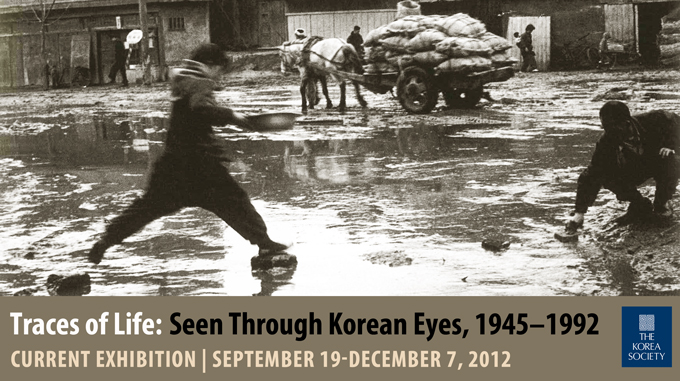
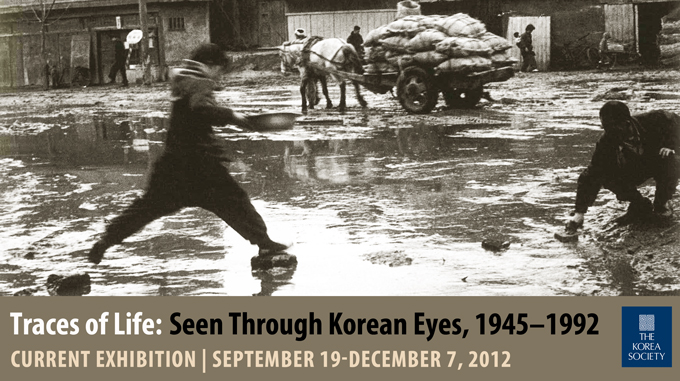
Experience the captivating imagery in this collection of photographs by some of the pioneers of modern Korean photography. The fifty-four photographs showcase the first generation of Korean realists who played a pivotal role in the development and enrichment of Korean photography as an art form. The exhibition marks the first time these original black and white photographs have been mounted in the United States and fills a chasm not only in the visual archive of modern Korean photography but also in the visual vernacular of the period.
Traces of Life: Seen Through Korean Eyes, 1945–1992 reveals everyday life through exuberant visual diversity and documents anthropologically important aspects of Korea’s nearly forgotten recent past. The photographs offer a counter-narrative of ordinary lives during this turbulent period of Korean history. These photographs are documentary, but at the same time aesthetically charged, illustrating and illuminating the traces and trails of Korean life as seen through Korean eyes.
The selected photographs are on loan from one of the first public photography museums in Korea, Dong-Gang Museum of Photography, and from several of the photographers and their estates. The thirteen photographers represented in the exhibition are Koo Wangsam, Lim Eungsik, Lee Haesun, Lee Hyungrok, Kim Hanyong, Han Youngsoo, Chung Bumtae, Choi Minsik, Joo Myungduk, Hong Suntae, Yuk Myungshim, Kim Kichan, and Kim Soonam.
This exhibition is the product of a joint effort between The Korea Society and an independent curator, Chang Jae Lee. Traces of Life will be on view in the Korea Society Gallery from September 19 through December 7, 2012. This exhibition, along with other exhibitions created by The Korea Society, is available for loan to universities and museums and other qualifying institutions in the United States. Please click below for booking information or contact Jinyoung Jin.
September 19-December 7, 2012
This program is supported, in part, by public funds from the New York City Department of Cultural Affairs in Partnership with the City Council.
Catalog Available: Edited by Chang Jae Lee Published by Noonbit Publishing Co., September 2012 pp. 136 (in English 110 pp. including 54 plates, in Korean 26 pp.) Foreword by Jinyoung Jin (TKS Gallery Director), introduction by David R. McCann (Korea Foundation Professor of Korean Literature at Harvard University), contributing essay by Sun Il (Curator of the Seoul National University Museum), and curatorial essay and afterword by Chang Jae Lee (Curator of Traces of Life).
The Korea Society and the Museum of The Moving Image co-present Spring, Summer, Fall, Winter… and Spring—a gorgeously shot feature film that has grossed more in box office receipts than any Korean movie released in United States to date. Directed by phenom Kim Ki-duk, the film is a pastoral poem about the changing seasons and a meditation on the cycle of life. In a tranquil and timeless setting of a temple floating on a lake in a forest, surrounded by mountain spires that cut the monastery off from worldly concerns, an old monk teaches his young disciple the wisdom of Buddha over the many seasons of their lives. In Korean with English subtitles.
Wednesday, August 22, 2012
Free Admission through the Museum of the Moving Image
Socrates Sculpture Park Vernon Boulevard, Long Island City N or Q train to Broadway, eight blocks west at Vernon Boulevard and the East River 8-10 minutes by taxi from The Korea Society
Spring, Summer, Fall, Witner… and Spring (봄여름가을겨울 그리고 봄) 2003, 106 min Director: Kim Ki-duk Starring: Oh Yeong-su, Kim Jong-ho, Seo Jae-Kyung
Made possible with the support of the New York State Council on the Arts.
The music of rare and exceptional artistic expression from North Korea will be showcased at the Korea Society as part of its Korean Traditional Music Series. Eun Sun Jung, an award-winning and talented young kayagŭm (12 and 25 string zither) artist from Seoul, Korea, presents some of the folk music of North Korea, selected for its vibrant folk music style and its contemporary interpretation of older traditions.
This includes the well-known folk songs of Paek Toraji (White Bellflower) and Hanopaekyôn (Living for Five Hundred Years), modern compositions for solo kayagûm based on North Korean folk songs by Hwang Kûm San and Ôm Chan Sôk. Ms. Jung holds both undergraduate and graduate degrees from Seoul National University, and has extensive professional performance experience touring in many cities in South Korea, France, Belgium, Germany, Japan and the United States. In 2011 she was selected as an Artist-in-Residence in New York City, sponsored by the Korean Ministry of Culture, Sports and Tourism.
Made possible with the support of the New York State Council on the Arts.
Thursday, August 2, 2012
6:30 PM
The Music of North Korea: Pathos and Passion
The Korea Society 950 Third Avenue @ 57th Street, 8th Floor
Learn to make two complete traditional vegetarian Korean meals during this two session hands-on workshop and demonstration at Whole Foods Market (Bowery Culinary Center). Chef Haelin Lee, a student of Blue House chef and Korean Master Jungyoung Sun, is a dynamic, young and accomplished traditional Korean chef, catering to clientele in the New York area. Chef Lee will demonstrate how to prepare various types of Korean banchan, or side dishes and how to incorporate them into flavorful main dishes with traditional spices and homemade sauces. Chef Lee will also provide hands-on instruction for a variety of seasonal desserts and appetizers.
In the first session, Chef Lee will demonstrate the preparation and serving of traditional Korean savory pancakes and sauce, a spicy bean sprout soup, flavorful side dishes, or banchan, that can be used as the elements in bibimbap (mixed rice dish), and a simple and elegant dessert of dried fruit and nuts.
The second session will build upon the skills taught in the first session, with the addition of techniques mandatory to create the traditional Korean appetizer Gujeol pan, or platter of nine-delicacies. In the hot summer months, Korean’s eat hot spicy foods to ‘sweat out’ the heat. Chef Lee will instruct students how to prepare a spicy and flavorful soft silken tofu vegetable stew, soondobu, with vegetable sides, or namul, and a cold and quick cucumber kimchi, oi kimchi. We complete the meal with a quick and simple sesame seed candy and dessert of yuzu orange with pomegranate seeds.
The Korea Society presents a retrospective of the work of Choi Min-shik, one of Korea’s most recognizable contemporary actors, as part of our ongoing “Korean Cinema Now” program with MoMI (the Museum of Moving Image).
Choi Min-shik had numerous television roles, but his big break came in 1999 when he played a cold-blooded North Korean soldier in Swiri (Dir. Kang Je-gyu) and suddenly gained a reputation as one of Korea’s finest actors. His acting dominates the silver screen, but his characters have more than charisma. In Failan, he played a thug, married to a Chinese woman out of convenience, but who sheds tears of regret when his “fake” wife dies. In Strokes of Fire, which won the Best Director Prize at the 55th Cannes Film Festival, he played the famous nineteenth-century Korean painter Jang Seung-up. In 2004, Choi returned to Cannes when director Park Chan-woo’s bloody revenge epic, Old Boy, won the Grand Prix-award. Choi’s impassioned and robust acting can seize an audience’s heart, and he is now known to film buffs worldwide.
This Choi Min-shik tribute will be presented at the newly renovated Museum of the Moving Image, home to New York City’s finest, state-of-the-art screen. Films are free with museum admission. This tribute is made possible by the New York State Council on the Arts with the support of Governor Andrew Cuomo and the New York State Legislature. Taxi 10 minutes from The Korea Society or NQ Train Outbound to 36th Ave., 36th Street and 35th Avenue, Astoria.
Made possible with the support of the New York State Council on the Arts.
Old Boy 2003, 120 min.
Director: Park Chan-wook Starring: Choi Min-shik, Kang Hye-jung, and Yu Ji-tae
Director Park Chan-wook’s flamboyant colors and giltzy cinematography and Choi Min-shik’s unforgettable performance made Old Boy an international hit.
Sunday, July 1, 2012 4 PM
The Museum of the Moving Image 35th Avenue at 37th Street, Astoria From midtown, taxi or N/Q Train outbound to 36th Avenue
In June of 2010, 10 Korean War veterans, now in their 80s and living in Long Island New York: Sal, Robert, Bill, Bob, Eugene, Frank, Arthur, John, Joseph, and Henry, visit Korea to celebrate the 60th anniversary of the Korean War. The documentary Far From Forgotten, traces these veterans’ emotional return to the DMZ and war memorial, where they realize that the DMZ that they visited after 60 years is not a reminder of the war but a place where we learn to find peace and plan for a hopeful future. Directors Jia Lim and Michael Unger will be present to introduce the film and several veterans who served in the Korean War.
Far From Forgotten
with
Michael Unger Director, Far From Forgotten
and
Jia Lim Director, Far From Forgotten
Friday, June 29, 2012 | 6:30 PM
The Korea Society 350 Madison Avenue, 24th Floor New York, NY 10017
Feast or Famine features 23 original posters from the Katharina Zellweger Collection. Zellweger collected over 100 posters during her tenure as the director of the Swiss Agency for Development and Cooperation program in Pyongyang from 2006 to 2011. This selection, rarely seen outside of the Democratic People’s Republic of Korea, centers around issues related to agriculture, animal husbandry, and food production. Created for a domestic audience and produced by government-run studios, the posters were designed to rally the population behind nationally promoted, food-related projects. The posters are original, hand-painted watercolors created to be copied and distributed in public campaigns.
June 7—August 24, 2012
Feast or Famine: DPRK Agrarian Posters from the Zellweger Collection









 The Korea Society proudly presents Barame Soop (Forest, Wind and Rain) performed by the Sonagi Project. One of the leading percussion groups in Korea, the Sonagi Project consists of five musicians led by Chang Jea Hyo. The group has created modern, original music on the basis of Korean traditional rhythms and chants. Barame Soop concerts are built around changgo (two-headed, hourglass shaped drums), ching (gongs), and p’ansori (narrative, story-telling folk opera), performed with an assumed liberty regarding the musical techniques and the forms of the ancient rhythms. Inspired by Korean Shamanism and the vocal art of p’ansori, Sonagi’s performances express exciting emotions from the deep bottom of the Korean heart with dynamic energy of Korean traditional music.





 Yeonghwa is the Korean word for film, and since South Korean cinema now features prominently in every major international film festival, it is a good word for cineastes to know. Korean film tends to blend technical excellence with idiosyncratic expression and an entrepreneurial spirit—filmmakers often write and direct their work, and both actors and filmmakers benefit from the country’s homegrown “star system”—while embracing a wide variety of styles and subjects. Korean cinema is generally made for a national audience, so its vision is rarely diminished by compromises in the name of global appeal.





 The music of rare and exceptional artistic expression from North Korea will be showcased at the Korea Society as part of its Korean Traditional Music Series. Eun Sun Jung, an award-winning and talented young kayagŭm (12 and 25 string zither) artist from Seoul, Korea, presents some of the folk music of North Korea, selected for its vibrant folk music style and its contemporary interpretation of older traditions.
 Learn to make two complete traditional vegetarian Korean meals during this two session hands-on workshop and demonstration at Whole Foods Market (Bowery Culinary Center). Chef Haelin Lee, a student of Blue House chef and Korean Master Jungyoung Sun, is a dynamic, young and accomplished traditional Korean chef, catering to clientele in the New York area. Chef Lee will demonstrate how to prepare various types of Korean banchan, or side dishes and how to incorporate them into flavorful main dishes with traditional spices and homemade sauces. Chef Lee will also provide hands-on instruction for a variety of seasonal desserts and appetizers.
 The Korea Society presents a retrospective of the work of Choi Min-shik, one of Korea’s most recognizable contemporary actors, as part of our ongoing “Korean Cinema Now” program with MoMI (the Museum of Moving Image).


 Feast or Famine features 23 original posters from the Katharina Zellweger Collection. Zellweger collected over 100 posters during her tenure as the director of the Swiss Agency for Development and Cooperation program in Pyongyang from 2006 to 2011. This selection, rarely seen outside of the Democratic People’s Republic of Korea, centers around issues related to agriculture, animal husbandry, and food production. Created for a domestic audience and produced by government-run studios, the posters were designed to rally the population behind nationally promoted, food-related projects. The posters are original, hand-painted watercolors created to be copied and distributed in public campaigns.