Po Kim: Making Impossible Demands on Art

In the course of his career, painter Po Kim  worked in three distinct modes, gestural abstraction, realist still-life and symbolist figuration. This talk will examine each of these periods and look at how Po Kim’s work related to the art of the period, especially that of other artists working in New York. I will also seek to understand the motives that sparked his stylistic restlessness, and ask whether his early experiences of war and violence in Korea and Japan may have helped inspire his evident faith in the power of art.


Po Kim: Making Impossible Demands on Art

Gallery Talk
with Raphael Rubinstein

Art critic and editor, Art in America
Professor of Critical Studies
University of Houston School of Art


Monday, October 23, 2017 | 6 – 7:30 PM

FREE: Pre-registration is now required for all Korea Society events, and an ID is required for security.


Join our membership program here!


NYCulture logo

This program is supported, in part, by public funds from the New York City Department of Cultural Affairs in Partnership with the City Council.


OF INTEREST:


The Buddhist Arts of Korea with Dr. Robert Mowry

This illustrated slide lecture will introduce Korean Buddhist art, focusing on the late Three Kingdoms period (traditionally, 57 BC – AD 668), the Unified Silla period (668–935), and the Koryŏ period (918–1392). Buddhism reached Korea from China in the fourth century; by the Unified Silla period, most members of the royal family were Buddhists, and the royal court patronized the religion, building temples and commissioning sculptures; by the Koryŏ period, the nation had espoused Buddhism as the state religion. Thus, during the millennium from the fourth through the fourteenth century (and the end of the Koryŏ dynasty), Buddhism flourished, as did Buddhist art, so that this era was the golden age of Buddhism in Korea. This lecture will pay particular attention to the sculpture of the Three Kingdoms and Unified Silla periods, to the magnificent temple architecture of the Unified Silla period (including Pulguk-sa and Sŏkkuram in Kyŏngju), and to the refined paintings and sumptuous sutras of the Koryŏ era. The lecture will explore the nature of Chinese influence on Korean Buddhist art, just as it will touch on Korean influence on Japanese Buddhist art.


The Buddhist Arts of Korea

Asia Week Lecture by Robert D. Mowry  


Thursday, March 16, 2017 | 6:30 PM

FREE Supporter [Formerly Explorer, YPN, Contributor], Fellow & Patron Members

Agenda

6:00 PM | Registration  
6:30 PM | Lecture

Join our membership program here!

$10 Individual Members
$15 Non-members


If you have any questions, please contact Jahee Yu  or (212) 759-7525 ext 301.

Space is Limited. Early Registration Requested.


NYCulture logo

This program is supported, in part, by public funds from the New York City Department of Cultural Affairs in Partnership with the City Council.

About the Speaker

2016 03 17  gallery-talk  speakerRecently retired after more than 25 years as a senior curator at the Harvard Art Museums (H/AM), Robert D. Mowry was also the university’s Alan J. Dworsky Curator of Chinese Art (2000-2013) and Head of the Department of Asian Art (1991-2013). He continues to serve as Senior Lecturer on Chinese and Korean Art in Harvard’s Department of the History of Art and Architecture. Under his stewardship, Harvard added numerous and very significant works to what already was one of the finest collections of Asian art in the Western world. Mowry was instrumental in acquiring several renowned collections as well as important endowments for the H/AM, over and above annual fundraising efforts for specific acquisitions and exhibitions. The National Museum of Korea has named Robert Mowry its Senior International Fellow for 2013, and he is also senior editor of its scholarly journal, The Journal of Korean Art and Archaeology.  


Mowry’s passion for Asian art and culture was sparked by his two-year service in the Peace Corps in Korea more than 40 years ago (1967-1969). He taught English at Seoul National University, before returning to the University of Kansas, where he completed his graduate work with Chu-tsing Li and Laurence Sickman, taking his degrees with honors. Fluent in Mandarin, he spent two years as a curatorial assistant and translator in the Department of Painting and Calligraphy at the National Palace Museum, Taipei (1975-1977). His career is distinguished with many pioneering leadership roles and ground-breaking scholarship. He was founding Curator of the Mr. and Mrs. John D. Rockefeller 3rd Collection at The Asia Society, New York (1980-1986), and, before that, Assistant Curator of Oriental Art at Harvard’s Fogg Art Museum (1977-1980).

Mowry is a popular speaker, consultant and author in his many areas of expertise, which include Chinese and Korean ceramics, Chinese painting of the Song, Yuan and Ming periods, Chinese jade, Chinese scholar’s materials, and Korean paintings. Among his many articles, catalogues, textbooks and books, perhaps his best known is Hare’s Fur, Tortoiseshell, and Partridge Feathers: Chinese Brown- and Black-Glazed Ceramics, 400-1400 (Harvard University Art Museums, 1996), the catalogue for an exhibition that he curated and that opened at Harvard’s Arthur M. Sackler Museum in December 1995 and then toured nationally in 1996. He also is the curator of and principal catalogue author for Worlds Within Worlds: The Richard Rosenblum Collection of Chinese Scholars’ Rocks (1997), another exhibition he organized.


Korean Ceramics: The Great Tradition

This illustrated slide lecture will survey the history of Korean ceramics from the early historic period through the nineteenth century. It will focus on the robust stonewares of the Three Kingdoms (57 BC-AD 668) and Unified Silla (668-935) periods, the classical celadons of the Koryŏ (Goryeo) dynasty (918-1392), and the delicate porcelains and rustic punch’ŏng (buncheong) wares of the Chosŏn (Joseon) dynasty (1392-1910). The lecture will emphasize characteristics and innovations that are uniquely Korean (such as the invention of the inlay technique of ceramic decoration), but it will also explore relationships between Korean ceramics and Chinese ceramics, just as it will touch on relationships between Korean ceramics and works of art in other media—from gold, silver, and bronze to lacquer and painting. The lecture will also seek to place the ceramics within the larger context of Korean society and culture.


Korean Ceramics: The Great Tradition

Asia Week Lecture by Robert D. Mowry  


Thursday, March 17, 2016 | 6:30 PM


If you have any questions, please contact Jahee Yu  or (212) 759-7525 ext 301.

Space is Limited. Early Registration Requested.


NYCulture logo

This program is supported, in part, by public funds from the New York City Department of Cultural Affairs in Partnership with the City Council.


About the Speaker

2016 03 17  gallery-talk  speakerRecently retired after more than 25 years as a senior curator at the Harvard Art Museums (H/AM), Robert D. Mowry was also the university’s Alan J. Dworsky Curator of Chinese Art (2000-2013) and Head of the Department of Asian Art (1991-2013). He continues to serve as Senior Lecturer on Chinese and Korean Art in Harvard’s Department of the History of Art and Architecture. Under his stewardship, Harvard added numerous and very significant works to what already was one of the finest collections of Asian art in the Western world. Mowry was instrumental in acquiring several renowned collections as well as important endowments for the H/AM, over and above annual fundraising efforts for specific acquisitions and exhibitions. The National Museum of Korea has named Robert Mowry its Senior International Fellow for 2013, and he is also senior editor of its scholarly journal, The Journal of Korean Art and Archaeology.  


Mowry’s passion for Asian art and culture was sparked by his two-year service in the Peace Corps in Korea more than 40 years ago (1967-1969). He taught English at Seoul National University, before returning to the University of Kansas, where he completed his graduate work with Chu-tsing Li and Laurence Sickman, taking his degrees with honors. Fluent in Mandarin, he spent two years as a curatorial assistant and translator in the Department of Painting and Calligraphy at the National Palace Museum, Taipei (1975-1977). His career is distinguished with many pioneering leadership roles and ground-breaking scholarship. He was founding Curator of the Mr. and Mrs. John D. Rockefeller 3rd Collection at The Asia Society, New York (1980-1986), and, before that, Assistant Curator of Oriental Art at Harvard’s Fogg Art Museum (1977-1980).

Mowry is a popular speaker, consultant and author in his many areas of expertise, which include Chinese and Korean ceramics, Chinese painting of the Song, Yuan and Ming periods, Chinese jade, Chinese scholar’s materials, and Korean paintings. Among his many articles, catalogues, textbooks and books, perhaps his best known is Hare’s Fur, Tortoiseshell, and Partridge Feathers: Chinese Brown- and Black-Glazed Ceramics, 400-1400 (Harvard University Art Museums, 1996), the catalogue for an exhibition that he curated and that opened at Harvard’s Arthur M. Sackler Museum in December 1995 and then toured nationally in 1996. He also is the curator of and principal catalogue author for Worlds Within Worlds: The Richard Rosenblum Collection of Chinese Scholars’ Rocks (1997), another exhibition he organized.


Adoption, Assimilation, Transformation: Korean Painting of the Koryo (918-1392) and Choson (1392-1910) Dynasties

Robert D. Mowry, Alan J. Dworsky Curator of Chinese Art Emeritus, Harvard Art Museums, and Senior Consultant on Chinese and Korean Art, Christie’s, New York, discusses the history and development of Korean ink paintings.

This illustrated slide lecture presents an introductory overview of the development of Korean painting during the Koryŏ (918-1392) and Chosŏn (1392-1910) dynasties, covering all four major categories of work:  Buddhist painting, literati painting (sometimes also called Sino-Korean painting), portrait painting, and folk painting. The Korean painting and ceramic traditions took inspiration from those of China, and Korean paintings and ceramics thus relate closely to those created in contemporaneous China. Even so, once they had fully mastered Chinese techniques, Korean artists typically transformed the subjects, formats, and styles adopted from China to meet their own aesthetic needs, thereby establishing distinctive Korean styles that reflect their Chinese origins but stand apart from them. That background will lay the foundation for understanding modern and contemporary Korean ink painting.

Korean royal hors d’oeuvres will be provided by master-chef Haelin Lee.


Thursday, March 19, 2015 | 6 PM

FREE with RSVP


 If you have any questions, please contact Jahee Yu  or (212) 759-7525


NYCulture current inverted white logo

This program is supported, in part, by public funds from the New York City Department of Cultural Affairs in Partnership with the City Council.


The Long Breath: Postwar Korean Art, 1953-1979

Joan Kee, Associate Professor of History of Art at the University of Michigan and a leading authority on contemporary Asian art, presents an overview of important artists and developments in postwar Korean art, including the rise of performance art and the significance of ink painting.

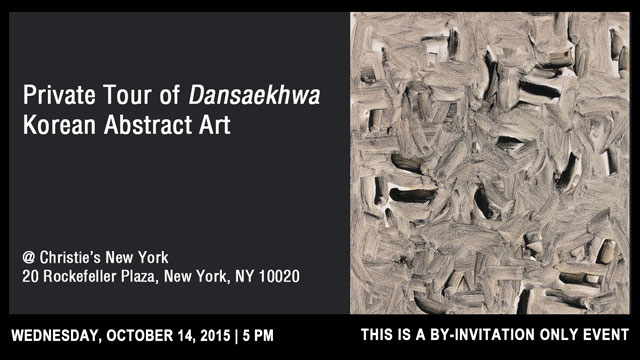
Kee points out that no clear-cut division exists between “modern” and “contemporary” in Korean art, and that this absence is not so much an omission as an intentional acknowledgment of the competing senses of time and history with which Korean artists engaged from roughly 1953—the provisional end of the Korean War—to 1988, the year of the Seoul Olympics, Korea’s proverbial “coming-out” party. The force of these engagements was especially palpable in the 1960s and 70s. This talk presents an overview of some of the most important artists and developments, including the emergence of Tansaekhwa, the loose constellation of abstract paintings which ranks among the most important artistic movements in post-1945 Asia, as well as the rise of performance art and the significance of ink painting. Such explorations continue to resonate today, as “contemporary art” worldwide becomes increasingly, and paradoxically, more expansive and less inclusive than ever before.


Thursday, March 12, 2015 | 6 PM


 If you have any questions, please contact Jahee Yu  or (212) 759-7525


The Beauty of Korean Arts and Crafts

2014 12 02  beauty-korean-arts-crafts  icon

Celebrate Korea’s handicrafts and artistic traditions with adoptive parents Debbi Kent and Joan Suwalsky in a talk about their new book, 100 Thimbles in a Box: The Spirit and Beauty of Korean Handicrafts . The authors will share their experiences in researching and writing this beautiful book of nearly 500 photographs illustrating 44 traditional arts, including ceramics, fiber arts, paper, inlay, metal, wood, and painting, which they wrote to help introduce the relatively little-known crafts of Korea to Western audiences.

A holiday Korean craft fair follows, featuring beautiful and unique handicrafts and art work from local Korean artists working in many of the traditional arts depicted in 100 Thimbles in a Box.Purchase the perfect holiday gift or simply admire how today’s artists are working in traditional art forms with innovative and contemporary results.


Tuesday, December 2, 2014  |  6:30 PM


Members: Free

Nonmembers: $10


Featured Artists:


Karen Ahn,  Maedeup Artist

Karen Ahn was born in Seoul, Korea. She studied Maedeup and other Korean folk art in college before coming to the U.S. to get her masters in graphic design at Pratt Institute. She worked in New York as a graphic designer and, for the past 20 years, has been creating Maedeup. She has taught the art of Maedeup in workshops at the Philadelphia Museum, Korean Cultural Service, Dong Hwa Korean Culture Center, Flushing Town Hall, Wave Hill, and Public Libraries throughout NYC. She has also exhibited her pieces at the Korean Cultural Service, Longwood Art Gallery, and Lee Young Hee Hanbok Museum.


Seongmin Ahn,  Painter

Seongmin Ahn graduated from Seoul National University and Maryland Institute College of Art. Her work takes Asian traditional painting as a starting point and transforms it into something experimental with her own interpretation, bridging tradition and modern, as well as East and West.

She received a grant from Pollock Krasner Foundation and a first prize from AHL Foundation. She has been reviewed in the Washington Post, the Philadelphia Inquirer, NY Arts magazine, Baltimore Sun and Plain Dealer. She has exhibited nationally and internationally, including at the Delaware Center for the Contemporary Arts, Queens College Art Center, and Hello Museum.


Sungho Choi,  Painter and Mixed Media Artist

Born in Seoul, Korea, Sung Ho Choi has lived and worked in New York City and Bergen County of New Jersey since 1981. He earned his master of Fine Art degree from Pratt Institute, New York City in 1984. Over 35 years, his works have been shown at numerous exhibitions in the North and Central America, Asia and Europe.  In 1993, Choi was commissioned by the Percent for Art program in NYC to create two permanent murals, My America and American Pie (completed 1996) for Intermediate School 5 in Elmhurst, New York City. The models of My America and American Pie have been traveling nationwide since 2011 through the exhibition titled, Infinite Mirror: Images of American Identity. In 2004, he completed another permanent public art project, Quiltroad, for the U.S. Federal Courthouse in Seattle, WA, commissioned by U.S. General Services Administration, Washington, DC. Awards that he has received include the Pollock-Krasner Foundation Grant in 1995, the Artists’ Project Grant from The National Endowment for the Arts, The Rockefeller Foundation, Andy Warhol Foundation for the Visual Arts, Inc. in 1996.


Eunjeon Kim, Ceramic Artist

Eunjeon Kim was born in Korea and received her BFA from the School of Arts at Hong-Ik University. She is currently a studio artist based in Virginia and has had numerous group and solo exhibitions around the country, including recent group exhibitions at Glenview Mansion Art Gallery in Rockville, Maryland and Workhouse Arts Center in Lorton, Virginia. Over the last decade, she has also had over 30 exhibitions in the Washington, D.C. area. She is currently the president of Han-Mee Artist Association and was previously vice president of the Korean American Artist Association and a director of the Hong-Ik Art Studio.


Jong S. Kim, Hanji Artist

Jong S. Kim has dedicated herself to teaching traditional Korean paper arts and crafts for decades. She is the director of Kim Jong Sook Hanji Arts and Craft Institute, the chairperson of the Korean Artist Society of America., and a  Hanji craft instructor at Joeun School, Korea-American Association of New Jersey.

Kim has received numerous awards and prizes for her work, including “Outstanding Artist Award” at the  National Crafts Exhibition in 2003 and the Seoul Traditional Art Crafts Competition Winner also in 2003.


Yanghee Kim-Lee, Jewelry Artist

Born in Deagu, Korea, Yanghee Kim-Lee received her BFA from the School of Arts at Hong-Ik University. She currently resides in Washington, D.C. and designs Korean-style brooches and other accessories using beads and metal. Her designs have been displayed in many group and solo exhibitions, primarily in the Washington, D.C. area. She is currently a director at the Hongik Art Studio.


Wonju Seo, Textile Mixed Media Artist

Wonju Seo is a a Korean-American textile artist. She was born in South Korea where she received her B.F.A in Fine Arts Painting from Hongik University and currently lives in New Jersey.  She has been working primarily with textiles, especially silk, for over 12 years. Her work has been deeply inspired by Korean antique bojagi. She received the Individual Artist Fellowship Award from the NJ State Council on the Arts in 2012, the Thomas Contemporary Quilt Recognition Award (Collector’s Choice) from the Visions Art Museum, San Diego, CA in 2012, and an Honorable Mention from the Smithtown Township Arts Council in 2011.  Her work, Inspiration of Blue, was reviewed in the New York Times article entitled Seeing Asian Cultures Through an Indigo Lens in 2014.  Her Wearable Pojagi is in the Newark Museum as part of its permanent collection.


Sungsook Setton,  Painter and Calligrapher

Sungsook Setton is a Korean-American artist and calligrapher. Besides her training in brush painting and calligraphy under Chinese and Korean masters, she has also studied Western art in Germany, the UK, and the United States, obtaining her BA in Studio Art at Stony Brook University and MFA in interdisciplinary art at Goddard College. Setton’s work has been widely exhibited in Canada, the UK, Taiwan, Korea, and the United States. She has received two dozen awards for her work, including Best of Show at the National Juried Exhibition by the Sumi-e Society of America. She serves on the faculty of Westchester Community College and the Art League of Long Island. Her work has been deeply influenced by artistic traditions in the East and West, drawing from art training in Europe, the US, and her native South Korea.


Seasonal Teas and Korean Sweets will be provided by Haelin Lee

Haelin Lee is an accomplished Korean chef who learned the art of traditional Korean cooking in the Blue House where she assisted with meal preparations for the President of South Korea and his guests as an assistant to Master Chef Jungyoung Sun. Princess Julia Lee, the daughter-in-law of Prince Yeong of the Empire (the last Korean Prince of the early 20th century), mentored Ms. Lee on traditional Korean food presentation and taste based on her experience in Naksunjae Palace. For the past five years, Ms. Lee’s private catering business, Art of Eating, has provided homemade traditional Korean food to a growing clientele.


The Beauty of Korean Arts and Crafts is generously sponsored by Asiana Airlines.

 2014 01 30  NewYearParty asiana logo3


The Sneider Legacy

2014 11 17 gallery-talk  icon

Daniel Sneider, Associate Director of Stanford’s Asia-Pacific Research Center, talks about his family’s long engagement with Korea.

Lea Sneider has a passion for folk art: the ceramics, woodwork, paintings, and sculpture used and enjoyed in everyday life. While accompanying her husband, Richard L. Sneider, to his appointment as U.S. Ambassador to Korea in 1974, Mrs. Sneider became an avid explorer of the art galleries and museums of Seoul, Daegu, and Busan. She sought out scholars of the rich tradition of Korean folk art, a field largely unexplored in the West at the time.  

After returning to the United States, Mrs. Sneider became an art dealer, curator, and influential mentor, as three of her former assistants went on to become East Asian art teachers in leading US universities: Princeton, Chicago and Brigham Young. Sneider, together with Robert Moes, former Curator of Asian Art at the Brooklyn Museum, produced the first-ever exhibition of Korean folk art in the West, Auspicious Spirits: Korean Folk Paintings and Related Objects, which opened in New York in 1983 and traveled across the country. “The work in Auspicious Spirits has the magic that has come to be expected from Asian art of the first quality,” wrote the New York Times.

This exhibition pays tribute to Lea Sneider, a great patron of Korean art and longtime board member of The Korea Society, with pieces from her personal collection.


The Sneider Legacy

Monday, November 17, 2014 | 6 PM


Gallery Talk: Contemporary Printmaking

2014 07 10 printmaking  icon

Learn about the fascinating history of printmaking in Asia and the West from Bruce Waldman, professor of printmaking at the School of Visual Arts. Professor Waldman will explain how printmaking evolved from simple beginnings into today’s complex kaleidoscope of techniques and genres through reference to many of the Korean and American prints showing in Made in New York/Made in Seoul, the exhibition currently at The Korea Society Gallery. He will also introduce the master printmakers in history who helped build the foundation for contemporary printmaking and explain how they influenced the artists taking part in the exhibition.


Thursday, July 10, 2014 | 5:30 PM


This program is now FREE to all guest, but please RSVP. Limited seats available.


NYCulture current inverted white logo

This program is supported, in part, by public funds from the New York City Department of Cultural Affairs in Partnership with the City Council.


Gallery Talk: Korean Contemporary Ceramics

2014 02 11  gallery-talk korean-contemporary-ceramics icon

Fresh from participating in the Gyeonggi International Ceramic Biennale, artist Young-mi Kim reports on her three-month journey to kilns, studios, and ceramic heritage sites throughout Korea.


Tuesday, February 11, 2014 | 6 PM


This program is now FREE to all guest, but please RSVP. Limited seats available.


NYCulture current inverted white logo

This program is supported, in part, by public funds from the New York City Department of Cultural Affairs in Partnership with the City Council.


Elegance and Tradition in Korean Furniture

2013 11 21  LyndelKingGalleryTalk icon

Dr. Lyndel King, Director and Chief Curator at the University of Minnesota’s Frederick R. Weisman Art Museum, introduces traditional Korean furniture with photos from the museum’s collection of Korean furniture, the largest in the world with over 200 pieces. Her presentation explores the traditional Korean home and interior furniture, highlighting its craftsmanship, many specialized uses, and regional differences.


Dr. King first became interested in Korean traditional furniture when she met Dr. Edward Wright in the early 1980s. Dr. Wright had built an extensive collection of traditional Korean furniture, ceramics, and screens during his long service as an administrator of the Korean-American Educational (Fulbright) Commission in Seoul between 1967 and 1979. Following his bequest of the collection to the museum in 1988, Dr. King curated several exhibitions of the Weisman’s collection of Korean furniture.


Thursday, November 21, 2013 | 6:30 PM


From the Edward Reynolds Wright Collection

2013 11 21  image012013 11 21  image022013 11 21  image05


YPNs, Explorers, and above |  Free

Members | $10

Non-members | $20


Gallery Talk

Elegance and Tradition in Korean Furniture

by

Lyndel King, Director and Chief Curator of Frederick R. Weisman Art Museum, University of Minnesota


NYCulture current inverted white logo

This program and the accompanying exhibit is supported, in part, by public funds from the New York City Department of Cultural Affairs in Partnership with the City Council.