Selling Happiness: 1960s-80s Consumer Design in Korea

During Korea’s drive for economic modernization, commercial artists created goods and advertisements that were visually appealing and richly detailed. After the war, Korea transformed itself economically, yet rapid growth was accompanied by dramatic social changes and political concerns surrounding authoritarianism. By the late 1980s, Korea had embraced democracy and a newly prosperous society clamored for fresh goods manufactured for domestic consumption. With the 1988 Olympic games, Korean products and adverts grew more global in orientation.

Koreans look upon these items with some nostalgia, as they stand in sharp and, at times, amusing contrast with today’s products, which range from remarkable paper-thin flatscreens to Motortrend’s Car of the Year. Presented with the support of the Korea Craft and Design Foundation, this exhibition features early consumer products, advertisements, and social commentary from a transitional and controversial era when the seeds of Korean design saw fertile ground.


ABOUT

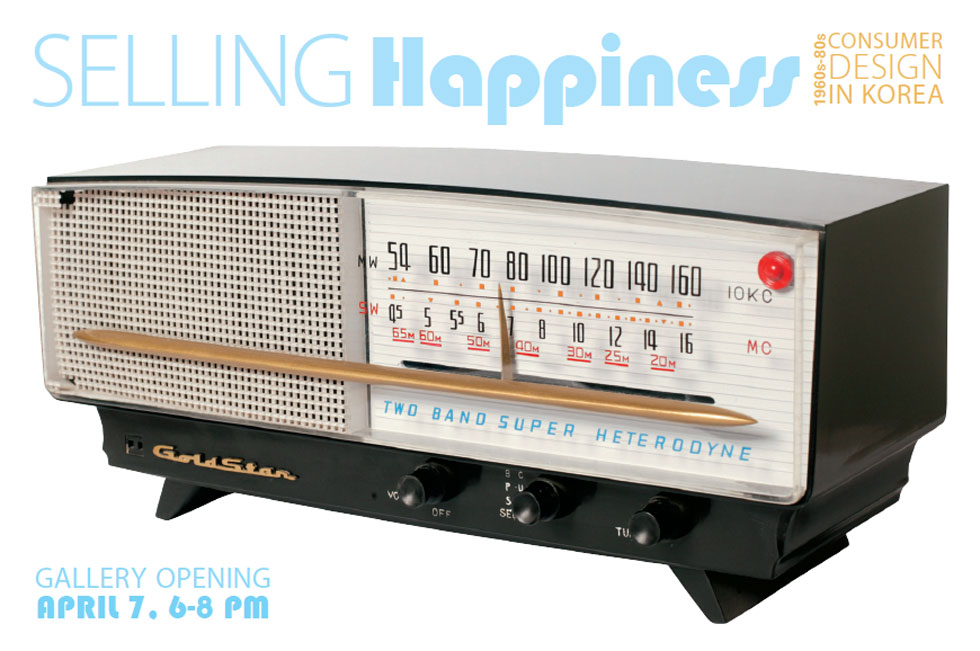
This exhibition is the first in the United States to focus on items associated with Korea’s export-led growth era. It features products and designs from the 1960s, 70s, and 80s, including Korea’s first domestically manufactured radio (the Goldstar A-501), Korea’s first black-and-white television (the VD-19), rice dispensers, cookers, and other kitchen items—even the popular “Italy towel,” employed in homes and bathhouses for a rigorous scrub.



Threading Life: A Lecture by Korean Quilt Master Haeja Kim


2011 03 24 threading life icon

Traditional Korean quilt technique requires keen attention to detail, patience, and dedication. With the arrival of the modern sewing machine, traditional quilting largely disappeared, yet master Kim Haeja remains steadfastly committed to the traditional ways of her craft. Designated Important Intangible Cultural Property No. 107 by the Korean government, Haeja Kim shares life’s lessons learned in the crafting of her quilts and textiles.

Thursday, March 24, 2011
6:30PM Gallery Talk and Q&A

Asia Week 2011 Gallery Talk

THREADING LIFE: A Lecture by Quilt Master Haeja Kim

with

Haeja Kim
Korean Traditional Quilt Artist, Important Intangible Cultural Property No. 107

The Korea Society
950 Third Avenue @ 57th Street, 8th Floor

Mapping Identity: Antiquarian Korean Maps of the MacLean Collection


2011 03 22 mapping identity icon

Richard Pegg, Asian art curator of Chicago’s MacLean Collection, examines Korean maps in a variety of formats, the challenges faced by cartographers, and the formation of multiple identities in Korea during the eighteenth and nineteenth centuries. The MacLean Collection, housed in a private museum outside Chicago, focuses on the cultures of Korea, China, and Southeast Asia.

Tuesday, March 22, 2011

Asia Week 2011 Gallery Talk
Mapping Identity: Antiquarian Korean Maps of the MacLean Collection

10,000 Threads: The Collected Works of Quilt Master Kim Haeja

2011 02 22  10000 threads icon

February 22—March 31, 2011

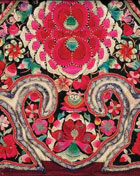
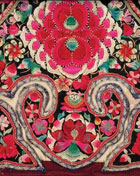
Traditional Korean quilting, with its unique “nubi” line-stitching, is elevated to a high art under the masterful hands of award-winning artisan Haeja Kim. A designated holder of an Important Intangible Cultural Property award by the Korean government for her efforts at preserving Korea’s artistic heritage, Kim meticulously line-stitches layers of batting and fabric into fine garments and coverings. The tiny stitches are employed over each article in a deceptively simple pattern, with smaller stitching highly valued and the mark of a true expert.

Nubi textiles are thought to have originated among Buddhist monks, who valued its strength, simplicity, and insulation against Korea’s frigid winters. Lay people employed it for traditional dress and soldiers for defense against the cold and added physical protection. However, the hand-craft of nubi largely disappeared in modern times with the introduction of the sewing machine.

The items selected for this special showing are grouped in three parts:

Children’s Clothing—February 22–March 4
Adult Clothing—March 7–18
Children’s Ceremonial Clothing—March 21–31

ABOUT THE ARTIST

Master Kim has been breathing new life into the art ever since she surprised visitors to the Korea Annual Traditional Art Exhibition two decades ago with 3mm-5mm nubi stitchwork—a feat, not seen for a century, that won the Prime Minister’s Award. Today, she is much sought after as a teacher and master of the form. In her humble and elegant rural studio, surrounded by attentive student apprentices, she displays a unique dedication to craft, hand-processing her fabrics with natural dyes like indigo, safflower, and charcoal. Her work has been exhibited in Korea, Japan, China, and France. This exhibition at The Korea Society represents Kim’s first major U.S. showing.


Korean Architecture and Design in Convergent Flux


New York City’s first cross-disciplinary exhibition of Korean architecture, landscape design, and urban planning celebrates both globalizing and hybridized conditions in contemporary Korean society. In cooperation with Harvard Graduate School of Design.

Tuesday, December 7, 2010

5 PM | Members Preview

6 PM | Public Reception


Christianity in Korea: A Panel Discussion


2010 12 09 Atlanta iconOn December 10, 2010, The Korea Society hosted a panel discussion at the First Presbyterian Church of Atlanta on the missionary experience in Korea. James T. Laney, former US ambassador to South Korea, led the panel, which included Donald Clark, professor of history at Trinity University, who gave an overview of the history of Christianity in Korea; William Brown, a son and grandson of Christan missionaries to Korea and China, who shared accounts written by missionaries in his family; and the Reverend George Wirth, senior pastor of the First Presbyterian Church of Atlanta, who suggested that American Christians have much to learn from Korean Presbyterians about church growth, management, and missionary work. The program was part of The Korea Society’s Korea Days regional outreach program in Atlanta, Georgia.


All events FREE and courtesy of lead corporate sponsor

pantech logo


Presented in cooperation with:

2010 11 18 world affairs council

2010 11 18 first church

presidental council on nation branding logo

2010 11 18 emory

2010 11 18 asia times

2010 11 18 atlanta film

Through Eastern Windows: Prints by Elizabeth Keith and Traditional Korean Hats

Elizabeth Keith, an intrepid traveler and visionary artist, first ventured to Asia almost a century ago, where she filled travel journals with lively, realistic sketches of Korea and other destinations. At the encouragement of a Japanese publisher, she translated her sketches and watercolors into etchings and woodblock prints. As author of Eastern Windows (1928) and Old Korea (1946), Keith sought to capture a “vanishing Korea,” and her work remains especially relevant today as a view into the Korea of her age.

Accompanying the woodblock prints, etchings, and watercolors on display is an array of traditional hats from the period. From horsehair to bamboo, the materials employed by the contemporaneous Korean artisans add context and texture to Keith’s work. The hats served to connote the wearer’s status, a theme also examined in Keith’s work.

The headpieces are on loan from the Chung Young Yang Embroidery Museum, Korean Art and Antiques, and the collection of Lea Sneider.

The Elizabeth Keith woodblock prints, etchings and watercolor are on loan from the collection of Young-Dahl Song. The attendant photos and postcards are from the collection of Norman Thorpe.

Thursday, October 14


Steel Helmets: U.S. Korean War Graphics & Korean War in Color


The Korea Society marks the 60th anniversary of the start of the Korean War with two exhibitions running June 25 through September 10: Steel Helmets: U.S. Korean War Graphics  and Korean War in Color. Both open six decades to the day of the outbreak of conflict.


Steel Helmets: U.S. Korean War Graphics  features twenty-eight framed graphics—eighteen Korean War film posters and ten comics—from the era. With images ranging from the stark to the romantic, the film posters project images of bravery, climatic extremes, love and loss. The comic-book images, sometimes brutally visceral, portray war in all its hell and heroics. Korean War in Color  features thirty images by famed correspondent and veteran John Rich, now in his 90s. Though most Americans recall the War through black-and-white press photos, the Kodachrome images here show the war in vivid, color detail—images of masses on the move, soldiers in the field, individuals in repose.

Accompanying the gallery exhibitions are a selection of films featured on the exhibition posters, a book signing by legendary photographer John Rich, and a lecture by author Brian Locke.


17 June 1PM All the Young Men (1960)                  
  3PM The Bridges at Toko-Ri (1954)
  5PM Pork Chop Hill
  6PM Press and Member Preview and Reception
     
25 June 1PM The Steel Helmet (1951)
  3PM Battle Hymn (1957)
  6PM Special Signing of the book, Korean War in Color, with author John Rich
     

war_in_color_books

22 July 6PM Hollywood, Race and The Korean War with Professor  Brian Locke

Steel Helmets: U.S. Korean War Graphics and Korean War in Color
June 25-September 10


Korean Masked Dance-Drama: Enchanted Fertility Rite and Social Satire

maskofnightJoin us as Theresa Ki-ja Kim, professor emeritus of theater arts at SUNY Stony Brook, discusses how Korea’s unique tradition of masked dance-dramas masterfully blended fertility rite, social satire, and popular entertainment. Held in conjunction with the exhibition, Masks of Night: Faces from Traditional Korean Dance-Dramas, Kim’s gallery talk will introduce the masked dance-drama, a form of performance that included songs, dances, and dialogues that aimed to satirize the local nobility (yangban) and promote fertility. Her talk will also examine how masked dance-dramas performed at the Korean royal court and throughout the countryside evolved from ancient shamanic rituals into a form of popular theater that helped release the pent-up social frustration generated by the rigid Confucian norms of the Chosŏn kingdom (1392-1910).


Gallery Talk with
Theresa Ki-ja Kim
Professor Emeritus, Department of Theatre Arts, SUNY Stony Brook, New York


ABOUT THE AUTHOR

Theresa Ki-ja Kim is a professor emeritus of theatre arts at SUNY Stony Brook and a Fulbright Scholar of the shamanic origins of theater. Kim’s collection of Korean theatrical masks, on display at Masks of Night: Faces from Traditional Korean Dance-Dramas, is a result of her personal associations with the masked dancers and shamans during years of researching, teaching, producing, and publishing in the fields of traditional Asian theater and shamanism. She holds a Ph.D. in performance studies from New York University.


Masks of Night: Faces from Traditional Korean Dance-Dramas

Koreans expressed their passion and fear through masked dance for hundreds of years.  The dance-drama dates back to shamanic ritual aimed at warding off malevolent spirits and grew into a form of popular entertainment that poked fun at the establishment.

March 4—April 25, 2010

Free and Open to the Public.

The Korea Society Gallery
950 Third Avenue @ 57th Street, 8th Floor 
(Building entrance on SW corner of Third Avenue and 57th Street)

Over the centuries, masked dance evolved from shamanic ritual to popular entertainment.  By the mid-eighteenth century, masked dance was firmly rooted as popular entertainment featuring dance, song and dialogue, with distinct regional varieties on offer.  Masked dance-dramas were staged outdoors and in the countryside as all-night, bonfire-lit events. The performances took place during planting and harvest, to promote fertility, and on the eve of the lunar new year and Buddha’s birthday to ensure good fortune. The dramas also were performed to welcome foreign envoys.

Dancers began by donning the masks—made from gourds, wood, bark, animal fur, cloth, and paper-mâché—and, like their shamanic predecessors, invoking the deities.  What followed was a riotous series of satirical sketches featuring characterizations of wayward monks, pompous playboys, love triangles and farcical noblemen. In this way, the dances functioned as a catharsis for the community, releasing through laughter the pent-up tensions created by the Chosŏn Dynasty’s (1392-1910) rigid moral and social strictures. The performance ended at dawn when the masks were tossed into the bonfire, symbolically expelling misfortune. As a result of this tradition, intact dance-drama masks from the period are exceedingly rare.

This exhibition features traditional dance-drama masks carved by four master artisans in the 1970s and 1980s. The masks here are of four regional types: Pongsan (Hwanghae province in the northwest of North Korea), Songp’a (Seoul), Yangju (north of Seoul), and Tongnae (south of Kyŏngsang province). The exhibition also features reproductions from an original set of Hahoe (Andong) exorcism masks from North Kyŏngsang province. Each regional style has been designated as an Important Intangible Cultural Property of Korea.  Unfortunately, the carving of traditional masks has become a dying skill.  Of the four artisans featured here, only one survives.

The masks in this exhibition are on loan from the collection of Dr. Theresa Ki-ja Kim.


mask1 mask2mask3 mask4mask7