Toy Stories: Souvenirs from Korean Childhood

Toy Stories: Souvenirs from Korean Childhood

Toy Stories: Souvenirs from Korean Childhood


Exhibition

January 31–April 18, 2008

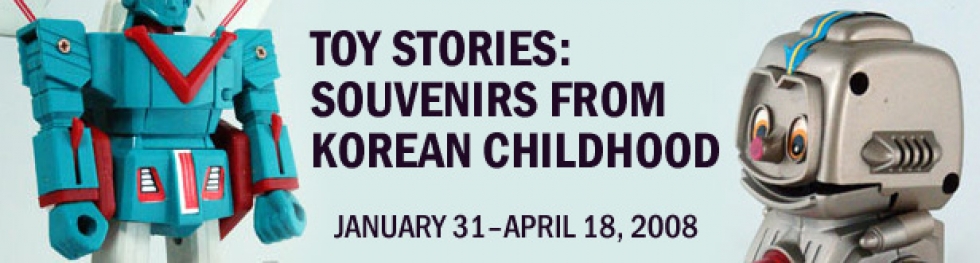
Toys are always more meaningful than the simple playthings they appear to be. They can embody the fantasies, values, obsessions and anxieties of a generation. With Toy Stories: Souvenirs from Korean Childhood, The Korea Society put on display over 90 children’s toys from South Korea in the 1970s and ‘80s. On loan from the Hyeon Tae-Joon Collection in Seoul, the toys—flamboyantly colored action figures, robots, miniature tanks and paper dolls—captured a society in economic and social flux and a generation with rising hopes for the future.

The exhibition debuted on January 31 with an opening reception. Guests admired lines of action figure heroes which, reflecting the economic circumstances of the period, were often bland knock-offs of foreign models. Plastic robots ornamented with futuristic weapons captured viewers’ attention just as they had drawn in a generation of Korean boys, treating them to a sneak preview of a fantastic future where science made anything possible. Korean girls’ futures were more limited, circumscribed by the miniature kitchen and hospital utensils and paper dolls that encouraged them to dream only of becoming housewives or nurses.

Many of the items in the exhibit were modeled on cartoon characters popular in Korea during the period, and in particular, characters drawn from Robot Taekwon V, Korea’s first feature-length animated movie. Throughout its run, Toy Stories: Souvenirs from Korean Childhood was complemented by programs that explored the importance of animation and Robot Taekwon V to Korean youth culture.

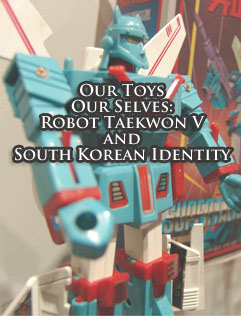
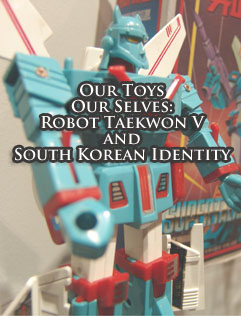
On February 7, Aaron Han Joon Magnan-Park, a professor in the department of film, television and theater at the University Notre Dame, gave a gallery talk titled “Our Toys Our Selves: Robot Taekwon V and South Korean Identity.” Magnan-Park explained how Robot Taekwon V cemented children’s loyalty to an emerging South Korean identity by using a state-sanctioned style of taekwondo to fight off invidious foreign enemies. On March 18, The Korea Society screened Robot Taekwon V for an audience of animation enthusiasts.


Thursday, January 31, 2008 at 5:30 PM

ImageFilm Screening: Robot Taekwon V
Animation feature-film,
Directed by Kim Cheong-gi,
produced by Yu Hyon-mok.
Running time: 79 minutes

When an army of giant mecha attack, young martial-arts champion Kim Hoon must pilot Robot Taekwon V to defend the planet! Inspired by Mazinger Z, a Japanese anime popular in 1970s Korea, Robot Taekwon V was the country’s first full-length animated feature and the first to be digitally restored (1976).


  • Gallery Talk

Thursday, February 7, 2008

Our Toys Our Selves: Robot Taekwon V and South Korean Identity
with
Aaron Han Joon Magnan-Park
Professor of Film, Television and Theatre, University of Notre Dame


Children growing up in South Korea in the1970s faced an overwhelming barrage of cultural influences from the United States and Japan, the nations that, for Koreans, defined the prevailing images of the successful modern industrialized state during the Cold War era. President Park Chung-Hee was determined to bring South Korea into their ranks and, as a means of achieving this goal, adopted an export-driven industrialization policy that laid the economic foundations for the country’s rise to its present status as the 11th largest economic power in the world.

However, merely emulating the American and Japanese models of economic and technological progress could not instill within the Korean population a long-term self-sacrificing work ethic. Rather, the nation needed a Korean-specific hero who could create a vision of a forward-looking, technologized South Korea independent of the type of technological advances that the United States and Japan could already provide.

Kim Cheong-gi’s 1976 animation feature-film Robot Taekwon V signaled a significant contribution in advancing the image of an independent South Korea through the persona of a Korean-specific robot that effectively stands guard against enemies of superior numbers and with access to advanced technology.

This presentation illustrated how the Korean-specific features of Robot Taekwon V encouraged South Korean audiences to celebrate a Korea-centric paradigm of heroism that negated the United States and Japan and more importantly, exorcised the North Korean threat.

About the Presenter

Aaron Han Joon Magnan-Park is an assistant professor in the Department of Film, Television and Theatre at the University of Notre Dame. He specializes in pan-Asian cinema, sound theory, international action cinema and post-colonial theory. He has previously taught at Victoria University of Wellington in New Zealand, Illinois State University, Wesleyan University, University of Iowa, American University of Paris and the University of Paris IV-Sorbonne.


Korean Funerary Figures: Companions for the Journey to the Other World

funerary-ft.jpgExhibition

July 26, 2007 – December 18, 2007


  • “… eye-catching.” – New York Times Art Review,
    “Korea’s Extraordinary Send-Offs for Ordinary People”, August 17, 2007 link
  • “… the artifacts… are truly treasures.” – Japan Times Review,
    “Little Friends for the Other World”, October 11, 2007 link

Death is an aspect of the human condition that touches every culture in every age, and almost all cultures envelop death in a rich artistry as a way of managing the trauma it causes. In nineteenth and early twentieth century Korea, artisans carved joyful wooden figurines depicting acrobats, clowns and mystical animals-which are called kkoktu-to place on the funeral biers of the departed. A collection of 72 kkoktu will be brought to the U.S., for the first time ever, for an exhibition in The Korea Society Gallery. Organized jointly with the Seoul-based Ockrang Cultural Foundation, Korean Funerary Figures: Companions for the Journey to the Other World will run at The Korea Society Gallery from July 26 to November 20, 2007.

The kkoktu are archaeological treasures in their own right. Their costumes and poses reflect the realities of rural Korean village life during a period that left few written records. More importantly, the kkoktu open a window on a timeless, characteristically Korean attitude towards death. Though the gaiety depicted in many of the figurines may seem incompatible with mourning, what they are intended to express is a deep desire that the deceased loved one will enter the next world surrounded by joy. The figurines also embody a sophisticated appreciation of the fleeting nature of all experience.

The show’s opening reception will be held on July 26 at 5:30 PM at The Korea Society Gallery. To provide a cultural context for the exhibition, immediately following the reception, Dr. Laurel Kendall of the American Museum of Natural History will give a Gallery Talk on the shamanic rituals for the dead beginning at 6:30 PM.


“Journey to the Grave, Dance to Paradise: Shamanic Rituals for the Dead”
with Laurel Kendall of the American Museum of Natural History.


ockranglogo.jpg

The Ockrang Cultural Foundation was established by Dr. Ockrang Kim, who also is the founder of the Dongsoong Art Center. In her capacity as chairperson of the Foundation, Dr. Kim has been providing support for culture and the arts since 1992. Under the guiding concept of promoting a contemporary renewal of the cultural traditions of Korea, the Foundation is engaged in a diverse array of projects. Its efforts are directed toward finding ways to support more creative and innovative forms of artistic expression rather than the conventional forms typically supported by the government and large corporations in Korea. In this way, the Foundation is seeking to develop a new methodology for promoting a more authentic Korean culture by funding opportunities for artists to conduct original cultural research and to devote themselves to creative activities. Currently, the diverse projects the Foundation is pursuing include the Ockrang Drama Prize, the Ockrang Documentary Award given in collaboration with the Seoul Women’s Film Festival, the Ockrang-Asian Cultural Council Fellowship awarded in collaboration with U.S.-based Rockefeller Foundation, the Ockrang Kkoktu Museum with its research program, and several other scholarship programs.

‘전통의 현대적 창조’라는 설립이념 아래 다양한 사업들을 펼쳐오고 있는 옥랑문화재단은 동숭아트센터 설립자인 김옥랑 이사장에 의해 1992년에 설립되었습니다. 정부와 대기업 중심의 획일화된 문화예술 지원에서 보다 다양한 문화예술 지원의 통로를 구축하고자 노력해 왔으며, 문화예술 연구 및 창작 활동 공간 지원을 통해 한국적인 문화의 메소드(method)개발을 위해 노력하고 있습니다. 현재 새로운 희곡과 작가를 발굴하는 옥랑희곡상, 여성영화제와 함께하는 다큐멘터리 옥랑상, 미국 록펠러재단과 연계하는 Ockrang-ACC Fellowship, 옥랑꼭두박물관(나무꼭두연구), 장학금사업등 다양한 사업을 펼쳐나가고 있습니다.

Exhibiting Korea

2007 05 24  ExhibitingKorea icon

A New, Monthly Series of Gallery Talk Programs

May 24 – November 16, 2007

Exhibiting Korea, a new monthly series of presentations on the fine arts, film, fashion and photograph of the Korean Peninsula, is debuting in April 2007. Series programs will address contemporary trends in cultural expression in Korea, and take audiences back to important movements they might have overlooked. These gallery talks, given by top experts, critics and artists, will put the colors and shapes of modern Korea on display — and explain the cultural and historical contexts behind them. Please join us.

Date Time Title Speaker
5/24 6:30PM The Forgotten Legacy of the Minjung Art Movement in South Korea Soyang Park
6/7 6:30PM The Modern Boy and Modern Girl in Colonial Korea: 1910-45 Yeon-Shim Chung
7/12 6:30PM Film Screening of A Petal and Q&A with Actress Lee Young-Lan Lee Young-Lan
8/9 6:30PM Film Screening: Im Kwon Tae’s Festival
10/25 6:30PM Dressed to Kill: Women’s Fashion and Body Politics in North Korea Suk-Young Kim
11/16 6:30PM The Kyopo Project Cindy Hwang

Gods, Demons, and Generals: Icons of Korean Shamanism

ImageGods, Demons and Generals: Icons of Korean Shamanism

The exhibition includes representations of Samsin Halmoni 삼신 (Birth Spirit), Sansin 산신 (Mountain God), Taesin Halmoni 대신 할머니 (Great Spirit Grandmother), Yongwang 용왕 (Dragon King), Sinchungdang 신중당 (Guardian Spirits) and images of many other shaman deities. As fixtures of traditional shaman shrines, twelve paintings provide a setting for rites that over the centuries have informed Koreans’ world view and their belief system in both overt and subtle ways. To glimpse the world depicted in these paintings is to gain a unique perspective on Korea’s ancient past and immediate present at once.

 
Gods, Demons and Generals: Icons of Korean Shamanism is available to travel to your school, university, library or museum. Please click for booking information.


Great Spirit Grandmother LonelySaint MountainGod SevenStarsoftheBigDipper SevenStarsoftheBigDipperwithMountainGodDragonKing 

Contents 12 framed paintings, 5 black-and-white and color photographs, text panels and labels
Fee Upon request
Tour Dates Currently available
Running Feet 210 running feet
Loan period 4 to 16 weeks
Crates 1
Weight Approx. 600 lbs.
Category Korean Art / History & Religion
Security Moderate / High
Shipping The Korea Society provides shipping to and from the exhibitor’s venue.
Contact Jinyoung Kim
Senior Program Officer for the Arts
212-759-7525 ext 316
email


Scheduled Venues
Kresge Art Museum, Michigan State University, East Lansing, MI, Sept 8 – October 18, 2009, web


Toured Venues
The Korea Society Gallery, New York, NY, February 28 –  May 31, 2006


Korean Comics: A Society Through Small Frames


Exhibition

September 7 – October 28, 2005

ryok_to_san_cover.jpgThis exhibition examined the changing social realities of Korean society from the 1950s to the 1990s through a selected reading of Korea’s most popular comic books. Featuring the works of 17 of the best-known artists, the exhibition offered a running commentary that reflected the lives of ordinary people—at once joyful, satirical and penetrating. What shines through these works most prominently is an engaged and vigorous civil society in Korea, continuously challenging and energizing the status quo in whimsical and provocative ways. By so doing, they play an important role in characterizing and distinguishing the culture, sensibility and sentiment of modern Korea.

Comics were first popularized in Korea in serialized newspaper strips during the 1960s, when the works of Kim Seong Hwan and others entered the idiom of everyday life. In doing so, they helped shape popular culture during the military dictatorship of former president Park Chung Hee (1961-1979). Later, Park Jae Dong produced serials in the liberal paper, Hankyoreh, under former presidents Chun Doo Hwan (1980-1988) and Roh Tae Woo (1988-1993). In contrast to the oppressive political atmosphere, the comic genre Myongnang Manhwa (“Cheerful Comics”) gave expression to a new popular culture in a rapidly transforming society. The humor and exuberance it expressed contrasted sharply with the pervading sense of social repression, stemming from censorship of the media and tight government control of most aspects of society. Slicing through the heavy atmosphere, Myongnang Manhwa provided not only a welcome relief but also penetrating social and political commentary. Cartoonists such as Kil Chang Dok, Kim Su Jung, Kim Won Bin, Park Ki Jeong, Park Su Dong, Shin Mun Su, and Yoon Sweng Un described common and seemingly banal episodes in everyday life while masterfully engaging the public with biting and witty commentary. At the time, a given comic’s popularity was a gauge of South Korea’s national pulse. The storylines of comics were sometimes built around historical content. Kim Yong Hwan, Ko Wu Young, and Lee Du Ho all popularized the history of ancient Korea, making it accessible to a wide range of audiences, both young and old. The rapid growth in popularity of historically based comics after the Korean War provides important clues as to the development of people’s identities vis-a-vis the emerging Korean state. Other cartoon artists in the exhibition drew comics that dealt with various contemporary social and cultural themes during the 1970s and 1980s. Heo Young Man, Kim Hyung Bae, Lee Hyun Se, Oh Se Young, and Park Bong Seong delved into topics ranging from Korea’s economic growth during the ’70s, to the resulting urban and rural divide, to the Vietnam War. Through these works, it is possible to see the decades-long social evolution of Korea in small frames.

The masterful drawing and writing of the featured artists provide a running commentary, at once joyful, satirical, penetrating, and reflect the lives of ordinary people. There were two related events held in conjunction with this exhibition. The first was an opening reception on September 7, 2005 that featured a lecture entitled “Life and Comix: 1960s Korea” by Heinz Insu Fenkl, director of the creative writing program and Interstitial Studies Institute at SUNY New Paltz. The second event was a screening of Empress Chung, a path-breaking Korean animation feature based on a classic Korean folktale, which was presented at The French Institute on September 21, 2005.

This exhibit is currently showing at art and cultural institutions nationwide. Click here to see where it is now, or to have it shown at your location.


The Meaning of Dragons in Korean Folklore

2005 02 02  MeaningofDragons icon

To mark the opening of an exhibition of Korean dragon paintings, author and folklore specialist Heinz Insu Fenkl, director of the Interstitial Studies Institute at SUNY New Paltz, lectured on dragon symbolism in both the East and West. Due to its association with serpents in the Old Testament, he explained, the dragon was considered a creature of evil in the West. In the folklore of the East, however, the dragon was viewed as auspicious and usually was depicted as a magical creature of unsurpassed power and vitality.

Fenkl went on to elucidate the subtle but important differences between Korean dragon iconography and the more widely known Chinese dragon imagery. Dragon mythology originated in ancient China, Fenkl noted. The legendary founder of Chinese civilization, Fu Hsi, was said to be half-man, half-dragon. After the folklore disseminated to the Korean Peninsula, however, local artists and storytellers made their own adaptations. Compared with their Chinese counterparts, Korean storytellers placed more emphasis on the spiritual powers of dragons. In fact, dragons play a role in many of the most important Korean myths and fables even though they generally are assigned to peripheral roles where their actions reflect the virtues of the main characters. Fenkl described one important figure, the Dragon King, who was said to live in a palace beneath the sea and was generous and welcoming to a fault. Dragons are still omnipresent in modern day Korea: on billboards and logos and in brand names and commercials. Unfortunately, while Koreans recognize them, these days knowledge of the folklore behind these cultural icons is fading. “This is all the more reason,” Fenkl concluded, “to take the time to really study the paintings hanging in the gallery.”

Gallery Talk

with

Heinz Insu Fenkl
Director, Interstitial Studies Institute, SUNY New Paltz

Wednesday, February 2, 2005


Dragon 1 (Detail-E)s

Picture from the exhibition,
Songs of Flying Dragons. (February 2-April 15, 2005)

Artist Unknown
Dragon Amidst Clouds
Ink on paper, 19th C
33 (H) X 58 (W) inches
Collection of Lea Sneider

A dragon’s body is usually partially hidden since human beings are not supposed to view its entire body. In this depiction clouds are used to hide the dragon; in other cases, waves provide cover.


Songs of the Flying Dragons


Exhibition

February 2 – April 10, 2005

This exhibition included four paintings of Korean dragons and a pair of dragon sculptures on loan from the Lea Sneider Collection. All the pieces mixed strict formalism with unexpected creativity. Two of the paintings depicted dragons as benevolent bringers of rain, symbolized by a dragon surrounded by clouds. A third painting depicted a dragon with carp swimming placidly beneath it, instead of jumping and striving to reach the heavens and become a dragon, as is usually the case. The fourth painting depicted a dragon hovering over two human figures. This was the “mystery” painting of the exhibition as it is very rare for human beings to be depicted in a dragon painting. Lastly, the exhibition included a pair of dragons that collectors believe once served as temple guardians. The Songs of the Flying Dragons exhibition debuted with a gallery talk by Heinz Insu Fenkl, director of the creative writing program and Interstitial Studies Institute at SUNY New Paltz.


A State of Mind: Life in North Korea

 2005 01 25  StateofMind icon

This program featured the screening of a documentary by award-winning producers Dan Gordon and John Battsek, which premiered on the PBS program, Wide Angle, on September 11, 2003. The documentary provides a rare, and surprising, glimpse into the individual and family life underneath the monolithic veneer of North Korean society. A Q&A session with Charles Armstrong, associate professor, Department of History, Columbia University, and Wide Angle Executive Producer Stephen Segaller followed the screening. Ambassador Donald P. Gregg served as the moderator for the program.

Tuesday, January 25, 2005

A State of Mind: Life in North Korea

with

Charles Armstrong
Associate Professor, Department of History, Columbia University,

Stephen Segaller
Executive Producer, Wide Angle

Moderated by

Donald P. Gregg
Ambassador