James Church’s Inspector O novels have been hailed as “crackling good” (The Washington Post) and “tremendously clever” (Tampa Tribune), with Church himself embraced by critics as “the equal of le Carre” (Publishers Weekly). Now Church—a former Western intelligence officer who pulls back the curtain on the hidden world of North Korea in a way no one else can—comes roaring back with a new series featuring Inspector O’s nephew, Bing, the director of state security in a region in northeast China bordering North Korea. When clues point to a beautiful woman’s disappearance and Bing’s sensitive assignment to bring an agent across the North Korean border, O reluctantly helps him navigate an increasingly complex and deadly maze. James Church has crafted a beautifully spare prose and layered descriptions of a country and a people he knows by heart. Don’t miss this very special hour.
Dr. David R. McCann, Korea Foundation Professor of Korean Literature at Harvard University, reveals the unique correlation between 20th century Korean photographs and modern Korean poetry through examples from Traces of Life: Seen Through Korean Eyes 1945-1992, the current exhibition at The Korea Society Gallery.
Friday, November 9, 2012
6:30 PM
Traces of Life interpreted through Korean Poetry
with David McCann Korea Foundation Professor of Korean Literature at Harvard University
Share in a musical global journey with virtuoso Mina Um, who took first at the Seventh Annual New York Music Competition and performed after at Carnegie Hall. She appeared as a soloist with the Hartford Symphony Orchestra, Boston Festival Orchestra and Farmington Valley Symphony. As a member of the Juilliard Orchestra, she performed again at Carnegie Hall and Lincoln Center. Having appeared on ABC and in New York Magazine, Ms. Um performs works by Bach (Sonata No. 3), Paganini (Caprice No. 21, Op. 1), Piazzolla (Tango Etudes), and Yun Isang (Das Vogenchen from Li-Na im Garten). In preparing for her debut at TKS, Ms. Um hints, “My violin is my time machine. With it, I travel through time and around the world.”
Join literary lion Young-ha Kim as he discusses the release of Black Flower. This powerful drama creates fiction from a little-known historical moment when a thousand Koreans flee war and the loss of their nation before colonial annexation. The travelers endure harsh seas for the promise of land in Mexico, but soon discover they’ve been sold into indentured servitude. Aboard ship, an orphan, Ijeong, falls in love with the daughter of a noble; separated when the various haciendados claim their laborers, he vows to find her. After years of working in the punishing heat of the henequen fields, the Koreans are caught in the midst of the Mexican Revolution. Some flee with Ijeong to Guatemala, where they found a New Korea amid Mayan ruins. A tale of star-crossed love, political turmoil, and the dangers of seeking freedom in a new world, Black Flower is an epic story by the award-winning Kim.
Tuesday, October 30
5:30PM Registration & Reception 6:00PM Discussion
with
Young-ha Kim, Author of Black Flower
Moderated by Dr. Stephen Noerper, Senior Vice President, The Korea Society
Seventeen-year-old Wan-deuk has every reason to be a rebellious and troubled student. Though he has a disabled father, a runaway mother, and comes from a desperately poor family, he never loses a fight. Wan-Deuk meets teacher Dong-Joo, who inspires him take up kickboxing.
‘Korean Cinema Now’ will be presented at the newly renovated Museum of the Moving Image, home to New York City’s finest, state-of-the-art screen. Films are free with museum admission. This tribute is made possible by the New York State Council on the Arts with the support of Governor Andrew Cuomo and the New York State Legislature. Taxi 10 minutes from The Korea Society or NQ Train Outbound to 36th Ave., 36th Street and 35th Avenue, Astoria.
Wan-deuk-i (Punch) 2011, 107 min.
Director: Lee Han Starring: Yoo Ah-in, Kim Yun-seok
Sunday, October 28, 2012 5 PM
The Museum of the Moving Image 35th Avenue at 37th Street, Astoria From midtown, taxi or N/Q Train outbound to 36th Avenue
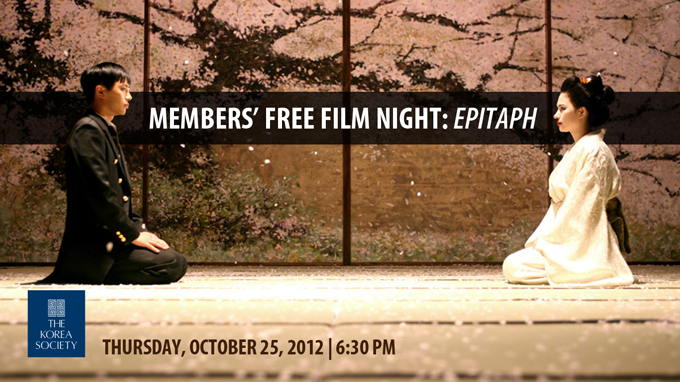
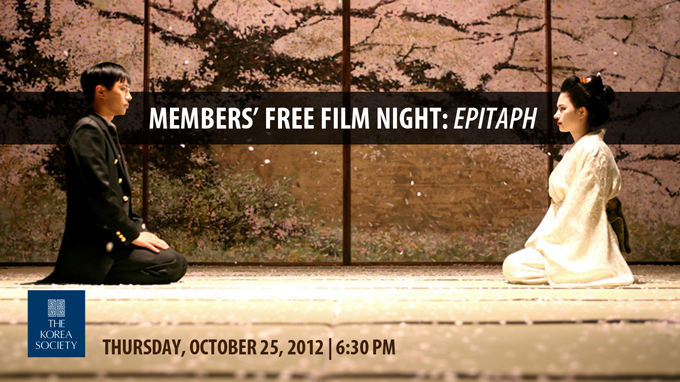
If you haven’t seen K-Horror, then you don’t know what scary is! To set the mood for Halloween, we will be screening Epitaph, a Korean horror film famous for its intricate plot and visually stunning cinematography.
The film begins in 1979, as an old doctor reminisces about his days as a medical student at the famous Ahn Seng Hospital in Seoul during the Japanese occupation of Korea. Through flashbacks, three frightening stories unfold. Full of twists, scary images, and jarring sound effects, “Epitaph” is a psychological thriller mixed with distinctly traditional Korean images of horror.
Epitaph, the directorial debut of the brothers Jung Sik and Jung Beom-sik, received the 2007 Blue Dragon Award for Best Film.
Celebrate Korea as a center of excellence in the classical arts with a short concert by virtuosa Jia Kim, who performs Bach’s Cello Suite No. 3 in C Major and Cassado’s Suite for Cello Solo. Kim began cello at eleven in Korea, where she took first in the Korean Music Association Competition, National Symphony Orchestra Competition, and Young Musician Foundation’s National Debut Concerto Competition. She has performed at Carnegie Hall, the Metropolitan Museum of Art, Avery Fischer Hall, Chicago Symphony Center’s Orchestra Hall, Alice Tully Hall, Miami’s Arsht Center, Valle De Bravo, Mexico, Toronto’s Royal Conservatory, and the Walt Disney Concert Hall in Los Angeles.
The Korea Society proudly presents Barame Soop (Forest, Wind and Rain) performed by the Sonagi Project. One of the leading percussion groups in Korea, the Sonagi Project consists of five musicians led by Chang Jea Hyo. The group has created modern, original music on the basis of Korean traditional rhythms and chants. Barame Soop concerts are built around changgo (two-headed, hourglass shaped drums), ching (gongs), and p’ansori (narrative, story-telling folk opera), performed with an assumed liberty regarding the musical techniques and the forms of the ancient rhythms. Inspired by Korean Shamanism and the vocal art of p’ansori, Sonagi’s performances express exciting emotions from the deep bottom of the Korean heart with dynamic energy of Korean traditional music.
LIVE HOUSE KOREA is made possible with the support of the New York State Council on the Arts.
Friday, October 5, 2012 6:30 PM
Barame Soop Performed by Chang Jae Hyo & The Sonagi Project
For more information, contact: Jinyoung Jin or call (212) 759-7525 ext. 316.
Christopher Phillips, Curator of International Center of Photography, speaks about the explosive development of Korean photography in the late twentieth century. This talk is presented in conjunction with the current exhibition, Traces of Life: Seen Through Korean Eyes 1945-1992.
Thursday, October 4, 2012
6:30 PM
Recent Directions in Korean Photography: The New Internationalism
with Christopher Phillips Curator of International Center of Photography
Yeonghwa is the Korean word for film, and since South Korean cinema now features prominently in every major international film festival, it is a good word for cineastes to know. Korean film tends to blend technical excellence with idiosyncratic expression and an entrepreneurial spirit—filmmakers often write and direct their work, and both actors and filmmakers benefit from the country’s homegrown “star system”—while embracing a wide variety of styles and subjects. Korean cinema is generally made for a national audience, so its vision is rarely diminished by compromises in the name of global appeal.
This third edition of Yeonghwa includes several distinctive contemporary narratives—from superior genre films to unclassifiable features by some of Korea’s renegade filmmakers—along with two features, drawn from MoMA’s collection, by Korean film pioneer Shin Sang-ok.
Trailer credit: Bongkeun Kwon
Introduction and all film summaries: Laurence Kardish, Senior Curator of Film, MoMA
This program is supported, in part, by public funds from the New York City Department of Cultural Affairs in Partnership with the City Council.
Thursday, September 20 through Sunday, September 30
MoMA (Museum of Modern Art) 11 West 53 Street, New York, NY 10019 (212) 708-9400 http://www.moma.org
Directed by Shin Sang-ok. Screenplay by Shin Bon-seung. With Kim Seo-ra, Choi Yoon-seok, Lee Hak-jae. Shin’s first film after his escape from North Korea is about the North Korean operative Kim Hyun-hee, who bombed a South Korean passenger plane in 1987. In Korean; English subtitles. 120 min.
Directed by Shin Sang-ok. Screenplay by Lim Hee-jae, based on the novel The Lodger and My Mother by Chu Yosup. With Kim Jin-kyu, Choi Eun-hee, Kim Hee-kap, Do Kum-bong. In this understated melodrama, a widow, in order to support herself and her young daughter, rents a room to a painter from the city and soon finds herself torn between her growing affection for the man and the constraints of rural society. In Koreal English subtitles. 103 min.
Written and directed by Hong Sang-soo. With Isabelle Huppert, Kwon Hye Hyo, Jung Yu Mi . Hong Sang-soo, a favorite of film critics and international film festival programmers, makes one of his most charming, gentle and graceful comedies with In Another Country. The ‘other country’ is South Korea, a nation whose behaviors, particularly between women and men, Hang Sang-soo understands so well and treats with smiling affection. And finding herself in this ‘other country’ is Anne, a Frenchwoman played by the irresistible Isabelle Huppert, who travels to a somewhat empty seaside town. Why she comes here, who she really is and whom she meets is told three times in different story variations, all ‘scripted’ by a young woman in economic difficulty. The play of parallel narratives is exquisite, and In Another Country is a luminous bagatelle. In Korean, French and English with English subtitles. Courtesy of Kino Lorber. 89 min.
Written and directed by Byun Young-joo, from the novel All She Was Worth by Miyabe Miyuki. With Lee Sun-kyun, Kim Min-hee, Cho Seong-ha, Kim Byeol. When a woman disappears just before her wedding, her hapless fiancée enlists his detective cousin to find her, and they find unsettling answers in a corrupt economic system. This surprising thriller, adapted from a Japanese bestseller by a filmmaker best known for feminist nonfiction films, provides an original perspective on debt. In Korean; English subtitles. 117 min.
Written and directed by Yang Jeong-ho. With Mun Jeong-ung, Kim Chang-hwan, Shin Jae-seung. After a night of celebratory drinking, a successful author wakes up on a train with no money or papers. Yet when he finally does find his bag, it’s a bag that has been missing since his childhood, and the search for his missing present becomes a journey into a dark past. Yang’s debut feature is a compelling, semi-supernatural thriller about one man’s return “home.” In Korean; English subtitles. 83 min.
Directed by Lee Sang-cheol, Shin A-ga. Screenplay by Shin. With Hwang Jeong-min, Han Song-hee, Kim Mi-hyang, Lee Jong-yoon. Jesus Hospital’s original title is Korean for “mink coat”—an object that has passed down to a girl who believes she has received a message from God through her grandmother, who is on life support and wishes to die. Set around Christmastime in Seoul, the film delves into the emotional dynamics of a Christian family. One of the best-reviewed and most popular Korean films of the year, Jesus Hospital won the country’s main acting awards for two of its leading actresses, Hwang and Han. In Korean; English subtitles. 91 min.
Directed by Ahn Sang-hoon. Screenplay by Choi Min-suk, Ahn Sang-hoon, Andy Yoon. With Kim Ha-neul, Yoo Seung-ho, Jo Hee-bong, Yang Yeong-jo. Director Ahn expertly mixes chills and affection in Blind, a superior genre film in the psychotic-killer-stalker mode. The potential victim here may be blind, but she is no weak and tremulous lady. Trained as a cop, the tough, resourceful young woman has known enough adversity for a lifetime—and she has a dog. In Korean; English subtitles. 111 min.
Written and directed by Park Hong-min. With Lee Jang-hoon, Kim Sun-bin, Choi So-eun. In this 3-D “metaphysical adventure,” a professor of logic learns that his wife, whom he didn’t even realize was gone, has been found in another city. He leaves to reunite with her, only to learn that she has become a shaman on a distant island. The strange news disturbs the logician—and gradually alters his relationship with reality. Park’s first feature suggests that 3-D may in fact reflect a third dimension where ghosts and talking fish inhabit the world quite naturally. In Korean; English subtitles. 105 min.
Written and directed by Kim Kyung-mook. With Paul Lee, Yeom Hyun-jun, Kim Sae-byeok, Lim Hyung-kook. The “stateless things” in the title of documentarian Kim’s first narrative feature are three marginalized young people in Seoul: a teenage North Korean defector and a Chinese Korean girl who occasionally do odd jobs together, and a gay hustler who, for a while anyway, has a lovely apartment and a sugar daddy. At once harsh and dreamy, the film treats its dispossessed characters with a hopeful empathy, bringing them together in a fresh and provocative manner. In Korean; English subtitles. 118 min.
Directed by Jeon Jae-hong. Screenplay by Kim Ki-duk. With Yoon Kye-sang, Kim Gyu-ri, Kim Jong-soo, Han Gi-jung. Jeon was an assistant to filmmaker Kim Ki-duk, who wrote and produced this film and whose influence is at once palpable and subordinate to Jeon’s own talent. Poongsan, who does not speak, carries messages back and forth between separated families in North and South Korea. When he is enlisted to smuggle the mistress of a high-ranking North Korean defector out of the North, passion intervenes, and an unexpected, “crazy” love threatens political chaos. In Korean; English subtitles. 121 min.
Directed by Jeon Soo-il. Screenplay by Jeon Kim Kyung. With Lee Seung-yeon, Seo Kap-sook, Park Hyeon-woo, Kang San-eh. Among a clutch of derelict buildings sits Pink, a condemned bar that caters to drifters and lost souls. Jeon’s eighth feature is a portrait of a struggling small business, the world-weary middle-aged woman who runs it, and her dwindling clientele. In Korean; English subtitles. 97 min.
Written and directed by Jeon Kyu-hwan. With Yoon Dong-hwan, Choi Won-jung, Shin Ye-an, Nollaig Walsh. Jeon, whose Town Trilogy (Mozart, Dance, and Animal) was a highlight of last year’s Yeonghwa, returns with a steamy and explicit melodrama that moves beyond Korea to India and even the Middle East. A married executive in Seoul has an affair and, eventually, so does his wife—with a foreign worker. Secrets multiply, and what began as personal betrayals become explosive global incidents. In Korean; English subtitles. 96 min.
Written and directed by Lee Sang-woo. With Won Tae-hee, Cha Seung-min, Kim Hun, Lee Yong-rye. A graduate of both UC Berkeley and the Kim Ki-duk “school” of filmmaking, Lee, one of Korea’s maverick multitasking filmmakers, makes his Yeongwha debut with this sensual melodrama. In a vivid exploration of the notion of karma, a Buddhist monk loses control. The calamitous results are followed, perhaps, by redemption. In Korean; English subtitles. 99 min.









 James Church’s Inspector O novels have been hailed as “crackling good” (The Washington Post) and “tremendously clever” (Tampa Tribune), with Church himself embraced by critics as “the equal of le Carre” (Publishers Weekly). Now Church—a former Western intelligence officer who pulls back the curtain on the hidden world of North Korea in a way no one else can—comes roaring back with a new series featuring Inspector O’s nephew, Bing, the director of state security in a region in northeast China bordering North Korea. When clues point to a beautiful woman’s disappearance and Bing’s sensitive assignment to bring an agent across the North Korean border, O reluctantly helps him navigate an increasingly complex and deadly maze. James Church has crafted a beautifully spare prose and layered descriptions of a country and a people he knows by heart. Don’t miss this very special hour.
 Dr. David R. McCann, Korea Foundation Professor of Korean Literature at Harvard University, reveals the unique correlation between 20th century Korean photographs and modern Korean poetry through examples from Traces of Life: Seen Through Korean Eyes 1945-1992, the current exhibition at The Korea Society Gallery.
 Share in a musical global journey with virtuoso Mina Um, who took first at the Seventh Annual New York Music Competition and performed after at Carnegie Hall. She appeared as a soloist with the Hartford Symphony Orchestra, Boston Festival Orchestra and Farmington Valley Symphony. As a member of the Juilliard Orchestra, she performed again at Carnegie Hall and Lincoln Center. Having appeared on ABC and in New York Magazine, Ms. Um performs works by Bach (Sonata No. 3), Paganini (Caprice No. 21, Op. 1), Piazzolla (Tango Etudes), and Yun Isang (Das Vogenchen from Li-Na im Garten). In preparing for her debut at TKS, Ms. Um hints, “My violin is my time machine. With it, I travel through time and around the world.”
 Join literary lion Young-ha Kim as he discusses the release of Black Flower. This powerful drama creates fiction from a little-known historical moment when a thousand Koreans flee war and the loss of their nation before colonial annexation. The travelers endure harsh seas for the promise of land in Mexico, but soon discover they’ve been sold into indentured servitude. Aboard ship, an orphan, Ijeong, falls in love with the daughter of a noble; separated when the various haciendados claim their laborers, he vows to find her. After years of working in the punishing heat of the henequen fields, the Koreans are caught in the midst of the Mexican Revolution. Some flee with Ijeong to Guatemala, where they found a New Korea amid Mayan ruins. A tale of star-crossed love, political turmoil, and the dangers of seeking freedom in a new world, Black Flower is an epic story by the award-winning Kim.
 Seventeen-year-old Wan-deuk has every reason to be a rebellious and troubled student. Though he has a disabled father, a runaway mother, and comes from a desperately poor family, he never loses a fight. Wan-Deuk meets teacher Dong-Joo, who inspires him take up kickboxing.


 The Korea Society proudly presents Barame Soop (Forest, Wind and Rain) performed by the Sonagi Project. One of the leading percussion groups in Korea, the Sonagi Project consists of five musicians led by Chang Jea Hyo. The group has created modern, original music on the basis of Korean traditional rhythms and chants. Barame Soop concerts are built around changgo (two-headed, hourglass shaped drums), ching (gongs), and p’ansori (narrative, story-telling folk opera), performed with an assumed liberty regarding the musical techniques and the forms of the ancient rhythms. Inspired by Korean Shamanism and the vocal art of p’ansori, Sonagi’s performances express exciting emotions from the deep bottom of the Korean heart with dynamic energy of Korean traditional music.
 Christopher Phillips, Curator of International Center of Photography, speaks about the explosive development of Korean photography in the late twentieth century. This talk is presented in conjunction with the current exhibition, Traces of Life: Seen Through Korean Eyes 1945-1992.
 Yeonghwa is the Korean word for film, and since South Korean cinema now features prominently in every major international film festival, it is a good word for cineastes to know. Korean film tends to blend technical excellence with idiosyncratic expression and an entrepreneurial spirit—filmmakers often write and direct their work, and both actors and filmmakers benefit from the country’s homegrown “star system”—while embracing a wide variety of styles and subjects. Korean cinema is generally made for a national audience, so its vision is rarely diminished by compromises in the name of global appeal.


