





Korean Through Folktale Workshop

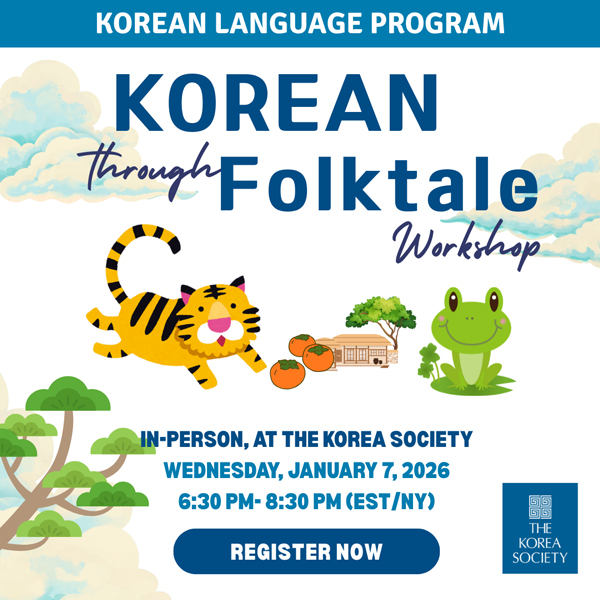
Korean Through Folktale Workshop
For learners who can read Korean alphabet.

Date: Wednesday, January 7, 2026, 6:30-8:30 PM (EDT)
Mode: In person, At The Korea Society
Instructor: Sabina Rowe
Material will be provided. 

Instruction will be provided in both English and Korean.


This interactive workshop introduces learners to two classic Korean folktales of “청개구리 (The Green Frog) ” and “호랑이와 곶감 (The Tiger and the Dried Persimmon).” The grammatical focus is on the basic past tense forms, taught within meaningful story contexts. Learners will also practice connective expressions as well as simple emotion-related expressions. Through these activities, participants will develop the ability to follow the flow of a story and understand its meaning. Ultimately, the goal of the workshop is to support learners in expressing their own thoughts in Korean using short, meaningful sentences.


For any inquiries, please email us at language@koreasociety.org.

Note: Korea Society membership discounts apply only to 8-week or 10-week courses, and not to this workshop


Biases blind us to the risk of Chinese military intervention in Korea 

8/16/2023 

In an article published by the Atlantic Council, Biases blind us to the risk of Chinese military intervention in Korea, Korea Society policy director Jonathan Corrado examines the historical record to highlight the cognitive biases that have plagued US intelligence assessments, with a particular focus on failures preceding China’s intervention in Korea over 70 years ago. Corrado warns that the “alchemy of cognitive and organizational biases is uniquely suited to advantage a PRC self-defensive counterattack strategy,” and offers some suggestions for how to avoid those pitfalls.

Indo-Pacific Strategies and Foreign Policy Challenges The US-China Strategic Competition

6/30/2023

Indo-Pacific Strategies and Foreign Policy Challenges
The US-China Strategic Competition

In a new Routledge book titled Indo-Pacific Strategies and Foreign Policy Challenges: The US-China Strategic Competition, Korea Society policy director Jonathan Corrado contributes a chapter, “Strengthening Indo-Pacific Chip Supply Chain: Opportunities and Obstacles for a Tech Alliance.”

South Korea as a Global Vaccine Hub

10/27/2022

In a submission for the 2022 KEI Academic Paper Series, Coauhors Tom ByrneClaire CallahanIrene Kyoung, and Salomé Da Silva Duarte Lepez explore South Korea’s aspiration to achieve the status of global vaccine hub as a national strategic policy priority. The paper first outlines the characteristics of a global vaccine hub and a WHO biotechnology hub, touches on collaborative vaccine efforts in Asia, and then discusses the institutional structure of South Korea’s global vaccine hub and the country’s Covid-19 partnerships. The paper provides an overview of global vaccines, including Covid-19 vaccine production, showing where South Korea fits into that ecosystem, and summarizes global vaccine diplomacy efforts. The paper notes the laudable achievements of Operation Warp Speed in the U.S. (and in the presentation, the Vaccine Task Force in the U.K.) in rapidly producing safe and effective vaccines early in the pandemic, although vaccine nationalism inevitably prevailed as global demand exceeded supply. The paper also notes the shortcomings of national and bilateral vaccine diplomacy, as well as multilateral mechanisms, in providing vaccine access and ensuring equity. It concludes that South Korea’s demonstrated capabilities to rise as a global vaccine development, manufacturing, and training hub will help bolster global public health capacities in the future.

Click here to read.

To watch the paper presentation program, click here

How the United States can build a chip alliance in Northeast Asia without decoupling

9/12/2022

In an article co-authored with Major Jessica Taylor for Pacific Forum PacNet, Korea Society policy director Jonathan Corrado discusses how the United States can build a chip alliance in Northeast Asia without decoupling. They write that “a successful collaboration will address risks to key points of the semiconductor supply chain by adding rigor to the system, ensuring continued access to supply, and maintaining an environment of innovation… The effort will fall short if the alliance cannot address members’ concerns and respond to the risks posed by the People’s Republic of China without tripping down the slippery slope of technological decoupling.”

Click here to read.

To download the article as PDF, click here

Can Korea Join the Quad? How Should the Group Evolve?

7/29/2022

In an article for Korea On Point by The Sejong Institute, Korea Society policy director Jonathan Corrado discusses how the timing of Korea’s enhanced engagement with the Quad will be shaped by domestic political factors, changes in the regional security environment, and the preferences of the Quad member countries. He writes, “Korea’s ability to engage in this emerging security group will not merely be a test of its ambitions, but will also serve as a measure of the Quad’s durability and effectiveness.” Corrado uses the results of an expert survey administered as part of a Pacific Forum fellowship to reveal areas of both considerable symmetry and stark differences between U.S. and Korean experts. He concludes that, “It will be important to interrogate these divergences to optimize the Quad’s success.”

The article is available here.

Ideology and Economic Policy in North Korea

5/5/2022

Korea Society policy director Jonathan Corrado published an article for Ideology and Economic Policy in North Korea, published by the North Korea Economic Forum (NKEF) at George Washington University’s Institute for Korean Studies (GWIKS). In an article titled, “Rose-Colored Glasses: The Information Ecosystem’s Influence on Generational Variation in Attitudes on North Korea’s Economic Management,” Corrado assesses a generational variation in North Korean attitudes about the government’s economic management, using survey data to find that the younger cohort has become more positive. Corrado’s analysis offers a basis for further investigation, suggesting that the young cohort has become more positive in their views of the leadership’s economic management because their lack of market experience makes them vulnerable to changes in the information ecosystem, including a concerted youth loyalty campaign and a reduction in the availability of foreign information.

The volume is available here.

Next Generation Perspectives on Korean Peninsula Security

12/15/2021

Korea Society policy director Jonathan Corrado writes about “Strengthening US-South Korea Cooperation on Semiconductor Supply Chain Resilience and Innovation” for an edited volume of the Emerging Leaders’ policy papers on Next Generation Perspectives on Korean Peninsula Security published by The National Committee on American Foreign Policy (NCAFP).

The volume is available here.

Rethinking Intelligence Failure: China’s Intervention in the Korean War

7/14/2021

Policy Director Jonathan Corrado published an article titled “Rethinking Intelligence Failure: China’s Intervention in the Korean War” in The International Journal of Intelligence and CounterIntelligence. The article evaluates how the U.S. Intelligence Community and policymakers failed to predict and prepare for China’s entrance into the Korean War and North Korea’s invasion. Diplomatic cables, personal accounts, and declassified national security documents reveal that warnings about possible intervention were undercut by contradicting analysis. Cognitive bias led to faulty assumptions and ambiguous conclusions. The negative effects of bias and politicization were mutually reinforcing, imperiling the efforts of actors who tried in vain to address them. Lessons gleaned from this history shed light on insights for persistent security challenges, such as the relationship between miscalculation and escalation and the difficulty of knowing one’s adversary, as well as America’s present strategic competition with China.

The article is available here.

South Korea’s Demographic Advantage is Over: The Regional Context and the Economic and Security Implications

7/2/21 |  
Pacific Forum |

Issues & Insights Vol. 21, WP 10 — South Korea’s Demographic Advantage is Over: The Regional Context and the Economic and Security Implications
 
In a paper for Pacific Forum’s Issues & Insights, president Tom Byrne and policy director Jonathan Corrado write on the economic and security risks South Korea’s low birth rate poses to its future, writing that “South Korea will have to make tough policy and fiscal choices, unless it can achieve another ‘Miracle on the Han’ —this time overcoming its demographic challenge.”

For PDF, click here