










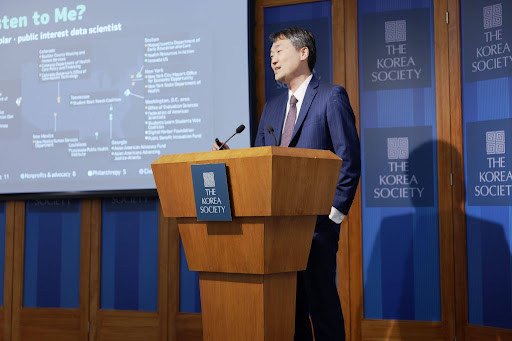
In this Korea Society program, Dr. Jae Yeon Kim, Assistant Professor of Public Policy at the University of North Carolina at Chapel Hill and recipient of the 2026 Sherman Family Korea Emerging Scholar Lecture Award, examines how artificial intelligence can improve public services. Drawing on research and experience in civic technology, Kim compares government systems in South Korea and the United States, explores the risks of prioritizing efficiency over public needs, and proposes an approach centered on accessibility, accountability, and citizen feedback.
Key Takeaways:
1. Effective Digital Government Requires Policy Reform, Not Just Better Technology
The barriers people encounter when accessing public services often originate in administrative rules and institutional structures rather than outdated technology alone. Comparing fragmented U.S. benefit systems with South Korea’s centralized digital services, Kim demonstrates how policy choices shape technological design. Adding AI without addressing underlying procedures risks automating existing burdens rather than making government more accessible.
2. South Korea’s Efficiency Trap Reveals the Limits of Centralized Innovation
South Korea’s ability to deploy digital services nationally enables rapid implementation, but it can also entrench design flaws that become difficult to reverse. Kim’s analysis of government app reviews highlights persistent authentication problems that shift responsibility onto citizens and obstruct access to services. Effective government therefore requires both the capacity to build systems and the willingness to listen, respond, and correct mistakes.
3. Independent Evaluation and Youth Participation Can Make AI More Accountable
Kim advocates an early warning system that uses independent audits, citizen feedback, and service-use data to identify problems before they become embedded at scale. Evaluation should examine everyday administrative burdens alongside major safety risks. By training young people to assess digital services and connect public experiences with policy reform, governments can create meaningful opportunities for the next generation to improve access and strengthen public trust.
About the Sherman Family Korea Emerging Lecture Award
The primary goal of the award is to encourage U.S. thought leadership on Korea among a new generation. The award is presented to emerging thought leaders from a wide range of disciplines and backgrounds working in the U.S. Prior awardees have explored topics in the arts, architecture, history, industrial policy, political science, and technology and have included Ph.D. candidates, junior professors (tenure and non-tenure track), researchers and professionals. Click here to view presentations of former award winners.
About the speaker

SPEAKERT
Jae Yeon Kim
Jae Yeon Kim is an Assistant Professor of Public Policy at the University of North Carolina at Chapel Hill, a Fellow at the Civic Power Lab at the Harvard Kennedy School, and a Better Government Lab Fellow at the University of Michigan's Ford School of Public Policy. He co-founded the Data for Good Roundtables, a safe and brave space where academics and practitioners come together to discuss using data for good.
Previously, Kim worked as a Senior Data Scientist at Code for America, where he collaborated with U.S. government agencies to improve access to safety net programs. Kim also served as an Assistant Research Scientist at the SNF Agora Institute at Johns Hopkins University, where he co-developed the Mapping the Modern Agora project. Kim earned his Ph.D. in Political Science from the University of California, Berkeley.
Combining his professional experience as a data scientist in the U.S. public sector with his academic training as a social scientist, Kim has developed a research agenda focused on policy implementation, government capacity, and technological change. A common thread across his research projects is addressing two major challenges in policy implementation as modern government becomes increasingly complex: (1) helping people navigate bureaucracy and strengthening trust between government and civil society, and (2) helping government agencies buy and use technology more effectively and responsibly.
Kim is currently finishing a book manuscript titled Unseen and Uncounted, which examines how the administrative challenges of identifying and categorizing non-Black minority communities gave rise to new racial group formations during the War on Poverty. He has also begun work on his second book project, tentatively titled Burdens, Profits, and People Power, which investigates how AI exacerbates existing inequalities through administrative burdens, what kinds of businesses profit from these hidden practices, and how people can build power to resist and transform this unjust system.
Kim's research has appeared in leading journals across public policy and the social sciences and has been recognized with three awards from different sections of the American Political Science Association. His research has been featured in The Washington Post, the Associated Press, and other national and international media outlets. His work has also informed how U.S. state and local governments deliver public services, procure AI systems, and train government officials; how foundations strategically distribute grants for public benefit innovation and civic engagement; and how nonprofits develop their research and evaluation capacity.
FAQ
01 / 03
How can AI improve access to public services in Korea and the United States?
Dr. Jae Yeon Kim argued that AI can help governments identify barriers, improve language access, and respond more effectively to public needs. However, these benefits require reforming the administrative procedures behind digital services, rather than simply adding AI to systems that are already difficult to navigate..
02 / 03
What is South Korea’s “efficiency trap” in digital government?
Kim described the efficiency trap as the ability to build and expand digital systems quickly without sufficient mechanisms to identify and correct problems experienced by users. Persistent authentication difficulties illustrate how centralized services can appear efficient while placing burdens on citizens and limiting access.
03 / 03
How can governments make public sector AI more accountable?
Kim proposed independent evaluation, citizen feedback, and analysis of how people use digital services to detect problems before they become entrenched. He also advocated training young people to assess administrative burdens and connect users’ experiences with policy improvements, making public needs the final test of government technology.


