

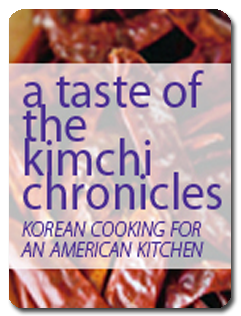
A Taste of The Kimchi Chronicles: Korean Cooking for an American Kitchen

2011 08 04 Kimchi-Chronicles icon

The Korea Society welcomes Marja Vongerichten, star of the new PBS series Kimchi Chonicles and wife of famed chef Jean-Georges, as she cooks and shares recipes from her newly released cookbook, The Kimchi Chronicles: Korean Cooking for an American Kitchen. The cookbook, available at the event, includes a recipe for every dish featured in the documentary as well as original dishes with a lighter, modern flair, revealing how the flavors of the Korean table can be readily integrated into any meal. Marja shares her thoughts on creating and adapting recipes and how The Kimchi Chronicles series inspired her to craft this beautiful new cookbook, which includes mouth-watering photos alongside her observations of Korean culinary culture.

Following Marja’s kitchen demonstration and author talk, guests at this exciting downtown event (Astor Center, 399 Lafayette) sampled her delicious creations and had the opportunity to meet the television host and author at the special signing of her new release. The Korea Society thanks publisher Rodale books for its support of this lovely summer’s evening of cuisine and conversation.


Thursday, August 4

Astor Center
399 Lafayette Street


Event Co-sponsors:

RODALE

PULMUONE

KOKO Living


Kimchi Chronicles website

Kimchi Chronicles Facebook Page

The Good, The Bad, The Weird


Join The Korea Society and the Museum of The Moving Image for a cinematic wild ride from director Kim Jee-woon’s. Set in the 1930s Manchurian desert, where lawlessness rules and ethnic groups clash, three Korean men fatefully meet on a train: a bounty hunter, the leader of a gang of bandits, and a train robber with nine lives. The three strangers chase across Manchuria to take possession of a valuable map. In Korean with subtitles.

Special Screening @ The Museum of the Moving Image
(Part of Outdoor Cinema 2011 at Socrates Sculpture Park)


Wednesday, July 27th | 7 PM

Free Admission through the Museum of the Moving Image


Socrates Sculpture Park
Vernon Boulevard, Long Island City
N or Q train to Broadway, eight blocks west at Vernon Boulevard and the East River
8-10 minutes by taxi from The Korea Society 


The Good, the Bad, the Weird (139 min) 2008
좋은 놈, 나쁜 놈, 이상한 놈

 Dir. Kim Jee-woon. In the 1930s Manchurian desert, where lawlessness rules and ethnic groups clash, three Korean men fatefully meet on a train: a bounty hunter, the leader of a gang of bandits, and a train robber with nine lives. The three strangers engage in a wild chase across Manchuria to take possession of a valuable map. In Korean with subtitles.


Special Screening of I Saw the Devil @ The Museum of the Moving Image

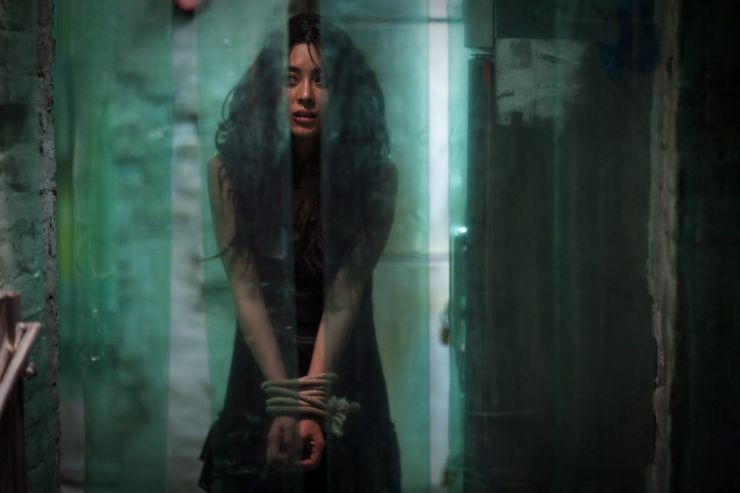
Director Kim Ji-woon’s latest film follows a bloody cycle of catch-and-release as the protagonist inflicts “equal sorrow” on his fiancée’s killer. Kim casts a distinctive mark in each of his films, and is known for the best “genre films” in Korean cinema. Kim Ji-woon made his directorial debut with The Quiet Family, a film hailed by critics and audiences for its unique styling. Kim went on to direct The Foul King (2000), A Tale of Two Sisters (2003), A Bittersweet Life (2005), and The Good, the Bad, and the Weird (2008). This screening of his latest release is part of the Korean Cinema Now showcase presented by the Museum of the Moving Image and The Korea Society. The museum recently reopened after a $67 million expansion, with dynamic new architecture by Thomas Leeser, capturing, according to Nicolai Ouroussoff of The New York Times, “in a building, the essence of a world in which images proliferate all around us.”

Due to depictions of violence and adult content, parental guidance is strongly advised.


Sunday, July 17, 2011 | 7 PM


Museum of the Moving Image
35th Avenue at 37th Street, Astoria 
From midtown, taxi or N/Q Train outbound to 36th Avenue 


Tickets $10 at The Museum of the Moving Image and include museum admission for exhibition viewing before 5 PM that day.


I Saw the Devil (141 min) 2010
악마를 보았다 

Dir. Kim Jee-woon. It’s hard to imagine the revenge thriller being pushed to greater extremes than this: Lee Byung-hun stars as a cop who ensnares the maniac that murdered his pregnant girlfriend in a brutal game of cat and mouse, and director Kim Jee-woon spares not a drop of blood in conceiving this extended bath in humanity at its most debased. Courtesy of Museum of the Moving Image.


Contemplative Traditions Music Series: P’ungnyu Strings (Kayagum)

2011 06 30 Kayagum icon

Enjoy a meditative hour of stringed kayagum set to p’ungnyu, the classical ensemble music of Korean nobility and central theme of our spring/summer performance series. The Korea Society here presents p’ungnyuin its chul-p’ungnyu(stringed-instrument) form. P’ungnyu also refers to a state of leisure when one is elevated from the mundane to better appreciate poetry, music, and companionship.

Park Yoon-suk, founder and president of the twenty-year-old Korean Traditional Music and Dance Institute of New York, opens with a Kayagum sanjo. Before her arrival in the United States, Park spent more than two and a half decades studying kayagum, p’ansori, and dance with many of Korea’s leading artists. Ms. Park won numerous awards and performed over 1,800 concerts across Asia and the United States, including a solo recital at Carnegie Hall. This performance is presented with the generous support of the New York State Council on the Arts.

$5 Members/Members Guest; $10 Guests
Explore Korea card holders attend this program for free with REGISTRATION


Thursday, June 30, 2011

6:30PM LIVE Performance


Contemplative Traditions Music Series:
P’ungnyu Strings (Kayagum)

with

Park Yoon-suk

The Korea Society
950 Third Avenue @ 57th Street, 8th Floor


nysca 200px white
LIVE HOUSE KOREA is made possible with the support of the New York State Council on the Arts.


The Writings of Lee UFan

The Korea Society presents the writings of celebrated artist, poet, and philosopher Lee UFan, in conjunction with the Guggenheim Museum’s retrospective exhibition, Lee UFan: Marking Infinity (June 24-September 28, 2011). Born in Korea in 1936, Lee has been an artistic and intellectual force in Korea, Japan, and Europe for more than four decades, articulating a unique aesthetic and philosophical stance grounded in modernity critique and Post-Minimalist practice. Lee, the author of seventeen books, has written seminal essays on contemporary art, Asian culture, and democracy that offer a powerful voice to our current cultural discourse. The Korea Society’s summer exhibition will present photographs and work with Lee’s poetry, criticism, and essays.

Contemplative Traditional Music Series: P’ungnyu Percussion (Changgo)

2011 05 19 Changgo iconEnjoy a meditative performance of changgo, a traditional hour-glass drum, adapted for p’ungnyu, the classical ensemble music of Korean nobility and central theme of The Korea Society’s 2011 traditional music series. P’ungnyu also refers to an elevated state of leisure in which one can better appreciate poetry, music, and companionship.

Percussionist Lee Chun-seung performs a solo Suljanggu, followed by a Samulnori and Binari featuring three additional percussion instruments, the kkwaengguari, buk, and jing, and finishes with Modeumbuk. Lee appeared at the 2002 World Cup Opening Ceremony and on the KBS Open Concert series. He has performed in Russia, Japan, China, and the United States, and is director and conductor of the acclaimed New York-based, non-profit Korean Traditional Marching Band. This series is made possible with public funds from the New York State Council on the Arts.


Thursday, May 19, 2011

Contemplative Traditional Music Series:
P’ungnyu Percussion (Changgo)

with

Lee Chun-seung


NYSCA

LIVE HOUSE KOREA is made possible with the support of the New York State Council on the Arts.

Contemplative Traditional Music Series: P’ungnyu Percussion (Changgo)

2011 05 19 Changgo icon

Enjoy a meditative performance of changgo, a traditional hour-glass drum, adapted for p’ungnyu, the classical ensemble music of Korean nobility and central theme of The Korea Society’s 2011 traditional music series. P’ungnyu also refers to an elevated state of leisure in which one can better appreciate poetry, music, and companionship.

Percussionist Lee Chun-seung performs a solo Suljanggu, followed by a Samulnori and Binari featuring three additional percussion instruments, the kkwaengguari, buk, and jing, and finishes with Modeumbuk. Lee appeared at the 2002 World Cup Opening Ceremony and on the KBS Open Concert series. He has performed in Russia, Japan, China, and the United States, and is director and conductor of the acclaimed New York-based, non-profit Korean Traditional Marching Band. This series is made possible with public funds from the New York State Council on the Arts.


Thursday, May 19, 2011

6:30PM LIVE Performance

Contemplative Traditional Music Series:

P’ungnyu Percussion (Changgo)

with

Lee Chun-seung

The Korea Society
950 Third Avenue @ 57th Street, 8th Floor


nysca 200px white

LIVE HOUSE KOREA is made possible with the support of the New York State Council on the Arts.


The Journals of Musan

Winner of “Best New Narrative Director” at 2011 Tribeca Film Festival!


The Tribeca Film Festival presents the New York premiere of the much-anticipated The Journals of Musan, co-hosted with The Korea Society. Director Park Jung-bum’s debut tells the story of a North Korean defector forging a new life in South Korea. The film took the New Currents Award at the Pusan International Film Festival. Park, who assisted Lee Chang-dong on the stirring Poetry, presents a disarmingly beautiful vision of loneliness, disconnect, and ethical ambiguity in this story of a lost soul’s struggle to connect. Park Jung-bum appears for Q&A with audiences after each screening.


Tickets available at TribecaFilm.com


Sunday, April 24 @ 7 PM Tuesday, April 26 @ 5:30 PM Wednesday, April 27 @ 9:30 PM
Clearview Cinemas Chelsea 5 Clearview Cinemas Chelsea 4 Clearview Cinemas Chelsea 1

The Journals of Musan (127 min) 2010
무산일기

Park Jungbum’s stunning and much-lauded debut is the story of Jeon Seung-chul, a North Korean defector forging a life in capitalist South Korea. Emerging from eight months in a resettlement camp, the unassuming Seung-chul is placed in a home on the rundown outskirts of Seoul, and finds a modest job papering the city with advertisement posters. Yearning for a human bond, he joins a church and meets Sook-young, a choir singer who works nights at a seedy karaoke bar. As he attempts to forge some kind of relationship with Sook-young and some kind of life in Seoul, Seung-chul finds his deepest kinship and comfort in a fellow outcast—a stray dog he adopts in the street. 

Marginalized in every way, from his liminal home on the city’s fringes to his frustrated attempts to integrate in either church or work, Seung-chul’s unwavering moral compass is testament to his integrity in the face of baseless prejudice. As both director and actor, Park (assistant director of Lee Chang-dong’s stirring Poetry) fully realizes a disarmingly beautiful vision of loneliness, disconnect, and ethical ambiguity in this story of a lost soul’s struggle to connect.


 Co-hosted by


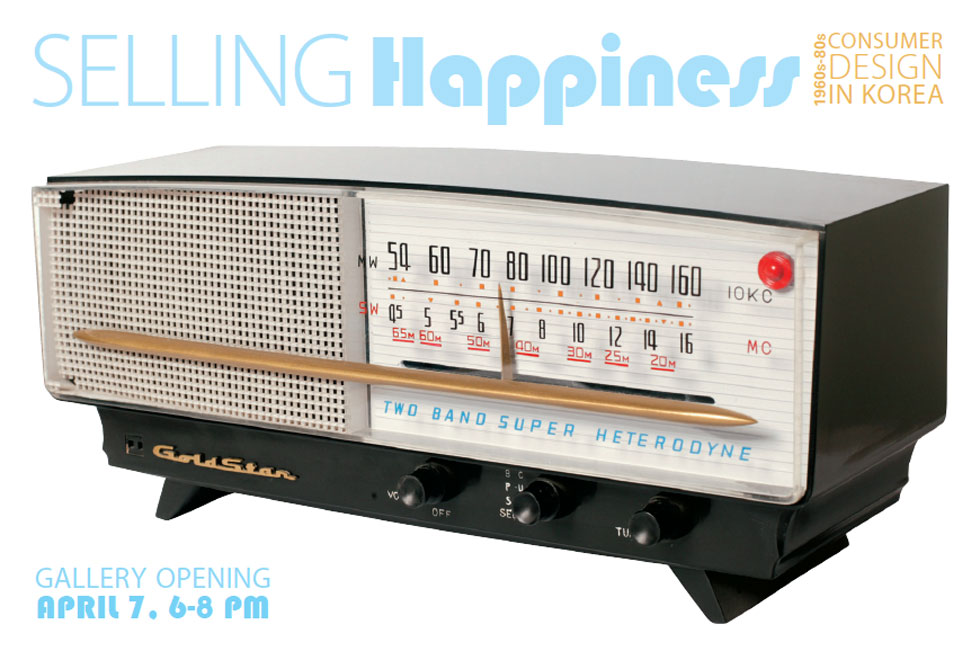
Selling Happiness: 1960s-80s Consumer Design in Korea

During Korea’s drive for economic modernization, commercial artists created goods and advertisements that were visually appealing and richly detailed. After the war, Korea transformed itself economically, yet rapid growth was accompanied by dramatic social changes and political concerns surrounding authoritarianism. By the late 1980s, Korea had embraced democracy and a newly prosperous society clamored for fresh goods manufactured for domestic consumption. With the 1988 Olympic games, Korean products and adverts grew more global in orientation.

Koreans look upon these items with some nostalgia, as they stand in sharp and, at times, amusing contrast with today’s products, which range from remarkable paper-thin flatscreens to Motortrend’s Car of the Year. Presented with the support of the Korea Craft and Design Foundation, this exhibition features early consumer products, advertisements, and social commentary from a transitional and controversial era when the seeds of Korean design saw fertile ground.


ABOUT

This exhibition is the first in the United States to focus on items associated with Korea’s export-led growth era. It features products and designs from the 1960s, 70s, and 80s, including Korea’s first domestically manufactured radio (the Goldstar A-501), Korea’s first black-and-white television (the VD-19), rice dispensers, cookers, and other kitchen items—even the popular “Italy towel,” employed in homes and bathhouses for a rigorous scrub.


Threading Life: A Lecture by Korean Quilt Master Haeja Kim


2011 03 24 threading life icon

Traditional Korean quilt technique requires keen attention to detail, patience, and dedication. With the arrival of the modern sewing machine, traditional quilting largely disappeared, yet master Kim Haeja remains steadfastly committed to the traditional ways of her craft. Designated Important Intangible Cultural Property No. 107 by the Korean government, Haeja Kim shares life’s lessons learned in the crafting of her quilts and textiles.

Thursday, March 24, 2011
6:30PM Gallery Talk and Q&A

Asia Week 2011 Gallery Talk

THREADING LIFE: A Lecture by Quilt Master Haeja Kim

with

Haeja Kim
Korean Traditional Quilt Artist, Important Intangible Cultural Property No. 107

The Korea Society
950 Third Avenue @ 57th Street, 8th Floor