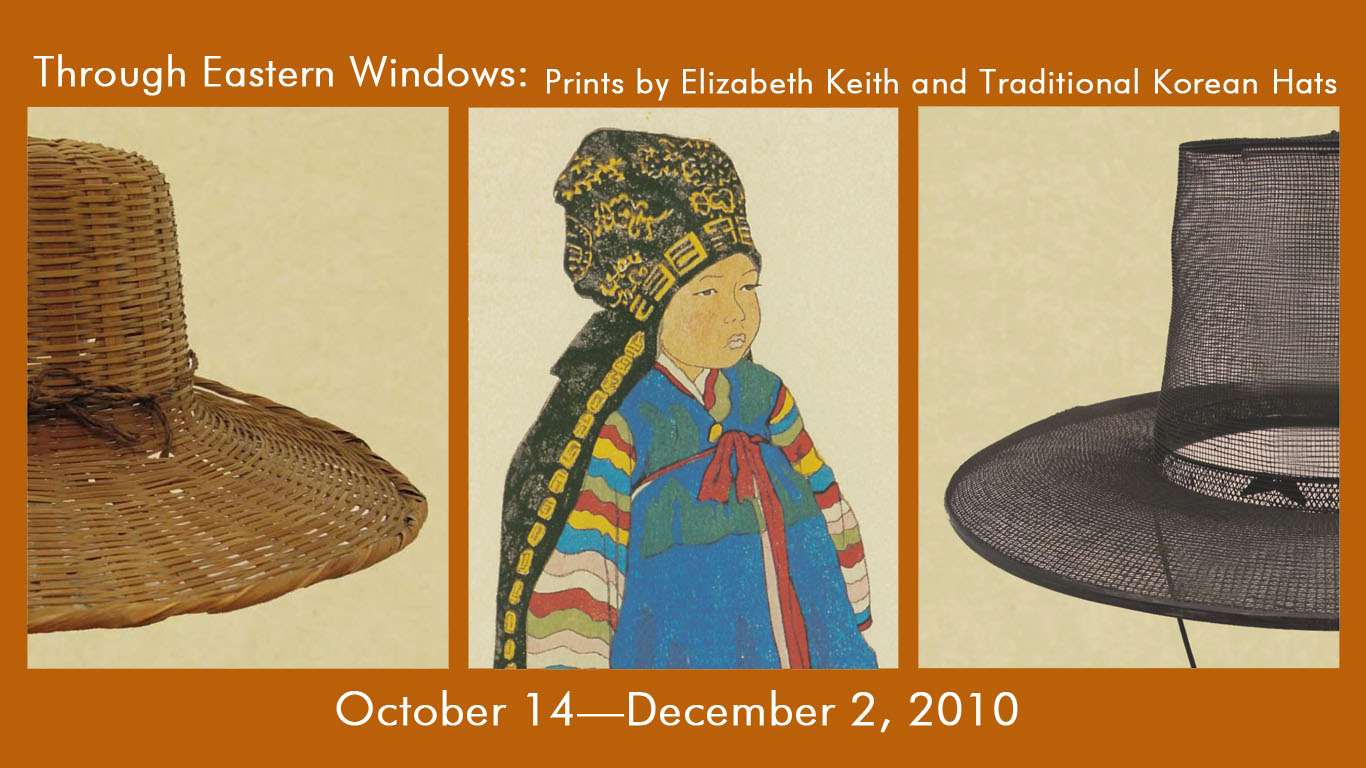
Through Eastern Windows: Prints by Elizabeth Keith and Traditional Korean Hats

Elizabeth Keith, an intrepid traveler and visionary artist, first ventured to Asia almost a century ago, where she filled travel journals with lively, realistic sketches of Korea and other destinations. At the encouragement of a Japanese publisher, she translated her sketches and watercolors into etchings and woodblock prints. As author of Eastern Windows (1928) and Old Korea (1946), Keith sought to capture a “vanishing Korea,” and her work remains especially relevant today as a view into the Korea of her age.

Accompanying the woodblock prints, etchings, and watercolors on display is an array of traditional hats from the period. From horsehair to bamboo, the materials employed by the contemporaneous Korean artisans add context and texture to Keith’s work. The hats served to connote the wearer’s status, a theme also examined in Keith’s work.

The headpieces are on loan from the Chung Young Yang Embroidery Museum, Korean Art and Antiques, and the collection of Lea Sneider.

The Elizabeth Keith woodblock prints, etchings and watercolor are on loan from the collection of Young-Dahl Song. The attendant photos and postcards are from the collection of Norman Thorpe.

Thursday, October 14


New York Korean Film Festival 2010 @ MoMA and BAM

nykff 2010 icon

The NYKFF 2010 Opening Reception will be held at The Korea Society on Thursday, 23 September 2010. The event will feature special remarks by Directors Im Sang-Soo (The Housemaid) and Boo Ji-Young (Sisters on the Road). We invite you to join us as we launch an amazing festival. The New York Korean Film Festival–the longest-running showcase of its kind in North America—is a true celebration of Korean cinema, with its auteurs, exciting screenings at MoMA and BAM Rose Cinema, and director discussions at The Korea Society.


NYKFF 2010 Opening Reception

With special remarks by Directors Im Sang-Soo and Boo Ji-Young.

FREE AND OPEN TO THE PUBLIC.

23 September 2010, 5-7 PM


The Korea Society
Samsung Center for Cultural Exchange
950 Third Ave, 8th Floor
New York, NY

Click here to RSVP.

The New York Korean Film Festival (NYKFF) is the foremost North American festival dedicated to showcasing the work of both mainstream and independent Korean cinema. Since its inception in 2001, NYKFF has established its own unique identity as a prestigious event on the world film circuit. Not only does the festival screen contemporary films, it also features panel discussions with directors and other leading figures in the world of Korean cinema.

This year, NYKFF audiences will be able to view some of the best of contemporary Korean cinema from September 22-30 at MoMa and October 1-3 at Bam Rose Cinema. Ranging from action to comedy, sci-fi to horror, to genre-bending altogether, this year’s films represent not only Korea’s top box-office hits but also some of the industry’s most creative and substantial movies to date.

All films will be shown in the original Korean with English subtitles.

For more information including film and special events schedules, ticket and venue information please visit www.koreanfilmfestival.org


Dynamic Korea: Dance and Song 2010

The movements of Korea’s classical dance tradition reflect the essential rhythms of life in Korea. The exuberant yott’aryongch’um (Taffy Peddler Dance) walks audiences through the bustling marketplaces of Korea, while meditative, deeply symbolic performances such as the hwahyonmu (Lotus Dance) and sungmu (Monk’s Dance) explore the country’s deep Buddhist roots. From the gentle, gliding grace of the opening chaech’onmu (Choson Court Dance) to the thunderous drumming of the closing p’unggo, the dancers and musicians of the Chae Hyang Soon Dance Company display the strength and energy of Korean tradition.

Dynamic Korea: Dance & Song
Performances by the Chae Hyang Soon Dance Company

2010_09_19_chae_hyang_soon_dance2010_09_19_chae_hyang_soon_dance12010_09_19_chae_hyang_soon_dance2

Sunday, 19 September || 3PM
Queens Theatre in the Park, New York, NY

Tuesday, 21 September || 1:30PM
St. Paul’s School, Concord, NH

Friday, 24 September || 8PM
Alabama Asian Cultures Foundation/Virginia Samford Theatre, Birmingham, AL

Sunday, 26 September || 4PM
Emory University, Atlanta, GA

Tuesday, 28 September || 7:30PM
University of North Carolina at Chapel Hill


Contact Information:

Queens Theatre in the Park (Sunday, September 19)
Box Office: 718-760-0064
Online: www.queenstheatre.org

DISCOUNT for TKS members.

The Korea Society
212-759-7525.

Global Music Korea: Global Beats, Celebrating the G20 Summit

2010 09 09  GlobalBeats icon

2010 09 09 gkThe Korea Society kicks off a rich autumn season of performing arts with percussionist Vongku Pak on traditional drum, or changgu, Eddy Jo Martinez on guitar, and Jorge Mesa on bass. This scintillating trio will perform a sizzling hour of rhythms, beats, and blues to mark this fall’s G20 leaders summit in Seoul. Come celebrate Korea—a crossroads of music and meeting place for world leaders—with this soulful summit salute. Pak opens with Sulganggo, a Korean hour-glass drum solo to “call the world to Korea,” followed by a blend of kutkǒri, ch’ilch’ae, and jajinmori rhythms.

Thursday, September 9, 2010

Steel Helmets: U.S. Korean War Graphics & Korean War in Color


The Korea Society marks the 60th anniversary of the start of the Korean War with two exhibitions running June 25 through September 10: Steel Helmets: U.S. Korean War Graphics  and Korean War in Color. Both open six decades to the day of the outbreak of conflict.


Steel Helmets: U.S. Korean War Graphics  features twenty-eight framed graphics—eighteen Korean War film posters and ten comics—from the era. With images ranging from the stark to the romantic, the film posters project images of bravery, climatic extremes, love and loss. The comic-book images, sometimes brutally visceral, portray war in all its hell and heroics. Korean War in Color  features thirty images by famed correspondent and veteran John Rich, now in his 90s. Though most Americans recall the War through black-and-white press photos, the Kodachrome images here show the war in vivid, color detail—images of masses on the move, soldiers in the field, individuals in repose.

Accompanying the gallery exhibitions are a selection of films featured on the exhibition posters, a book signing by legendary photographer John Rich, and a lecture by author Brian Locke.


17 June 1PM All the Young Men (1960)                  
  3PM The Bridges at Toko-Ri (1954)
  5PM Pork Chop Hill
  6PM Press and Member Preview and Reception
     
25 June 1PM The Steel Helmet (1951)
  3PM Battle Hymn (1957)
  6PM Special Signing of the book, Korean War in Color, with author John Rich
     

war_in_color_books

22 July 6PM Hollywood, Race and The Korean War with Professor  Brian Locke

Steel Helmets: U.S. Korean War Graphics and Korean War in Color
June 25-September 10


20th Annual Golf Tournament

2010 10 18  Golf iconThe Korea Society is delighted to invite you to participate in our 20th Annual Van Fleet Memorial Benefit Golf Tournament to be held on Monday, October 18, 2010 at the prestigious Alpine Country Club in Demarest, New Jersey. As we celebrate the tournament’s 20th anniversary, we hope to make this our most successful golf tournament yet. It will be a great opportunity for our members, friends and sponsors to join together for a day of golf while they show their support for our programs.


Monday, October 18, 2010
10:00 A.M. to 6:30 P.M.

Alpine Country Club
80 Anderson Avenue
Demarest, NJ 07627
Click for map


Schedule of Events

10-10:30 AM   REGISTRATION
10:30-11:00 AM   BRUNCH PROGRAM
with
James E. Glassman
MD and Senior Economist
JPMorgan Chase

speaking on US/Global Economic Landscape

11:00-11:30 AM   OPEN DRIVING RANGE
11:30 AM   SHOTGUN TEE OFF
4:30-5:30 PM   COCKTAILS
5:30-6:30 PM   DINNER/AWARDS CEREMONY
 
Program

2010 Golf Tournament Supporters

Patron
Chevron

Sponsor
JP Morgan Chase & Co.
KEB NY Financial Corp.

Contributer
Bank of America Merrill Lynch
Credit Suisse
LG Electronics USA, Inc.
Robert E. Fallon

Donors-In-Kind
Asiana Airlines
Bradford Renaissance Portraits Corporation
Corning Incorporated
Doubletree Fort Lee
Fila USA
Hyundai Motor America
Korean Air
Lazard Asset Management LLC
LG Electronics USA, Inc.
Lotte Hotel
Samsung Electronics America, Inc.
Sulhwasoo
Tiffany & Co.


Sponsors

2010 Tournament Co-chairs


Thomas C. Hubbard
Chairman
The Korea Society


Mark C. Minton
President
The Korea Society


Anil Bhalla
Vice Chairman
Investment Banking
JP Morgan

Chang Soo Choi
President & CEO
Samsung Electronics America, Inc.

Robert E. Fallon
Adjunct Professor
Columbia Business School

Stefan C. James
Managing Director
Global Head of International Subsidiary Banking
Bank of America Merrill Lynch

Yeon Hak Jeong
President & CEO
KEB NY Financial Corp.

Young Heon Kim
General Manager
Asiana Airlines

Won Ma
Vice President, Eastern U.S.A.
Korean Air

Wayne Park
President & CEO
LG Electronics, North American HQ

Paul Tregidgo
Vice Chairman Debt Capital Markets
Credit Suisse

Michael K. Wirth
Executive Vice President
Global Downstream
Chevron

If This Kayagŭm Could Talk…

2010 05 20 live house korea small“…It would speak to the seasons.” Join us for a rich evening of time circling through the elegant sounds of Rami Seo’s kayagǔm. Powerful at times, passive at others, Ms. Seo’s stringed wonder takes us from spring through summer, to autumn’s passing and wintry embrace…and back again to spring. Relax amid the contemplative sounds and relish the rich history of the kayagǔm.

Thursday, May 20, 2010
6:15 PM Check-in
6:30 PM Recital

“If This Kayagŭm Could Talk…”
Kayagŭm Recital

The Korea Society
950 Third Avenue @ 57th Street, 8th Floor

$10 for members and students; $20 for nonmembers
(Walk-in registration will incur an additional charge of $5)

For more information or to register for the program, please contact Heewon Kim or 212-759-7525, ext. 355.

If this kayagǔm could talk…

If this kayagǔm could talk
It might tell tales…
Of kings that ruled
In gilded courts,
Bent peasants
Out in the fields,
A nameless ki-saeng
With her private audience,
A famed musician
Whose song is legend;

Or it might tell
Of untried dreams,
And uncounted hours,
Unspoken truths,
And unshed tears…

If this kayagǔm could talk
You just might hear
The unstrung words
To my heart’s impetuous song;
Within each measure
My unrelenting pulse;
My palpable Joy
Resonating…
Beneath my weeping fingertips.

-Michelle C. Yoon

nysca 200px white
LIVE HOUSE KOREA is made possible with the support of the New York State Council on the Arts.


The Fabulous Kim Sisters


The year is 1960, and The Kim Sisters have set the Vegas Strip afire with rich harmonies and an ability to play dozens of instruments. The sisters had been in the United States only two short years at the legendary Thunderbird—after singing for American GIs during and after the Korean War. From there, they became a staple of Rat Pack-era Las Vegas, booking clubs across the United States and appearing a record 22 times on the Ed Sullivan Show. Join us as we trace the meteoric rise of The Kim Sisters—from singing for chocolate bars in war-torn Korea to making $13,000 a week as headline entertainers—with a special montage from The Fabulous Kim Sisters and sister Sue Kim Bonifazio sharing her Stardust memories.


Thursday, April 15th | 6:30 PM
Q&A with Sue Kim Bonifazio | 7:15 PM

Moderated by Benjamin Min Han, New York University  
Film Screening at The Korea Society


The Fabulous Kim Sisters
39 Minutes


Korean Masked Dance-Drama: Enchanted Fertility Rite and Social Satire

maskofnightJoin us as Theresa Ki-ja Kim, professor emeritus of theater arts at SUNY Stony Brook, discusses how Korea’s unique tradition of masked dance-dramas masterfully blended fertility rite, social satire, and popular entertainment. Held in conjunction with the exhibition, Masks of Night: Faces from Traditional Korean Dance-Dramas, Kim’s gallery talk will introduce the masked dance-drama, a form of performance that included songs, dances, and dialogues that aimed to satirize the local nobility (yangban) and promote fertility. Her talk will also examine how masked dance-dramas performed at the Korean royal court and throughout the countryside evolved from ancient shamanic rituals into a form of popular theater that helped release the pent-up social frustration generated by the rigid Confucian norms of the Chosŏn kingdom (1392-1910).


Gallery Talk with
Theresa Ki-ja Kim
Professor Emeritus, Department of Theatre Arts, SUNY Stony Brook, New York


ABOUT THE AUTHOR

Theresa Ki-ja Kim is a professor emeritus of theatre arts at SUNY Stony Brook and a Fulbright Scholar of the shamanic origins of theater. Kim’s collection of Korean theatrical masks, on display at Masks of Night: Faces from Traditional Korean Dance-Dramas, is a result of her personal associations with the masked dancers and shamans during years of researching, teaching, producing, and publishing in the fields of traditional Asian theater and shamanism. She holds a Ph.D. in performance studies from New York University.


Masks of Night: Faces from Traditional Korean Dance-Dramas

Koreans expressed their passion and fear through masked dance for hundreds of years.  The dance-drama dates back to shamanic ritual aimed at warding off malevolent spirits and grew into a form of popular entertainment that poked fun at the establishment.

March 4—April 25, 2010

Free and Open to the Public.

The Korea Society Gallery
950 Third Avenue @ 57th Street, 8th Floor 
(Building entrance on SW corner of Third Avenue and 57th Street)

Over the centuries, masked dance evolved from shamanic ritual to popular entertainment.  By the mid-eighteenth century, masked dance was firmly rooted as popular entertainment featuring dance, song and dialogue, with distinct regional varieties on offer.  Masked dance-dramas were staged outdoors and in the countryside as all-night, bonfire-lit events. The performances took place during planting and harvest, to promote fertility, and on the eve of the lunar new year and Buddha’s birthday to ensure good fortune. The dramas also were performed to welcome foreign envoys.

Dancers began by donning the masks—made from gourds, wood, bark, animal fur, cloth, and paper-mâché—and, like their shamanic predecessors, invoking the deities.  What followed was a riotous series of satirical sketches featuring characterizations of wayward monks, pompous playboys, love triangles and farcical noblemen. In this way, the dances functioned as a catharsis for the community, releasing through laughter the pent-up tensions created by the Chosŏn Dynasty’s (1392-1910) rigid moral and social strictures. The performance ended at dawn when the masks were tossed into the bonfire, symbolically expelling misfortune. As a result of this tradition, intact dance-drama masks from the period are exceedingly rare.

This exhibition features traditional dance-drama masks carved by four master artisans in the 1970s and 1980s. The masks here are of four regional types: Pongsan (Hwanghae province in the northwest of North Korea), Songp’a (Seoul), Yangju (north of Seoul), and Tongnae (south of Kyŏngsang province). The exhibition also features reproductions from an original set of Hahoe (Andong) exorcism masks from North Kyŏngsang province. Each regional style has been designated as an Important Intangible Cultural Property of Korea.  Unfortunately, the carving of traditional masks has become a dying skill.  Of the four artisans featured here, only one survives.

The masks in this exhibition are on loan from the collection of Dr. Theresa Ki-ja Kim.


mask1 mask2mask3 mask4mask7