Lee Chang-Dong and Moon So-ri present “Oasis”


With Director Lee Chang-Dong and Actress Moon So-ri. 


Wednesday, May 5, 2008 | 7:00 PM

Asia Society
725 Park Avenue (at 70th Street)
New York, NY 10021

Admission:
$10 Members / $12 Non-members


OASIS (133 min) 2002
오아시스

Kundo Cover Kundo Screenshot

Lead actress Moon So-ri will join director Lee for audience Q&A after the screening.

Jong-du Hong (Sol Kyung-gu) is just out of prison for manslaughter and decides to call on the family of the victim. They send him away, but not before he has met the victim’s daughter Gong-ju (Moon So-ri), a young woman disabled by cerebral palsy. Both victims of family abuse these two misfits form a fragile but supportive relationship.


Inside North Korea with the New York Philharmonic


Exhibition

April 24–May 16, 2008

Opening Reception
Wednesday, April 30, 2008

The Korea Society is pleased to present Inside North Korea with the New York Philharmonic, an exhibition of photographs by award-winning photographer Mark Edward Harris that document the concert by the New York Philharmonic orchestra in the Democratic People’s Republic of Korea on February 26, 2008.

In these fascinating and often-stunning photographs, Harris offers a portrait of the historic event, encompassing both the concert itself and all the other major activities of the nearly 300-member delegation—artists, staff, accompanying patrons, guests and press corps. The exhibition captures multiple aspects of the New York Philharmonic orchestra’s two-day visit to Pyongyang, the capital of the Democratic People’s Republic of Korea. Most notably, the photographs afford an inside view of this previously unimaginable influx of Americans—the largest group since the days of the Korean War over half a century ago—and insights into the inhabitants of this reclusive country.

The exhibition is accompanied by Harris’ book, Inside North Korea, published by Chronicle Books in 2007, which features photographs from previous visits to the Democratic People’s Republic of Korea. These photographs document life in Pyongyang and scenes from along the northern border with China, the highly militarized DMZ and the tightly controlled economic and tourist zones. The book, which includes short essays, extended captions and a foreword by noted North Korea expert Bruce Cumings, will be available for purchase at The Korea Society during the period of the exhibition.

  • Voice of America News (Coverage of exhibit in Korean)
  • FrictionTV (Video with President of The Korea Society, Evans Revere, and photographer Mark Edward Harris)

Following its run at The Korea Society, Inside North Korea with the New York Philharmonic will be available for travel to colleges, universities, galleries and non-profit institutions across America.


Reinventing Traditional Korean Music

2008 02 28 - Reinventing Traditional Korean Music icon

Komun’go performance and master class

with

Heo Yoon-Jeong
Komun’go Performer and Composer

Thursday, February 28, 2008

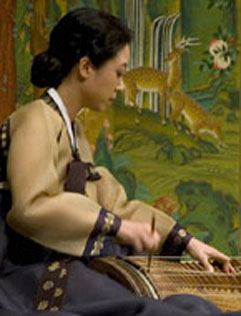
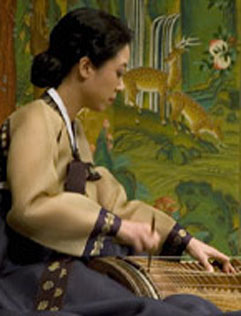
Legend has it that when Korean courtiers first played the seven-string komun’go over 1,500 years ago, a black crane appeared and danced to its music. A similar, if less literal magic was in the air as critically acclaimed performer and composer Heo Yoon-Jeong performed a program of traditional komun’go arrangements blended with contemporary sounds and techniques. Taking time between prices, Heo explained the instrument’s acoustic structure and long history.

Our Toys, Our Selves: Robot Taekwon V and South Korean Identity


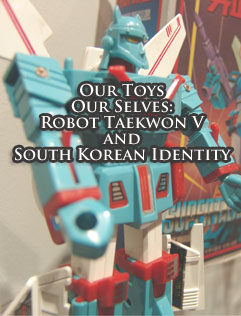
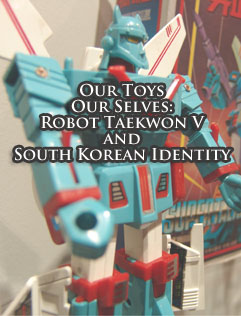
2008 02 07 Korean Toys iconOn February 7, 2008, Aaron Han Joon Magnan-Park, an assistant professor in the Department of Film, Television and Theatre at the University of Notre Dame, delivered at lecture at The Korea Society entitled “Our Toys, Our Selves: Robot Taekwon V and South Korean Identity.” The lecture was in support of “Toy Stories: Souvenirs from Korean Childhood,” an exhibition of toys from 1970s and 1980s Korea, showing at The Korea Society gallery, and available for travel around the United States in 2008.

Toy Stories: Souvenirs from Korean Childhood

Toy Stories: Souvenirs from Korean Childhood

Toy Stories: Souvenirs from Korean Childhood


Exhibition

January 31–April 18, 2008

Toys are always more meaningful than the simple playthings they appear to be. They can embody the fantasies, values, obsessions and anxieties of a generation. With Toy Stories: Souvenirs from Korean Childhood, The Korea Society put on display over 90 children’s toys from South Korea in the 1970s and ‘80s. On loan from the Hyeon Tae-Joon Collection in Seoul, the toys—flamboyantly colored action figures, robots, miniature tanks and paper dolls—captured a society in economic and social flux and a generation with rising hopes for the future.

The exhibition debuted on January 31 with an opening reception. Guests admired lines of action figure heroes which, reflecting the economic circumstances of the period, were often bland knock-offs of foreign models. Plastic robots ornamented with futuristic weapons captured viewers’ attention just as they had drawn in a generation of Korean boys, treating them to a sneak preview of a fantastic future where science made anything possible. Korean girls’ futures were more limited, circumscribed by the miniature kitchen and hospital utensils and paper dolls that encouraged them to dream only of becoming housewives or nurses.

Many of the items in the exhibit were modeled on cartoon characters popular in Korea during the period, and in particular, characters drawn from Robot Taekwon V, Korea’s first feature-length animated movie. Throughout its run, Toy Stories: Souvenirs from Korean Childhood was complemented by programs that explored the importance of animation and Robot Taekwon V to Korean youth culture.

On February 7, Aaron Han Joon Magnan-Park, a professor in the department of film, television and theater at the University Notre Dame, gave a gallery talk titled “Our Toys Our Selves: Robot Taekwon V and South Korean Identity.” Magnan-Park explained how Robot Taekwon V cemented children’s loyalty to an emerging South Korean identity by using a state-sanctioned style of taekwondo to fight off invidious foreign enemies. On March 18, The Korea Society screened Robot Taekwon V for an audience of animation enthusiasts.


Thursday, January 31, 2008 at 5:30 PM

ImageFilm Screening: Robot Taekwon V
Animation feature-film,
Directed by Kim Cheong-gi,
produced by Yu Hyon-mok.
Running time: 79 minutes

When an army of giant mecha attack, young martial-arts champion Kim Hoon must pilot Robot Taekwon V to defend the planet! Inspired by Mazinger Z, a Japanese anime popular in 1970s Korea, Robot Taekwon V was the country’s first full-length animated feature and the first to be digitally restored (1976).


  • Gallery Talk

Thursday, February 7, 2008

Our Toys Our Selves: Robot Taekwon V and South Korean Identity
with
Aaron Han Joon Magnan-Park
Professor of Film, Television and Theatre, University of Notre Dame


Children growing up in South Korea in the1970s faced an overwhelming barrage of cultural influences from the United States and Japan, the nations that, for Koreans, defined the prevailing images of the successful modern industrialized state during the Cold War era. President Park Chung-Hee was determined to bring South Korea into their ranks and, as a means of achieving this goal, adopted an export-driven industrialization policy that laid the economic foundations for the country’s rise to its present status as the 11th largest economic power in the world.

However, merely emulating the American and Japanese models of economic and technological progress could not instill within the Korean population a long-term self-sacrificing work ethic. Rather, the nation needed a Korean-specific hero who could create a vision of a forward-looking, technologized South Korea independent of the type of technological advances that the United States and Japan could already provide.

Kim Cheong-gi’s 1976 animation feature-film Robot Taekwon V signaled a significant contribution in advancing the image of an independent South Korea through the persona of a Korean-specific robot that effectively stands guard against enemies of superior numbers and with access to advanced technology.

This presentation illustrated how the Korean-specific features of Robot Taekwon V encouraged South Korean audiences to celebrate a Korea-centric paradigm of heroism that negated the United States and Japan and more importantly, exorcised the North Korean threat.

About the Presenter

Aaron Han Joon Magnan-Park is an assistant professor in the Department of Film, Television and Theatre at the University of Notre Dame. He specializes in pan-Asian cinema, sound theory, international action cinema and post-colonial theory. He has previously taught at Victoria University of Wellington in New Zealand, Illinois State University, Wesleyan University, University of Iowa, American University of Paris and the University of Paris IV-Sorbonne.


Film Panel: Finishing the Game


When Bruce Lee died, he left behind 12 minutes of footage from his final film. The upcoming movie Finishing the Game imagines what would have happened if bumbling studio executives had tried to find a passable stand-in for Lee to finish the film. The answer is hilarity. 

Starring Roger Fan (Better Luck Tomorrow), Sung Kang (The Fast and the Furious: Tokyo Drift), Monique Curren (Maria Full of Grace) and MC Hammer, Finishing the Game was an official selection of the 2007 Sundance Film Festival. Now yKAN and The Korea Society are presenting the film’s director and lead actors for a film panel at The Korea Society (950 Third Avenue, on the corner of 57th Street) on September 26, 2007 from 7:00 to 9:00 PM, followed by a reception at Opia. 

The panel will feature Finishing the Game director Justin Lin, and actors Roger Fan and Sung Kang, discussing their recent film and their experiences as Asian American artists in Hollywood. 


Wednesday, September 26, 2007 | 7:00 PM

The Korea Society
950 Third Avenue., 8th Floor
New York, NY 10023
(SW corner on 57th)

Free admission with RSVP


The film opens in New York at the IFC Center on October 5th, 2007.

Finishing the Game – a film by Justin Lin
English – Color 88 minutes

October 5 – New York – IFC Center
October 19 – San Francisco – Embarcadero Center Cinema
October 19 – Berkley – Shattuck Cinema
October 26 – Los Angeles – NuArt Theatre
October 26 – San Diego – Ken Theatre
October 26 – Minneapolis – Lagoon Cinema
November 16 – Philadelphia – Ritz @ The Bourse
November 16 – Seattle – Varsity Theatre


For more information on the film, visit these links:

http://youoffendmeyouoffendmyfamily.com
http://www.myspace.com/finishingthegame


Co-Presented with yKAN.


Is the Korean Wave Dead? The Next Phase of Korean Pop Culture

2014 04 08 korean-cinema  icon2

Recent years have seen a wave of Korean pop culture—known as hallyu—sweep across Asia as consumers from Thailand to Japan became ardent fans of Korean TV dramas, movies and music acts. No pop culture phenomenon lasts forever, however, and recently released statistics suggest that exports from Korea’s entertainment industry are now declining. Is the Korean wave finally ebbing? If so, why? And what can be done about it?

These questions were put to Michael Huh, vice president of ImaginAsian TV and Kim Yong-hwa, director of the recent Korean comedy 200 Pound Beauty, at a panel discussion moderated by The Korea Society’s film blogger Samuel Jamier.

Huh characterized the current trend as a market correction. When Korean pop culture first caught the world’s attention—especially Korean TV dramas, which are the most profitable segment of Korea’s entertainment exports—the industry responded with hasty exuberance. Korean producers rushed to create new dramatic series in order to capture the momentum. In the process, they might have neglected the fundamentals of their genre, and soon many Korean dramas featured formulaic narratives and focused on the drawing power of a limited number of stars. It should be no surprise then, he added, that viewers’ interest is waning.

The panelists agreed that Korean film companies would be wise to improve their marketing strategies, as they often lack clear plans on how to promote their cultural products abroad. Huh pointed to the recently released film The Host as evidence. The Host did phenomenally well with South Korean audiences he said, and had all the qualities necessary to be an international hit. But The Host’s distributors didn’t have a specific target audience in mind when they released it in the U.S., and as a result their marketing efforts fizzled and The Host was less successful in the American market than it could have been.

Kim shared Huh’s belief that the current downward trend was more of a normal fluctuation than a disaster. He described the state of the industry as basically healthy, but suggested it is facing long-term troubles. Presently, a small number of hit movies are subsidizing the production of many more mediocre films. While this keeps the industry afloat, it contributes to a blockbuster mentality that might sink it in the long run.

Kim said that the Korean entertainment industry’s emerging success in the late 1990s was derived, paradoxically, from its inability to compete with Hollywood blockbusters on equal terms when it came to production budgets or special effects. As a result, Korean directors were forced to focus relentlessly on the quality and originality of their stories and audiences responded. Now that the industry’s appeal is softening, Kim believes Korean directors have an excellent opportunity to refocus on their storylines and surprise their audiences all over again. Indeed, he added, Korean directors are already experimenting with new cinematic formulas that augur well for the future—such as the upcoming D-War, a sci-fi epic that blends Korean folklore with non-Korean actors.


Thursday, August 23, 2007 | 6 PM
Registration and reception @ 6 PM
Presentation and Q&A @ 6:30 PM


The Korea Society

950 Third Avenue, 8th Floor
New York, NY 10022

Admission:
$10 Members / $15 Non-members


Panelists:

Kim Yong-Hwa (Movie Director, 200-Pound Beauty)
Michael Huh (Vice-President, ImaginAsian TV)
Robert Cagle (Assistant Professor of cinema studies, University of Illinois at Urbana-Champaign)
Samuel Jamier (Moderator, The Korea Society Film Blog)

Recent years have seen a wave of Korean pop culture (hallyu) sweep across Asia as Korean movies, music and TV have kept audiences rapt. But now production costs are soaring, a backlash against Korean content is brewing in some of its most lucrative Asian markets and the domestic screen quota system, which nurtured the country’s entertainment talent, is being dismantled. Is the Korean Wave receding?

Join the discussion as some of the top producers of Korean pop culture discuss the state of their industry and where it’s headed next.

Presented in conjunction with the New York Korean Film Festival, presented by Helio (August 21 – September 2, 2007).



Korean Funerary Figures: Companions for the Journey to the Other World

funerary-ft.jpgExhibition

July 26, 2007 – December 18, 2007


  • “… eye-catching.” – New York Times Art Review,
    “Korea’s Extraordinary Send-Offs for Ordinary People”, August 17, 2007 link
  • “… the artifacts… are truly treasures.” – Japan Times Review,
    “Little Friends for the Other World”, October 11, 2007 link

Death is an aspect of the human condition that touches every culture in every age, and almost all cultures envelop death in a rich artistry as a way of managing the trauma it causes. In nineteenth and early twentieth century Korea, artisans carved joyful wooden figurines depicting acrobats, clowns and mystical animals-which are called kkoktu-to place on the funeral biers of the departed. A collection of 72 kkoktu will be brought to the U.S., for the first time ever, for an exhibition in The Korea Society Gallery. Organized jointly with the Seoul-based Ockrang Cultural Foundation, Korean Funerary Figures: Companions for the Journey to the Other World will run at The Korea Society Gallery from July 26 to November 20, 2007.

The kkoktu are archaeological treasures in their own right. Their costumes and poses reflect the realities of rural Korean village life during a period that left few written records. More importantly, the kkoktu open a window on a timeless, characteristically Korean attitude towards death. Though the gaiety depicted in many of the figurines may seem incompatible with mourning, what they are intended to express is a deep desire that the deceased loved one will enter the next world surrounded by joy. The figurines also embody a sophisticated appreciation of the fleeting nature of all experience.

The show’s opening reception will be held on July 26 at 5:30 PM at The Korea Society Gallery. To provide a cultural context for the exhibition, immediately following the reception, Dr. Laurel Kendall of the American Museum of Natural History will give a Gallery Talk on the shamanic rituals for the dead beginning at 6:30 PM.


“Journey to the Grave, Dance to Paradise: Shamanic Rituals for the Dead”
with Laurel Kendall of the American Museum of Natural History.


ockranglogo.jpg

The Ockrang Cultural Foundation was established by Dr. Ockrang Kim, who also is the founder of the Dongsoong Art Center. In her capacity as chairperson of the Foundation, Dr. Kim has been providing support for culture and the arts since 1992. Under the guiding concept of promoting a contemporary renewal of the cultural traditions of Korea, the Foundation is engaged in a diverse array of projects. Its efforts are directed toward finding ways to support more creative and innovative forms of artistic expression rather than the conventional forms typically supported by the government and large corporations in Korea. In this way, the Foundation is seeking to develop a new methodology for promoting a more authentic Korean culture by funding opportunities for artists to conduct original cultural research and to devote themselves to creative activities. Currently, the diverse projects the Foundation is pursuing include the Ockrang Drama Prize, the Ockrang Documentary Award given in collaboration with the Seoul Women’s Film Festival, the Ockrang-Asian Cultural Council Fellowship awarded in collaboration with U.S.-based Rockefeller Foundation, the Ockrang Kkoktu Museum with its research program, and several other scholarship programs.

‘전통의 현대적 창조’라는 설립이념 아래 다양한 사업들을 펼쳐오고 있는 옥랑문화재단은 동숭아트센터 설립자인 김옥랑 이사장에 의해 1992년에 설립되었습니다. 정부와 대기업 중심의 획일화된 문화예술 지원에서 보다 다양한 문화예술 지원의 통로를 구축하고자 노력해 왔으며, 문화예술 연구 및 창작 활동 공간 지원을 통해 한국적인 문화의 메소드(method)개발을 위해 노력하고 있습니다. 현재 새로운 희곡과 작가를 발굴하는 옥랑희곡상, 여성영화제와 함께하는 다큐멘터리 옥랑상, 미국 록펠러재단과 연계하는 Ockrang-ACC Fellowship, 옥랑꼭두박물관(나무꼭두연구), 장학금사업등 다양한 사업을 펼쳐나가고 있습니다.

Exhibiting Korea

2007 05 24  ExhibitingKorea icon

A New, Monthly Series of Gallery Talk Programs

May 24 – November 16, 2007

Exhibiting Korea, a new monthly series of presentations on the fine arts, film, fashion and photograph of the Korean Peninsula, is debuting in April 2007. Series programs will address contemporary trends in cultural expression in Korea, and take audiences back to important movements they might have overlooked. These gallery talks, given by top experts, critics and artists, will put the colors and shapes of modern Korea on display — and explain the cultural and historical contexts behind them. Please join us.

Date Time Title Speaker
5/24 6:30PM The Forgotten Legacy of the Minjung Art Movement in South Korea Soyang Park
6/7 6:30PM The Modern Boy and Modern Girl in Colonial Korea: 1910-45 Yeon-Shim Chung
7/12 6:30PM Film Screening of A Petal and Q&A with Actress Lee Young-Lan Lee Young-Lan
8/9 6:30PM Film Screening: Im Kwon Tae’s Festival
10/25 6:30PM Dressed to Kill: Women’s Fashion and Body Politics in North Korea Suk-Young Kim
11/16 6:30PM The Kyopo Project Cindy Hwang

Producing a Film across Seoul and New York: Making West 32nd


Hollywood makes lots of legal thrillers, but none of them speak so directly to the Korean American experience as the newly released West 32nd. While in New York for the film’s premiere at the Tribeca Flim Festival, co-writer and director Michael Kang and stars Grace Park and Jun Sung Kim came to The Korea Society for a freewheeling panel discussion on how the film was made and what this unique, Korean American statement means to its creators.

West 32nd is more than a Grisham-esque story of murder and deception among gangsters in New York’s Koreatown, said Kang. It’s a drama about one’s connection to, and separation from, one’s culture. The lead character, John Kim (John Cho), is a pro-bono lawyer assigned to defend a Korean American teenager framed for a gangland murder. With the help of the boy’s sister, Lila Lee (Grace Park), Kim delves deep into Koreatown’s underworld where he’s manipulated by gangster Mike Juhn (Jun Sung Kim). Though Kim is the model of second-generation immigrant success, he can’t speak Korean and as the mystery deepens, despite the fact he’s Korean, he’s increasingly out of his element.

With a predominately Korean American cast, West 32nd’s themes of identity seeped into the production process. The film’s characters alternate between Korean and English dialog, and Kang said that he wanted both languages to sound authentic. Many sections of dialog required extensive re-writing and finding bilingual actors was a major challenge. Once Park and Kim signed onto the project, language was still a problem. Both actors said they had to rehearse their Korean to appear perfectly fluent. 

Whatever the travails, they were glad to have done West 32nd. Though both have played many roles in Hollywood and Korea, this was the first project that allowed them to give portray Korean American characters in a multi-dimensional way.


Wednesday, May 2, 2007 | 6:30 PM

The Korea Society
950 Third Ave., 8th floor
New York, NY 10022


 Join Michael Kang, the Korean American filmmaker and Humanitas Award- winning director, along with actors Grace Park and Jun Kim as they discuss their new film, at the Tribeca Film Festival. Moderated by William Phuan, program associate at Asian Cinevision, the conversation will include personal, behind-the-scenes production stories, career advice for Asian American film talent and information on the prospects for marketing Asian American films internationally.


WEST 32ND

Directed by Michael Kang 
Starring John Cho, Jun Sung Kim, Grace Park and Jane Kim

West 32nd stars John Cho (Harold & Kumar Go to White Castle) as an ambitious young lawyer who takes on a pro bono case to exonerate a 14 year-old boy from a first-degree murder charge. The case takes him into a seamy underworld he never knew existed, right in the heart of midtown Manhattan. West 32nd also stars Grace Park (Battlestar Galactica) and marks Korean actor Jun Kim’s first American film role. Based on co-writer Edmund Lee’s coverage of Korean organized crime in New York for The Village Voice, West 32nd is the eagerly awaited follow-up to Kang’s debut film The Motel.

Presented by Tribeca Film Festival, Asian Cinevision and The Korea Society.


 Sponsored by AZN, ACV, AsianAve.com, yKan