


The Fabulous Kim Sisters


The year is 1960, and The Kim Sisters have set the Vegas Strip afire with rich harmonies and an ability to play dozens of instruments. The sisters had been in the United States only two short years at the legendary Thunderbird—after singing for American GIs during and after the Korean War. From there, they became a staple of Rat Pack-era Las Vegas, booking clubs across the United States and appearing a record 22 times on the Ed Sullivan Show. Join us as we trace the meteoric rise of The Kim Sisters—from singing for chocolate bars in war-torn Korea to making $13,000 a week as headline entertainers—with a special montage from The Fabulous Kim Sisters and sister Sue Kim Bonifazio sharing her Stardust memories.


Thursday, April 15th | 6:30 PM
Q&A with Sue Kim Bonifazio | 7:15 PM

Moderated by Benjamin Min Han, New York University  
Film Screening at The Korea Society


The Fabulous Kim Sisters
39 Minutes


Korean Masked Dance-Drama: Enchanted Fertility Rite and Social Satire

maskofnightJoin us as Theresa Ki-ja Kim, professor emeritus of theater arts at SUNY Stony Brook, discusses how Korea’s unique tradition of masked dance-dramas masterfully blended fertility rite, social satire, and popular entertainment. Held in conjunction with the exhibition, Masks of Night: Faces from Traditional Korean Dance-Dramas, Kim’s gallery talk will introduce the masked dance-drama, a form of performance that included songs, dances, and dialogues that aimed to satirize the local nobility (yangban) and promote fertility. Her talk will also examine how masked dance-dramas performed at the Korean royal court and throughout the countryside evolved from ancient shamanic rituals into a form of popular theater that helped release the pent-up social frustration generated by the rigid Confucian norms of the Chosŏn kingdom (1392-1910).


Gallery Talk with
Theresa Ki-ja Kim
Professor Emeritus, Department of Theatre Arts, SUNY Stony Brook, New York


ABOUT THE AUTHOR

Theresa Ki-ja Kim is a professor emeritus of theatre arts at SUNY Stony Brook and a Fulbright Scholar of the shamanic origins of theater. Kim’s collection of Korean theatrical masks, on display at Masks of Night: Faces from Traditional Korean Dance-Dramas, is a result of her personal associations with the masked dancers and shamans during years of researching, teaching, producing, and publishing in the fields of traditional Asian theater and shamanism. She holds a Ph.D. in performance studies from New York University.


Masks of Night: Faces from Traditional Korean Dance-Dramas

Koreans expressed their passion and fear through masked dance for hundreds of years.  The dance-drama dates back to shamanic ritual aimed at warding off malevolent spirits and grew into a form of popular entertainment that poked fun at the establishment.

March 4—April 25, 2010

Free and Open to the Public.

The Korea Society Gallery
950 Third Avenue @ 57th Street, 8th Floor 
(Building entrance on SW corner of Third Avenue and 57th Street)

Over the centuries, masked dance evolved from shamanic ritual to popular entertainment.  By the mid-eighteenth century, masked dance was firmly rooted as popular entertainment featuring dance, song and dialogue, with distinct regional varieties on offer.  Masked dance-dramas were staged outdoors and in the countryside as all-night, bonfire-lit events. The performances took place during planting and harvest, to promote fertility, and on the eve of the lunar new year and Buddha’s birthday to ensure good fortune. The dramas also were performed to welcome foreign envoys.

Dancers began by donning the masks—made from gourds, wood, bark, animal fur, cloth, and paper-mâché—and, like their shamanic predecessors, invoking the deities.  What followed was a riotous series of satirical sketches featuring characterizations of wayward monks, pompous playboys, love triangles and farcical noblemen. In this way, the dances functioned as a catharsis for the community, releasing through laughter the pent-up tensions created by the Chosŏn Dynasty’s (1392-1910) rigid moral and social strictures. The performance ended at dawn when the masks were tossed into the bonfire, symbolically expelling misfortune. As a result of this tradition, intact dance-drama masks from the period are exceedingly rare.

This exhibition features traditional dance-drama masks carved by four master artisans in the 1970s and 1980s. The masks here are of four regional types: Pongsan (Hwanghae province in the northwest of North Korea), Songp’a (Seoul), Yangju (north of Seoul), and Tongnae (south of Kyŏngsang province). The exhibition also features reproductions from an original set of Hahoe (Andong) exorcism masks from North Kyŏngsang province. Each regional style has been designated as an Important Intangible Cultural Property of Korea.  Unfortunately, the carving of traditional masks has become a dying skill.  Of the four artisans featured here, only one survives.

The masks in this exhibition are on loan from the collection of Dr. Theresa Ki-ja Kim.


mask1 mask2mask3 mask4mask7 

Director Bong Joon-Ho

Director Bong Joon-Ho

Director Bong Joon-Ho


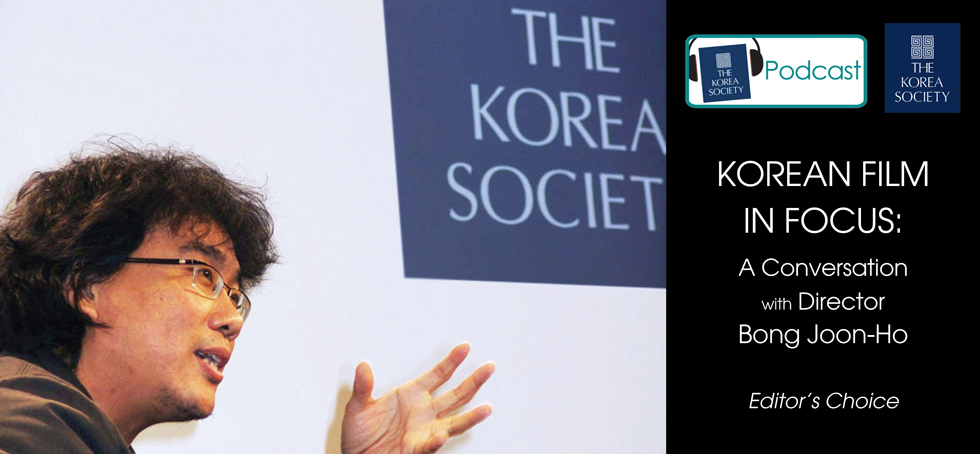
Korean Film in Focus: A Conversation with Director Bong Joon-ho |

Long before he swept the Oscars with Parasite, Director Bong Joon Ho visited The Korea Society to talk about his career and films in February 2010. Listen to the highlights from his conversation with Michael Atkinson.


Korean Ghost Stories

2009 12 17 Korean Ghost Stories icon

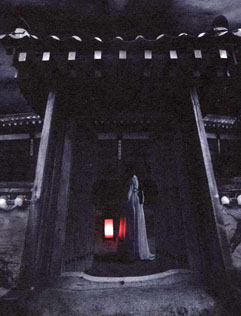
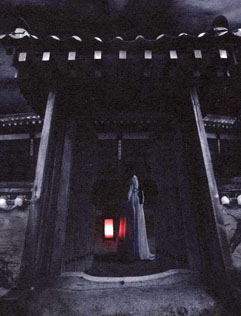
Through November and December, 2009, The Korea Society is screening episodes from Korean Ghost Stories, KBS’ popular and long-running television series. Known in Korea as Hometown of Legend, the series has thrilled Korean audiences with tales of the supernatural since it began airing in 1977. Often drawn from ancient folklore, these tales of tortured ghosts and supernatural curses have a uniquely Korean feel, and as such, provide a look into how Korean culture views issues of justice, revenge, and the role of women in a Confucian society. As part of our screening program, Yuni Cho, senior program officer for film, prepared questions for Lee Min-hong, who directed several episodes of Korean Ghost Stories, including The Reincarnated Princess, which will be screened at The Korea Society on Thursday, December 17th. Director Lee discusses the popularity of the series, as well as what sets it apart from other Asian horror films and TV. This podcast is also available as a video on http://www.youtube.com/user/TheKoreaSociety.


Talismans of Protection from Chosŏn Korea: Antique Locks, Latches and Key Charms

Shown for the first time in the United States, the collection features a rare collection of locks, latches and key charms, from the Chosŏn Dynasty (1392-1910), beautifully designed metal and wood objects executed in myriad shapes.

This exhibition features a rare collection of locks, latches and key charms, from the Chosŏn Dynasty (1392-1910). The items reveal the richly symbolic and exquisitely decorative dimensions of traditional Korean aesthetic and craft traditions. On loan from the Lock Museum in Seoul and shown for the first time in the United States, the collection includes beautifully designed metal and wood objects executed in myriad shapes: dragons, turtles, butterflies, fish, bats and swallows. Although these objects served functional purposes in everyday life, such as securing gates and protecting the contents of chests and other kinds of furniture, the beauty of their design underscores the primarily symbolic nature of the protection they afforded. Traditionally, Koreans believed that locks and latches fashioned in the shape of talismanic animals could invoke the power of these animals both to ensure the protection of their property and to bestow the blessings of wealth, health, fecundity and happiness. As an accompaniment to the locks and latches, key charms evolved from functional key holders into exquisitely decorated personal accessories passed from mothers to daughters as a symbol of the transfer of responsibility for ensuring the good management of household affairs.

On loan from the Lock Museum in Seoul, and shown for the first time in the US. The exhibition was organized by The Korea Society and is co-presented with Flushing Town Hall.


Rhythms to Make the Heart Beat Faster

2009 09 30 rhythms to make the heart beat faster icon

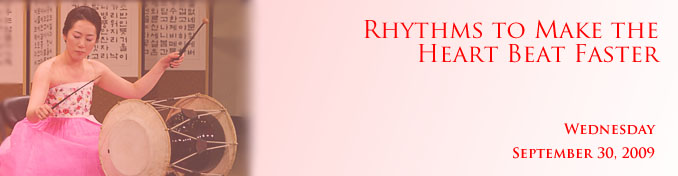
On September 30, 2009, Minji Kim, traditional percussionist, dancer, and a Republic of Korea 2009 Korean Traditional Artist-in-Residence, performed an evening of folk music on the changgo, an hourglass drum at the heart of traditional Korean music. The night’s program began with an introduction by Dr. Ju-Yong Ha, composer and ethnomusicologist, who also provided commentary before each of the three musical selections: a kayagum sanjo, a duet for haegum and changgo, and a solo percussion piece for changgo. Minji Kim was accompanied by Gee Sook Baek on the kayagum and Lee Kyung Kang on the haegum.


Dynamic Korea: Dance and Song 2009

Performed by Chae Hyang Soon Dance Company
dynamic the korea society1

Bring the rhythm and vitality of Korea’s classical dance tradition to your performing arts venue with Chae Hyang Soon Dance Company. The Korea Society is now accepting bookings for the group’s fall 2010 U.S. tour.

Handed down from generation to generation, the movements of Korea’s classical dance tradition reflect the essential rhythms of life in Korea. The exuberant yŏtt’aryŏngch’um (Taffy Peddler Dance) walks audiences through the bustling marketplaces of Korea, while meditative, deeply symbolic performances such as the hwahyŏnmu (Lotus Dance) and sŭngmu (Monk’s Dance) explore the country’s deep Buddhist roots. From the gentle, gliding grace of the opening chaech’ŏnmu (Chosŏn Court Dance) to the thunderous drumming of the closing punggo, the dancers and musicians of the Chae Hyang Soon Dance Company are animated by the strength and energy of the Korean tradition.

dynamic the korea society2Tour Specifications:

Period: September 16-30, 2010
Fee: Available upon request
Contents: 12 performances by 12 performers
Category: Folk Music and Dance / Religious
Time: 90 minutes

For more information, to receive a press kit with DVD or to schedule a performance at your institution, please contact Heewon Kim at The Korea Society at (212) 759-7525, ext. 355 or at heewon.ny@koreasociety.org.

Read more to view a video clip of the performance.

The Korea Society Interviews Park Chan-wook

2009 07 24 park chan wook icon

South Korean star director Park Chan-wook (JSA, Old Boy), has thrilled both critics and audiences in his native country for a decade. His “vengeance” trilogy brought international recognition, including a Cannes Film Festival Grand Prize (2008) and a Jury Prize (2009), and established Park as a virtuoso filmmaker with a thoroughly original artistic vision. On July 24, 2009, The Korea Society recorded a special interview with the director in which he spoke about his influences, his meteoric ascension into the pantheon of internationally celebrated directors, and his latest film, Thirst.

Thirst is a stylish vampire thriller with a dramatic bite, and continues Park’s exploration of the dark side of the human soul. A devout priest (Song Kang-ho, The Host) on a mission to Africa volunteers as a test subject in a vaccine trial-gone-awry. Now a vampire, he returns to Korea to endure the torments of temptation, embodied by a childhood friend’s wife (Kim Ok-bin).

Missionary Photography in Korea: Encountering the West Through Christianity


mt_ignore:missionary_exhibition.jpg

The arrival of the first Western missionaries in Korea in the late 19th century was a pivotal moment in the history of Christianity in Korea and the history of Korea as a whole. The missionaries established new religious identities and stoked early culture clashes. They also documented their mission and the society around them with early cameras. Missionary Photography in Korea: Encountering the West Through Christianity—the largest ever show of Korean missionary photographs in the U.S.—features rare images taken by missionaries in Korea between 1890 and 1940.

Taken by both Protestant and Catholic missionaries, the photographs—on display along with unique supplementary objects such as an original photo album and New Year’s calendars—offer a singular perspective on life in Korea during times of profound change. They illustrate the forging of contemporary institutions and values in the crucible of encounters with American Christian missionaries by Koreans.

The impact of early Western contact on Koreans is evident in the telltale signs of new cultural norms and new religious identities, and clues that these new ways were conflicting with long-held traditions. Less directly evident, but equally important, the images also allow the viewer to surmise how Koreans in turn had a formative impact on the missionaries, which led to intertwined personal histories that became a foundation for subsequent relations between Korea and the United States.

Drawn from four private collections and six academic archives, the images have been digitally restored and printed in a manner that retains, as far as possible, the archival quality of the images.

On May 5, 2009, Don Baker, Associate Professor in the Department of Asian Studies at the University of British Columbia, spoke about the history of Christianity and religion in Korea with Fred Carriere, The Korea Society’s Executive Vice President. The interview is in support of ‘Missionary Photography in Korea: Encountering the West through Christianity,’ an exhibition previously on display at The Korea Society Gallery.

Purchase the 184-page hardcover exhibition catalog.

2009_10_22_donald-clark

In order to better serve you, our online ordering system is now through Google Checkout.

Add items to your order by completing the form below and clicking “add to cart.” You may add multiple tickets by filling in new information and clicking “add to cart” again.

Click “Checkout” in the left sidebar to complete your order. Gmail users may use their existing accounts, or you will be asked to create a free Google account when checking out.

The purchase options below with “New Membership” include a one-year individual membership level of support to The Korea Society which grants member discounts to this item and future events, classes and programs. If purchased, New Membership information will be separately mailed to your physical address. Thank you for your support.

If you have any questions, please email or call Heewon Kim at (212) 759-7525, ext. 355.

Hardcover Exhibition Catalog, Missionary Photography in Korea


Exhibition Catalog $40.00


Missionary Photography in Korea 34 42 5 71 83

  1. Anti-TB campaign Christmas Seals (Seoul / 1930s, Norman Thorpe Collection)
  2. Western Style Clothing Shop in Korea (Chemulp’o Port/ca. 1910, Mission Photograph Collection, General Commission on Archives and History, The United Methodist Church, Madison, New Jersey)
  3. A Christian Wedding (Seoul/ca. 1920, Mission Photograph Collection, General Commission on Archives and History, The United Methodist Church, Madison, New Jersey)
  4. Catholic Foreign Mission Society of America (P’yŏngyang / 1924, Maryknoll Mission Archives)
  5. Soongsil Christian Academy’s Soccer Team Champions (P’yŏngyang / 1925, The Moffett Korea Collection, Special Collections of the Princeton Theological Seminary)
  6. Missionary Children: The Roberts Daughters (Sonch’ŏn, North Pyŏngan Province / ca. 1910, Donald Clark Collection)