Quick & Easy Korean Cooking Podcast

2009 05 07  quick-easy-cooking icon

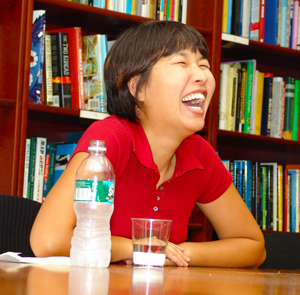
  On May 7, 2009, Cecilia Hae-Jin Lee, author of Eating Korean: From Barbecue to Kimchi, Recipes from my Home, visited The Korea Society to speak about about her latest cookbook, Quick & Easy Korean Cooking (Chronicle Books). Lee is also the author of several travel guides and her writing has been featured in Food and Wine, Eating Well, the Los Angeles Times, the Washington Post, the Whole Life Times, the Asian Pacific American Journal, and Korean Culture magazine.


The Religious Revolution in Modern Korean History

2009 05 05 ReligiousRevolutionIcon

On May 5, 2009, Don Baker, Associate Professor in the Department of Asian Studies at the University of British Columbia, spoke about the history of Christianity and religion in Korea with Fred Carriere, The Korea Society’s Executive Vice President. The interview is in support of ‘Missionary Photography in Korea: Encountering the West through Christianity,’ an exhibition previously on display at The Korea Society Gallery.

The arrival of the first Western missionaries in Korea in the late 19th century was a pivotal moment in the history of Christianity in Korea and the history of Korea as a whole. The missionaries established new religious identities and stoked early culture clashes. They also documented their mission and the society around them with early cameras. Missionary Photography in Korea: Encountering the West Through Christianity—the largest ever show of Korean missionary photographs in the U.S.—features rare images taken by missionaries in Korea between 1890 and 1940.

Taken by both Protestant and Catholic missionaries, the photographs—on display along with unique supplementary objects such as an original photo album and New Year’s calendars—offer a singular perspective on life in Korea during times of profound change. They illustrate the forging of contemporary institutions and values in the crucible of encounters with American Christian missionaries by Koreans.

The impact of early Western contact on Koreans is evident in the telltale signs of new cultural norms and new religious identities, and clues that these new ways were conflicting with long-held traditions. Less directly evident, but equally important, the images also allow the viewer to surmise how Koreans in turn had a formative impact on the missionaries, which led to intertwined personal histories that became a foundation for subsequent relations between Korea and the United States.

Drawn from four private collections and six academic archives, the images have been digitally restored and printed in a manner that retains, as far as possible, the archival quality of the images.

Purchase the 184-page hardcover exhibition catalog here.

TradINNOVAtion: New Trends in Contemporary Korean Architecture

2009 04 14 tradinnovation icon

Korea’s dizzying economic and urban growth over the past 50 years has seen the country exchange its traditional architectural landscape for Westernized office towers and apartment blocks. At the dawn of the twenty-first century, a few Korean architects are embracing buildings visibly rooted in history and synthesizing traditional forms and the demands of modern life. Architect Doojin Hwang will explain the theory, design and methodology behind the “creative restoration” changing the face of Korea’s cities.

TradINNOVAtion: New Trends in Contemporary Korean Architecture

Gallery Talk with

Doojin Hwang
Principal, Doojin Hwang Architects

Tuesday, April 14, 2009

Pojagi: Cloth, Color and Beyond

Join us for a panel discussion on the art and history of Korean wrapping cloths, or pojagi, with Lee Talbot, assistant curator of The Textile Museum; Chunghie Lee, fiber artist; and Seta K. Wehbé, assistant collection manager of the Antonio Ratti Textile Center at the Metropolitan Museum of Art. Linking pojagi aesthetics to both traditional American quilts and contemporary abstract painting, the panelists will discuss the enduring appeal of pojagi and what they reveal about the lives and times of their creators.

This lecture is organized in conjunction with Unwrapping the Secrets of Korean Textiles: An Exhibition of Pojagi , which runs through April 24, 2009 at The Korea Society Gallery. You may also be interested in the workshop sessions, Making a Pojagi, beginning February 24.


Wednesday, March 18, 2009


Gallery Talk

with

Lee Talbot
Assistant Curator of Eastern Hemisphere Collections at The Textile Museum

Seta K. Wehbé
Assistant Collection Manager of the Antonio Ratti Textile Center at the Metropolitan Museum of Art

Chunghie Lee
Artist


Korean Films Made During the Japanese Occupation


The Korea Society and The Museum of Modern Art (MoMA) are proud to present seven films from one of the earliest, and most complex, periods of Korean cinema. Recently discovered in a Chinese warehouse and restored by The Korean Film Archive, the films date from the 1930s and ’40s, a period when Korea was dominated by the dictates of Japanese colonialists. These dramas are thus uncomfortably pro-Japanese. Yet simultaneously, their rich aesthetics and formal experimentation reach beyond imperial Japanese ideology to express timeless themes of longing, loss and duty. 

The films will be shown in five programs from January 28 through February 1 at The Roy and Niuta Titus Theaters at MoMa.
All films are in Korean with English subtitles. 


Wednesday, January 28 – Sunday, February 1, 2009

Museum of Modern Art
11 W 53rd St, New York, NY 10019

Tickets may be purchased from the MoMA box office. 
Click here for more information. 
(Museum full admission includes any film for that day.)


Wednesday, Jan 28   6:00 Spring in the Korean Peninsula 8:00 Straits of Chosun
Thursday, Jan 29     8:00 Fishermen’s Fire and Volunteer
Friday, Jan 30   6:00 Angels on the Street 8:00 Sweet Dreams and Military Train
Saturday, Jan 31 1:00 Spring in the Korean Peninsula 3:00 Straits of Chosun 5:00 Angels on the Street
Sunday, Feb 1 1:00 Fishermen’s Fire and Volunteer 3:30 Sweet Dreams and Military Train  


SPRING IN THE KOREAN PENINSULA (84 min) 1941

Wednesday, January 28 | 6 PM
Saturday, January 31 | 1 PM

Directed by Lee Byeong-Il. Starring Kim Il-Hae, Seo Wol-Young and Kim So-Young. A film adaptation of a traditional Korean tale, Spring in the Korean Peninsula is a backstage romance between a director and an actress that falls into crisis when the director is jailed.


STRAITS OF CHOSUN (75 min) 1943

Wednesday, January 18 | 8 PM
Saturday, January 31 | 3 PM

Directed by Park Ki-Chae. Starring Nam Seung-Min, Moon Yae-Bong and Kim Shin-Jae. Made at the height of World War II, when Japanese censorship was at its tightest, Straits of Chosun tells the bittersweet story of a husband and wife separated by war. 


FISHERMAN’S FIRE (52 min) 1939

Thursday, January 29 | 8 PM
Sunday, February 1 | 1 PM

Directed by Ahn Chul-Yeong. Starring Park Hak, Nah Woong and Park Jung-Kyeong. Following a fisherman’s daughter as she moves from her seaside village to bustling Seoul and is quickly beset by shady characters, Fisherman’s’ Fire is about the things you lose when you lose your home. 


VOLUNTEER (55 min) 1941

Thursday, January 29 | 8 PM
Sunday, February 1 | 1 PM

Directed by Ahn Seok-Young. Starring Choi Woon-Bong, Moon Yae-Bong and Lee Keum-Ryong. A simple Korean farmer’s son who aches to leave the countryside behind and fight for Imperial Japan finally gets his chance when colonial authorities enact a draft.


ANGELS ON THE STREET (73 min) 1941

Friday, January 30 | 6 PM
Saturday, January 31 | 5 PM

Directed by Choi In-Kyu. Starring Kim Il-Hae, Moon Yae-Bong and Kim Shin-Jae. Notably realistic for its era in depicting the gritty poverty of contemporary Seoul, Angels on the Street is the story of a man struggling to set up an orphanage for the city’s street kids.


SWEET DREAMS (46 min) 1936

Friday, January 30 | 8 PM
Sunday, February 1 | 3:30 PM

Directed by Yang Ju-Nam. Starring Cho Taek-Won, Moon Yae-Bong and Yoo Sun-Ok. Korean cinema’s first talkie, Sweet Dreams nearly left audiences speechless with its scandalous melodrama about a wife who abandons her family to live with another man.


MILITARY TRAIN (66 min) 1938

Friday, January 30 | 8 PM
Sunday, February 1 | 3:30 PM

Directed by Seo Kwang-Jae. Starring Wang Pyeong and Moon Yae-Bong. Won-jin passes information about a Japanese military train to resistance fighters, putting the life of his best friend, the engineer, in danger in this hybrid of a spy thriller and a pro-Japanese morality play. 


Encountering North Korea Through Its Art

2008 12 04  EncounteringNKThroughArt icon
Image
Gallery Talk

with

 
Jane Portal
Matsutaro Shoriki Chair of the Art of Asia, Oceania and Africa, Museum of Fine Arts, Boston.

Thursday, December 4, 2008

We might think that we know about North Korea – it has been so much in the news recently, presenting a nuclear threat to the region. But in fact we know very little about the country. In the 19th century, the undivided country was called the hermit kingdom. Since 1953, the South has become accessible and widely known, while the North has remained a hermit, with very few tourists being allowed to travel there to find out what it is really like. Perhaps one form of evidence which would help us understand the north better is through its art. Jane Portal was very privileged to be able to travel to Pyongyang in 2001 and 2002 as a result of the establishment of diplomatic relations between the UK and the DPRK. At that time she started to collect a variety of contemporary works for the British Museum.

This lecture is in conjunction with the gallery exhibit North Korean Images at Utopia’s Edge, on view at The Korea Society Gallery through December 12, 2008.

Above print:
Happiness (1990), Hwang Chol-Ho
Linoleum Print (Ed. 1 of 5)
25 (H)” x 21¾ (W)”

A young boy gives his father, a miner, his report card from school.

Cabaret Cinema: Kim Ki-duk’s ‘The Bow’

Presented with the Korea Society

Friday, November 28, 2008 | 9:30 PM

Rubin Museum of Art
150 West 17th Street
New York, NY 10011


THE BOW (90 min) 2005

Dir. Kim Ki-duk. Starring Jeon Sung-Hwan, Han Yeo-Reum, Seo Ji-Seok. With a bow and arrow, a sixty-year old man protects the young girl he plans to marry when she turns seventeen. She’s content with their life on a fishing boat until a young man arrives and changes everything. 

The Bow illustrates the Bhutanese proverb: “The arrow of divine beings with absolute wisdom: it cannot be seen when shot, but can be seen when it hits.”


Power and Beauty: KBS’s ‘Hwang Jin Yi’


The blockbuster TV Drama from Korea
Monthly Screening Series

In an age when women were treated as if they were invisible, Hwang Jin Yi, the celebrated Korean courtesan-singer-poet of the 16th century, was larger than life. Her beauty, wit and intellect propelled her from obscurity into the company of Korea’s most powerful aristocrats. The defining romance of her life broke across Korea’s rigid class lines and was in turn shattered by tragedy. A symbol of art and individuality, the subject of countless novels, movies and operas, Hwang Jin Yi remains a powerful feminist figure in Korea to this day.

Directed by Kim Cheol-gyu (More Beautiful Than Flowers) and written by Yoon Sun-Ju (The Immortal Lee Soon Shin), the acclaimed KBS TV drama series Hwang Jin Yi retells the tumultuous life story of Korea’s most famous kisaeng (courtesan). Join The Korea Society on Wednesday, November 12—and on the second Wednesday of each month through February—as we screen selected episodes from this lavish and epic series. Top actress Ha Ji-won’s portrayal of Hwang Jin Yi made the series an instant television event when the series first aired in Korea in 2006, causing a nationwide rediscovery of the role kisaeng played in Korean history.

All screenings presented in Korean with English subtitles.


November 12, 2008 – February 11, 2009 | 6:30 PM


The Korea Society
950 Third Ave., 8th Floor
New York, NY 10022

Admission:
$5 Members / $10 Non-members

Order tickets online or by calling The Korea Society at (212) 759-7525, ext. 323.


Wednesday, November 12, 2008 6:30 The Zenith of a Kisaeng
Wednesday, December 10, 2008 6:30 The Birth of a Kisaeng
Wednesday, January 14, 2009 6:30 Grievance
Wednesday, February 11, 2009 6:30 Finale


PART 1: THE ZENITH OF A KISAENG

Wednesday, November 12, 2008 | 6:30 PM

Hwang Jin Yi’s intelligence, beauty and talent have made her the most famous kisaeng in Korea—every man desires her, every woman is jealous of her. But at the height of her fame, Hwang Jin Yi shows only contempt for the aristocracy that adores her. After the death of her first love, shevows to become as unfeeling as the cold moon, and adopts Myŏngwŏl (bright moon) as her courtesan name.

Part One will be introduced by David McCann, professor of Korean Literature at Harvard University. The screening will be followed by a discussion of Hwang Jin Yi and Chosun society with director Kim Cheol-gyu and David McCann.


PART 2: THE BIRTH OF A KISAENG

Wednesday, December 10, 2008 | 6:30 PM

Hwang Jin Yi’s mother fears that her young daughter will follow in her footsteps and become a kisaeng: a singer, dancer and hostess who lives a life catering to the whims of the yangban elite. Determined that her daughter should become more than a mere plaything for men, she sends Hwang Jin Yi deep into the forest to be cared for by an old monk. But when Hwang Jin Yi slips away and glimpses the beauty of a kisaeng dance, she is drawn to her destiny.

Special Guest: Actress Jeon Mi-seon (the mother) will appear from Korea through an exclusive video conference to discuss the making of Hwang Jin Yi and answer audience questions.


PART 3: GRIEVANCE

Wednesday, January 14, 2009 | 6:30 PM

Hwang Jin Yi islearning dance from Yim Baek-moo, one of the best court dancers in the kingdom and a harsh and manipulative teacher. When Hwang Jin Yi’s first love ends tragically, she sees Yim’s scheming behind it. Jealousy and bitterness build between the two as they prepare for what turns out to be a fateful performance of the crane dance. 

Special Screening Guest Hwang Jin Yi writer Yoon Sun-ju
will join the audience by videoconference after the screening to talk about writing for the series and take questions.


PART 4: FINALE

Wednesday, February 11, 2009 | 6:30 PM

Having won the acclaim of King and court, Hwang Jin Yi is confidant that she will win the heart of the people by performing her elegant dances in the marketplace. The people turn out to be a much harder audience to impress than the nobility. Hwang Jin Yi wrestles with the question of whether her life’s passion is really meaningful if it doesn’t resonate with the people among who she was raised.


Co-sponsored by KBS.


Crossing The Line


With
Nicholas Bonner, Producer of Crossing the Line

In the 1960s, four U.S. soldiers serving in the Korean Demilitarized Zone crossed the most heavily fortified border on earth and defected to Communist North Korea. Trapped in the most secretive country on earth, their life was hidden from the outside world for 40 years. Not even the U.S. government knew their fate. James Joseph Dresnok, one of these four American defectors, is the only one who remains in North Korea today.

The Korea Society has organized an eight-campus screening tour of Crossing the Line, a new documentary film that tells his story, from October 27 through November 12, 2008. The program includes a post-screening discussion led by the documentary’s co-producer Nicholas Bonner who will talk about Dresnok, North Korea and the experience of filming a documentary in one of the least media-friendly environments in the world.

The filmmakers of Crossing the Line were allowed unprecedented access by the North Korean authorities to the subject of their documentary. They were permitted not only to interview Dresnok extensively but also to follow him through his daily life in Pyongyang. Their film, narrated by actor Christian Slater, presents a story that the New York Daily News has called “fascinating” and “unforgettable.”

Join The Korea Society on Tuesday, October 28, 2008 for a screening of this unique documentary, followed by a conversation with co-producer Nicholas Bonner, or check the schedule below for a screening near you. 


Tuesday, October 28, 2008 | 6 PM
6:00 PM–6:30 PM ♦
Registration and Reception
6:30 PM–8:30 PM ♦
Screening and Q&A


The Korea Society
950 Third Avenue., 8th Floor
New York, NY 10023
(SW corner on 57th)

Admission:
$10 Members / $15 Non-members
(Walk-in registration will incur an additional charge of $5.)

For more information or to register for the program, contact Heewon Kim at (212) 759-7525, ext. 355, or by email.


Schedule:

Monday, October 27, 2008–6:15 PM
Harvard University 
CGIS South Building (Tsai Auditorium)
1730 Cambridge Street
Cambridge, Massachusetts
Contact #: (617) 496-2141

Tuesday, October 28, 2008–6:30 PM
The Korea Society
950 Third Avenue, Eighth Floor
New York, NY
Contact #: (212) 759-7525, ext. 355

Wednesday, October 29, 2008–5:30 PM
Johns Hopkins University 
Kenney Auditorium in the Nitze Building
1619 Massachusetts Avenue, NW
Washington, DC
Contact #: (202) 663-5830

Thursday, October 30, 2008–6:30 PM
Ohio State University  (poster pdf) 
University Hall 0014
230 North Oval Mall
Columbus, OH
Contact #: (614) 688-4253 

Monday, November 3, 2008–6:30 PM
University of Missouri, Columbia 
100 Stewart Hall
Columbia, MO
Contact #: (573) 882-6902 

Monday, November 3, 2008–7:00 PM
University of Kansas 
Alderson Auditorium
Lawrence, KS
Contact #: 785-864-3849

Tuesday, November 4, 2008–4:00 PM
University of Kansas (poster pdf) 
English Room, Kansas Union
Lawrence, KS
Contact #: (785) 864-3849

Wednesday, November 5, 2008–7:30 PM
University of Notre Dame (poster pdf) 
Eck Visitors Center Auditorium
100 Eck Center
Notre Dame, IN
Contact #: (574) 631-8873

Saturday, November 8, 2008–5:00 PM
Nestrick Room (Dwinelle 142)
UC Berkeley
San Francisco, CA
Contact #: (510) 642-5674

Monday, November 10, 2008–4:00 PM
University of California at Los Angeles 
314 Royce Hall
UCLA Campus
Los Angeles, CA
Contact #: (310) 825-3284 

Wednesday, November 12, 2008–6:15 PM
University of California at Santa Barbara 
McCune Conference Center (HSSB 6020)
UCSB Campus
Santa Barbara, CA
Contact #: (805) 893-3907


Koryo Saram: The Unreliable People


Screening And A Conversation
With Filmmaker Y. David Chung And Prof. John Kuo Wei Tchen

“Koryo Saram” (the Soviet Korean phrase for Korean person) tells the harrowing saga of survival in the open steppe country and the sweep of Soviet history through the eyes of these deported Koreans, who were designated by Stalin as an “unreliable people” and enemies of the state. Through recently uncovered archival footage and new interviews, the film follows the deportees’ history of integrating into the Soviet system while working under punishing conditions in Kazakhstan, a country which became a concentration camp of exiled people from throughout the Soviet Union.

Today, in the context of Kazakhstan’s recent emergence as a rapidly modernizing, independent state, the story of the Kazakhstani-Koreans situated within this ethnically diverse country has resonance with the experience of many Americans and how they have assimilated to form new cultures in our world of increasingly displaced people.

The screening will be followed by a conversation between filmmaker Y. David Chung and Prof. John Kuo Wei Tchen, Founding Director of A/P/A Institute at NYU.Visit www.apa.nyu.edu


Thursday, September 25, 2008 | 6:30 PM


Cantor Film Center
36 East 8th Street
Theater 102
New York, NY 10003
(212) 998-4100

Free and open to the public

Please RSVP by Tuesday, September 23 to apa.rsvp@nyu.edu or call 212-992-8653


Co-sponsored by:
The Korea Society & the NYU Center for Media, Culture, and History/Center for Media and Religion
With support by Asia Society