Toy Stories: Souvenirs from Korean Childhood

Toy Stories: Souvenirs from Korean Childhood

Toy Stories: Souvenirs from Korean Childhood


Exhibition

January 31–April 18, 2008

Toys are always more meaningful than the simple playthings they appear to be. They can embody the fantasies, values, obsessions and anxieties of a generation. With Toy Stories: Souvenirs from Korean Childhood, The Korea Society put on display over 90 children’s toys from South Korea in the 1970s and ‘80s. On loan from the Hyeon Tae-Joon Collection in Seoul, the toys—flamboyantly colored action figures, robots, miniature tanks and paper dolls—captured a society in economic and social flux and a generation with rising hopes for the future.

The exhibition debuted on January 31 with an opening reception. Guests admired lines of action figure heroes which, reflecting the economic circumstances of the period, were often bland knock-offs of foreign models. Plastic robots ornamented with futuristic weapons captured viewers’ attention just as they had drawn in a generation of Korean boys, treating them to a sneak preview of a fantastic future where science made anything possible. Korean girls’ futures were more limited, circumscribed by the miniature kitchen and hospital utensils and paper dolls that encouraged them to dream only of becoming housewives or nurses.

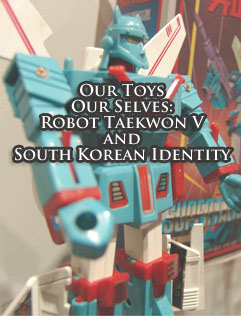
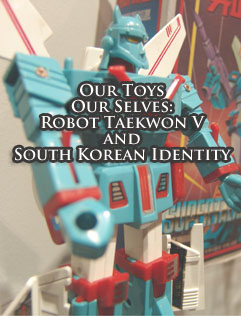
Many of the items in the exhibit were modeled on cartoon characters popular in Korea during the period, and in particular, characters drawn from Robot Taekwon V, Korea’s first feature-length animated movie. Throughout its run, Toy Stories: Souvenirs from Korean Childhood was complemented by programs that explored the importance of animation and Robot Taekwon V to Korean youth culture.

On February 7, Aaron Han Joon Magnan-Park, a professor in the department of film, television and theater at the University Notre Dame, gave a gallery talk titled “Our Toys Our Selves: Robot Taekwon V and South Korean Identity.” Magnan-Park explained how Robot Taekwon V cemented children’s loyalty to an emerging South Korean identity by using a state-sanctioned style of taekwondo to fight off invidious foreign enemies. On March 18, The Korea Society screened Robot Taekwon V for an audience of animation enthusiasts.


Thursday, January 31, 2008 at 5:30 PM

ImageFilm Screening: Robot Taekwon V
Animation feature-film,
Directed by Kim Cheong-gi,
produced by Yu Hyon-mok.
Running time: 79 minutes

When an army of giant mecha attack, young martial-arts champion Kim Hoon must pilot Robot Taekwon V to defend the planet! Inspired by Mazinger Z, a Japanese anime popular in 1970s Korea, Robot Taekwon V was the country’s first full-length animated feature and the first to be digitally restored (1976).


  • Gallery Talk

Thursday, February 7, 2008

Our Toys Our Selves: Robot Taekwon V and South Korean Identity
with
Aaron Han Joon Magnan-Park
Professor of Film, Television and Theatre, University of Notre Dame


Children growing up in South Korea in the1970s faced an overwhelming barrage of cultural influences from the United States and Japan, the nations that, for Koreans, defined the prevailing images of the successful modern industrialized state during the Cold War era. President Park Chung-Hee was determined to bring South Korea into their ranks and, as a means of achieving this goal, adopted an export-driven industrialization policy that laid the economic foundations for the country’s rise to its present status as the 11th largest economic power in the world.

However, merely emulating the American and Japanese models of economic and technological progress could not instill within the Korean population a long-term self-sacrificing work ethic. Rather, the nation needed a Korean-specific hero who could create a vision of a forward-looking, technologized South Korea independent of the type of technological advances that the United States and Japan could already provide.

Kim Cheong-gi’s 1976 animation feature-film Robot Taekwon V signaled a significant contribution in advancing the image of an independent South Korea through the persona of a Korean-specific robot that effectively stands guard against enemies of superior numbers and with access to advanced technology.

This presentation illustrated how the Korean-specific features of Robot Taekwon V encouraged South Korean audiences to celebrate a Korea-centric paradigm of heroism that negated the United States and Japan and more importantly, exorcised the North Korean threat.

About the Presenter

Aaron Han Joon Magnan-Park is an assistant professor in the Department of Film, Television and Theatre at the University of Notre Dame. He specializes in pan-Asian cinema, sound theory, international action cinema and post-colonial theory. He has previously taught at Victoria University of Wellington in New Zealand, Illinois State University, Wesleyan University, University of Iowa, American University of Paris and the University of Paris IV-Sorbonne.


Film Panel: Finishing the Game


When Bruce Lee died, he left behind 12 minutes of footage from his final film. The upcoming movie Finishing the Game imagines what would have happened if bumbling studio executives had tried to find a passable stand-in for Lee to finish the film. The answer is hilarity. 

Starring Roger Fan (Better Luck Tomorrow), Sung Kang (The Fast and the Furious: Tokyo Drift), Monique Curren (Maria Full of Grace) and MC Hammer, Finishing the Game was an official selection of the 2007 Sundance Film Festival. Now yKAN and The Korea Society are presenting the film’s director and lead actors for a film panel at The Korea Society (950 Third Avenue, on the corner of 57th Street) on September 26, 2007 from 7:00 to 9:00 PM, followed by a reception at Opia. 

The panel will feature Finishing the Game director Justin Lin, and actors Roger Fan and Sung Kang, discussing their recent film and their experiences as Asian American artists in Hollywood. 


Wednesday, September 26, 2007 | 7:00 PM

The Korea Society
950 Third Avenue., 8th Floor
New York, NY 10023
(SW corner on 57th)

Free admission with RSVP


The film opens in New York at the IFC Center on October 5th, 2007.

Finishing the Game – a film by Justin Lin
English – Color 88 minutes

October 5 – New York – IFC Center
October 19 – San Francisco – Embarcadero Center Cinema
October 19 – Berkley – Shattuck Cinema
October 26 – Los Angeles – NuArt Theatre
October 26 – San Diego – Ken Theatre
October 26 – Minneapolis – Lagoon Cinema
November 16 – Philadelphia – Ritz @ The Bourse
November 16 – Seattle – Varsity Theatre


For more information on the film, visit these links:

http://youoffendmeyouoffendmyfamily.com
http://www.myspace.com/finishingthegame


Co-Presented with yKAN.


Is the Korean Wave Dead? The Next Phase of Korean Pop Culture

2014 04 08 korean-cinema  icon2

Recent years have seen a wave of Korean pop culture—known as hallyu—sweep across Asia as consumers from Thailand to Japan became ardent fans of Korean TV dramas, movies and music acts. No pop culture phenomenon lasts forever, however, and recently released statistics suggest that exports from Korea’s entertainment industry are now declining. Is the Korean wave finally ebbing? If so, why? And what can be done about it?

These questions were put to Michael Huh, vice president of ImaginAsian TV and Kim Yong-hwa, director of the recent Korean comedy 200 Pound Beauty, at a panel discussion moderated by The Korea Society’s film blogger Samuel Jamier.

Huh characterized the current trend as a market correction. When Korean pop culture first caught the world’s attention—especially Korean TV dramas, which are the most profitable segment of Korea’s entertainment exports—the industry responded with hasty exuberance. Korean producers rushed to create new dramatic series in order to capture the momentum. In the process, they might have neglected the fundamentals of their genre, and soon many Korean dramas featured formulaic narratives and focused on the drawing power of a limited number of stars. It should be no surprise then, he added, that viewers’ interest is waning.

The panelists agreed that Korean film companies would be wise to improve their marketing strategies, as they often lack clear plans on how to promote their cultural products abroad. Huh pointed to the recently released film The Host as evidence. The Host did phenomenally well with South Korean audiences he said, and had all the qualities necessary to be an international hit. But The Host’s distributors didn’t have a specific target audience in mind when they released it in the U.S., and as a result their marketing efforts fizzled and The Host was less successful in the American market than it could have been.

Kim shared Huh’s belief that the current downward trend was more of a normal fluctuation than a disaster. He described the state of the industry as basically healthy, but suggested it is facing long-term troubles. Presently, a small number of hit movies are subsidizing the production of many more mediocre films. While this keeps the industry afloat, it contributes to a blockbuster mentality that might sink it in the long run.

Kim said that the Korean entertainment industry’s emerging success in the late 1990s was derived, paradoxically, from its inability to compete with Hollywood blockbusters on equal terms when it came to production budgets or special effects. As a result, Korean directors were forced to focus relentlessly on the quality and originality of their stories and audiences responded. Now that the industry’s appeal is softening, Kim believes Korean directors have an excellent opportunity to refocus on their storylines and surprise their audiences all over again. Indeed, he added, Korean directors are already experimenting with new cinematic formulas that augur well for the future—such as the upcoming D-War, a sci-fi epic that blends Korean folklore with non-Korean actors.


Thursday, August 23, 2007 | 6 PM
Registration and reception @ 6 PM
Presentation and Q&A @ 6:30 PM


The Korea Society

950 Third Avenue, 8th Floor
New York, NY 10022

Admission:
$10 Members / $15 Non-members


Panelists:

Kim Yong-Hwa (Movie Director, 200-Pound Beauty)
Michael Huh (Vice-President, ImaginAsian TV)
Robert Cagle (Assistant Professor of cinema studies, University of Illinois at Urbana-Champaign)
Samuel Jamier (Moderator, The Korea Society Film Blog)

Recent years have seen a wave of Korean pop culture (hallyu) sweep across Asia as Korean movies, music and TV have kept audiences rapt. But now production costs are soaring, a backlash against Korean content is brewing in some of its most lucrative Asian markets and the domestic screen quota system, which nurtured the country’s entertainment talent, is being dismantled. Is the Korean Wave receding?

Join the discussion as some of the top producers of Korean pop culture discuss the state of their industry and where it’s headed next.

Presented in conjunction with the New York Korean Film Festival, presented by Helio (August 21 – September 2, 2007).


Korean Funerary Figures: Companions for the Journey to the Other World

funerary-ft.jpgExhibition

July 26, 2007 – December 18, 2007


  • “… eye-catching.” – New York Times Art Review,
    “Korea’s Extraordinary Send-Offs for Ordinary People”, August 17, 2007 link
  • “… the artifacts… are truly treasures.” – Japan Times Review,
    “Little Friends for the Other World”, October 11, 2007 link

Death is an aspect of the human condition that touches every culture in every age, and almost all cultures envelop death in a rich artistry as a way of managing the trauma it causes. In nineteenth and early twentieth century Korea, artisans carved joyful wooden figurines depicting acrobats, clowns and mystical animals-which are called kkoktu-to place on the funeral biers of the departed. A collection of 72 kkoktu will be brought to the U.S., for the first time ever, for an exhibition in The Korea Society Gallery. Organized jointly with the Seoul-based Ockrang Cultural Foundation, Korean Funerary Figures: Companions for the Journey to the Other World will run at The Korea Society Gallery from July 26 to November 20, 2007.

The kkoktu are archaeological treasures in their own right. Their costumes and poses reflect the realities of rural Korean village life during a period that left few written records. More importantly, the kkoktu open a window on a timeless, characteristically Korean attitude towards death. Though the gaiety depicted in many of the figurines may seem incompatible with mourning, what they are intended to express is a deep desire that the deceased loved one will enter the next world surrounded by joy. The figurines also embody a sophisticated appreciation of the fleeting nature of all experience.

The show’s opening reception will be held on July 26 at 5:30 PM at The Korea Society Gallery. To provide a cultural context for the exhibition, immediately following the reception, Dr. Laurel Kendall of the American Museum of Natural History will give a Gallery Talk on the shamanic rituals for the dead beginning at 6:30 PM.


“Journey to the Grave, Dance to Paradise: Shamanic Rituals for the Dead”
with Laurel Kendall of the American Museum of Natural History.


ockranglogo.jpg

The Ockrang Cultural Foundation was established by Dr. Ockrang Kim, who also is the founder of the Dongsoong Art Center. In her capacity as chairperson of the Foundation, Dr. Kim has been providing support for culture and the arts since 1992. Under the guiding concept of promoting a contemporary renewal of the cultural traditions of Korea, the Foundation is engaged in a diverse array of projects. Its efforts are directed toward finding ways to support more creative and innovative forms of artistic expression rather than the conventional forms typically supported by the government and large corporations in Korea. In this way, the Foundation is seeking to develop a new methodology for promoting a more authentic Korean culture by funding opportunities for artists to conduct original cultural research and to devote themselves to creative activities. Currently, the diverse projects the Foundation is pursuing include the Ockrang Drama Prize, the Ockrang Documentary Award given in collaboration with the Seoul Women’s Film Festival, the Ockrang-Asian Cultural Council Fellowship awarded in collaboration with U.S.-based Rockefeller Foundation, the Ockrang Kkoktu Museum with its research program, and several other scholarship programs.

‘전통의 현대적 창조’라는 설립이념 아래 다양한 사업들을 펼쳐오고 있는 옥랑문화재단은 동숭아트센터 설립자인 김옥랑 이사장에 의해 1992년에 설립되었습니다. 정부와 대기업 중심의 획일화된 문화예술 지원에서 보다 다양한 문화예술 지원의 통로를 구축하고자 노력해 왔으며, 문화예술 연구 및 창작 활동 공간 지원을 통해 한국적인 문화의 메소드(method)개발을 위해 노력하고 있습니다. 현재 새로운 희곡과 작가를 발굴하는 옥랑희곡상, 여성영화제와 함께하는 다큐멘터리 옥랑상, 미국 록펠러재단과 연계하는 Ockrang-ACC Fellowship, 옥랑꼭두박물관(나무꼭두연구), 장학금사업등 다양한 사업을 펼쳐나가고 있습니다.

Exhibiting Korea

2007 05 24  ExhibitingKorea icon

A New, Monthly Series of Gallery Talk Programs

May 24 – November 16, 2007

Exhibiting Korea, a new monthly series of presentations on the fine arts, film, fashion and photograph of the Korean Peninsula, is debuting in April 2007. Series programs will address contemporary trends in cultural expression in Korea, and take audiences back to important movements they might have overlooked. These gallery talks, given by top experts, critics and artists, will put the colors and shapes of modern Korea on display — and explain the cultural and historical contexts behind them. Please join us.

Date Time Title Speaker
5/24 6:30PM The Forgotten Legacy of the Minjung Art Movement in South Korea Soyang Park
6/7 6:30PM The Modern Boy and Modern Girl in Colonial Korea: 1910-45 Yeon-Shim Chung
7/12 6:30PM Film Screening of A Petal and Q&A with Actress Lee Young-Lan Lee Young-Lan
8/9 6:30PM Film Screening: Im Kwon Tae’s Festival
10/25 6:30PM Dressed to Kill: Women’s Fashion and Body Politics in North Korea Suk-Young Kim
11/16 6:30PM The Kyopo Project Cindy Hwang

Producing a Film across Seoul and New York: Making West 32nd


Hollywood makes lots of legal thrillers, but none of them speak so directly to the Korean American experience as the newly released West 32nd. While in New York for the film’s premiere at the Tribeca Flim Festival, co-writer and director Michael Kang and stars Grace Park and Jun Sung Kim came to The Korea Society for a freewheeling panel discussion on how the film was made and what this unique, Korean American statement means to its creators.

West 32nd is more than a Grisham-esque story of murder and deception among gangsters in New York’s Koreatown, said Kang. It’s a drama about one’s connection to, and separation from, one’s culture. The lead character, John Kim (John Cho), is a pro-bono lawyer assigned to defend a Korean American teenager framed for a gangland murder. With the help of the boy’s sister, Lila Lee (Grace Park), Kim delves deep into Koreatown’s underworld where he’s manipulated by gangster Mike Juhn (Jun Sung Kim). Though Kim is the model of second-generation immigrant success, he can’t speak Korean and as the mystery deepens, despite the fact he’s Korean, he’s increasingly out of his element.

With a predominately Korean American cast, West 32nd’s themes of identity seeped into the production process. The film’s characters alternate between Korean and English dialog, and Kang said that he wanted both languages to sound authentic. Many sections of dialog required extensive re-writing and finding bilingual actors was a major challenge. Once Park and Kim signed onto the project, language was still a problem. Both actors said they had to rehearse their Korean to appear perfectly fluent. 

Whatever the travails, they were glad to have done West 32nd. Though both have played many roles in Hollywood and Korea, this was the first project that allowed them to give portray Korean American characters in a multi-dimensional way.


Wednesday, May 2, 2007 | 6:30 PM

The Korea Society
950 Third Ave., 8th floor
New York, NY 10022


 Join Michael Kang, the Korean American filmmaker and Humanitas Award- winning director, along with actors Grace Park and Jun Kim as they discuss their new film, at the Tribeca Film Festival. Moderated by William Phuan, program associate at Asian Cinevision, the conversation will include personal, behind-the-scenes production stories, career advice for Asian American film talent and information on the prospects for marketing Asian American films internationally.


WEST 32ND

Directed by Michael Kang 
Starring John Cho, Jun Sung Kim, Grace Park and Jane Kim

West 32nd stars John Cho (Harold & Kumar Go to White Castle) as an ambitious young lawyer who takes on a pro bono case to exonerate a 14 year-old boy from a first-degree murder charge. The case takes him into a seamy underworld he never knew existed, right in the heart of midtown Manhattan. West 32nd also stars Grace Park (Battlestar Galactica) and marks Korean actor Jun Kim’s first American film role. Based on co-writer Edmund Lee’s coverage of Korean organized crime in New York for The Village Voice, West 32nd is the eagerly awaited follow-up to Kang’s debut film The Motel.

Presented by Tribeca Film Festival, Asian Cinevision and The Korea Society.


 Sponsored by AZN, ACV, AsianAve.com, yKan


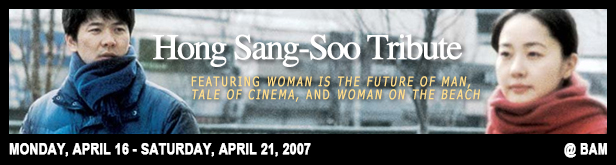
Hong Sang-Soo Tribute


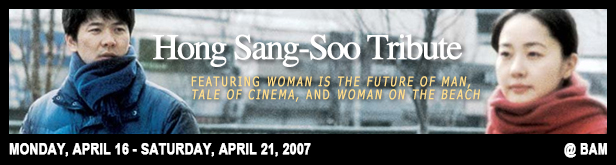
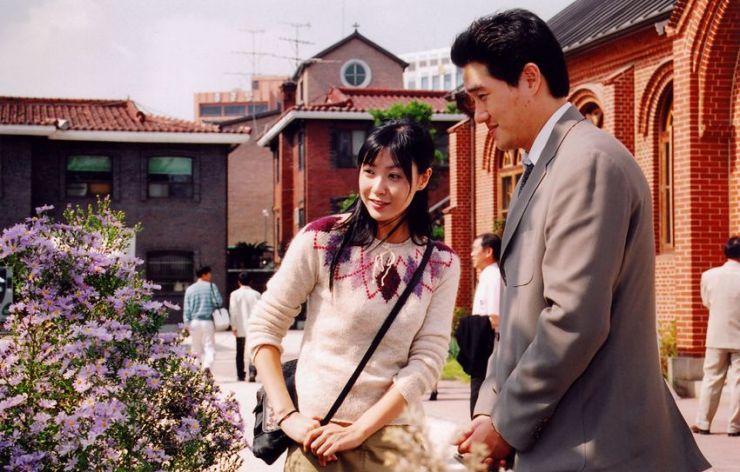
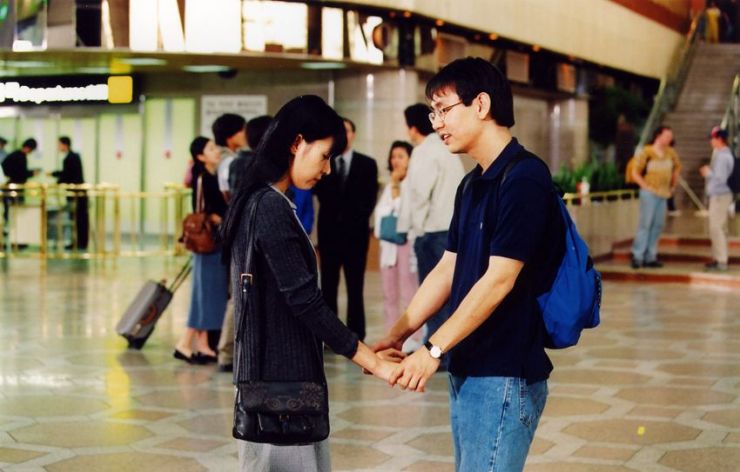
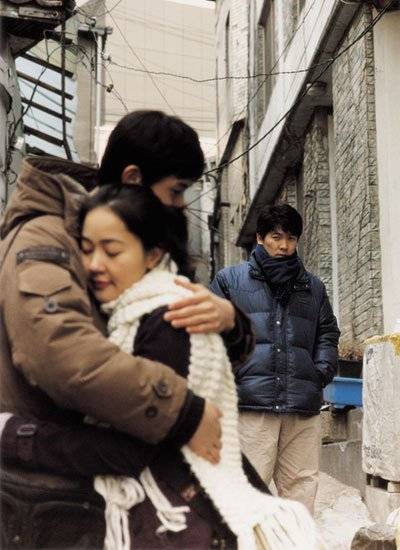
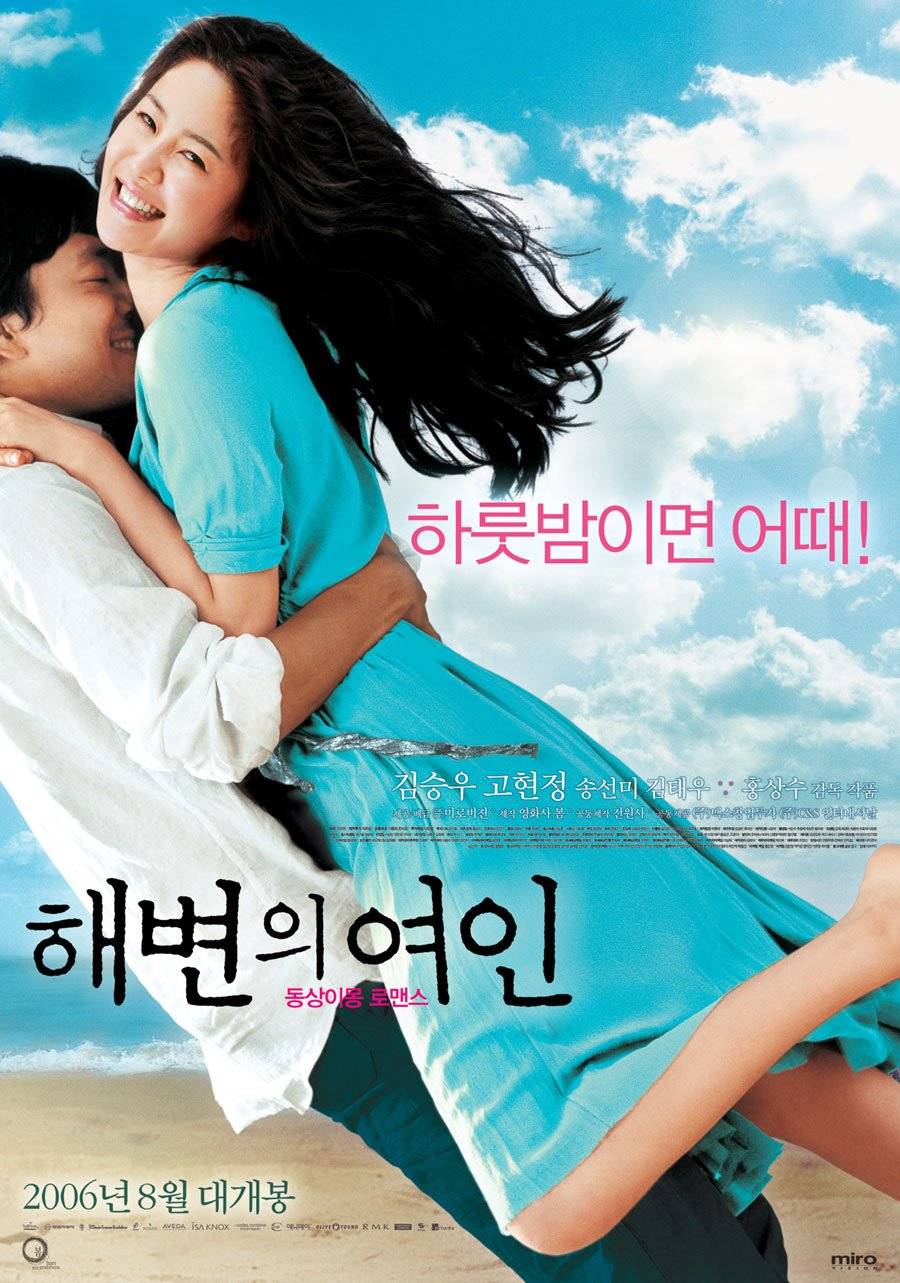
The Korea Society co- presents a ‘Hong Sang-Soo tribute’ with BAM Cinematek, featuring the celebrated Korean director’s three latest films that have won over critics and audiences alike worldwide – Woman is the Future of ManTale of Cinema and Woman on the Beach.

“One of the most exciting and authentically individual filmmakers to emerge on the world stage recently…. Wreathed in a profound melancholy, Hong’s films lyrically explore the limits of subjectivity, both its pathos and its dangers, often through different viewpoints that don’t so much cancel one another out as add another tile to the mosaic of existence.” – Manohla Dargis, The New York Times 


Monday, April 16 – Saturday, April 21, 2007

BAM Cinematek
30 Lafayette Avenue
Brooklyn, NY 11217
Get Directions to BAM

Buy Tickets 


WOMAN IS THE FUTURE OF MAN (88 min) 2004
여자는 남자의 미래다

Monday, April 16 | 4:30 PM

With Yu Ji-Tae, Kim Tae-Woo, Sung Hyun-Ah. Two male college friends reunite and spontaneously decide to look up a woman with whom they were both separately involved. “The men’s self-immolating behavior is what’s saddest in the Hong universe, thanks largely to his duplicitous manner with narrative. You can rarely grip the shape of the entire film until past the halfway marker. When you do, the tragedy of soured lives is beyond the point of no return.” – The Village Voice


TALE OF CINEMA (89 min) 2005
극장전

Friday, April 20 | 2 PM, 4:30 PM, 6:50 PM, 9:15 PM

With Lee Ki-Woo, Uhm Ji-Won. A young man bumps into a female friend; the ensuing evening involves drinking, sex, and a suicide pact. Turns out it’s only a film (within a film), but life imitates art, which in turn imitates life… “Tale expands on Hong’s preoccupations with a renewed conceptual depth. While it may be a tough film to love, it is also Hong’s finest work to date, marking a bold new direction just when Hong is most in need of a fresh start.” – Michael Sicinski, Cinema Scope


WOMAN ON THE BEACH (126 min) 2006
해변의 여인

Saturday, April 21 | 3 PM, 6 PM, 9 PM

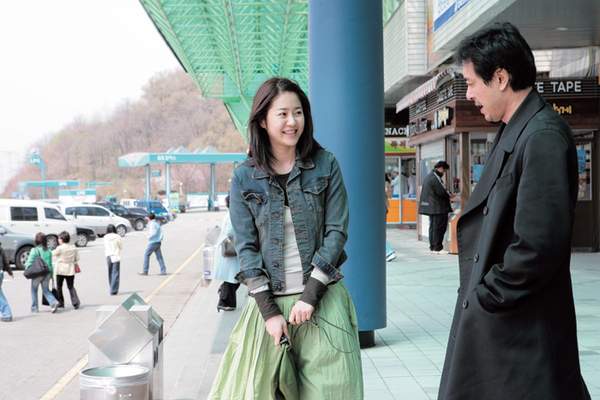
With Go Hyun-Jung, Kim Seung-Woo, Kim Tae-Woo, Song Seon-Mi. A filmmaker, writing his latest script at a seaside resort town, becomes involved with two women. As ever, Hong is comically and painfully lucid in outlining the jealousy and self-absorption that fuel his male characters’ drunken acting out. In the scene that is at the heart of this film, he does so literally with the help of a diagram-a fitting gesture for a filmmaker so obsessed with the geometry of human relationships.


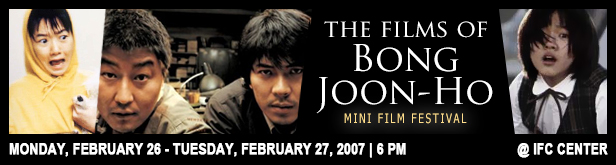
Bong Joon-Ho Mini Film Festival


A special line-up of acclaimed South Korean director Bong Joon-Ho’s box-office mega-hits will include showings of Barking Dogs Never Bite and Memories of Murder, and shorts Incoherence and Sink and Rise. Bong will attend the screening of his latest film, The Host, for a Q&A afterwards.

Bong Joon-Ho took the 2006 Cannes Film Festival by storm with his smart, terrifying new monster movie The Host. In anticipation of the film’s release, this a mini-fest of his maximal career presents a special line-up of Bong’s signature cinema — black comedies, gritty crime dramas and horror thrillers with a comic book feel — and Bong himself in person for the closing screening of The Host


Monday, February 26 – Tuesday, February 27, 2007

IFC Center
323 Sixth Ave (Ave of the Americas), New York, NY 10014
Get Directions to the IFC Center


Monday, February 26 7:00 BARKING DOGS NEVER BITE 9:15 MEMORIES OF MURDER
Tuesday, February 27 6:00 SINK AND RISE & INCOHERENCE 8:30 THE HOST


THE HOST (119 min) 2006
괴물


Tuesday, February 27 | 8:30 PM
Director Bong Joon-ho in person!

Starring: Song Kang- Ho, Park Hae-Il, Bae Du-Na, Byeon Hie-Bong, Ko Ah-Sung. Toxins from a U.S military base flow into Korea’s Han River, causing the birth of a mutant creature which terrorizes Seoul. When it grabs a little girl, her dysfunctional family must band together to save her. The Host is like a mutant hybrid spawned from the improbable union of Little Miss Sunshine and Godzilla, for the film is a family comedy and political satire in which an unnaturally evolved tadpole just happens to loom (very) large. Bong expertly balances absurd humor against tense thrills, and domestic drama against mass mayhem, reasserting South Korea’s place at the pinnacle of genre-busting cinema – and most of all he surprises at every turn in a film where, despite a realistic social milieu, almost anything seems possible.

Awards:
Best Director, 5th Korea Film Festival
Best Film, 5th Korea Film Festival
Best Sound, 5th Korea Film Festival
Best CG, 5th Korea Film Festival
Best Picture, 5th Korea Film Festival
Cannes Film Festival
New York Film Festival
Toronto International Film Festival
DHL Audience Choice Award for Best Feature, Hawaii International Film Festival
Pusan International Film Festival
Best Special Effects and Orient Express Award for Best Asian Film, Sitges International Film Festival of Catalonia (Spain) 2006


MEMORIES OF MURDER (127 min) 2003
살인의 추억


Monday, February 26 | 9:15 PM

Starring: Song Kang-Ho, Kim Sang-Kyung, Park Hae-Il. South Korea was rocked to its foundations when struck by its first serial killer, who raped and murdered ten women in a small village in Kyonggi Province between 1986 and 1991. Director Bong Joon-Ho (Barking Dogs Never Bite) has taken the investigation and combined it with best-of-career performances from Song Kang-Ho (JSASympathy for Mr. Vengeance) and Kim Sang-Kyung (Turning Gate), to make Korea’s most highly-acclaimed film of 2003, a master work that is itself like a memory of a dream: heartbreaking, mysterious, stunningly beautiful, and unspeakably sad.

A comedy, of sorts, of procedural errors that would be hilarious were it not so tragic, the film is a haunting look at a nation finding itself inevitably slipping back to an earlier, uglier era when an authoritarian government could freely violate the rights of private citizens in the name of the law.

Awards:
Best Films, Grand Bell Awards
Best Actor (Song Kang-Ho), Grand Bell Awards
Best Director (Bong Joon-Ho), Grand Bell Awards
Silver Seashell, San Sebastian International Film Festival
FIPRESCI Prize, San Sebastian International Film Festival
Best New Director (Bong Joon-Ho), San Sebastian International Film Festival 2003
Asian Film Award, Tokyo International Film Festival
Grand Prix, Cognac Festival Du Film Policier
Premiere Award, Cognac Festival du Film Policier
Prix Mediatheques, Cognac Festival du Film Policier
Special Prize of the Police, Cognac Festival du Film Policier
Best Screenplay Award, Audience Award, Torino Film Festival (Italy)


BARKING DOGS NEVER BITE (106 min) 2000
플란다스의 개

Monday, February 26 | 7:00 PM

Starring: Bae Du-Na, Lee Sung-Jae. American Beauty hopped up on laughing gas, Barking Dogs Never Bite‘s plot is choreographed as intricately as a triple-time minuet. Its director says it’s about corruption and innocence (and it is), but the story plays as a wild comedy focusing on two of the greatest characters to appear onscreen in decades: Lee Sung-Jae, a part-time lecturer who learns he’ll do anything to achieve a coveted position as a professor and Bae Doo-Na, a female member of an apartment building’s custodial staff who yearns to do something brave. A shaggy-dog story about the mysteries of pregnancy, the length of toilet paper, lost dogs, and good stew, this movie is a bedtime story for urban sophisticates, scored to a be-bop soundtrack. The director’s debut feature, and one of the few independent Korean films, it gleefully mixes razor-sharp acting, goofy physicality, black comedy, and genuine warmth. It’s the kind of movie that audiences live for, and that gives marketing departments nightmares.

Awards:
Best Editing, Slamdance Film Festival 2001
International Film Critics Federation Award of Young Asian
FIPRESCI Award for young Asian filmmakers, 25th Hong Kong International Film Festival
Special award presented to composer Cho Sung-Woo for his soundtrack for Barking Dogs Never Bite, Buenos Aires International Film Festival (Argentina) 2001.
Best Newcomer Award to Producer Cho Min-hwan for Barking Dogs Never Bite, Munich Film Fest (Germany) 2001


SINK & RISE (95 min) 2004 and INCOHERENCE (30 min) 1994
Part of TWENTIDENTITY

Tuesday, February 27 | 6:00 PM

Bong contributed Sink and Rise to this omnibus film made for the 20th anniversary of the Korean Academy of Film Arts; screening with the director’s early short black comedy.

SINK & RISE
Taken from Twentidentity, a 20-part omnibus film made by alumni of the Korean Academy of Film Arts on the occasion of the school’s 20th anniversary, Bong’s contribution is Sink and Rise, a whimsical work set alongside the Han River that can be seen as a warm up for the director’s third feature The Host.  

INCOHERENCE
A short black comedy that criticizes society with his Bong Joon-Ho’s unique sense of humor, Incoherence was invited to international film festivals in San Diego and Hong Kong, giving Bong his first taste of artistic recognition.





Gods, Demons, and Generals: Icons of Korean Shamanism

ImageGods, Demons and Generals: Icons of Korean Shamanism

The exhibition includes representations of Samsin Halmoni 삼신 (Birth Spirit), Sansin 산신 (Mountain God), Taesin Halmoni 대신 할머니 (Great Spirit Grandmother), Yongwang 용왕 (Dragon King), Sinchungdang 신중당 (Guardian Spirits) and images of many other shaman deities. As fixtures of traditional shaman shrines, twelve paintings provide a setting for rites that over the centuries have informed Koreans’ world view and their belief system in both overt and subtle ways. To glimpse the world depicted in these paintings is to gain a unique perspective on Korea’s ancient past and immediate present at once.

 
Gods, Demons and Generals: Icons of Korean Shamanism is available to travel to your school, university, library or museum. Please click for booking information.


Great Spirit Grandmother LonelySaint MountainGod SevenStarsoftheBigDipper SevenStarsoftheBigDipperwithMountainGodDragonKing 

Contents 12 framed paintings, 5 black-and-white and color photographs, text panels and labels
Fee Upon request
Tour Dates Currently available
Running Feet 210 running feet
Loan period 4 to 16 weeks
Crates 1
Weight Approx. 600 lbs.
Category Korean Art / History & Religion
Security Moderate / High
Shipping The Korea Society provides shipping to and from the exhibitor’s venue.
Contact Jinyoung Kim
Senior Program Officer for the Arts
212-759-7525 ext 316
email


Scheduled Venues
Kresge Art Museum, Michigan State University, East Lansing, MI, Sept 8 – October 18, 2009, web


Toured Venues
The Korea Society Gallery, New York, NY, February 28 –  May 31, 2006


Korean Dance: Tradition and Creation


Korean Dance: Tradition and Creation

November 8 – 16, 2005

A 16-member troupe from the Seoul Performing Arts Company presented an exquisite program of folk dances as well as contemporary interpretations of ancient court and shamanic dances in five cities from coast-to-coast in the U.S. This tour was organized and funded by The Korea Society in association with the Seoul Performing Arts Company. Several members of the company also presented a workshop for high school students at the Wilshire School in Los Angeles on Tuesday, November 15.

The Seoul Performing Arts Company was established on August 1, 1986 with the founding objective of presenting the indigenous Korean performing arts in new attire and promoting them around the world. The Company has created many productions of musical and traditional Korean song and dance. It has gone on the road in over 45 countries, staging about 850 performances. Its performances at the closing and opening ceremonies of the ’88 Seoul Olympics, the promotional event for the 2001 World Cup, ’99 Winter Asian Games, the 2000 Korea Millennium Grand Gala, and other major international cultural events held in the United States, Japan, and several African and European countries have brought the company to a high standard of polish.

Program DescriptionDrum Dance of Ch’oyong (Ch’oyong Pukch’um)
8 minutes/ 5 dancers
Choreography: Son In-Young
The Drum Dance of Ch’oyong derives from the second dance of a two-dance suite that is said to have originated during the reign of King Hon’gang (r. 875-886), the forty-ninth ruler of the Silla kingdom. The first dance, no longer performed, was an elegant and slow dance in the court-dance tradition-movements in court dances are usually soft and subdued. However, the second dance, while classified as a court dance, stands out from other court dances for several reasons: it is the only dance in which the performers wear masks; it is performed by men rather than women; and its movements are comparatively strong and vigorous. In some historical documents, it is referred to as “the dance of the five directions.” Each direction is represented by a color: north is black, south is red, east is blue, west is white, and the center is yellow. The predominant color of the costume of each of the five dancers is one of the colors associated with the five directions. In 1971, the government of the Republic of Korea designated this dance as Intangible Cultural Asset No. 39. In this version, the drums of the dancers are substitutes for the usual musical accompaniment.

Sword Dance (Tonggyong Kommu)
7 minutes/ 8 dancers
Reconstruction: Eum Ok-Ja
During the Silla dynasty (57 B.C.-935 A.D.) an institution known as hwarang was established. The hwarang were young boys trained in Korea’s cultural and military arts. The oldest reference to a sword dance relates to a hwarang. Beyond legendary origin, the current form of the dance is sometimes attributed to performances in the court and sometimes to village performances. The tempo is slow, the dancers walk around the circle – still manipulating their swords-form a single straight line parallel to the audience, bow, and quietly exit by backing away from the performing area. Although a suggestion of military action has been offered, the strongest impression is that of a kaleidoscopic ensemble that groups and regroups amidst a flurry and swish of sword blades-all with the calm dignity of a regal group of dancers.

Dongnae Crane Dance (Dongnae Hak ch’um)
7 minutes/ 5 dancers
Reconstruction: Lee Sung-Hoon
Designated as Intangible Cultural Property No. 3 by the city of Pusan, the Dongnae Crane Dance reflects the distinctive geographical features of Dongnae. The landscape of this area suggests the shape of a crane, and many place names in the district are related to the crane. As a popular hot springs resort area, Dongnae traditionally has attracted many people of highly refined tastes. This fostered the development of a strong tradition of recreational activities that include singing, dancing and poetry. Yangban enthusiasts are believed to have been responsible for the development of the distinct genre of the crane dance performed in Dongnae, which is viewed as an expression of their appreciation for refined forms of recreation. Above all, however, the distinctive feature of the Dongnae Crane Dance is that it does not mimic the actual movements of a crane but rather attempts to represent these movements in a more abstract and symbolic way.

Improvised Dance (Ipch’um) & Taegum Solo (Taegum Sanjo)
5 minutes/ 1 dancer/ 1 musician
Choreography: Chae Sang-Mook & Kim Hyeon-Ah
This Improvised Dance retains the basic form of a traditional dance in which there is no instrumental accompaniment and most of the movements are improvised. Being a kind of festive dance, it takes mirth and artistic taste for its theme. Its appeal is that the audience feels drawn to participate in the performance by dancing and humming, which further adds to its popularity.

The taegum is a bamboo instrument with a clear and cool sound, which has been played in both court music and folk music since the era of Three Kingdoms period (57 B.C.-935 A.D.). With its wondrous resonance, clear and sometimes thrilling sounds, the taegum has been regarded as a holy instrument that brings peace to the world.

Fan Dance (Puch’aech’um)
6 minutes/ 9 dancers
Choreography: Chae Sang-Mook
Widely regarded as the most unique Korean traditional dance, the Fan Dance originated from a shamanic ritual. This splendid dance with luxurious dresses and brilliant fans of painted blossoms illustrates the beauty of vivid colors and the harmony of group movements within in a confined space. The dance reaches a climax with the dancers forming a large fluttering flower that appears to rotate.

Military Drill Dance (Hullyongmu)
8 minutes/ 8 dancers
Reconstruction: Chong Jin-Wook
This work was created in the 1930’s by Han Sung-Joon, who is considered to be the father of modern Korean dance. It is modeled on the forms of the traditional military drill. It is a striking dance that captures the disposition of the troops, a confrontation scene and the training of the soldiers.

Farmers’ Band (Nongak)
30 minutes/ 13 dancers/ 6 musicians
Choreography: Seo Han-Woo
The Farmers’ Band combines dance and music. It is representative of the joyful comradeship farmers traditionally enjoyed while working in co-operation with each other. In agricultural communities, up until the recent past, it was customary for Korean farmers to pray for peace and abundance by singing and dancing communally after each harvest. The instruments they played on these occasions included a small gong (kkwaenggari), a large gong (), an hourglass-shaped drum (changgo), a barrel drum (puk), and a small handheld frame drum (sogo). There were many variations of this kind of performance, and it also was linked with religious and social customs.