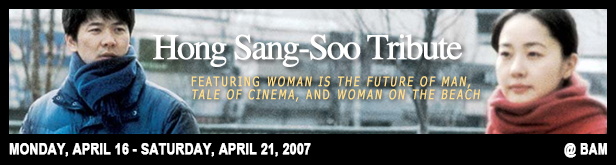
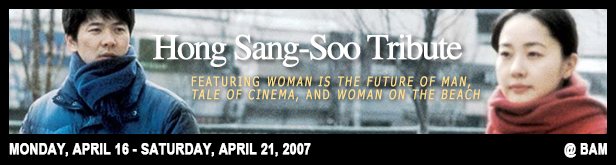
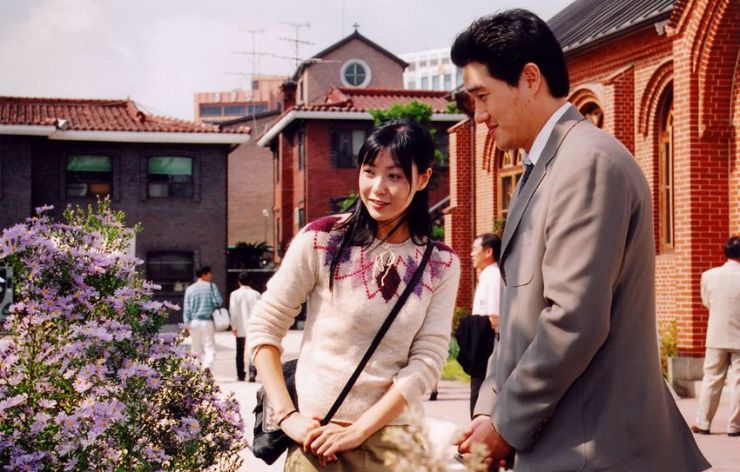
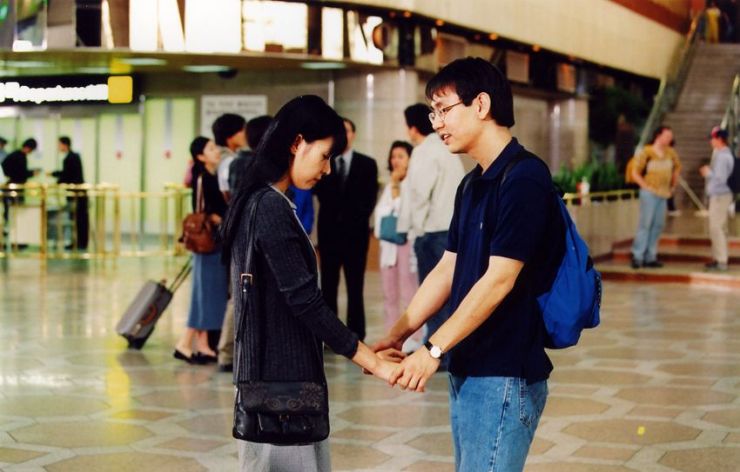
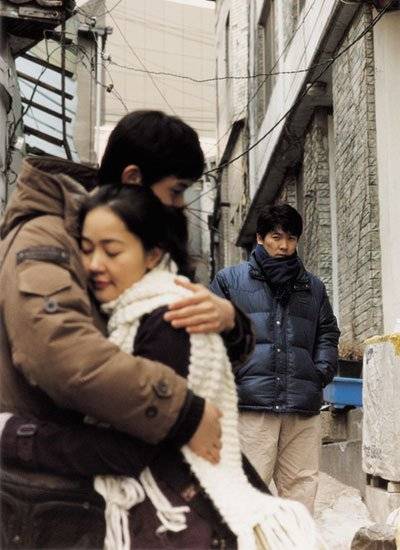
The Korea Society co- presents a ‘Hong Sang-Soo tribute’ with BAM Cinematek, featuring the celebrated Korean director’s three latest films that have won over critics and audiences alike worldwide – Woman is the Future of Man, Tale of Cinema and Woman on the Beach.
“One of the most exciting and authentically individual filmmakers to emerge on the world stage recently…. Wreathed in a profound melancholy, Hong’s films lyrically explore the limits of subjectivity, both its pathos and its dangers, often through different viewpoints that don’t so much cancel one another out as add another tile to the mosaic of existence.” – Manohla Dargis, The New York Times
WOMAN IS THE FUTURE OF MAN (88 min) 2004 여자는 남자의 미래다
Monday, April 16 | 4:30 PM
With Yu Ji-Tae, Kim Tae-Woo, Sung Hyun-Ah. Two male college friends reunite and spontaneously decide to look up a woman with whom they were both separately involved. “The men’s self-immolating behavior is what’s saddest in the Hong universe, thanks largely to his duplicitous manner with narrative. You can rarely grip the shape of the entire film until past the halfway marker. When you do, the tragedy of soured lives is beyond the point of no return.” – The Village Voice
With Lee Ki-Woo, Uhm Ji-Won. A young man bumps into a female friend; the ensuing evening involves drinking, sex, and a suicide pact. Turns out it’s only a film (within a film), but life imitates art, which in turn imitates life… “Tale expands on Hong’s preoccupations with a renewed conceptual depth. While it may be a tough film to love, it is also Hong’s finest work to date, marking a bold new direction just when Hong is most in need of a fresh start.” – Michael Sicinski, Cinema Scope
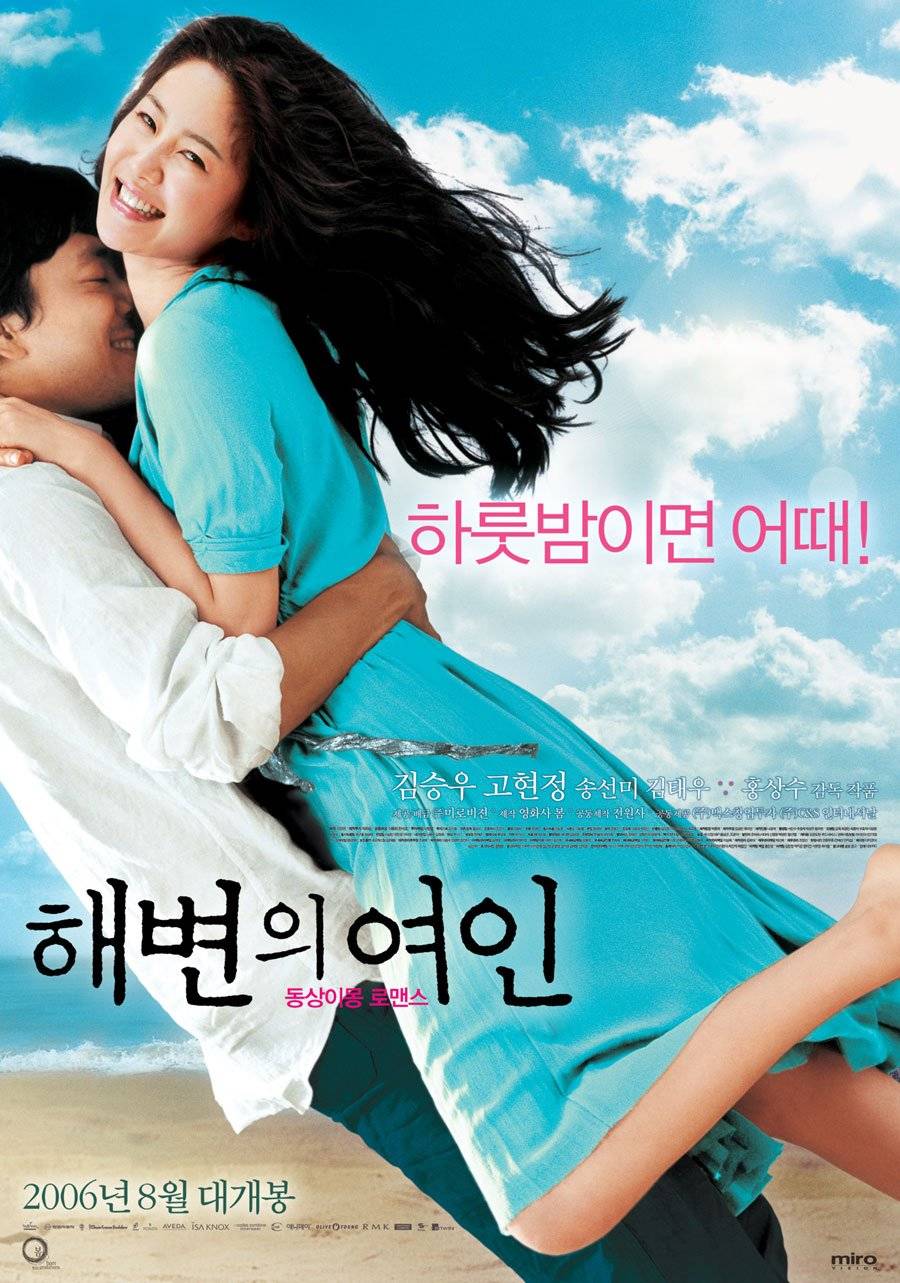
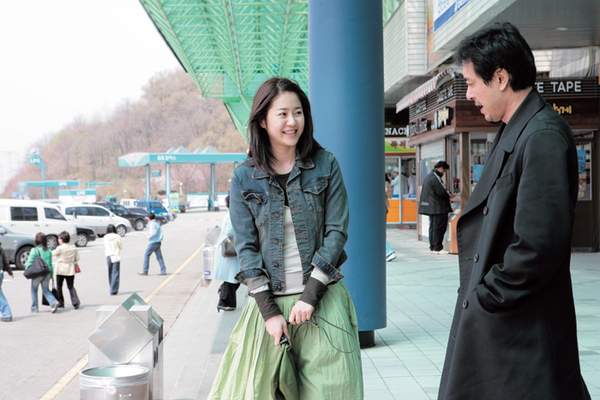
WOMAN ON THE BEACH (126 min) 2006 해변의 여인
Saturday, April 21 | 3 PM, 6 PM, 9 PM
With Go Hyun-Jung, Kim Seung-Woo, Kim Tae-Woo, Song Seon-Mi. A filmmaker, writing his latest script at a seaside resort town, becomes involved with two women. As ever, Hong is comically and painfully lucid in outlining the jealousy and self-absorption that fuel his male characters’ drunken acting out. In the scene that is at the heart of this film, he does so literally with the help of a diagram-a fitting gesture for a filmmaker so obsessed with the geometry of human relationships.
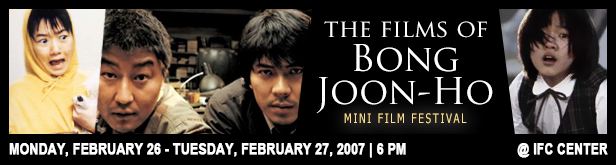
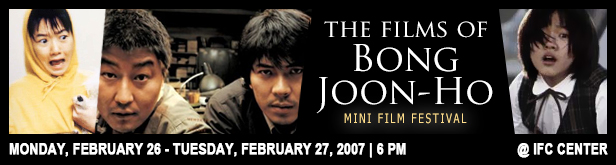
A special line-up of acclaimed South Korean director Bong Joon-Ho’s box-office mega-hits will include showings of Barking Dogs Never Bite and Memories of Murder, and shorts Incoherence and Sink and Rise. Bong will attend the screening of his latest film, The Host, for a Q&A afterwards.
Bong Joon-Ho took the 2006 Cannes Film Festival by storm with his smart, terrifying new monster movie The Host. In anticipation of the film’s release, this a mini-fest of his maximal career presents a special line-up of Bong’s signature cinema — black comedies, gritty crime dramas and horror thrillers with a comic book feel — and Bong himself in person for the closing screening of The Host.
Tuesday, February 27 | 8:30 PM Director Bong Joon-ho in person!
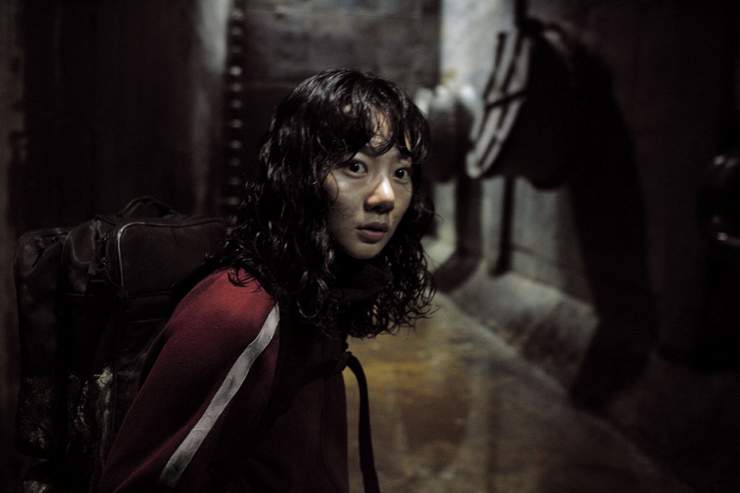
Starring: Song Kang- Ho, Park Hae-Il, Bae Du-Na, Byeon Hie-Bong, Ko Ah-Sung. Toxins from a U.S military base flow into Korea’s Han River, causing the birth of a mutant creature which terrorizes Seoul. When it grabs a little girl, her dysfunctional family must band together to save her. The Host is like a mutant hybrid spawned from the improbable union of Little Miss Sunshine and Godzilla, for the film is a family comedy and political satire in which an unnaturally evolved tadpole just happens to loom (very) large. Bong expertly balances absurd humor against tense thrills, and domestic drama against mass mayhem, reasserting South Korea’s place at the pinnacle of genre-busting cinema – and most of all he surprises at every turn in a film where, despite a realistic social milieu, almost anything seems possible.
Awards: Best Director, 5th Korea Film Festival Best Film, 5th Korea Film Festival Best Sound, 5th Korea Film Festival Best CG, 5th Korea Film Festival Best Picture, 5th Korea Film Festival Cannes Film Festival New York Film Festival Toronto International Film Festival DHL Audience Choice Award for Best Feature, Hawaii International Film Festival Pusan International Film Festival Best Special Effects and Orient Express Award for Best Asian Film, Sitges International Film Festival of Catalonia (Spain) 2006
MEMORIES OF MURDER (127 min) 2003 살인의 추억
Monday, February 26 | 9:15 PM
Starring: Song Kang-Ho, Kim Sang-Kyung, Park Hae-Il. South Korea was rocked to its foundations when struck by its first serial killer, who raped and murdered ten women in a small village in Kyonggi Province between 1986 and 1991. Director Bong Joon-Ho (Barking Dogs Never Bite) has taken the investigation and combined it with best-of-career performances from Song Kang-Ho (JSA, Sympathy for Mr. Vengeance) and Kim Sang-Kyung (Turning Gate), to make Korea’s most highly-acclaimed film of 2003, a master work that is itself like a memory of a dream: heartbreaking, mysterious, stunningly beautiful, and unspeakably sad.
A comedy, of sorts, of procedural errors that would be hilarious were it not so tragic, the film is a haunting look at a nation finding itself inevitably slipping back to an earlier, uglier era when an authoritarian government could freely violate the rights of private citizens in the name of the law.
Awards: Best Films, Grand Bell Awards Best Actor (Song Kang-Ho), Grand Bell Awards Best Director (Bong Joon-Ho), Grand Bell Awards Silver Seashell, San Sebastian International Film Festival FIPRESCI Prize, San Sebastian International Film Festival Best New Director (Bong Joon-Ho), San Sebastian International Film Festival 2003 Asian Film Award, Tokyo International Film Festival Grand Prix, Cognac Festival Du Film Policier Premiere Award, Cognac Festival du Film Policier Prix Mediatheques, Cognac Festival du Film Policier Special Prize of the Police, Cognac Festival du Film Policier Best Screenplay Award, Audience Award, Torino Film Festival (Italy)
BARKING DOGS NEVER BITE (106 min) 2000 플란다스의 개
Monday, February 26 | 7:00 PM
Starring: Bae Du-Na, Lee Sung-Jae. American Beauty hopped up on laughing gas, Barking Dogs Never Bite‘s plot is choreographed as intricately as a triple-time minuet. Its director says it’s about corruption and innocence (and it is), but the story plays as a wild comedy focusing on two of the greatest characters to appear onscreen in decades: Lee Sung-Jae, a part-time lecturer who learns he’ll do anything to achieve a coveted position as a professor and Bae Doo-Na, a female member of an apartment building’s custodial staff who yearns to do something brave. A shaggy-dog story about the mysteries of pregnancy, the length of toilet paper, lost dogs, and good stew, this movie is a bedtime story for urban sophisticates, scored to a be-bop soundtrack. The director’s debut feature, and one of the few independent Korean films, it gleefully mixes razor-sharp acting, goofy physicality, black comedy, and genuine warmth. It’s the kind of movie that audiences live for, and that gives marketing departments nightmares.
Awards: Best Editing, Slamdance Film Festival 2001 International Film Critics Federation Award of Young Asian FIPRESCI Award for young Asian filmmakers, 25th Hong Kong International Film Festival Special award presented to composer Cho Sung-Woo for his soundtrack for Barking Dogs Never Bite, Buenos Aires International Film Festival (Argentina) 2001. Best Newcomer Award to Producer Cho Min-hwan for Barking Dogs Never Bite, Munich Film Fest (Germany) 2001
SINK & RISE (95 min) 2004 and INCOHERENCE (30 min) 1994 Part of TWENTIDENTITY
Tuesday, February 27 | 6:00 PM
Bong contributed Sink and Rise to this omnibus film made for the 20th anniversary of the Korean Academy of Film Arts; screening with the director’s early short black comedy.
SINK & RISE Taken from Twentidentity, a 20-part omnibus film made by alumni of the Korean Academy of Film Arts on the occasion of the school’s 20th anniversary, Bong’s contribution is Sink and Rise, a whimsical work set alongside the Han River that can be seen as a warm up for the director’s third feature The Host.
INCOHERENCE A short black comedy that criticizes society with his Bong Joon-Ho’s unique sense of humor, Incoherence was invited to international film festivals in San Diego and Hong Kong, giving Bong his first taste of artistic recognition.
Organized in partnership with the National Museum of Korea, the Cleveland Museum of Art presentsTen Kings of Hell: The Afterlife in Medieval Korea, an exhibition that explores the artistic legacy of the Goryeo dynasty (918–1392), posing daring questions: How did medieval Koreans envision the world beyond death and how did works of art and materiality shape and reflect that imagined realm?
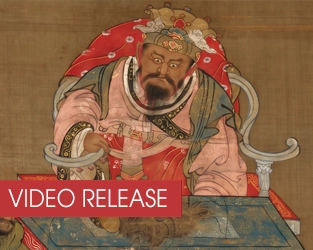
Presenting an exceptional array of important artworks, including the CMA’s recent acquisitions—the Fourth King of Hell from the late 1300s, the Knife Sheath from the 1100s (Apollo’s Acquisition of the Year Award 2022), and the Kṣitigarbha Bodhisattva from the 1300s—the exhibition unfolds across three interlocking sections, each illuminating the soul’s passage from death through purgatory to the Buddhist paradise. At its dramatic center is the historic reunification of a dispersed set of 10 hanging scrolls from the 1300s depicting the 10 Kings of Hell. Brought together for the first time since the 1960s, the scrolls offer a rare opportunity to experience the set’s panoramic sequence of judgment, atonement, and salvation.
Among its most compelling narratives, the exhibition examines how sociopolitical upheavals and environmental pressures shaped medieval Korea’s deep preoccupation with purgatorial afterlife—not only as a moral and devotional terrain but also as a response to broader natural forces, from climatic volatility during the Little Ice Age to the devastating reach of the Black Death. A select group of contemporary artworks is also included to underscore the enduring resonance of humanity’s existential concerns.
Featuring more than one hundred works drawn from leading public and private collections in Korea, Japan, the United States, and the United Kingdom, Ten Kings of Hell: The Afterlife in Medieval Korea is accompanied by a substantial, richly illustrated catalogue, anchored in the contributing scholars’ shared commitment to transregional and interdisciplinary investigation.
In a conversation with The Korea Society, Sooa Im McCormick, Korea Foundation Curator of Korean Art at the Cleveland Museum of Art, explores the art from the Goryeo dynasty and this landmark exhibition.
About the Speaker
Speaker
Sooa Im McCormick
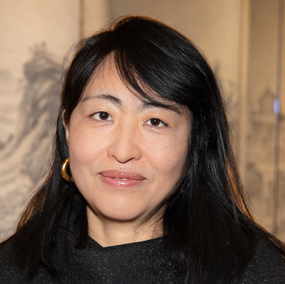
Sooa Im McCormick joined the Cleveland Museum of Art in 2015 and is primarily responsible for the Korean art collection. McCormick holds a PhD from the University of Kansas, and an MA in art history from Rutgers, the State University of New Jersey. She also completed graduate coursework in art history at Hongik University, Seoul, where she focused on Chinese and Korean art.
At the CMA, she has curated the exhibitions Chaekgeori: Pleasure of Possessions in Korean Painted Screens and Gold Needles: Embroidery Arts from Korea (Arlene M. and Arthur S. Holden Textile Gallery and Korea Foundation Gallery, March 8−July 26, 2020). As a cutting-edge scholar, she has published a number of articles that deal with the intersections between art and ecology and the issues of gender and diversity.
FAQ
01 / 02
Who is Sooa Im McCormick?
Sooa Im McCormick joined the Cleveland Museum of Art in 2015 and is primarily responsible for the Korean art collection. McCormick holds a PhD from the University of Kansas, and an MA in art history from Rutgers, the State University of New Jersey. She also completed graduate coursework in art history at Hongik University, Seoul, where she focused on Chinese and Korean art.
At the CMA, she has curated the exhibitions Chaekgeori: Pleasure of Possessions in Korean Painted Screens and Gold Needles: Embroidery Arts from Korea (Arlene M. and Arthur S. Holden Textile Gallery and Korea Foundation Gallery, March 8−July 26, 2020). As a cutting-edge scholar, she has published a number of articles that deal with the intersections between art and ecology and the issues of gender and diversity.
02 / 02
Can I see the exhibition in person?
Yes. Ten Kings of Hell: The Afterlife in Medieval Korea is on view at the Cleveland Museum of Art through January 3, 2027. Organized with the National Museum of Korea, it brings together more than 100 works, centered on a set of ten 14th-century hanging scrolls of the Ten Kings of Hell shown together for the first time since the 1960s. Tickets are required.
Gods, Demons and Generals: Icons of Korean Shamanism
The exhibition includes representations of Samsin Halmoni 삼신 (Birth Spirit), Sansin 산신 (Mountain God), Taesin Halmoni 대신 할머니 (Great Spirit Grandmother), Yongwang 용왕 (Dragon King), Sinchungdang 신중당 (Guardian Spirits) and images of many other shaman deities. As fixtures of traditional shaman shrines, twelve paintings provide a setting for rites that over the centuries have informed Koreans’ world view and their belief system in both overt and subtle ways. To glimpse the world depicted in these paintings is to gain a unique perspective on Korea’s ancient past and immediate present at once.
Gods, Demons and Generals: Icons of Korean Shamanism is available to travel to your school, university, library or museum. Please click for booking information.
Contents
12 framed paintings, 5 black-and-white and color photographs, text panels and labels
Fee
Upon request
Tour Dates
Currently available
Running Feet
210 running feet
Loan period
4 to 16 weeks
Crates
1
Weight
Approx. 600 lbs.
Category
Korean Art / History & Religion
Security
Moderate / High
Shipping
The Korea Society provides shipping to and from the exhibitor’s venue.
Contact
Jinyoung Kim Senior Program Officer for the Arts 212-759-7525 ext 316 email
Scheduled Venues Kresge Art Museum, Michigan State University, East Lansing, MI, Sept 8 – October 18, 2009, web
Toured Venues The Korea Society Gallery, New York, NY, February 28 – May 31, 2006
A 16-member troupe from the Seoul Performing Arts Company presented an exquisite program of folk dances as well as contemporary interpretations of ancient court and shamanic dances in five cities from coast-to-coast in the U.S. This tour was organized and funded by The Korea Society in association with the Seoul Performing Arts Company. Several members of the company also presented a workshop for high school students at the Wilshire School in Los Angeles on Tuesday, November 15.
The Seoul Performing Arts Company was established on August 1, 1986 with the founding objective of presenting the indigenous Korean performing arts in new attire and promoting them around the world. The Company has created many productions of musical and traditional Korean song and dance. It has gone on the road in over 45 countries, staging about 850 performances. Its performances at the closing and opening ceremonies of the ’88 Seoul Olympics, the promotional event for the 2001 World Cup, ’99 Winter Asian Games, the 2000 Korea Millennium Grand Gala, and other major international cultural events held in the United States, Japan, and several African and European countries have brought the company to a high standard of polish.
Program DescriptionDrum Dance of Ch’oyong (Ch’oyong Pukch’um) 8 minutes/ 5 dancers Choreography: Son In-Young The Drum Dance of Ch’oyong derives from the second dance of a two-dance suite that is said to have originated during the reign of King Hon’gang (r. 875-886), the forty-ninth ruler of the Silla kingdom. The first dance, no longer performed, was an elegant and slow dance in the court-dance tradition-movements in court dances are usually soft and subdued. However, the second dance, while classified as a court dance, stands out from other court dances for several reasons: it is the only dance in which the performers wear masks; it is performed by men rather than women; and its movements are comparatively strong and vigorous. In some historical documents, it is referred to as “the dance of the five directions.” Each direction is represented by a color: north is black, south is red, east is blue, west is white, and the center is yellow. The predominant color of the costume of each of the five dancers is one of the colors associated with the five directions. In 1971, the government of the Republic of Korea designated this dance as Intangible Cultural Asset No. 39. In this version, the drums of the dancers are substitutes for the usual musical accompaniment.
Sword Dance (Tonggyong Kommu) 7 minutes/ 8 dancers Reconstruction: Eum Ok-Ja During the Silla dynasty (57 B.C.-935 A.D.) an institution known as hwarang was established. The hwarang were young boys trained in Korea’s cultural and military arts. The oldest reference to a sword dance relates to a hwarang. Beyond legendary origin, the current form of the dance is sometimes attributed to performances in the court and sometimes to village performances. The tempo is slow, the dancers walk around the circle – still manipulating their swords-form a single straight line parallel to the audience, bow, and quietly exit by backing away from the performing area. Although a suggestion of military action has been offered, the strongest impression is that of a kaleidoscopic ensemble that groups and regroups amidst a flurry and swish of sword blades-all with the calm dignity of a regal group of dancers.
Dongnae Crane Dance (Dongnae Hak ch’um) 7 minutes/ 5 dancers Reconstruction: Lee Sung-Hoon Designated as Intangible Cultural Property No. 3 by the city of Pusan, the Dongnae Crane Dance reflects the distinctive geographical features of Dongnae. The landscape of this area suggests the shape of a crane, and many place names in the district are related to the crane. As a popular hot springs resort area, Dongnae traditionally has attracted many people of highly refined tastes. This fostered the development of a strong tradition of recreational activities that include singing, dancing and poetry. Yangban enthusiasts are believed to have been responsible for the development of the distinct genre of the crane dance performed in Dongnae, which is viewed as an expression of their appreciation for refined forms of recreation. Above all, however, the distinctive feature of the Dongnae Crane Dance is that it does not mimic the actual movements of a crane but rather attempts to represent these movements in a more abstract and symbolic way.
Improvised Dance (Ipch’um) & Taegum Solo (Taegum Sanjo) 5 minutes/ 1 dancer/ 1 musician Choreography: Chae Sang-Mook & Kim Hyeon-Ah This Improvised Dance retains the basic form of a traditional dance in which there is no instrumental accompaniment and most of the movements are improvised. Being a kind of festive dance, it takes mirth and artistic taste for its theme. Its appeal is that the audience feels drawn to participate in the performance by dancing and humming, which further adds to its popularity.
The taegum is a bamboo instrument with a clear and cool sound, which has been played in both court music and folk music since the era of Three Kingdoms period (57 B.C.-935 A.D.). With its wondrous resonance, clear and sometimes thrilling sounds, the taegum has been regarded as a holy instrument that brings peace to the world.
Fan Dance (Puch’aech’um) 6 minutes/ 9 dancers Choreography: Chae Sang-Mook Widely regarded as the most unique Korean traditional dance, the Fan Dance originated from a shamanic ritual. This splendid dance with luxurious dresses and brilliant fans of painted blossoms illustrates the beauty of vivid colors and the harmony of group movements within in a confined space. The dance reaches a climax with the dancers forming a large fluttering flower that appears to rotate.
Military Drill Dance (Hullyongmu) 8 minutes/ 8 dancers Reconstruction: Chong Jin-Wook This work was created in the 1930’s by Han Sung-Joon, who is considered to be the father of modern Korean dance. It is modeled on the forms of the traditional military drill. It is a striking dance that captures the disposition of the troops, a confrontation scene and the training of the soldiers.
Farmers’ Band (Nongak) 30 minutes/ 13 dancers/ 6 musicians Choreography: Seo Han-Woo The Farmers’ Band combines dance and music. It is representative of the joyful comradeship farmers traditionally enjoyed while working in co-operation with each other. In agricultural communities, up until the recent past, it was customary for Korean farmers to pray for peace and abundance by singing and dancing communally after each harvest. The instruments they played on these occasions included a small gong (kkwaenggari), a large gong (), an hourglass-shaped drum (changgo), a barrel drum (puk), and a small handheld frame drum (sogo). There were many variations of this kind of performance, and it also was linked with religious and social customs.
International DUMBO Dance Festival: Contemporary Korean Choreographers
October 19 – 25, 2005
In association with WHITE WAVE, a Brooklyn-based performance, teaching and rehearsal hub, The Korea Society presented the first annual International DUMBO Dance Festival. Marking an exciting departure from the usual presentation of traditional Korean performing arts, the Festival featured seven up-and-coming young Korean choreographers/dancers who are active not just in Korea but worldwide. These artists performed eleven highly varied, contemporary routines that were grouped into two separate programs and performed on six occasions at the John Ryan Theater in Brooklyn from October 19 to October 23.
The Artists and their works
Jung Young-Doo (Korea)
Craving for More Choreographed by: Jung Young-Doo Danced by: Jung Young-Doo & Son Yea-Ran Music by: Lee Kot-Byul (Korean Fiddlist) Costume by: Doo Dance Theater
We always try to move up and crave for more. How many of us could be satisfied with what we already have? Most of us live anxiously worrying about love, work, dreams to fulfill and so on. The complicated movements paradoxically suggest peace and harmony of life to the audience. By taking a step down from our restless lives, we may be happier. Breathtaking movement by two dancers is a wonderful feat to experience the endless flow of delicate emotion. It will direct the audience to look back on their lives. Craving for More has received awards from the 2004 Yokohama Dance Collection Solo & Duo Competition, the Yokohama Red Brick Warehouse Number1, the Laureat du Prix de L’Ambassade de France pour jeunes choregraphes and the Yokohama Arts Foundation.
Incompatible Yet One Choreographed by Jung Young-Doo Danced by Jung Young-Doo, Kim Nam-Keon & Kwak Go-Eun Music by: Maurice Ravel Costume by: Sim Young-Sim Jung
Young-Doo’s work has been seen at Seoul International Dance Festival’s Contemporary Korean Dances by Young Artists as well as in Australia, Japan, Hong Kong, Singapore, and Taiwan. His awards include the 2004 Yokohama Dance Collection Solo & Duo Competition Grand-Prize and Special Award.
Lee Tae-Sang (Korea)
Rush Choreographed by: Lee Tae-Sang Danced by: Lee Tae-Sang, In Jung-Ju, Byeon So-Yeon & Lee Kyung-Joon Coustume by: Lee Tae-Sang Lighting by: Lee In-Yeon
Rush can be compared to a needle in one’s body. In the piece, Lee Tae-Sang expresses the danger and limitation of being in modern society and examines the meaning of identity. Rush was premiered in The 22nd International Modern Dance Festival (Modafe2003).
Lee Tae-Sang was awarded the Best Choreographer at the 2005 Dance Festival for the Critics’ Choice of Young Artists and has been seen at ImPulsTanz in Austria and Dusseldorf Tanzhaus in Germany. Tae-sang Lee has collaborated on works with Akram Khan and Jeremy Nelson.
Lee Kyung-Eun (Korea)
Between Collaboration by: Lee Kyung-Eun & Saito Eiji Danced by: Lee Kyung-Eun & Saito Eiji Prop, Music by: Lee Kyung-Eun & Saito Eiji Costume by: SSAMZIE
Between is a co-production of Theater ZERO in Korea and the AOYAMA Theatre in Tokyo. It premiered in November, 2004 at the Korea/Japan Dance Festival. It was also presented at the 5th Seoul Performing Arts Festival in Seoul and the Korea/Japan Dance Contact in Tokyo (2005).
Off Destiny Choreographed by: Lee Kyung-Eun Danced by: Lee Kyung-Eun Music by: J. S. Bach Costume by: Lee Kyung-Eun
Off Destiny was choreographed and developed from Lee Kyung-Eun’s composition workshop at the Montpellier Dance Festival in 2002. The piece is an attempt to use the rhythm within, and external music was used only at critical and necessary moments.
Lee Kyung-Eun was the winner of the choreography contest of The 8th International Solo-Tanz-Theater Festival, Stuttgart and toured 5 major cities with the work. She was also awarded Best Choreographer at the 2003 Dance Festival for the Critics’ Choice of Young Artists. She received 2nd Grand Atelier Choregraphes-Compositeurs at the Royaumont Foundation.
Kim Yun-Jung (Germany)
Farewell Images Choreographed & Danced by: Kim Yun-Jung Music by: Tekn Kim Lighting design by: Eric vanden Dungen Voices: Kim Hyojung, Ahn Hyejung and Kim Eun-jung
Farewell Images was performed at the Dance Museum (Seoul), Aoyama Theater (Tokyo), Frankfurt Book Fair 2005 and toured cities around Germany including Aachen, Munster and Dusseldorf.
8 Days Choreographed by: Kim Yun-Jung Danced by: Kim Yun-Jung, Han Chang-Ho & Lee Youngil Music by: Kim Tekn Costume by: Lee Hyemin Film & stage design by: Ha Sungok Lighting design by: Lee Boman
8 Days was invited to KUNSTSTIFTUNG NRW (NORD RHEIN WESFALLEN) and Seoul Perfuming Arts Festival and received financial support from the City of Dusseldorf, the Stiftung Kunst und Kultur and LG Electronics.
Kim Yoon-Jung, based in Dusseldorf, Germany, has presented work in Korea with the Whang Mi Sook Dance Company and the Yang Jung Soo Contemporary Dance Company; and in Europe with Mary Fulkerson, Joao da Silva Jr., Charlotte Zerbey, Marcus Grolle and with the Russian choreographer Olga Pona.
CHA Jin-Yeob (England)
Fragments Choreographed by: Hofesh Shechter Danced by: Cha Jin-Yeob & Hofesh Shechter Music by: Hofesh Shechter, Eric Idle and J.S. Bach
Fragments premiered at the Kuopio Dance Festival in Finland, June 2003 and then toured the UK, Italy, Portugal, Switzerland and Poland, where the piece won first place in a choreography competition. It presents an insight into a couple’s life inside the noise of their culture. A rich sound track is the centerpiece through soft and intense moments that investigate the nature of the couple’s relationship under the pressure of inner and outer voices.
Volupte Choreographed by: Cha Jin-Yeob & Hofesh Shechter Danced by: Cha Jin Yeob Music by: Hofesh Shechter
Volupte premiered at The Korean World Dance Stars Festival in July 2005. The work explores the edge, the delicate point, and the fragile moment where the individual loses the world of definitions and dives into an ocean of unexplainable sensation.
Cha Jin-Yeob received the best choreographer award in The Korean Choreography Festival in 2002. She worked with Dance Energy Company in Munich, Germany and for Micha Purucker from 1999 through 2003. Currently, she is a member of Edge, the post graduate company of LCDS, and is also working in London with choreographer Hofesh Shechter.
Nam Young-Ho (France)
Porte D’ame (Gate of Soul) Choreographed by: Nam Young-Ho Danced by: Nam Young-Ho and Christelle Delhaye Music by: Christelle Delhaye Costume by: Judith Chaperon Lighting by: Thierry Lenain
This piece was created with the support of the Dance of all Senses Festival, in Falaise, Normandie, the French Ministry for Culture and Communication, the Languedoc-Roussillon Council, the Montpellier City Council, and the Herault Council. Gate of Soul is a peaceful duet for two females, a dancer and a musician (cello), inspired by the philosophy of Tao.
The Rascalou-Nam Dance Company was founded in 1998 in Montpellier, France by co-artistic directors Nam Young-Ho and Francois Rascalou. Since its inception, the company has performed amazing works in both domestic and international arenas. Her work has been invited to the 2005 Montpellier Dance Festival.
Kim Eun-Jeong (Korea)
Monghwan Choreographed by: Kim Eun-Jeong Danced by: Kim Eun-Jeong and Han Chang-Ho Music by: Seo Jung-Min (p’ansori vocalization) and Lee Hwa-Yeon (Korean zither)
Monghwan (Bitter Dream) paints a daydream by depicting a pair of lovers on a yellow mat. As the sound of a love song from the story of Chunhyang and the sorrowful wail of a Korean zither engulf them, they express the border of coexistence between reality and unreality. They navigate as if the broken ship of life floats on the ocean.
Kim Eun-Jeong has perform at Tanz Messe in Dusseldorf, Germany, supported by Korea World Dance Center, Switzerland’s Theater Winterthur 2004 and at Agora Theater in Tokyo, Japan.
The choreographers and dancers were chosen by Young Soon Kim, the curator of the Festival, who also is WHITE WAVE’s artistic director. In picking performers, Kim attempted to achieve something more than just capturing the rhythms and movements of Korea. As all the artists she selected for the Festival either have planted their Korean roots in foreign soil or at least performed extensively abroad, she wanted to highlight how in the process of establishing their careers they have created singular, cross-cultural performances.
Following their performances in Brooklyn, the dancers went on the road for a final performance on October 25 at St. Lawrence University in Canton, New York.
This exhibition examined the changing social realities of Korean society from the 1950s to the 1990s through a selected reading of Korea’s most popular comic books. Featuring the works of 17 of the best-known artists, the exhibition offered a running commentary that reflected the lives of ordinary people—at once joyful, satirical and penetrating. What shines through these works most prominently is an engaged and vigorous civil society in Korea, continuously challenging and energizing the status quo in whimsical and provocative ways. By so doing, they play an important role in characterizing and distinguishing the culture, sensibility and sentiment of modern Korea.
Comics were first popularized in Korea in serialized newspaper strips during the 1960s, when the works of Kim Seong Hwan and others entered the idiom of everyday life. In doing so, they helped shape popular culture during the military dictatorship of former president Park Chung Hee (1961-1979). Later, Park Jae Dong produced serials in the liberal paper, Hankyoreh, under former presidents Chun Doo Hwan (1980-1988) and Roh Tae Woo (1988-1993). In contrast to the oppressive political atmosphere, the comic genre Myongnang Manhwa (“Cheerful Comics”) gave expression to a new popular culture in a rapidly transforming society. The humor and exuberance it expressed contrasted sharply with the pervading sense of social repression, stemming from censorship of the media and tight government control of most aspects of society. Slicing through the heavy atmosphere, Myongnang Manhwa provided not only a welcome relief but also penetrating social and political commentary. Cartoonists such as Kil Chang Dok, Kim Su Jung, Kim Won Bin, Park Ki Jeong, Park Su Dong, Shin Mun Su, and Yoon Sweng Un described common and seemingly banal episodes in everyday life while masterfully engaging the public with biting and witty commentary. At the time, a given comic’s popularity was a gauge of South Korea’s national pulse. The storylines of comics were sometimes built around historical content. Kim Yong Hwan, Ko Wu Young, and Lee Du Ho all popularized the history of ancient Korea, making it accessible to a wide range of audiences, both young and old. The rapid growth in popularity of historically based comics after the Korean War provides important clues as to the development of people’s identities vis-a-vis the emerging Korean state. Other cartoon artists in the exhibition drew comics that dealt with various contemporary social and cultural themes during the 1970s and 1980s. Heo Young Man, Kim Hyung Bae, Lee Hyun Se, Oh Se Young, and Park Bong Seong delved into topics ranging from Korea’s economic growth during the ’70s, to the resulting urban and rural divide, to the Vietnam War. Through these works, it is possible to see the decades-long social evolution of Korea in small frames.
The masterful drawing and writing of the featured artists provide a running commentary, at once joyful, satirical, penetrating, and reflect the lives of ordinary people. There were two related events held in conjunction with this exhibition. The first was an opening reception on September 7, 2005 that featured a lecture entitled “Life and Comix: 1960s Korea” by Heinz Insu Fenkl, director of the creative writing program and Interstitial Studies Institute at SUNY New Paltz. The second event was a screening of Empress Chung, a path-breaking Korean animation feature based on a classic Korean folktale, which was presented at The French Institute on September 21, 2005.
The Korea Society once again provided financial and logistical support for the New York Korean Film Festival in 2005 and also served as its fiscal agent. For the fifth year in a row, the best in new wave Korean cinema was brought to the streets of New York under the auspices of this unique event, which is presented annually by Samsung Electronics America, Inc. and organized by Media Bank, Inc. Other festival sponsors this year included the Korean Film Council, the Korean Cultural Service in New York and The Village Voice. The films were screened at The Lighthouse Theater from September 2 to September 6 and at BAM Rose Cinemas from September 7 through September 11. With six international premieres, five North American premieres, two U.S. premieres and two New York premieres, the festival presented 15 films representing a broad cross-section of recent Korean new wave cinema. It included critical favorites and box-office blockbusters, in genres ranging from horror, comedy, and melodrama to sports films, and historical fiction, from veteran and debut filmmakers, stars, and stars-in-the-making alike. The theme of this year’s festival, “Truth and Dare,” was chosen to emphasize the risk-taking, soul-searching nature of both the characters in the films and the filmmakers themselves in their efforts to arrive at necessary, often painful personal truths. Outside of Korea, there is nowhere else where a general audience can see the many faces of Korean cinema in such a concentrated period of time.
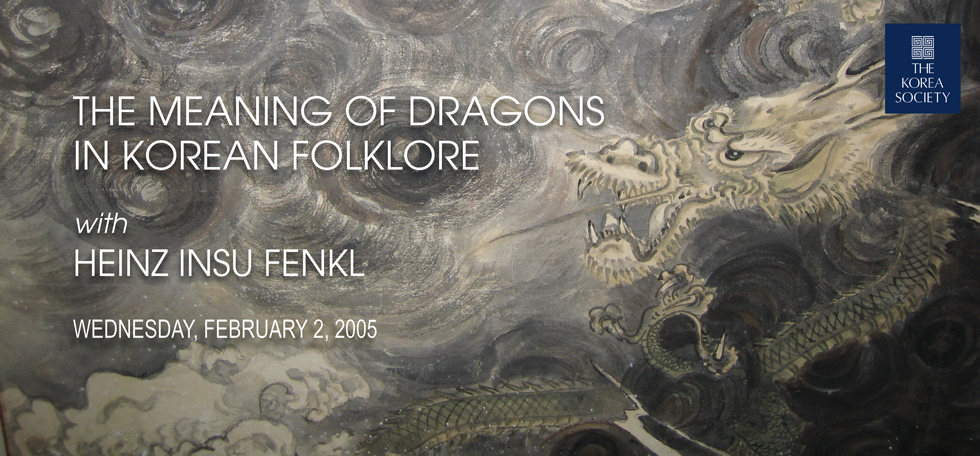
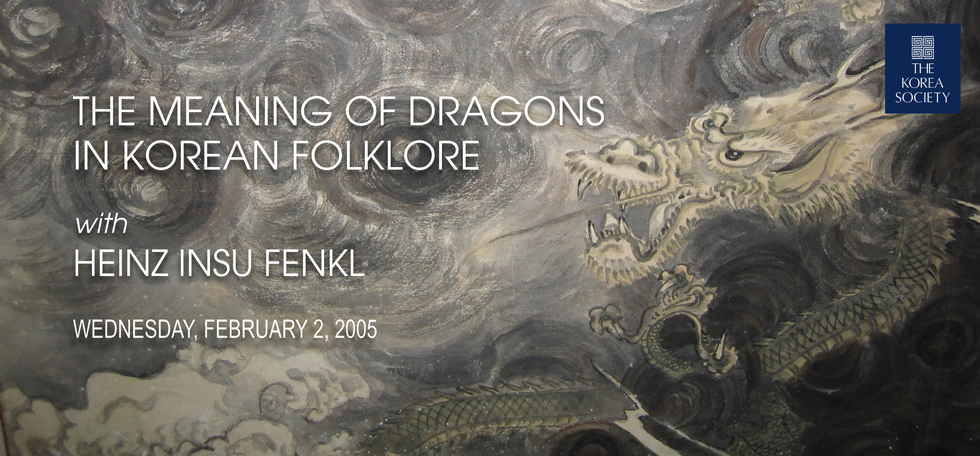
To mark the opening of an exhibition of Korean dragon paintings, author and folklore specialist Heinz Insu Fenkl, director of the Interstitial Studies Institute at SUNY New Paltz, lectured on dragon symbolism in both the East and West. Due to its association with serpents in the Old Testament, he explained, the dragon was considered a creature of evil in the West. In the folklore of the East, however, the dragon was viewed as auspicious and usually was depicted as a magical creature of unsurpassed power and vitality.
Fenkl went on to elucidate the subtle but important differences between Korean dragon iconography and the more widely known Chinese dragon imagery. Dragon mythology originated in ancient China, Fenkl noted. The legendary founder of Chinese civilization, Fu Hsi, was said to be half-man, half-dragon. After the folklore disseminated to the Korean Peninsula, however, local artists and storytellers made their own adaptations. Compared with their Chinese counterparts, Korean storytellers placed more emphasis on the spiritual powers of dragons. In fact, dragons play a role in many of the most important Korean myths and fables even though they generally are assigned to peripheral roles where their actions reflect the virtues of the main characters. Fenkl described one important figure, the Dragon King, who was said to live in a palace beneath the sea and was generous and welcoming to a fault. Dragons are still omnipresent in modern day Korea: on billboards and logos and in brand names and commercials. Unfortunately, while Koreans recognize them, these days knowledge of the folklore behind these cultural icons is fading. “This is all the more reason,” Fenkl concluded, “to take the time to really study the paintings hanging in the gallery.”
Gallery Talk
with
Heinz Insu Fenkl Director, Interstitial Studies Institute, SUNY New Paltz
Wednesday, February 2, 2005
Picture from the exhibition, Songs of Flying Dragons. (February 2-April 15, 2005)
Artist Unknown Dragon Amidst Clouds Ink on paper, 19th C 33 (H) X 58 (W) inches Collection of Lea Sneider
A dragon’s body is usually partially hidden since human beings are not supposed to view its entire body. In this depiction clouds are used to hide the dragon; in other cases, waves provide cover.
This exhibition included four paintings of Korean dragons and a pair of dragon sculptures on loan from the Lea Sneider Collection. All the pieces mixed strict formalism with unexpected creativity. Two of the paintings depicted dragons as benevolent bringers of rain, symbolized by a dragon surrounded by clouds. A third painting depicted a dragon with carp swimming placidly beneath it, instead of jumping and striving to reach the heavens and become a dragon, as is usually the case. The fourth painting depicted a dragon hovering over two human figures. This was the “mystery” painting of the exhibition as it is very rare for human beings to be depicted in a dragon painting. Lastly, the exhibition included a pair of dragons that collectors believe once served as temple guardians. The Songs of the Flying Dragons exhibition debuted with a gallery talk by Heinz Insu Fenkl, director of the creative writing program and Interstitial Studies Institute at SUNY New Paltz.
















 Gods, Demons and Generals: Icons of Korean Shamanism


 This exhibition examined the changing social realities of Korean society from the 1950s to the 1990s through a selected reading of Korea’s most popular comic books. Featuring the works of 17 of the best-known artists, the exhibition offered a running commentary that reflected the lives of ordinary people—at once joyful, satirical and penetrating. What shines through these works most prominently is an engaged and vigorous civil society in Korea, continuously challenging and energizing the status quo in whimsical and provocative ways. By so doing, they play an important role in characterizing and distinguishing the culture, sensibility and sentiment of modern Korea.