Advertising in South Korea is often referred to as a “flower of capitalism.” Rather than calling attention to the inherent links between commercial advertising and capitalism, this clichéd metaphor presents advertising as a wholesome, creative medium of public good and positive contribution to society. South Korean’s consume advertising as a product of popular culture and celebrate it for the humanist societal ideals it often promotes, instead of viewing it as an intrusive commercial message. Dr. Fedorenko explores the origins of such attitudes toward advertising through some notable contemporary examples, and considers challenges of using advertising for public good in the twenty-first century South Korea.
Tuesday, June 16, 2015 | 6:30 PM
Flower of Capitalism:Cultural Logic of South Korea Advertising w/ Dr. Olga Fedorenko, NYU
Since November, 16 Youth Ambassadors in New York and Los Angeles embarked on a journey of self-exploration and intercultural-leadership that culminated with ten days of total immersion in Korean culture. The New York-based Youth Ambassadors will share their experiences, including stories from a ten-day study tour to Korea with their Los Angeles-based partners. Current New York City public high school sophomores and juniors are especially welcome to attend and learn more about how to apply to be part of Project Bridge 2015-2016. Funded by Korea Foundation.
Educators are invited to explore how the creation of the Korean alphabet, hangul, affected Korean society and literature during the Choson Kingdom. Dr. Mark Peterson, Professor of Korean Studies at Brigham Young University, reveals details about the alphabet’s development, its creator King Sejong, and how this writing system was received by various social classes. Dr. Michael Pettid, Professor of Premodern Korean Studies at Binghamton University, demonstrates hangul’s effects on Choson women and literature. The conference ends with a classroom activities workshop to help educators incorporate this unique topic into their curriculum. Funded by the Freeman Foundation.
Free event, early registration requested. Please register here or contact Luz Lanzot for more information.
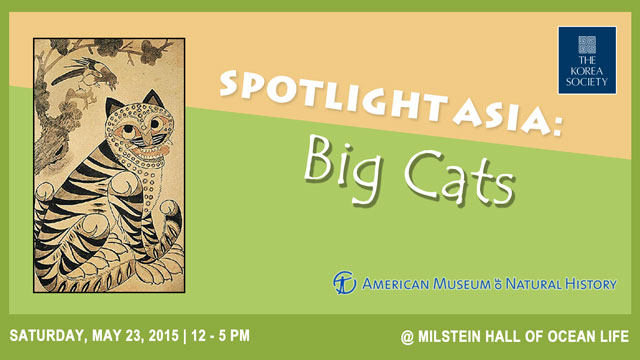
Celebrate the role of big cats in Asian culture with The Korea Society and the American Museum of Natural History! Master storyteller, artist, and filmmaker Maria Yoon unravels Korean myths, legends and folk tales. Artist Kate Oh Trabulsi, winner of the 2014 Korean Fine Art Association’s Chairman Award, leads a minhwa tiger painting workshop. All ages are welcome!
Entrance is included with museum admission.
Please visit the American Museum of Natural History’s website for more information.
This program is supported by public funds from the New York City Department of Cultural Affairs in Partnership with the City Council.
Educators are encouraged to apply for the 2015 Summer Fellowship in Korean Studies. This year, the program is conducted in conjunction with the Foreign Policy Research Institute in Philadelphia, PA. Participants get an intimate view of Korea through visits to the DMZ, Buddhist Temples, and early historical sites.
For full-time Social Studies Teachers, Curriculum Coordinators, or Supervisors of programs involving Korean history and culture
Thirty finalists receive:
Study Tour of South Korea from August 18 to August 26 (approximate dates)
Stipend of $800 to cover all or most transportation costs to South Korea
Transportation throughout Korea, hotel accommodations, and most meals
Teaching materials and other academic materials about Korea and US/Korea Relations
Guides, speakers, admissions, and more!
REQUIREMENTS:
To apply, you must be a full-time social studies teacher, curriculum coordinator, or supervisor of a program involving Korean history and culture. Applicants commit to developing a lesson plan or unit of study on the Korean War, contemporary issues, or US-Korean relations. Upon acceptance, a refundable-deposit of $100 is required. Deposits are refunded upon the completion of the Lesson Plan/Unit of Study.
Participants should be in good health, hikes and walking tours may be strenuous at times and summer temperatures can be very hot. Finalists should bring spending money for souvenirs, occasional lunches, laundry, phone calls, and incidentals.
Attendance is required at all activities and programs.
Tentative Dates: August 18-26, 2015
Deadline: April 30, 2015 DEADLINE EXTENDED: MAY 15, 2015
The Korea Society welcomes applications for the 11th annual Spring Fellowship in Korean Studies. This expense-paid program in Korea will include lectures, guided tours, and opportunities for on-site study in locales of historic and contemporary significance. This program is made possible through the generous financial support of the Freeman Foundation and the Academy of Korean Studies.
Eligibility
Applications are welcomed from anyone who meets one or more of the following eligibility criteria:
1) state or school district supervisors and curriculum coordinators
2) elementary and secondary school textbook writers
3) textbook publishing company editors and supervisors
4) elementary and secondary teachers (social studies, history, geography, art, and literature)
Application
Applicants should submit the application, including the application form and supporting documentation, by February 27th (postmarked) to:
Luz Lanzot Korean Studies Program The Korea Society 950 Third Avenue, 8th Floor New York, NY 10022
Learn about the international appeal of K-pop music and Korean cinema as experts detail the development of Korean popular culture into a worldwide phenomenon. A K-pop dance workshop will follow the lectures and discussions. Supported by the Freeman Foundation.
Free event, early registration requested. Please register here or contact Luz Lanzot for more information.
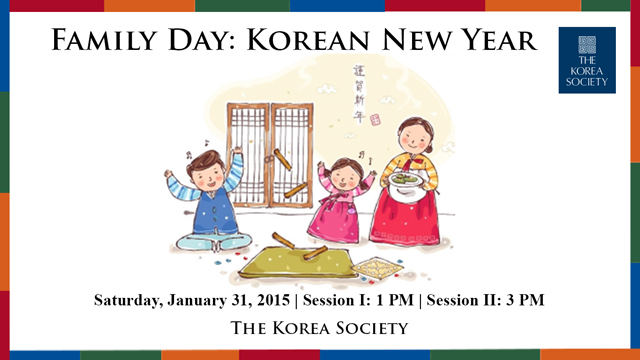
Celebrate Sŏllal, the Korean New Year, with a day of fun-filled family activities at The Korea Society! Enjoy storytelling based on Korean folk tales and practice sebae, the New Year’s bow, to show respect for elders. Learn Korean calligraphy and brush painting, make a tasty treat, play traditional games, and participate in arts & crafts projects! Unforgettable memories await your family at The Korea Society.
Limited Space Available
Session I: 1 PM (FULL)
Session II: 3 PM (FULL)
Tickets:
Members: $25 per family of 3-5 ($5 each additional family member), $10 for individuals
Non-members: $30 per family of 3-5 ($5 each additional family member), $15 for individuals
Family Day is part of CelebrASIA NYC, a collaboration among leading cultural institutions in New York City designed to introduce children to Asian festivals and themes. Children are invited to ring in many Asian New Years from January to March by participating in hands-on workshops and programs at Japan Society, Museum of Chinese in America, The Korea Society, Asia Society, China Institute, Flushing Town Hall, and the Rubin Museum of Art. Members of all participating organizations receive discounts for all CelebrASIA events. Please contact your institution for the promotional code when purchasing tickets at each venue. Visit www.celebrasia.org for more information.
This program is supported by public funds from the New York City Department of Cultural Affairs in Partnership with the City Council.
Congratulations to the 16 students chosen to be Youth Ambassadors for the 2014-2015 Project Bridge program. These Youth Ambassadors, from New York and Los Angeles, travel to Korea for a study tour where they meet with government officials, business professionals, scholars, students, and artists. The Youth Ambassadors promote understanding about Korea and tolerance by building bridges of interaction across lines of race, culture, and ethnicity. Application instructions for the 2015-2016 program will be announced in early September.
2014-2015 Youth Ambassadors
First Name
Last Name
School
City
David
Alonso
High School of Economics & Finance
New York
Jevhoy
Bailey-Gordon
High School for Law, Advocacy, and Community Justice
Explore Korean culture through dance! Participants will enjoy learning six exciting types of Korean dance including: HalRyang Mu (한량무), Sogo Ch’um (소고춤), Bong San Tal Ch’um (봉산탈춤), Ip Ch’um (입춤), Salpuri Ch’um (살풀이), and Kpop. Experienced teaching artist Karen Kriegel develops micro choreographies based on longer dance pieces to provide a sampler of the basic movements, music, rhythm, and various dance styles within traditional Korean dance. Supported by New York State Council for the Arts.
All are welcomed to participate in this workshop series. Dance experience is not necessary. All ages, body types, abilities, and genders are encouraged to join.
For educators, lesson plans with Common Core connections for various grades are supplied.
Session Schedule & Descriptions
September 29, 2014
한량무 HalRyang Mu Fan Dance “The Scholar’s Dance”
Influenced by Confucian thought, this dance focuses on the fan technique. HalRyang Mu reflects the joy felt by an young accomplished Confucian scholar as he looks to a bright future.
October 6, 2014
소고춤 Sogo Ch’um Small Drum Farmer’s Dance
Using movements from the various forms of 농악 (farmer’s music), this dance was performed outdoors during seasonal celebrations and village events. The choreography focuses on both individual and team movements, while utilizing a small handheld drum.
Designated the 17th Important Intangible Cultural Property of Korea by the Korean government in 1967, this mask dance is a form of socio-political theater that uses playfulness and satire to raise community issues and question authority. The masks, or 탈 (t’al), are props intended to ridicule members of society. The drama consists of seven acts and can last several hours. This workshop focuses on the first l6 PMevel of study, or 기본 (kibon), from Act 2 for a character known as 목중 (meokjung). This dance is also known as “The dance of the eight young monks who like to play and do whatever they can to avoid their studies.”
November 3, 2014
입춤 Ip Ch’um I “Free Dance”
This traditional style typifies the movements found in Korean dance forms, and display the true nature of the Korean aesthetic. Using breath and curved lines of the body, the dance is an illusion of ease and free-flowing improvisation. In actuality, it is highly choreographed using every muscle in the body and controlled breathing.
November 10, 2014
살풀이 Salpuri Ch’um Scarf and Shaman Dance
This stage technique is influenced by the female shamans of the Korean peninsula. Multiple elements of theater, Confucian, Buddhist, and Shamanistic histories, as well as feminist theory, are used in this piece. Emotional transformation defines this dance form.
November 24, 2014
Kpop and Hallyu
Korean pop music and dance have quickly spread to all corners of the globe. Through resources such as YouTube, Kpop is strongly identified with Korea. This workshop will feature a popular choreography and provide a basic history of the dance form within Hallyu, the Korean culture wave.
Art Workshop: Korea Through Dance is made possible by the New York State Council on the Arts with the support of Governor Andrew Cuomo and the New York State Legislature.