









Global Venture Without Borders:
A Conversation with Eric Kim

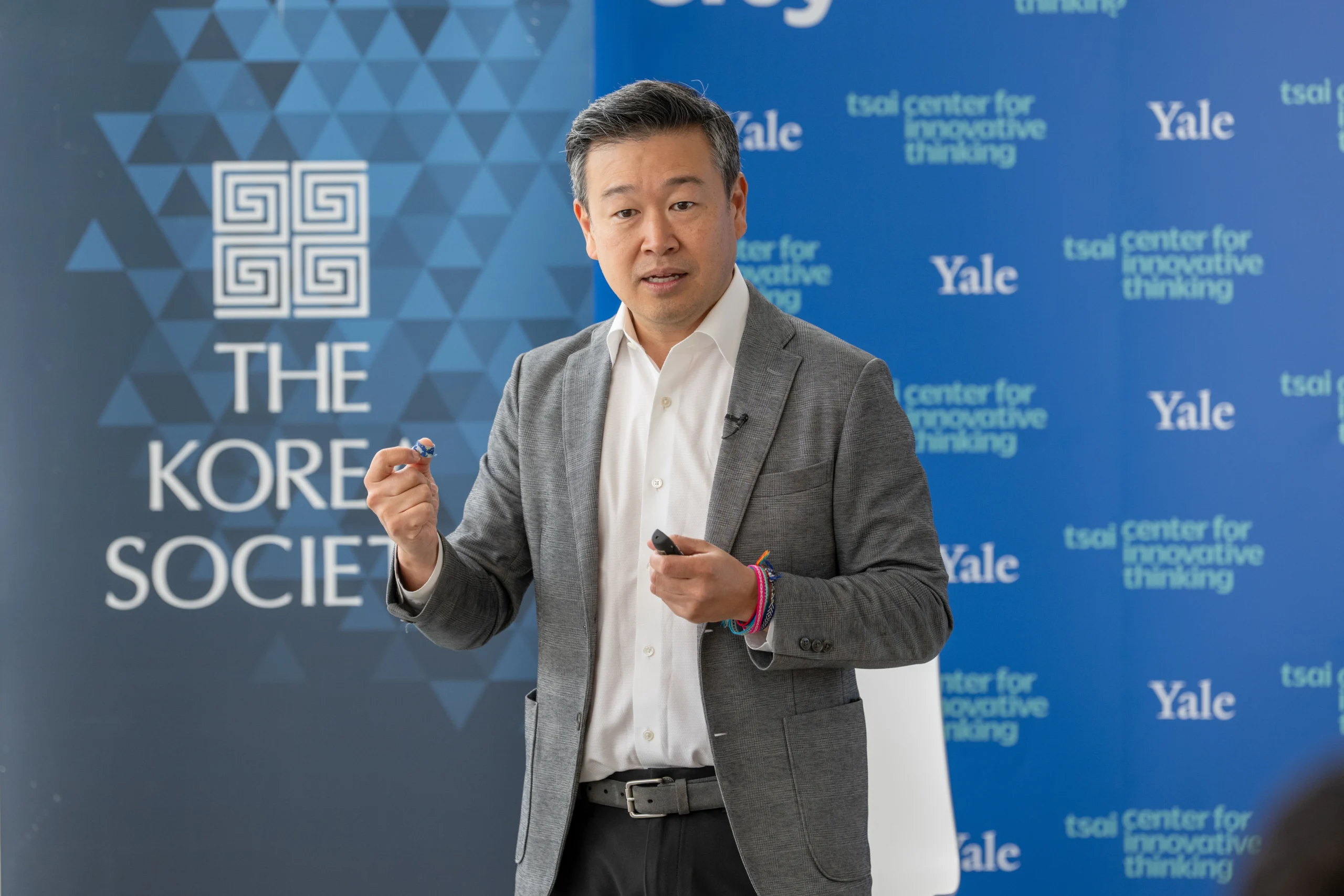
As part of our commitment to building the next generation of founders, The Korea Society brought Startup Scene to Yale Ventures – connecting one of the world’s most dynamic consumer technology investors with Yale’s entrepreneurial community. We were honored to welcome Eric Kim, Co-Founder and Managing Partner at Goodwater Capital and Yale University alumnus, for a fireside conversation on building global consumer technology companies across borders.

Eric Kim reflected on his journey to founding Goodwater Capital, a leading global venture firm with a portfolio of transformative consumer technology companies including Kakao, Coupang, Spotify, ByteDance, and Stitch Fix. Eric also shared insights on the rise of the global startup ecosystem, cross-border investment strategy, and how investors identify and scale the next generation of consumer platforms.

This conversation was moderated by Josh Geballe, Senior Associate Provost for Entrepreneurship and Innovation at Yale University and Managing Director of Yale Ventures.

This program is supported by Hanwha Life

Co-Hosted with


SPEAKER

Eric Kim

Goodwater Capital


Eric J. Kim is Co-Founder and Managing Partner of Goodwater Capital, a global consumer technology venture capital firm. He has led investments in companies including Kakao, TikTok, Coupang, Xendit, Viva Republica (Toss), Daangn Market (Karrot), MoMo, Scentbird, Hallow, Midi Health, and Everlywell.

Previously, Eric was a Managing Director at Maverick Capital, where he helped build the firm’s global venture capital, leading investments across North America, Europe, and Asia. He began his career as a business analyst at McKinsey & Company.

Eric has long been involved in education and the arts. A classically trained cellist, he was a member of the Grammy-nominated Yale Cellos. He serves on the Board of Advisors for Yale University’s School of Music and on the boards of Empowerly and StudySmarter, companies operating at the intersection of AI and education, and previously served on the national board of College Track.

Eric earned his undergraduate degree in Cognitive Science from Yale University (Phi Beta Kappa, magna cum laude) and an MBA from Stanford University’s Graduate School of Business.

MODERATOR

Josh Geballe

Josh Geballe is Senior Associate Provost for Entrepreneurship and Innovation at Yale University and Managing Director of Yale Ventures. He is responsible for a wide range of services and programs for students, faculty, and the broader New Haven community to launch new startups based on Yale research, provide training in entrepreneurship and innovation, expand external research partnerships, and foster the growth of the local innovation and entrepreneurship community.

Prior to launching Yale Ventures in 2022 Josh served as Chief Operating Officer for the State of Connecticut under Governor Ned Lamont. With responsibility for all executive branch agencies covering 30,000 employees, he led successful initiatives to modernize government operations and led the state's nationally recognized response to the COVID-19 pandemic.

Prior to his three years in public service Josh spent his career in the technology industry, most recently as CEO of Core Informatics, a venture-backed scientific software company that was acquired by Thermo Fisher Scientific where he went on to serve as Vice President and General Manager of Digital Science. Previously he spent 11 years at IBM in a variety of international executive roles.

Josh serves on the boards of directors of several non-profit organizations, including ClimateHaven where he is the founding board chair, Connecticut Innovations, AdvanceCT, BioCT and the Mory’s Association.

Josh holds an MBA from the Yale School of Management and a BA from Yale University.

01 / 03

How do the US and Korea health care systems compare?

The U.S. and South Korean healthcare systems offer distinct but complementary strengths. The U.S. excels in basic science research and specialized medical care, but high costs, fragmented electronic medical records, and regulatory complexity can create barriers to preventive screening and diagnostic services. South Korea, by contrast, offers a more centralized and efficient healthcare delivery model, with universal access to preventive screening, high-volume integrated medical centers, and comparatively affordable diagnostics. Its concentrated clinical infrastructure also enables rapid patient enrollment for clinical trials. These differences create opportunities for cross-border health-tech startups such as Lunit and HiMedi to connect Korea’s efficient healthcare delivery and medical technology capabilities with the research, innovation, and market opportunities of the U.S. ecosystem.

02 / 03

How is AI transforming the healthcare industry, and where are the greatest opportunities for innovation?

AI is moving from research into practical clinical applications, improving early disease detection, reducing diagnostic costs, and enabling more personalized treatments. Key areas of innovation include AI-powered radiology and pathology, where algorithms help identify early-stage abnormalities and biomarkers to support precision medicine and drug development. Emerging applications also include non-invasive diagnostics using skin images and voice patterns, AI-driven drug discovery, and personalized therapies. Meanwhile, digital therapeutics are gaining traction as software-based treatments expand their recognition and reimbursement pathways. These developments create growing opportunities for entrepreneurs to translate AI advances into more accessible, efficient, and personalized healthcare solutions.

03 / 03

What are the key considerations for Korean healthcare and biotech startups seeking to enter and scale in the U.S. market?

Korean startups should approach U.S. expansion with a clear market strategy, strong clinical evidence, and realistic expectations. Rather than rushing to establish a U.S. entity or restructure their corporate headquarters, founders should first demonstrate product differentiation and validate market demand through credible clinical data. They should also understand U.S. regulatory requirements, particularly FDA approval, reimbursement pathways, HIPAA compliance, and the fragmented electronic medical record environment. Building relationships with U.S. pharmaceutical companies and healthcare partners requires persistence, a clear understanding of industry needs, and consistent follow-up. Equally important are investing in market education to build trust in unfamiliar healthcare models and establishing local leadership with sufficient autonomy to navigate the U.S. business environment. Ultimately, successful expansion depends not simply on entering the U.S. market, but on demonstrating a compelling value proposition that meets the needs of American patients, providers, and industry partners.

Date & Time
Location

Tsai CITY (Center for Innovative Thinking at Yale) 17 Prospect St, New Haven, CT

Images