
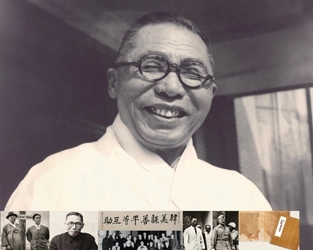
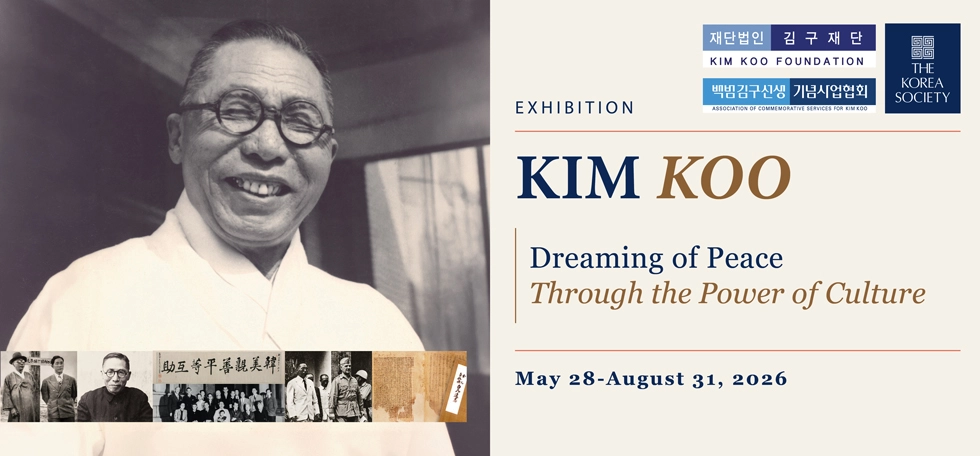
May 28-August 31, 2026 | The Korea Society is honored to host a special exhibition honoring the life, enduring vision, and profound legacy of Kim Koo—one of the most revered leaders of the Korean independence movement. As a central figure in the Korean independence movement and the President of the Provisional Government of the Republic of Korea, Kim Koo presented a visionary outlook that emphasized national strength based on culture rather than military or economic power. |


The Korea Society is honored to host a special exhibition honoring the life, enduring vision, and profound legacy of Kim Koo—one of the most revered leaders of the Korean independence movement. As a central figure in the Korean independence movement and the President of the Provisional Government of the Republic of Korea, Kim Koo presented a visionary outlook that emphasized national strength based on culture rather than military or economic power. To commemorate UNESCO’s designation of 2026 as the 150th anniversary of Kim Koo’s birth, The Korea Society offers a unique opportunity to reflect on his legacy through a visual exhibition.
This exhibition is produced in partnership between The Korea Society and The Association of Commemorative Service for Patriot Kim Koo and made possible by the support of the Kim Koo Foundation.
Kim Koo: Dreaming of Peace Through the Power of Culture
May 28-August 31, 2026
The Korea Society Gallery is open only by appointment. The appointment must be made at least 24 hours prior to the scheduled visit. To make an appointment, please contact
Gallery Hours: Monday-Friday 10 AM-4:30 PM
By Appointment Only
Commemorating the 150th Anniversary of Kim Koo’s Birth:
Exhibition Opening & Presentation
Invitation-only
Live Webcast: Thursday, May 28, 2026 | 6 PM (EDT)
Kim Koo and UNESCO’s Shared Vision of Culture — The Story Behind the 150th Birth Anniversary Designation :
UNESCO has designated 2026 as a year to commemorate the 150th anniversary of Kim Koo’s birth. This decision goes beyond a simple historical tribute; it is the international community’s official recognition that Kim Koo’s vision—achieving world peace through the "power of culture" rather than economic or military might—aligns deeply with the universal values pursued by UNESCO.
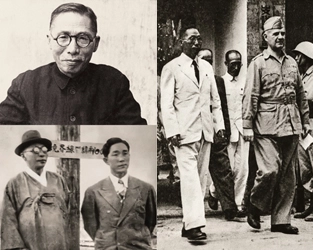
As the President of the Provisional Government of the Republic of Korea, Kim Koo led the independence movement and understood the importance of international solidarity better than anyone. In 1932, following the patriotic deeds of Yi Bong-chang and Yun Bong-gil, he managed to evade the pursuit of the Japanese Imperialists and continue his activities through the vital assistance of American missionary Dr. George Fitch. Furthermore, he solidified the foundation for independence through practical cooperation with democratic nations, such as collaborating with the U.S. Office of Strategic Services (OSS) to prepare for “The Eagle Project,” a domestic infiltration operation. He also successfully persuaded Chiang Kai-shek to ensure the guarantee of Korean independence at the Cairo Conference. These actions demonstrate that Kim Koo’s independence movement was more than mere resistance; it was part of an international solidarity effort sharing the universal values of freedom and human rights.
Kim Koo’s true pioneering spirit became even more evident after liberation. In his essay "My Wish," included in his 1947 autobiography Paikbum Ilji (백범일지), he emphasized moving past hatred to build a nation where everyone enjoys happiness through cultural development, thereby contributing to world peace. His vision—that humanity can only prosper together when each nation develops its unique culture and engages in mutual exchange—is strikingly consistent with UNESCO’s cultural philosophy today.
The designation of this UNESCO anniversary year is the culmination of extensive preparations that began in June 2024. The process required meticulous attention due to various international and political circumstances. The final hurdle, consent from North Korea, was cleared through the method of "tacit consent"; leading to the final confirmation. This serves as a significant opportunity for Korea to expand its global contribution to cultural policy and discourse. At the same time, it is a meaningful declaration to the world that the spirit of Kim Koo—who fought against imperialist violence while ultimately aiming for human happiness and world peace—remains a vital universal value in our modern era.
The Korea Society
350 Madison Avenue, 24th Floor, NYC
