

Contemplative Traditional Music Series: P’ungnyu Percussion (Changgo)

2011 05 19 Changgo iconEnjoy a meditative performance of changgo, a traditional hour-glass drum, adapted for p’ungnyu, the classical ensemble music of Korean nobility and central theme of The Korea Society’s 2011 traditional music series. P’ungnyu also refers to an elevated state of leisure in which one can better appreciate poetry, music, and companionship.

Percussionist Lee Chun-seung performs a solo Suljanggu, followed by a Samulnori and Binari featuring three additional percussion instruments, the kkwaengguari, buk, and jing, and finishes with Modeumbuk. Lee appeared at the 2002 World Cup Opening Ceremony and on the KBS Open Concert series. He has performed in Russia, Japan, China, and the United States, and is director and conductor of the acclaimed New York-based, non-profit Korean Traditional Marching Band. This series is made possible with public funds from the New York State Council on the Arts.


Thursday, May 19, 2011

Contemplative Traditional Music Series:
P’ungnyu Percussion (Changgo)

with

Lee Chun-seung


NYSCA

LIVE HOUSE KOREA is made possible with the support of the New York State Council on the Arts.

Contemplative Traditional Music Series: P’ungnyu Percussion (Changgo)

2011 05 19 Changgo icon

Enjoy a meditative performance of changgo, a traditional hour-glass drum, adapted for p’ungnyu, the classical ensemble music of Korean nobility and central theme of The Korea Society’s 2011 traditional music series. P’ungnyu also refers to an elevated state of leisure in which one can better appreciate poetry, music, and companionship.

Percussionist Lee Chun-seung performs a solo Suljanggu, followed by a Samulnori and Binari featuring three additional percussion instruments, the kkwaengguari, buk, and jing, and finishes with Modeumbuk. Lee appeared at the 2002 World Cup Opening Ceremony and on the KBS Open Concert series. He has performed in Russia, Japan, China, and the United States, and is director and conductor of the acclaimed New York-based, non-profit Korean Traditional Marching Band. This series is made possible with public funds from the New York State Council on the Arts.


Thursday, May 19, 2011

6:30PM LIVE Performance

Contemplative Traditional Music Series:

P’ungnyu Percussion (Changgo)

with

Lee Chun-seung

The Korea Society
950 Third Avenue @ 57th Street, 8th Floor


nysca 200px white

LIVE HOUSE KOREA is made possible with the support of the New York State Council on the Arts.


The Journals of Musan

Winner of “Best New Narrative Director” at 2011 Tribeca Film Festival!


The Tribeca Film Festival presents the New York premiere of the much-anticipated The Journals of Musan, co-hosted with The Korea Society. Director Park Jung-bum’s debut tells the story of a North Korean defector forging a new life in South Korea. The film took the New Currents Award at the Pusan International Film Festival. Park, who assisted Lee Chang-dong on the stirring Poetry, presents a disarmingly beautiful vision of loneliness, disconnect, and ethical ambiguity in this story of a lost soul’s struggle to connect. Park Jung-bum appears for Q&A with audiences after each screening.


Tickets available at TribecaFilm.com


Sunday, April 24 @ 7 PM Tuesday, April 26 @ 5:30 PM Wednesday, April 27 @ 9:30 PM
Clearview Cinemas Chelsea 5 Clearview Cinemas Chelsea 4 Clearview Cinemas Chelsea 1

The Journals of Musan (127 min) 2010
무산일기

Park Jungbum’s stunning and much-lauded debut is the story of Jeon Seung-chul, a North Korean defector forging a life in capitalist South Korea. Emerging from eight months in a resettlement camp, the unassuming Seung-chul is placed in a home on the rundown outskirts of Seoul, and finds a modest job papering the city with advertisement posters. Yearning for a human bond, he joins a church and meets Sook-young, a choir singer who works nights at a seedy karaoke bar. As he attempts to forge some kind of relationship with Sook-young and some kind of life in Seoul, Seung-chul finds his deepest kinship and comfort in a fellow outcast—a stray dog he adopts in the street. 

Marginalized in every way, from his liminal home on the city’s fringes to his frustrated attempts to integrate in either church or work, Seung-chul’s unwavering moral compass is testament to his integrity in the face of baseless prejudice. As both director and actor, Park (assistant director of Lee Chang-dong’s stirring Poetry) fully realizes a disarmingly beautiful vision of loneliness, disconnect, and ethical ambiguity in this story of a lost soul’s struggle to connect.


 Co-hosted by


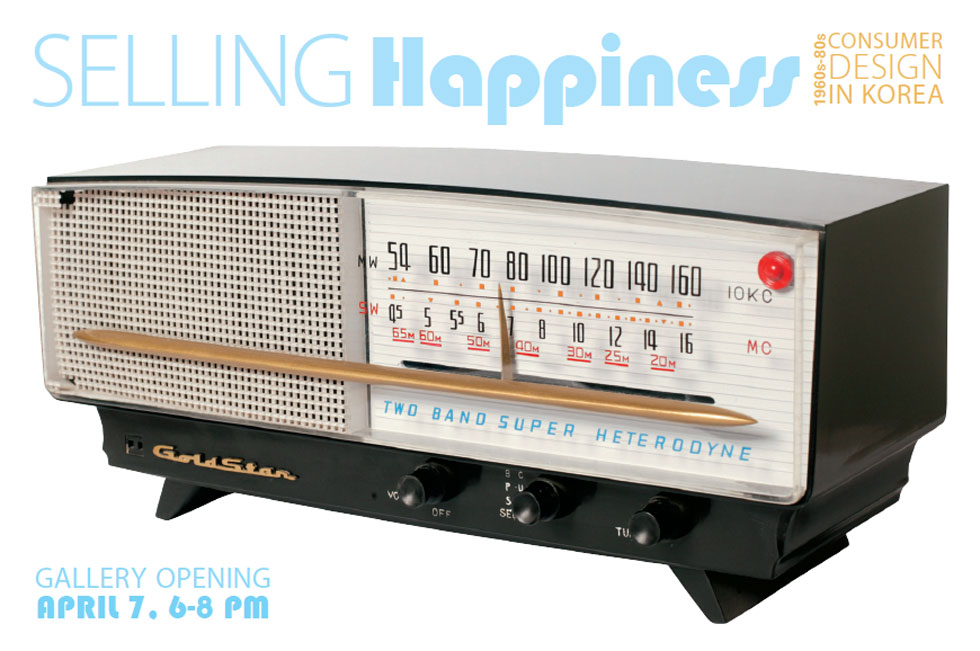
Selling Happiness: 1960s-80s Consumer Design in Korea

During Korea’s drive for economic modernization, commercial artists created goods and advertisements that were visually appealing and richly detailed. After the war, Korea transformed itself economically, yet rapid growth was accompanied by dramatic social changes and political concerns surrounding authoritarianism. By the late 1980s, Korea had embraced democracy and a newly prosperous society clamored for fresh goods manufactured for domestic consumption. With the 1988 Olympic games, Korean products and adverts grew more global in orientation.

Koreans look upon these items with some nostalgia, as they stand in sharp and, at times, amusing contrast with today’s products, which range from remarkable paper-thin flatscreens to Motortrend’s Car of the Year. Presented with the support of the Korea Craft and Design Foundation, this exhibition features early consumer products, advertisements, and social commentary from a transitional and controversial era when the seeds of Korean design saw fertile ground.


ABOUT

This exhibition is the first in the United States to focus on items associated with Korea’s export-led growth era. It features products and designs from the 1960s, 70s, and 80s, including Korea’s first domestically manufactured radio (the Goldstar A-501), Korea’s first black-and-white television (the VD-19), rice dispensers, cookers, and other kitchen items—even the popular “Italy towel,” employed in homes and bathhouses for a rigorous scrub.


Threading Life: A Lecture by Korean Quilt Master Haeja Kim


2011 03 24 threading life icon

Traditional Korean quilt technique requires keen attention to detail, patience, and dedication. With the arrival of the modern sewing machine, traditional quilting largely disappeared, yet master Kim Haeja remains steadfastly committed to the traditional ways of her craft. Designated Important Intangible Cultural Property No. 107 by the Korean government, Haeja Kim shares life’s lessons learned in the crafting of her quilts and textiles.

Thursday, March 24, 2011
6:30PM Gallery Talk and Q&A

Asia Week 2011 Gallery Talk

THREADING LIFE: A Lecture by Quilt Master Haeja Kim

with

Haeja Kim
Korean Traditional Quilt Artist, Important Intangible Cultural Property No. 107

The Korea Society
950 Third Avenue @ 57th Street, 8th Floor

Mapping Identity: Antiquarian Korean Maps of the MacLean Collection


2011 03 22 mapping identity icon

Richard Pegg, Asian art curator of Chicago’s MacLean Collection, examines Korean maps in a variety of formats, the challenges faced by cartographers, and the formation of multiple identities in Korea during the eighteenth and nineteenth centuries. The MacLean Collection, housed in a private museum outside Chicago, focuses on the cultures of Korea, China, and Southeast Asia.

Tuesday, March 22, 2011

Asia Week 2011 Gallery Talk
Mapping Identity: Antiquarian Korean Maps of the MacLean Collection

10,000 Threads Around the World


2011 03 08 Spike Gillespie icon

In conjunction with the gallery exhibition 10,000 Threads, acclaimed author Spike Gillespie explores the diversity and common threads of quilting in Korea, its neighbors, and lands beyond. Gillespie takes the listener on a global journey of the art, approaches, and techniques of quilt making.

Tuesday, March 8, 2011

Asia Week 2011 Gallery Talk
10,000 Threads Around the World

with

Spike Gillespie
Author, Quilts Around the World: The Story of Quilting from Alabama to Zimbabwe

10,000 Threads: The Collected Works of Quilt Master Kim Haeja

2011 02 22  10000 threads icon

February 22—March 31, 2011

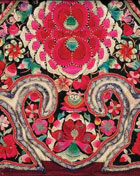
Traditional Korean quilting, with its unique “nubi” line-stitching, is elevated to a high art under the masterful hands of award-winning artisan Haeja Kim. A designated holder of an Important Intangible Cultural Property award by the Korean government for her efforts at preserving Korea’s artistic heritage, Kim meticulously line-stitches layers of batting and fabric into fine garments and coverings. The tiny stitches are employed over each article in a deceptively simple pattern, with smaller stitching highly valued and the mark of a true expert.

Nubi textiles are thought to have originated among Buddhist monks, who valued its strength, simplicity, and insulation against Korea’s frigid winters. Lay people employed it for traditional dress and soldiers for defense against the cold and added physical protection. However, the hand-craft of nubi largely disappeared in modern times with the introduction of the sewing machine.

The items selected for this special showing are grouped in three parts:

Children’s Clothing—February 22–March 4
Adult Clothing—March 7–18
Children’s Ceremonial Clothing—March 21–31

ABOUT THE ARTIST

Master Kim has been breathing new life into the art ever since she surprised visitors to the Korea Annual Traditional Art Exhibition two decades ago with 3mm-5mm nubi stitchwork—a feat, not seen for a century, that won the Prime Minister’s Award. Today, she is much sought after as a teacher and master of the form. In her humble and elegant rural studio, surrounded by attentive student apprentices, she displays a unique dedication to craft, hand-processing her fabrics with natural dyes like indigo, safflower, and charcoal. Her work has been exhibited in Korea, Japan, China, and France. This exhibition at The Korea Society represents Kim’s first major U.S. showing.


Special Screening of HaHaHa


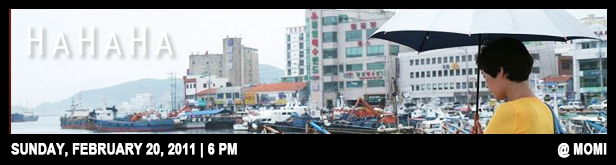
The Korea Society joins the newly renovated Museum of the Moving Image to present Hong Sang-soo’s Hahaha, a deceptively light romantic comedy which won the 2010 Prize Un Certain Regard at Cannes. The film follows a filmmaker on the skids who meets a film-critic friend. During a drinking session, they decide to share memories of trips they took to the same seaside town. Enjoy this special screening at Museum of the Moving Image’s new 267-seat cinema, which is only ten minutes from The Korea Society, at 35th Avenue and 37th Street in Astoria.


Sunday, July 17, 2011 | 6 PM


Museum of the Moving Image
35th Avenue at 37th Street, Astoria 
From midtown, taxi or N/Q Train outbound to 36th Avenue 


Tickets $10 at The Museum of the Moving Image and include museum admission for exhibition viewing before 5 PM that day.


HaHaHa (115 min) 2010
하하하 

About the Director
Since winning Best New Director at the Asian Pacific Film Festival, Hong Sang-soo has emerged as a leading contemporary Korean director. Greatly influenced by French New Wave cinema, Hong’s work is unique among Korean filmmakers. He skillfully captures simple moments in life, and crafts unforgettable scenes of human relationships and interaction. He won international recognition for The Power of Kangwon Province, Virgin Stripped Bare by Her Bachelors, Woman is the Future of Man, The Turning Gate, and Woman on the Beach.


Special Screening of Poetry

About the Director: Lee Chang-dong was a successful novelist and screenwriter before he came to be one of Korea’s most talented directors. His movies, such as “Peppermint Candy,” “Oasis,” “Secret Sunshine,” and his award-winning debut, “Green Fish,” are viewed as artistic critiques of Korean society. Director Lee has garnered much international recognition and has won awards at the prestigious Cannes, Berlin, and Toronto film festivals.


Sunday, January 23, 2011 | 4 PM


Museum of the Moving Image
35th Avenue at 37th Street, Astoria 
From midtown, taxi or N/Q Train outbound to 36th Avenue 

Wall Street Journal Article


General admission $10
Visit The Museum of the Moving Image for more information
.


Poetry (139 min) 2010

A mysterious death, a woman with Alzheimer’s, and a poetry class are at the core of this highly acclaimed new film by Lee Chang-dong (Secret Sunshine). Featuring an indelible central performance by Yun Jung-hee, this multilayered drama also won best screenplay at Cannes. Courtesy of Kino International. Directed by Lee Chang-dong.