Dr. Hyangjin Lee, this year’s Kim Koo Visiting Professor of Korean Studies at Harvard University, examined the evolution of anti-Communist films in South Korea. Dr. Lee explored the historical legacy of anti-Communist drama through the oppressive film policy in the pre-democratization era and the subsequent democratic transformation of South Korea. To evaluate the historical legacy of the Cold War in the identity politics of South Korean national cinema, she highlighted three films that deal with the war and national division, namely The Marines Never Returned (Lee Man-hui, 1963), Rainy Days (Yu Hyun-mok, 1979) and Spring in My Hometown (Lee Kwang-mok, 1998).
Monday, June 8, 2015 | 6:30 PM
This program is supported, in part, by public funds from the New York City Department of Cultural Affairs in Partnership with the City Council.
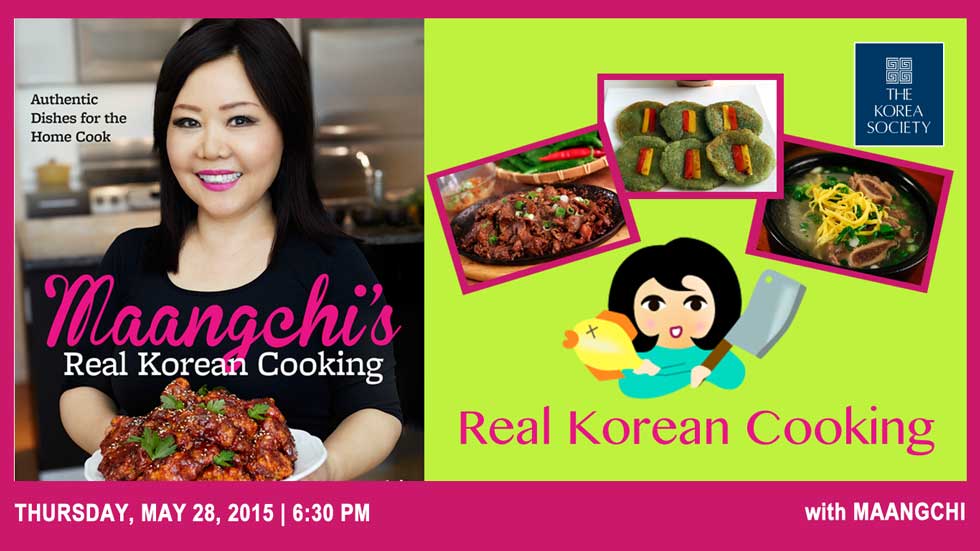
Maangchi has taught people from all over the world how to make Korean food through YouTube, where her videos have been viewed over 65 million times. Maangchi’s first cookbook, Real Korean Cooking, includes 125 of her favorite recipes and illustrates the tremendous variety of Korean cooking. Over two years in the making, the book focuses on traditional and authentic Korean dishes with whole chapters devoted to Korean fermentation and banchan (Korean side dishes).
Maangchi sits down with Matt Rodbard, Executive Editor of Food Republic, to discuss how her passion for Korean food led her to become an internet sensation and a cookbook author. She demonstrates recipes and shares cooking tips and techniques.
Members with Book: $20* Nonmembers with Book: $30* (*ticket price includes one copy of the book Maangchi’s Real Korean Cooking)
Cookbooks will also be sold separately at the event for $20.
If you have any questions, please contact Jamie Tyberg or (212) 759-7525, ext. 321.
Culinary programs are generously sponsored by SK.
About the SpeakerAbout the ModeratorAbout the Book
Maangchi (“Hammer” in Korean) was born and raised in South Korea, where she learned the fundamentals of home cooking from her relatives. A former counselor for victims of domestic violence and movie extra, she is the founder-owner of maangchi.com, the top online destination for Korean cooking. She also has her own YouTube channel and is a member of YouTube’s partnership program.
Matt Rodbard is the Executive Editor of Food Republic where he edits a variety of stories and writes primarily about restaurants, chefs, drinks, music and traveling with “food on the brain.” He’s written for Bon Appétit, Travel & Leisure, Tasting Table, Men’s Journal, Spin, and Time Out New York. Rodbard authored the 2013 Korean Restaurant Guide: New York, and he and Momofuku/Jean-Georges alum Deuki Hong are authors of a book, Koreatown USA, to be published in 2016 which will “explore Korean food in America, in both traditional settings (the food of K-Towns in Los Angeles, New York and beyond), as well as in the kitchens of non-Korean chefs.”
From the Publisher Her millions of fans compare her to Julia Child. An Internet sensation, Maangchi has won the admiration of home cooks and chefs alike with her trademark combination of good technique and good cheer as she demonstrates the vast and delicious cuisine of Korea. In Maangchi’s Real Korean Cooking, she shows how to cook all the country’s best dishes, from few-ingredient dishes (Spicy Napa Cabbage) to those made familiar by Korean restaurants (L.A. Galbi, Bulgogi, Korean Fried Chicken) to homey one-pots like Bibimbap.
For beginners, there are dishes like Spicy Beef and Vegetable Soup and Seafood Scallion Pancake. Maangchi includes a whole chapter of quick, spicy, sour kimchis and quick pickles as well. Banchan, or side dishes (Steamed Eggplant, Pan-Fried Tofu with Spicy Seasoning Sauce, and refreshing Cold Cucumber Soup) are mainstays of the Korean table and can comprise a meal.
With her step-by-step photos—800 in all—Maangchi makes every dish a snap. A full glossary, complete with photos, explains ingredients. Throughout, Maangchi suggests substitutions where appropriate and provides tips based on her readers’ questions.
Gamin, a celebrated piri (cylindrical double-reed bamboo oboe) player known for blurring the lines between classical and modern—and Eastern and Western—music, performs an evening of contemporary compositions on traditional Korean wind instruments. She will play new pieces by composers Paul Yeon Lee and Theodore Wiprud. ETHEL, a progressive string quartet that shares a commitment to musical collaborations, makes a guest appearance. Don’t miss this remarkable evening of musical exploration!
Choong Supim builds bridges between different worlds. He combines sculpture, painting, and found objects to assert a harmony among contrasting concepts, such as the regimentation of modern civilization and a chaotic universe, urban and rural life, and the West and Korea. To Lim, the emphasis on distinctions conceals a deeper truth, which he seeks to uncover through an “emptying of self” and a patching of the “in-betweens.”
The installation artwork in this exhibition, Luna, And Her Thousand Reflections, blends light, video, architecture, and elements from Korea’s traditional weaving culture, and employs moon imagery to reference an important debate on the nature of principle and material force that occupied Confucian scholars in 16th century Chosŏn Korea. It was the title piece of the National Museum of Modern and Contemporary Art Korea’s 2012 retrospective of Lim’s work, and was modified by the artist to fit our space.
Born in Jincheon, Chungcheongbuk-do, Lim attended Seoul National University before continuing his studies in New York City, where he now lives and works. Lim’s art is part of the permanent collections of the Metropolitan Museum of Art, the Smithsonian’s Hirshhorn Museum, and the Leeum Samsung Museum of Art in Korea.
This exhibition is presented in collaboration with the Dongwha Cultural Foundation.
Welcome Spring by filling a Korean lunchbox (dosirak) with tasty foodto take on a picnic! Learn how to prepare kimbap, theseaweed rice rolls at the center of any Korean picnic, in a hands-on workshop led by culinary instructor Shin Kim. She’ll demonstrate how to make several kimbap fillings, including shigeumchi muchim (seasoned spinach), gyeran mari (rolled omelettes), and danmuji (sweet pickled radishes)–all of which can also be served as banchan, Korean side dishes.
Wednesday, April 22, 2015 | 6 PM
Advanced ticket purchase required for this event. Space is limited.
$25 Members / $40 Non-members
If you have any questions, please contact Claudia Pak or (212) 759-7525, ext. 321.
Create a lucky pouch (bok jumeoni), during this 4 week, 8 hour workshop with artists Wonju Seo and Karen Ahn. Using two traditional art forms, bojagi (patchwork) and maedeup (knotting), participants will make their own unique and lucky silk pouch. These bags were originally made as a substitute for pockets, since hanbok, Korean traditional clothes, have no pockets.
This workshop meets for a total of 8 hours over four sessions:
Mondays, April 6, 13, 20, and 27 | 6 – 8 PM
Advance ticket purchase required for this event. Space is limited.
If you have any questions, please contact Claudia Y. Pak or (212) 759-7525, ext. 321.
Members | $160
Non-members | $190
Lucky Pouches is made possible by the New York State Council on the Arts with the support of Governor Andrew Cuomo and the New York State Legislature.
After losing his parents and left hand to the Korean War, Park Dae Sung so loved art that by the age of ten he would rigorously and repeatedly copy ink-and-wash images and calligraphy from classic texts. This courageous young boy grew into an artist of visionary integrity, who, with deep gratitude to his artistic birthright, gracefully transcends imitation of his predecessors. Park Dae Sung achieves the traditional goal of the ink-and-wash painter—to reveal the fundamental core and character of a subject—through a skillful combination of classical modes of organization, calligraphic delineation, and influences from Korean, Asian, and Western masters.
The heartfelt reverence, thoughtful celebration, and exalted whimsy in Park Dae Sung’s paintings explore both his subjects and an artistic sensibility vast enough to encompass opposites such as gravity and buoyancy, scrupulous attention to detail and essential simplification, and sweet intimacy and awesome grandeur. Like the Chosŏn-era scholar-artists before him, Park has traveled extensively, including to the Diamond Mountains in the North, and along the Silk Road through China, the source of his calligraphic subjects. An heir to Korea’s “true-view” tradition, he lifts the real mountains, trees, houses, and vistas visited on his journeys into the artist’s land of benevolent, powerful beauty. His paintings of Kyŏngju capture the spirit of the capital of Korea’s Silla Dynasty and the heart of Korean Buddhism, without losing an ounce of the land’s earthy gravity.
This exhibition of Park Dae Sung’s work, presented in collaboration with the Dongwha Cultural Foundation, contains ink-and-wash paintings, calligraphy, and studies of pottery representative of this master of modern interpretation of traditional Korean ink painting.
Robert D. Mowry, Alan J. Dworsky Curator of Chinese Art Emeritus, Harvard Art Museums, and Senior Consultant on Chinese and Korean Art, Christie’s, New York, discusses the history and development of Korean ink paintings.
This illustrated slide lecture presents an introductory overview of the development of Korean painting during the Koryŏ (918-1392) and Chosŏn (1392-1910) dynasties, covering all four major categories of work: Buddhist painting, literati painting (sometimes also called Sino-Korean painting), portrait painting, and folk painting. The Korean painting and ceramic traditions took inspiration from those of China, and Korean paintings and ceramics thus relate closely to those created in contemporaneous China. Even so, once they had fully mastered Chinese techniques, Korean artists typically transformed the subjects, formats, and styles adopted from China to meet their own aesthetic needs, thereby establishing distinctive Korean styles that reflect their Chinese origins but stand apart from them. That background will lay the foundation for understanding modern and contemporary Korean ink painting.
Korean royal hors d’oeuvres will be provided by master-chef Haelin Lee.
Learn about the international appeal of K-pop music and Korean cinema as experts detail the development of Korean popular culture into a worldwide phenomenon. A K-pop dance workshop will follow the lectures and discussions. Supported by the Freeman Foundation.
Free event, early registration requested. Please register here or contact Luz Lanzot for more information.
Makeup artist Seong Hee Park, who created looks for K-Pop’s Wonder Girls and TV star Yunjin Kim, explores how the traditional ideals of Korean beauty in the paintings of Chosŏn-era artist Shin Yun-bok influences today’s Korean female stars.






 Choong Supim builds bridges between different worlds. He combines sculpture, painting, and found objects to assert a harmony among contrasting concepts, such as the regimentation of modern civilization and a chaotic universe, urban and rural life, and the West and Korea. To Lim, the emphasis on distinctions conceals a deeper truth, which he seeks to uncover through an “emptying of self” and a patching of the “in-betweens.”


