Hollywood makes lots of legal thrillers, but none of them speak so directly to the Korean American experience as the newly released West 32nd. While in New York for the film’s premiere at the Tribeca Flim Festival, co-writer and director Michael Kang and stars Grace Park and Jun Sung Kim came to The Korea Society for a freewheeling panel discussion on how the film was made and what this unique, Korean American statement means to its creators.
West 32nd is more than a Grisham-esque story of murder and deception among gangsters in New York’s Koreatown, said Kang. It’s a drama about one’s connection to, and separation from, one’s culture. The lead character, John Kim (John Cho), is a pro-bono lawyer assigned to defend a Korean American teenager framed for a gangland murder. With the help of the boy’s sister, Lila Lee (Grace Park), Kim delves deep into Koreatown’s underworld where he’s manipulated by gangster Mike Juhn (Jun Sung Kim). Though Kim is the model of second-generation immigrant success, he can’t speak Korean and as the mystery deepens, despite the fact he’s Korean, he’s increasingly out of his element.
With a predominately Korean American cast, West 32nd’s themes of identity seeped into the production process. The film’s characters alternate between Korean and English dialog, and Kang said that he wanted both languages to sound authentic. Many sections of dialog required extensive re-writing and finding bilingual actors was a major challenge. Once Park and Kim signed onto the project, language was still a problem. Both actors said they had to rehearse their Korean to appear perfectly fluent.
Whatever the travails, they were glad to have done West 32nd. Though both have played many roles in Hollywood and Korea, this was the first project that allowed them to give portray Korean American characters in a multi-dimensional way.
Wednesday, May 2, 2007 | 6:30 PM
The Korea Society 950 Third Ave., 8th floor New York, NY 10022
Join Michael Kang, the Korean American filmmaker and Humanitas Award- winning director, along with actors Grace Park and Jun Kim as they discuss their new film, at the Tribeca Film Festival. Moderated by William Phuan, program associate at Asian Cinevision, the conversation will include personal, behind-the-scenes production stories, career advice for Asian American film talent and information on the prospects for marketing Asian American films internationally.
Directed by Michael Kang Starring John Cho, Jun Sung Kim, Grace Park and Jane Kim
West 32nd stars John Cho (Harold & Kumar Go to White Castle) as an ambitious young lawyer who takes on a pro bono case to exonerate a 14 year-old boy from a first-degree murder charge. The case takes him into a seamy underworld he never knew existed, right in the heart of midtown Manhattan. West 32nd also stars Grace Park (Battlestar Galactica) and marks Korean actor Jun Kim’s first American film role. Based on co-writer Edmund Lee’s coverage of Korean organized crime in New York for The Village Voice, West 32nd is the eagerly awaited follow-up to Kang’s debut film The Motel.
Presented by Tribeca Film Festival, Asian Cinevision and The Korea Society.
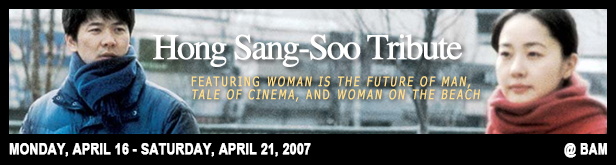
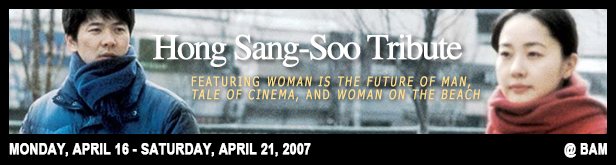
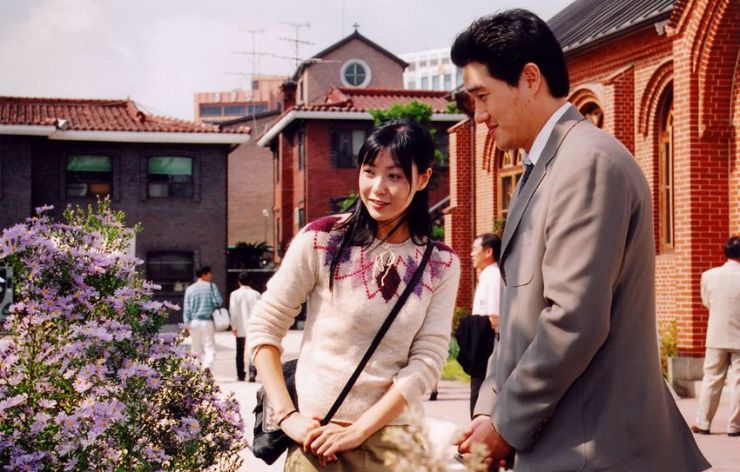
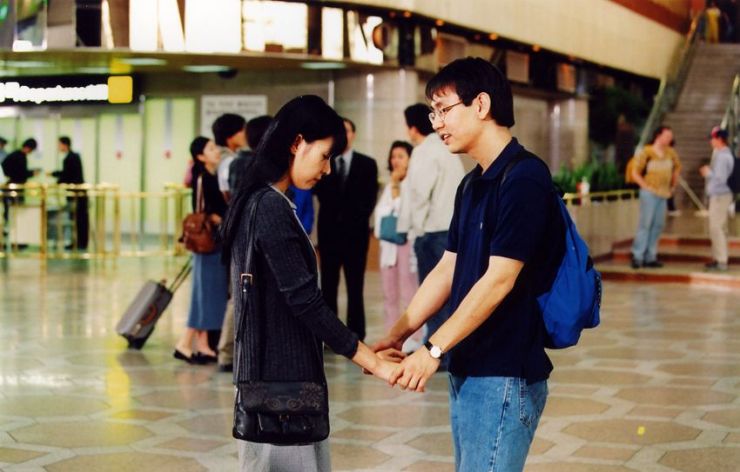
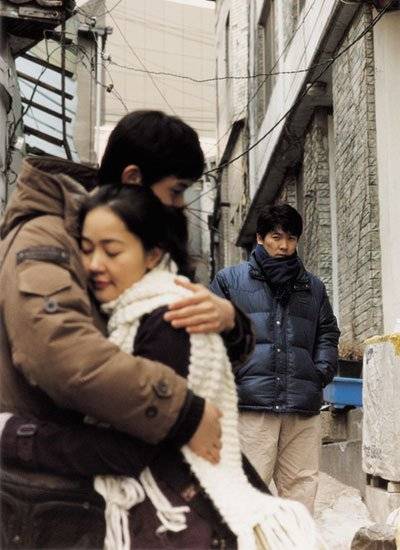
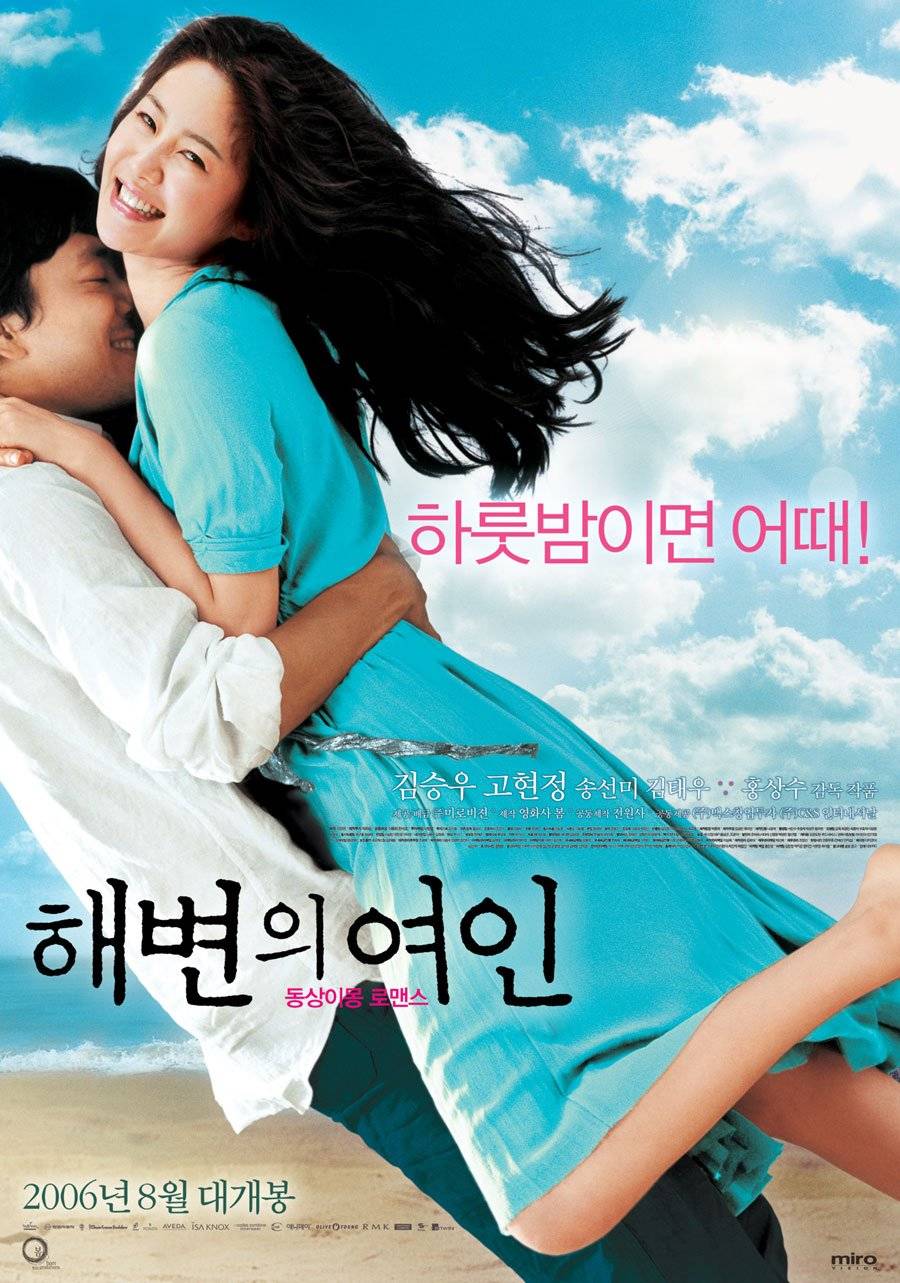
The Korea Society co- presents a ‘Hong Sang-Soo tribute’ with BAM Cinematek, featuring the celebrated Korean director’s three latest films that have won over critics and audiences alike worldwide – Woman is the Future of Man, Tale of Cinema and Woman on the Beach.
“One of the most exciting and authentically individual filmmakers to emerge on the world stage recently…. Wreathed in a profound melancholy, Hong’s films lyrically explore the limits of subjectivity, both its pathos and its dangers, often through different viewpoints that don’t so much cancel one another out as add another tile to the mosaic of existence.” – Manohla Dargis, The New York Times
WOMAN IS THE FUTURE OF MAN (88 min) 2004 여자는 남자의 미래다
Monday, April 16 | 4:30 PM
With Yu Ji-Tae, Kim Tae-Woo, Sung Hyun-Ah. Two male college friends reunite and spontaneously decide to look up a woman with whom they were both separately involved. “The men’s self-immolating behavior is what’s saddest in the Hong universe, thanks largely to his duplicitous manner with narrative. You can rarely grip the shape of the entire film until past the halfway marker. When you do, the tragedy of soured lives is beyond the point of no return.” – The Village Voice
With Lee Ki-Woo, Uhm Ji-Won. A young man bumps into a female friend; the ensuing evening involves drinking, sex, and a suicide pact. Turns out it’s only a film (within a film), but life imitates art, which in turn imitates life… “Tale expands on Hong’s preoccupations with a renewed conceptual depth. While it may be a tough film to love, it is also Hong’s finest work to date, marking a bold new direction just when Hong is most in need of a fresh start.” – Michael Sicinski, Cinema Scope
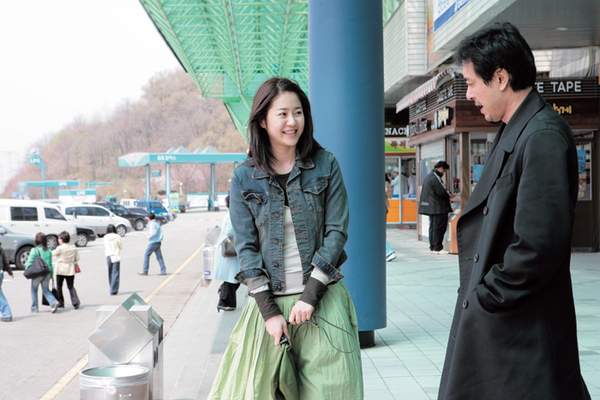
WOMAN ON THE BEACH (126 min) 2006 해변의 여인
Saturday, April 21 | 3 PM, 6 PM, 9 PM
With Go Hyun-Jung, Kim Seung-Woo, Kim Tae-Woo, Song Seon-Mi. A filmmaker, writing his latest script at a seaside resort town, becomes involved with two women. As ever, Hong is comically and painfully lucid in outlining the jealousy and self-absorption that fuel his male characters’ drunken acting out. In the scene that is at the heart of this film, he does so literally with the help of a diagram-a fitting gesture for a filmmaker so obsessed with the geometry of human relationships.
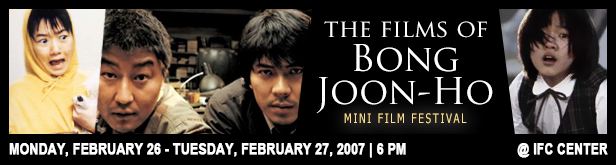
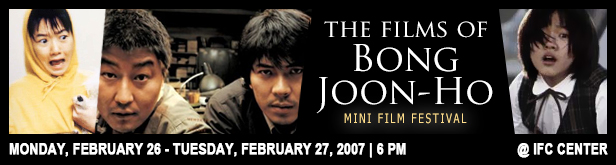
A special line-up of acclaimed South Korean director Bong Joon-Ho’s box-office mega-hits will include showings of Barking Dogs Never Bite and Memories of Murder, and shorts Incoherence and Sink and Rise. Bong will attend the screening of his latest film, The Host, for a Q&A afterwards.
Bong Joon-Ho took the 2006 Cannes Film Festival by storm with his smart, terrifying new monster movie The Host. In anticipation of the film’s release, this a mini-fest of his maximal career presents a special line-up of Bong’s signature cinema — black comedies, gritty crime dramas and horror thrillers with a comic book feel — and Bong himself in person for the closing screening of The Host.
Tuesday, February 27 | 8:30 PM Director Bong Joon-ho in person!
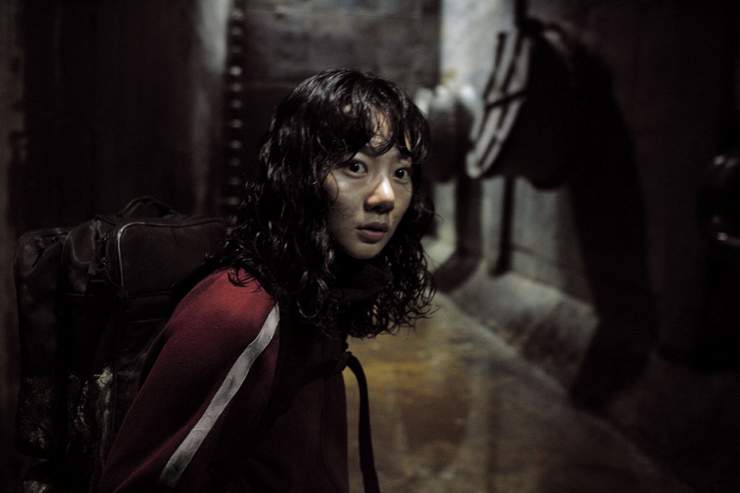
Starring: Song Kang- Ho, Park Hae-Il, Bae Du-Na, Byeon Hie-Bong, Ko Ah-Sung. Toxins from a U.S military base flow into Korea’s Han River, causing the birth of a mutant creature which terrorizes Seoul. When it grabs a little girl, her dysfunctional family must band together to save her. The Host is like a mutant hybrid spawned from the improbable union of Little Miss Sunshine and Godzilla, for the film is a family comedy and political satire in which an unnaturally evolved tadpole just happens to loom (very) large. Bong expertly balances absurd humor against tense thrills, and domestic drama against mass mayhem, reasserting South Korea’s place at the pinnacle of genre-busting cinema – and most of all he surprises at every turn in a film where, despite a realistic social milieu, almost anything seems possible.
Awards: Best Director, 5th Korea Film Festival Best Film, 5th Korea Film Festival Best Sound, 5th Korea Film Festival Best CG, 5th Korea Film Festival Best Picture, 5th Korea Film Festival Cannes Film Festival New York Film Festival Toronto International Film Festival DHL Audience Choice Award for Best Feature, Hawaii International Film Festival Pusan International Film Festival Best Special Effects and Orient Express Award for Best Asian Film, Sitges International Film Festival of Catalonia (Spain) 2006
MEMORIES OF MURDER (127 min) 2003 살인의 추억
Monday, February 26 | 9:15 PM
Starring: Song Kang-Ho, Kim Sang-Kyung, Park Hae-Il. South Korea was rocked to its foundations when struck by its first serial killer, who raped and murdered ten women in a small village in Kyonggi Province between 1986 and 1991. Director Bong Joon-Ho (Barking Dogs Never Bite) has taken the investigation and combined it with best-of-career performances from Song Kang-Ho (JSA, Sympathy for Mr. Vengeance) and Kim Sang-Kyung (Turning Gate), to make Korea’s most highly-acclaimed film of 2003, a master work that is itself like a memory of a dream: heartbreaking, mysterious, stunningly beautiful, and unspeakably sad.
A comedy, of sorts, of procedural errors that would be hilarious were it not so tragic, the film is a haunting look at a nation finding itself inevitably slipping back to an earlier, uglier era when an authoritarian government could freely violate the rights of private citizens in the name of the law.
Awards: Best Films, Grand Bell Awards Best Actor (Song Kang-Ho), Grand Bell Awards Best Director (Bong Joon-Ho), Grand Bell Awards Silver Seashell, San Sebastian International Film Festival FIPRESCI Prize, San Sebastian International Film Festival Best New Director (Bong Joon-Ho), San Sebastian International Film Festival 2003 Asian Film Award, Tokyo International Film Festival Grand Prix, Cognac Festival Du Film Policier Premiere Award, Cognac Festival du Film Policier Prix Mediatheques, Cognac Festival du Film Policier Special Prize of the Police, Cognac Festival du Film Policier Best Screenplay Award, Audience Award, Torino Film Festival (Italy)
BARKING DOGS NEVER BITE (106 min) 2000 플란다스의 개
Monday, February 26 | 7:00 PM
Starring: Bae Du-Na, Lee Sung-Jae. American Beauty hopped up on laughing gas, Barking Dogs Never Bite‘s plot is choreographed as intricately as a triple-time minuet. Its director says it’s about corruption and innocence (and it is), but the story plays as a wild comedy focusing on two of the greatest characters to appear onscreen in decades: Lee Sung-Jae, a part-time lecturer who learns he’ll do anything to achieve a coveted position as a professor and Bae Doo-Na, a female member of an apartment building’s custodial staff who yearns to do something brave. A shaggy-dog story about the mysteries of pregnancy, the length of toilet paper, lost dogs, and good stew, this movie is a bedtime story for urban sophisticates, scored to a be-bop soundtrack. The director’s debut feature, and one of the few independent Korean films, it gleefully mixes razor-sharp acting, goofy physicality, black comedy, and genuine warmth. It’s the kind of movie that audiences live for, and that gives marketing departments nightmares.
Awards: Best Editing, Slamdance Film Festival 2001 International Film Critics Federation Award of Young Asian FIPRESCI Award for young Asian filmmakers, 25th Hong Kong International Film Festival Special award presented to composer Cho Sung-Woo for his soundtrack for Barking Dogs Never Bite, Buenos Aires International Film Festival (Argentina) 2001. Best Newcomer Award to Producer Cho Min-hwan for Barking Dogs Never Bite, Munich Film Fest (Germany) 2001
SINK & RISE (95 min) 2004 and INCOHERENCE (30 min) 1994 Part of TWENTIDENTITY
Tuesday, February 27 | 6:00 PM
Bong contributed Sink and Rise to this omnibus film made for the 20th anniversary of the Korean Academy of Film Arts; screening with the director’s early short black comedy.
SINK & RISE Taken from Twentidentity, a 20-part omnibus film made by alumni of the Korean Academy of Film Arts on the occasion of the school’s 20th anniversary, Bong’s contribution is Sink and Rise, a whimsical work set alongside the Han River that can be seen as a warm up for the director’s third feature The Host.
INCOHERENCE A short black comedy that criticizes society with his Bong Joon-Ho’s unique sense of humor, Incoherence was invited to international film festivals in San Diego and Hong Kong, giving Bong his first taste of artistic recognition.
Gods, Demons and Generals: Icons of Korean Shamanism
The exhibition includes representations of Samsin Halmoni 삼신 (Birth Spirit), Sansin 산신 (Mountain God), Taesin Halmoni 대신 할머니 (Great Spirit Grandmother), Yongwang 용왕 (Dragon King), Sinchungdang 신중당 (Guardian Spirits) and images of many other shaman deities. As fixtures of traditional shaman shrines, twelve paintings provide a setting for rites that over the centuries have informed Koreans’ world view and their belief system in both overt and subtle ways. To glimpse the world depicted in these paintings is to gain a unique perspective on Korea’s ancient past and immediate present at once.
Gods, Demons and Generals: Icons of Korean Shamanism is available to travel to your school, university, library or museum. Please click for booking information.
Contents
12 framed paintings, 5 black-and-white and color photographs, text panels and labels
Fee
Upon request
Tour Dates
Currently available
Running Feet
210 running feet
Loan period
4 to 16 weeks
Crates
1
Weight
Approx. 600 lbs.
Category
Korean Art / History & Religion
Security
Moderate / High
Shipping
The Korea Society provides shipping to and from the exhibitor’s venue.
Contact
Jinyoung Kim Senior Program Officer for the Arts 212-759-7525 ext 316 email
Scheduled Venues Kresge Art Museum, Michigan State University, East Lansing, MI, Sept 8 – October 18, 2009, web
Toured Venues The Korea Society Gallery, New York, NY, February 28 – May 31, 2006
A 16-member troupe from the Seoul Performing Arts Company presented an exquisite program of folk dances as well as contemporary interpretations of ancient court and shamanic dances in five cities from coast-to-coast in the U.S. This tour was organized and funded by The Korea Society in association with the Seoul Performing Arts Company. Several members of the company also presented a workshop for high school students at the Wilshire School in Los Angeles on Tuesday, November 15.
The Seoul Performing Arts Company was established on August 1, 1986 with the founding objective of presenting the indigenous Korean performing arts in new attire and promoting them around the world. The Company has created many productions of musical and traditional Korean song and dance. It has gone on the road in over 45 countries, staging about 850 performances. Its performances at the closing and opening ceremonies of the ’88 Seoul Olympics, the promotional event for the 2001 World Cup, ’99 Winter Asian Games, the 2000 Korea Millennium Grand Gala, and other major international cultural events held in the United States, Japan, and several African and European countries have brought the company to a high standard of polish.
Program DescriptionDrum Dance of Ch’oyong (Ch’oyong Pukch’um) 8 minutes/ 5 dancers Choreography: Son In-Young The Drum Dance of Ch’oyong derives from the second dance of a two-dance suite that is said to have originated during the reign of King Hon’gang (r. 875-886), the forty-ninth ruler of the Silla kingdom. The first dance, no longer performed, was an elegant and slow dance in the court-dance tradition-movements in court dances are usually soft and subdued. However, the second dance, while classified as a court dance, stands out from other court dances for several reasons: it is the only dance in which the performers wear masks; it is performed by men rather than women; and its movements are comparatively strong and vigorous. In some historical documents, it is referred to as “the dance of the five directions.” Each direction is represented by a color: north is black, south is red, east is blue, west is white, and the center is yellow. The predominant color of the costume of each of the five dancers is one of the colors associated with the five directions. In 1971, the government of the Republic of Korea designated this dance as Intangible Cultural Asset No. 39. In this version, the drums of the dancers are substitutes for the usual musical accompaniment.
Sword Dance (Tonggyong Kommu) 7 minutes/ 8 dancers Reconstruction: Eum Ok-Ja During the Silla dynasty (57 B.C.-935 A.D.) an institution known as hwarang was established. The hwarang were young boys trained in Korea’s cultural and military arts. The oldest reference to a sword dance relates to a hwarang. Beyond legendary origin, the current form of the dance is sometimes attributed to performances in the court and sometimes to village performances. The tempo is slow, the dancers walk around the circle – still manipulating their swords-form a single straight line parallel to the audience, bow, and quietly exit by backing away from the performing area. Although a suggestion of military action has been offered, the strongest impression is that of a kaleidoscopic ensemble that groups and regroups amidst a flurry and swish of sword blades-all with the calm dignity of a regal group of dancers.
Dongnae Crane Dance (Dongnae Hak ch’um) 7 minutes/ 5 dancers Reconstruction: Lee Sung-Hoon Designated as Intangible Cultural Property No. 3 by the city of Pusan, the Dongnae Crane Dance reflects the distinctive geographical features of Dongnae. The landscape of this area suggests the shape of a crane, and many place names in the district are related to the crane. As a popular hot springs resort area, Dongnae traditionally has attracted many people of highly refined tastes. This fostered the development of a strong tradition of recreational activities that include singing, dancing and poetry. Yangban enthusiasts are believed to have been responsible for the development of the distinct genre of the crane dance performed in Dongnae, which is viewed as an expression of their appreciation for refined forms of recreation. Above all, however, the distinctive feature of the Dongnae Crane Dance is that it does not mimic the actual movements of a crane but rather attempts to represent these movements in a more abstract and symbolic way.
Improvised Dance (Ipch’um) & Taegum Solo (Taegum Sanjo) 5 minutes/ 1 dancer/ 1 musician Choreography: Chae Sang-Mook & Kim Hyeon-Ah This Improvised Dance retains the basic form of a traditional dance in which there is no instrumental accompaniment and most of the movements are improvised. Being a kind of festive dance, it takes mirth and artistic taste for its theme. Its appeal is that the audience feels drawn to participate in the performance by dancing and humming, which further adds to its popularity.
The taegum is a bamboo instrument with a clear and cool sound, which has been played in both court music and folk music since the era of Three Kingdoms period (57 B.C.-935 A.D.). With its wondrous resonance, clear and sometimes thrilling sounds, the taegum has been regarded as a holy instrument that brings peace to the world.
Fan Dance (Puch’aech’um) 6 minutes/ 9 dancers Choreography: Chae Sang-Mook Widely regarded as the most unique Korean traditional dance, the Fan Dance originated from a shamanic ritual. This splendid dance with luxurious dresses and brilliant fans of painted blossoms illustrates the beauty of vivid colors and the harmony of group movements within in a confined space. The dance reaches a climax with the dancers forming a large fluttering flower that appears to rotate.
Military Drill Dance (Hullyongmu) 8 minutes/ 8 dancers Reconstruction: Chong Jin-Wook This work was created in the 1930’s by Han Sung-Joon, who is considered to be the father of modern Korean dance. It is modeled on the forms of the traditional military drill. It is a striking dance that captures the disposition of the troops, a confrontation scene and the training of the soldiers.
Farmers’ Band (Nongak) 30 minutes/ 13 dancers/ 6 musicians Choreography: Seo Han-Woo The Farmers’ Band combines dance and music. It is representative of the joyful comradeship farmers traditionally enjoyed while working in co-operation with each other. In agricultural communities, up until the recent past, it was customary for Korean farmers to pray for peace and abundance by singing and dancing communally after each harvest. The instruments they played on these occasions included a small gong (kkwaenggari), a large gong (), an hourglass-shaped drum (changgo), a barrel drum (puk), and a small handheld frame drum (sogo). There were many variations of this kind of performance, and it also was linked with religious and social customs.
International DUMBO Dance Festival: Contemporary Korean Choreographers
October 19 – 25, 2005
In association with WHITE WAVE, a Brooklyn-based performance, teaching and rehearsal hub, The Korea Society presented the first annual International DUMBO Dance Festival. Marking an exciting departure from the usual presentation of traditional Korean performing arts, the Festival featured seven up-and-coming young Korean choreographers/dancers who are active not just in Korea but worldwide. These artists performed eleven highly varied, contemporary routines that were grouped into two separate programs and performed on six occasions at the John Ryan Theater in Brooklyn from October 19 to October 23.
The Artists and their works
Jung Young-Doo (Korea)
Craving for More Choreographed by: Jung Young-Doo Danced by: Jung Young-Doo & Son Yea-Ran Music by: Lee Kot-Byul (Korean Fiddlist) Costume by: Doo Dance Theater
We always try to move up and crave for more. How many of us could be satisfied with what we already have? Most of us live anxiously worrying about love, work, dreams to fulfill and so on. The complicated movements paradoxically suggest peace and harmony of life to the audience. By taking a step down from our restless lives, we may be happier. Breathtaking movement by two dancers is a wonderful feat to experience the endless flow of delicate emotion. It will direct the audience to look back on their lives. Craving for More has received awards from the 2004 Yokohama Dance Collection Solo & Duo Competition, the Yokohama Red Brick Warehouse Number1, the Laureat du Prix de L’Ambassade de France pour jeunes choregraphes and the Yokohama Arts Foundation.
Incompatible Yet One Choreographed by Jung Young-Doo Danced by Jung Young-Doo, Kim Nam-Keon & Kwak Go-Eun Music by: Maurice Ravel Costume by: Sim Young-Sim Jung
Young-Doo’s work has been seen at Seoul International Dance Festival’s Contemporary Korean Dances by Young Artists as well as in Australia, Japan, Hong Kong, Singapore, and Taiwan. His awards include the 2004 Yokohama Dance Collection Solo & Duo Competition Grand-Prize and Special Award.
Lee Tae-Sang (Korea)
Rush Choreographed by: Lee Tae-Sang Danced by: Lee Tae-Sang, In Jung-Ju, Byeon So-Yeon & Lee Kyung-Joon Coustume by: Lee Tae-Sang Lighting by: Lee In-Yeon
Rush can be compared to a needle in one’s body. In the piece, Lee Tae-Sang expresses the danger and limitation of being in modern society and examines the meaning of identity. Rush was premiered in The 22nd International Modern Dance Festival (Modafe2003).
Lee Tae-Sang was awarded the Best Choreographer at the 2005 Dance Festival for the Critics’ Choice of Young Artists and has been seen at ImPulsTanz in Austria and Dusseldorf Tanzhaus in Germany. Tae-sang Lee has collaborated on works with Akram Khan and Jeremy Nelson.
Lee Kyung-Eun (Korea)
Between Collaboration by: Lee Kyung-Eun & Saito Eiji Danced by: Lee Kyung-Eun & Saito Eiji Prop, Music by: Lee Kyung-Eun & Saito Eiji Costume by: SSAMZIE
Between is a co-production of Theater ZERO in Korea and the AOYAMA Theatre in Tokyo. It premiered in November, 2004 at the Korea/Japan Dance Festival. It was also presented at the 5th Seoul Performing Arts Festival in Seoul and the Korea/Japan Dance Contact in Tokyo (2005).
Off Destiny Choreographed by: Lee Kyung-Eun Danced by: Lee Kyung-Eun Music by: J. S. Bach Costume by: Lee Kyung-Eun
Off Destiny was choreographed and developed from Lee Kyung-Eun’s composition workshop at the Montpellier Dance Festival in 2002. The piece is an attempt to use the rhythm within, and external music was used only at critical and necessary moments.
Lee Kyung-Eun was the winner of the choreography contest of The 8th International Solo-Tanz-Theater Festival, Stuttgart and toured 5 major cities with the work. She was also awarded Best Choreographer at the 2003 Dance Festival for the Critics’ Choice of Young Artists. She received 2nd Grand Atelier Choregraphes-Compositeurs at the Royaumont Foundation.
Kim Yun-Jung (Germany)
Farewell Images Choreographed & Danced by: Kim Yun-Jung Music by: Tekn Kim Lighting design by: Eric vanden Dungen Voices: Kim Hyojung, Ahn Hyejung and Kim Eun-jung
Farewell Images was performed at the Dance Museum (Seoul), Aoyama Theater (Tokyo), Frankfurt Book Fair 2005 and toured cities around Germany including Aachen, Munster and Dusseldorf.
8 Days Choreographed by: Kim Yun-Jung Danced by: Kim Yun-Jung, Han Chang-Ho & Lee Youngil Music by: Kim Tekn Costume by: Lee Hyemin Film & stage design by: Ha Sungok Lighting design by: Lee Boman
8 Days was invited to KUNSTSTIFTUNG NRW (NORD RHEIN WESFALLEN) and Seoul Perfuming Arts Festival and received financial support from the City of Dusseldorf, the Stiftung Kunst und Kultur and LG Electronics.
Kim Yoon-Jung, based in Dusseldorf, Germany, has presented work in Korea with the Whang Mi Sook Dance Company and the Yang Jung Soo Contemporary Dance Company; and in Europe with Mary Fulkerson, Joao da Silva Jr., Charlotte Zerbey, Marcus Grolle and with the Russian choreographer Olga Pona.
CHA Jin-Yeob (England)
Fragments Choreographed by: Hofesh Shechter Danced by: Cha Jin-Yeob & Hofesh Shechter Music by: Hofesh Shechter, Eric Idle and J.S. Bach
Fragments premiered at the Kuopio Dance Festival in Finland, June 2003 and then toured the UK, Italy, Portugal, Switzerland and Poland, where the piece won first place in a choreography competition. It presents an insight into a couple’s life inside the noise of their culture. A rich sound track is the centerpiece through soft and intense moments that investigate the nature of the couple’s relationship under the pressure of inner and outer voices.
Volupte Choreographed by: Cha Jin-Yeob & Hofesh Shechter Danced by: Cha Jin Yeob Music by: Hofesh Shechter
Volupte premiered at The Korean World Dance Stars Festival in July 2005. The work explores the edge, the delicate point, and the fragile moment where the individual loses the world of definitions and dives into an ocean of unexplainable sensation.
Cha Jin-Yeob received the best choreographer award in The Korean Choreography Festival in 2002. She worked with Dance Energy Company in Munich, Germany and for Micha Purucker from 1999 through 2003. Currently, she is a member of Edge, the post graduate company of LCDS, and is also working in London with choreographer Hofesh Shechter.
Nam Young-Ho (France)
Porte D’ame (Gate of Soul) Choreographed by: Nam Young-Ho Danced by: Nam Young-Ho and Christelle Delhaye Music by: Christelle Delhaye Costume by: Judith Chaperon Lighting by: Thierry Lenain
This piece was created with the support of the Dance of all Senses Festival, in Falaise, Normandie, the French Ministry for Culture and Communication, the Languedoc-Roussillon Council, the Montpellier City Council, and the Herault Council. Gate of Soul is a peaceful duet for two females, a dancer and a musician (cello), inspired by the philosophy of Tao.
The Rascalou-Nam Dance Company was founded in 1998 in Montpellier, France by co-artistic directors Nam Young-Ho and Francois Rascalou. Since its inception, the company has performed amazing works in both domestic and international arenas. Her work has been invited to the 2005 Montpellier Dance Festival.
Kim Eun-Jeong (Korea)
Monghwan Choreographed by: Kim Eun-Jeong Danced by: Kim Eun-Jeong and Han Chang-Ho Music by: Seo Jung-Min (p’ansori vocalization) and Lee Hwa-Yeon (Korean zither)
Monghwan (Bitter Dream) paints a daydream by depicting a pair of lovers on a yellow mat. As the sound of a love song from the story of Chunhyang and the sorrowful wail of a Korean zither engulf them, they express the border of coexistence between reality and unreality. They navigate as if the broken ship of life floats on the ocean.
Kim Eun-Jeong has perform at Tanz Messe in Dusseldorf, Germany, supported by Korea World Dance Center, Switzerland’s Theater Winterthur 2004 and at Agora Theater in Tokyo, Japan.
The choreographers and dancers were chosen by Young Soon Kim, the curator of the Festival, who also is WHITE WAVE’s artistic director. In picking performers, Kim attempted to achieve something more than just capturing the rhythms and movements of Korea. As all the artists she selected for the Festival either have planted their Korean roots in foreign soil or at least performed extensively abroad, she wanted to highlight how in the process of establishing their careers they have created singular, cross-cultural performances.
Following their performances in Brooklyn, the dancers went on the road for a final performance on October 25 at St. Lawrence University in Canton, New York.
This exhibition examined the changing social realities of Korean society from the 1950s to the 1990s through a selected reading of Korea’s most popular comic books. Featuring the works of 17 of the best-known artists, the exhibition offered a running commentary that reflected the lives of ordinary people—at once joyful, satirical and penetrating. What shines through these works most prominently is an engaged and vigorous civil society in Korea, continuously challenging and energizing the status quo in whimsical and provocative ways. By so doing, they play an important role in characterizing and distinguishing the culture, sensibility and sentiment of modern Korea.
Comics were first popularized in Korea in serialized newspaper strips during the 1960s, when the works of Kim Seong Hwan and others entered the idiom of everyday life. In doing so, they helped shape popular culture during the military dictatorship of former president Park Chung Hee (1961-1979). Later, Park Jae Dong produced serials in the liberal paper, Hankyoreh, under former presidents Chun Doo Hwan (1980-1988) and Roh Tae Woo (1988-1993). In contrast to the oppressive political atmosphere, the comic genre Myongnang Manhwa (“Cheerful Comics”) gave expression to a new popular culture in a rapidly transforming society. The humor and exuberance it expressed contrasted sharply with the pervading sense of social repression, stemming from censorship of the media and tight government control of most aspects of society. Slicing through the heavy atmosphere, Myongnang Manhwa provided not only a welcome relief but also penetrating social and political commentary. Cartoonists such as Kil Chang Dok, Kim Su Jung, Kim Won Bin, Park Ki Jeong, Park Su Dong, Shin Mun Su, and Yoon Sweng Un described common and seemingly banal episodes in everyday life while masterfully engaging the public with biting and witty commentary. At the time, a given comic’s popularity was a gauge of South Korea’s national pulse. The storylines of comics were sometimes built around historical content. Kim Yong Hwan, Ko Wu Young, and Lee Du Ho all popularized the history of ancient Korea, making it accessible to a wide range of audiences, both young and old. The rapid growth in popularity of historically based comics after the Korean War provides important clues as to the development of people’s identities vis-a-vis the emerging Korean state. Other cartoon artists in the exhibition drew comics that dealt with various contemporary social and cultural themes during the 1970s and 1980s. Heo Young Man, Kim Hyung Bae, Lee Hyun Se, Oh Se Young, and Park Bong Seong delved into topics ranging from Korea’s economic growth during the ’70s, to the resulting urban and rural divide, to the Vietnam War. Through these works, it is possible to see the decades-long social evolution of Korea in small frames.
The masterful drawing and writing of the featured artists provide a running commentary, at once joyful, satirical, penetrating, and reflect the lives of ordinary people. There were two related events held in conjunction with this exhibition. The first was an opening reception on September 7, 2005 that featured a lecture entitled “Life and Comix: 1960s Korea” by Heinz Insu Fenkl, director of the creative writing program and Interstitial Studies Institute at SUNY New Paltz. The second event was a screening of Empress Chung, a path-breaking Korean animation feature based on a classic Korean folktale, which was presented at The French Institute on September 21, 2005.
The Korea Society once again provided financial and logistical support for the New York Korean Film Festival in 2005 and also served as its fiscal agent. For the fifth year in a row, the best in new wave Korean cinema was brought to the streets of New York under the auspices of this unique event, which is presented annually by Samsung Electronics America, Inc. and organized by Media Bank, Inc. Other festival sponsors this year included the Korean Film Council, the Korean Cultural Service in New York and The Village Voice. The films were screened at The Lighthouse Theater from September 2 to September 6 and at BAM Rose Cinemas from September 7 through September 11. With six international premieres, five North American premieres, two U.S. premieres and two New York premieres, the festival presented 15 films representing a broad cross-section of recent Korean new wave cinema. It included critical favorites and box-office blockbusters, in genres ranging from horror, comedy, and melodrama to sports films, and historical fiction, from veteran and debut filmmakers, stars, and stars-in-the-making alike. The theme of this year’s festival, “Truth and Dare,” was chosen to emphasize the risk-taking, soul-searching nature of both the characters in the films and the filmmakers themselves in their efforts to arrive at necessary, often painful personal truths. Outside of Korea, there is nowhere else where a general audience can see the many faces of Korean cinema in such a concentrated period of time.
This exhibition included four paintings of Korean dragons and a pair of dragon sculptures on loan from the Lea Sneider Collection. All the pieces mixed strict formalism with unexpected creativity. Two of the paintings depicted dragons as benevolent bringers of rain, symbolized by a dragon surrounded by clouds. A third painting depicted a dragon with carp swimming placidly beneath it, instead of jumping and striving to reach the heavens and become a dragon, as is usually the case. The fourth painting depicted a dragon hovering over two human figures. This was the “mystery” painting of the exhibition as it is very rare for human beings to be depicted in a dragon painting. Lastly, the exhibition included a pair of dragons that collectors believe once served as temple guardians. The Songs of the Flying Dragons exhibition debuted with a gallery talk by Heinz Insu Fenkl, director of the creative writing program and Interstitial Studies Institute at SUNY New Paltz.
With the exclusive support of Hanwha Life, The Korea Society proudly presents Startup Scene: Entrepreneurs of Tomorrow (hereinafter referred to as Startup Scene), a dedicated corporate program series for the startup entrepreneurial community that encompasses the US and South Korean economic landscape.
Since its launch in 2024, Startup Scene has established itself as a vital platform for knowledge sharing, inspiration, and networking. Through a series of in-house programs, Startup Scene features a diverse range of accomplished startup founders, delving into their strategies and sharing lessons from their entrepreneurial journeys. These initiatives will culminate in an annual forum, offering participants an immersive experience to deepen their understanding of the startup ecosystem and gain practical tools for their ventures.
Join us to be inspired, informed, and connected as we continue to shape the future of entrepreneurship.
The Korea Society is honored to announce the return of the 2026 Startup Scene annual forum, “Startups in Focus: AI Powering the Way We Live.” This year, the annual forum brings together founders, investors, and technology… Read More
Global Venture Without Borders: A Conversation with Eric Kim
Friday, April 10, 2026
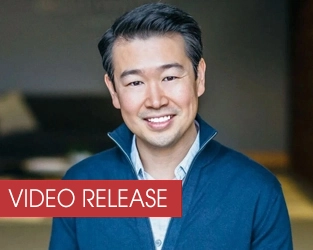
We are honored to welcome Eric Kim, Co-Founder and Managing Partner at Goodwater Capital and Yale University alumnus, for a fireside conversation on building global consumer technology companies across borders… Read More
Startup Scene: Entrepreneurs of Tomorrow 2026 Emerging Design Competition
Application Period: Monday, December 15, 2025 to Monday, March 30, 2026 (11:59 PM EST)
The “Startup Scene: Emerging Design Competition” is designed to encourage innovative thinking, creativity, and entrepreneurial spirit among Korean-American and Korean students enrolled in colleges, universities, and graduate schools across the United States… Read More
New Year, New You! Powered by K-Health
Thursday, January 22, 2026 | 6:00 PM (EST)
Join us for a timely discussion with William Ban (Himedi), Taesoo Sean Kim (IceMiller), and Ken Nesmith (Lunit) spotlighting Korea’s health-tech startups, scale-ups, and leading institutions at the forefront of medical innovation… Read More
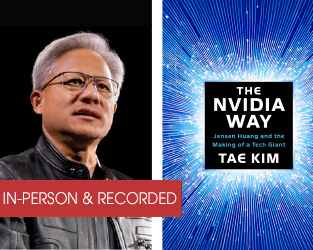
The Nvidia Way: Jensen Huang and the Making of a Tech Giant with Tae Kim
Thursday, December 4, 2025 | 6:30 PM (EST)
Join us for a conversation with Tae Kim, author of The Nvidia Way: Jensen Huang and the Making of a Tech Giant. Now as the world’s leading AI chipmaker, Nvidia offers a fascinating window into the new era of global entrepreneurship vis-à-vis its partnership with Korea… Read More
Riding the Momentum: How VCs Navigate Hype and Sustainable Growth
Wednesday, September 3, 2025
This edition of Startup Scene will explore one of venture capital’s most elusive forces: momentum… Read More
Startups in Focus: Driving US-Korea Economic Synergy Tuesday, April 22, 2025
The Korea Society is excited to announce the return of Startup Scene’s keystone annual forum for 2025: “Startups in Focus: Driving US-Korea Economic Synergy”, supported exclusively by Hanwha Life… Read More
Scaling SaaS: The Art of Storytelling & Investor Strategy Wednesday, March 5, 2025 | 6 PM (EST)
When it comes to building a successful SaaS (Software as a Service) business, many assume that exceptional coding skills are the key to success. However, our next Startup Scene program offers a different perspective… Read More
Startup Scene: Entrepreneurs of Tomorrow 2025 Student Ideation Competition Application Period: Monday, February 17 to Monday, March 3, 2025 (11:59 PM EST) Final 3 teams announcement: Monday, March 24, 2025 Final pitch and Award Ceremony: Tuesday, April 22, 2025
The Korea Society is calling for entries for “Startup Scene: Student Ideation Competition.” The competition is a part of the Society’s corporate series, Startup Scene: Entrepreneurs of Tomorrow (hereinafter Startup Scene), proudly supported by Hanwha Life exclusively. Startup Scene is dedicated to empower the startup entrepreneurial community that encompasses the US and South Korean economic landscape… Read More
Tech, Culture, and K-Beauty: Dino’s Playbook for Building MBX Tuesday, January 28, 2025 | 6 PM (EST)
Join us for an exclusive conversation with Hyungseok Dino Ha (hereinafter Dino), Co-Founder and CEO of MBX (formerly Memebox), a visionary multi-brand beauty and personal care company leading the convergence of technology, culture, and K-beauty… Read More
Empowering Women with Holistic Care: A Conversation with Rael’s Co-Founder and CEO, Yanghee Paik Thursday, June 20, 2024 | 6 PM (EDT)
The Korea Society is pleased to invite you to a fireside chat with Co-founder and CEO of Rael, Yanghee Paik. In 2017, Yanghee joined forces with two other Korean-American women to revolutionize the stagnant American feminine-care product market by introducing clean, high-performing holistic feminine care products… Read More
Changes, Challenges, and Chances in K-Startups amid AI Era Wednesday, May 1, 2024 | 8:30 AM (EDT)
The Korea Society would like to invite you to a half-day startup forum, “Changes, Challenges, and Chances in K-Startups amid the AI Era,” on Wednesday, May 1, 2024, from 8:30 AM to 1:30 PM. The forum marks the culmination of a year-long series, Startup Scene: Entrepreneurs of Tomorrow… Read More
Charting Entrepreneurial Paths: Curtis Lee, From Luxe to Pinwheel and Beyond Wednesday, February 28, 2024 | 6 PM (EST)
Navigating the uncertainties of quitting an established career to venture into entrepreneurship is a common challenge for many aspiring startup founders. The question of when to take that leap adds another layer of complexity to the journey. To shed light on these dilemmas, we invite you to join our conversation with Curtis Lee... Read More
Startup Scene: Entrepreneurs of Tomorrow Saeju Jeong: An Unwavering Visionary Behind Noom Wednesday, January 24, 2024 | 6 PM (EST)
Join us for our inaugural program of Startup Scene: Entrepreneur of Tomorrow, featuring Saeju Jeong, the Co-Founder and former CEO, and now serving as Executive Chair of Noom. Noom, established in 2008 with Saeju’s friend, Artem Pekatov, introduced a pioneering weight loss app in 2017… Read More















 Gods, Demons and Generals: Icons of Korean Shamanism


 This exhibition examined the changing social realities of Korean society from the 1950s to the 1990s through a selected reading of Korea’s most popular comic books. Featuring the works of 17 of the best-known artists, the exhibition offered a running commentary that reflected the lives of ordinary people—at once joyful, satirical and penetrating. What shines through these works most prominently is an engaged and vigorous civil society in Korea, continuously challenging and energizing the status quo in whimsical and provocative ways. By so doing, they play an important role in characterizing and distinguishing the culture, sensibility and sentiment of modern Korea.