

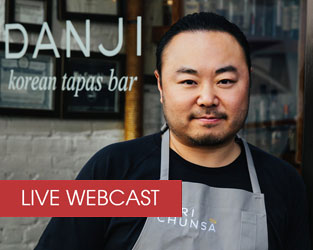
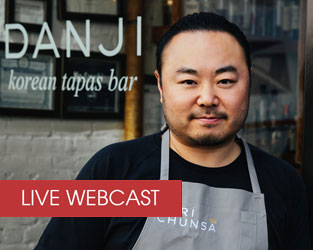
Chef Hooni Kim with Andrew Friedman

A chef known for defining Korean food in America brings a powerful culinary legacy into your kitchen. Hooni Kim, chef/owner of Danji and Hanjan, discussed his eagerly-anticipated cookbook, My Korea: Traditional Flavors, Modern Recipes, his insight and deep knowledge on Korean cuisine, and the challenges he faces as a restaurateur in New York City during the COVID-19 pandemic.

An Epicurious Spring 2020 “Book We Want to Cook from Now”
An Eater Best Cookbook of Spring 2020
Amazon Best Book of the Month, April 2020

Due to the novel coronavirus (COVID-19), this program will be conducted virtually. This live session will be provided free of charge at the specified date and time. A limited number of viewing links will be provided to the people who sign up through the form below. Those unable to view the live session will have the opportunity to watch the recorded video or listen to the podcast soon after.
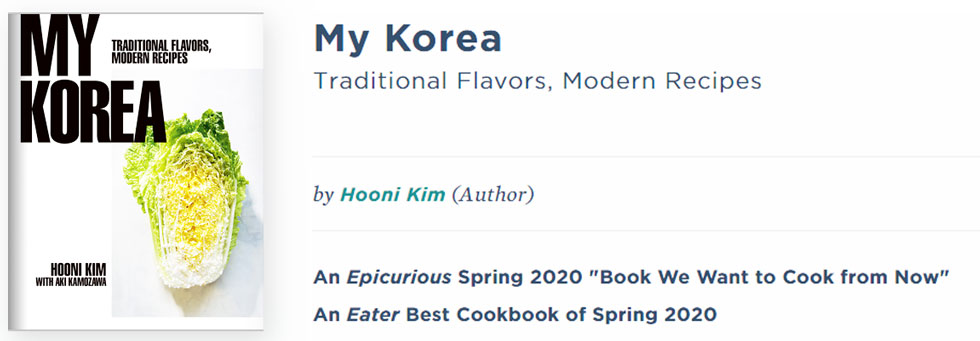


To buy or pre-order a copy of MY KOREA, please visit: https://wwnorton.com/books/9780393239720


Chef Hooni Kim
with
Andrew Friedman

Thursday, April 30, 2020 | 6:30 PM

The Korea Society
350 Madison Avenue, 24th Floor
New York, NY 10017


ABOUT THE SPEAKER:

Chef Hooni Kim’s first restaurant, Danji in the Hell’s Kitchen district of Manhattan received accolades from numerous publications including The New York Times, New York Magazine, Wall Street Journal, and The Village Voice. In 2012, Danji received a Michelin star, the first ever for a Korean restaurant. His second restaurant Hanjan in the Flatiron district was awarded 2 stars and listed as one of the 10 best new restaurants of 2013 by the New York Times, which heralded Chef Hooni Kim as “the city’s leading interpreter of Korean cuisine.”

Chef Hooni Kim was born in Seoul, Korea but has resided in New York City for over 30 years. He attended University of California, Berkeley, and International Culinary Center, and trained at Daniel and Masa before opening his own restaurant. Chef Hooni Kim was recognized as an ambassador of food and culture by the Korean government in 2011. He divides his time between New York City and Korea, where he is the founder of Yori Chunsa, a nonprofit that trains orphans to become cooks. His long-awaited debut cookbook, My Korea: Traditional Flavors, Modern Recipes, was published by W. W. Norton in April, 2020.


ABOUT THE MODERATOR:

Andrew Friedman has made a life and career of covering professional chefs. Formerly a film and television development executive, Andrew began his writing career when Alfred Portale asked him to collaborate on the Gotham Bar and Grill Cookbook, which won the Julia Child Award for Best Chef or Restaurant Cookbook. Most recently, Andrew is the author of Chefs, Drugs, and Rock & Roll: How Food Lovers, Free Spirits, Misfits, and Wanderers Created a New American Profession (Ecco, 2018), and of Knives at Dawn: America’s Quest for Culinary Glory at the Bocuse d’Or, the World’s Most Prestigious Cooking Competition (Free Press, 2009). He also co-edited the popular anthology Don’t Try This at Home, and has collaborated on more than 25 cookbooks, memoirs, and other projects with some of America’s finest and most well-known chefs, from legends like Alfred Portale to today’s tastemakers, such as Bill Telepan and Michael White. He also puts his industry knowledge and interviewing experience to use on the popular podcast Andrew Talks to Chefs. Andrew lives in New York.
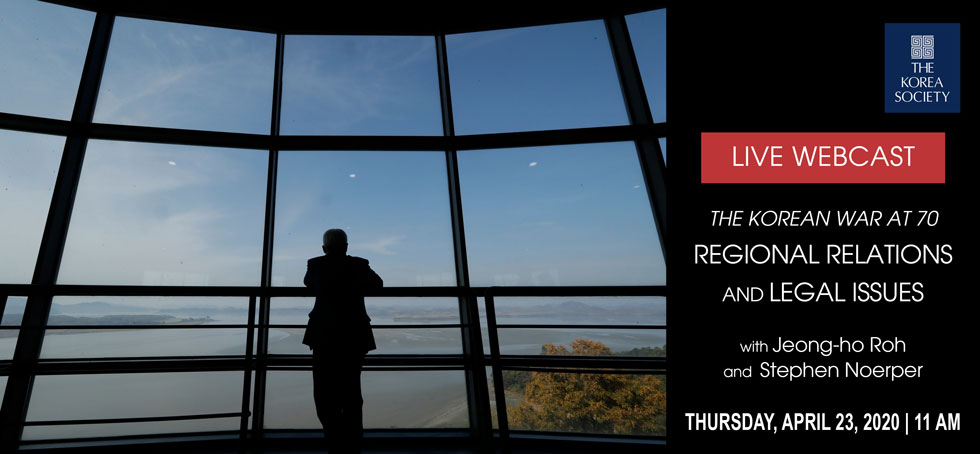
 

The Korean War at 70: Regional Relations and Legal Issues


Columbia Center for Korean Legal Studies director and professor Jeong-ho Roh and senior director and professor Stephen Noerper presented on legal issues and regional relations for Columbia Law School and SIPA graduate students. Policy director Jonathan Corrado and co-producer Peter Stuehmke concluded with an online screening of Last Ship in the Harbor.

The Korea Society is closely monitoring and following the safety precautions from the New York City and New York State Health Department and the Centers for Disease Control (CDC) regarding the novel coronavirus (COVID-19). Please understand that the time and format of this discussion is subject to change. We will notify all attendees who have RSVPed of any such changes and make refunds available. For any questions, you can reach out to policy@koreasociety.org. Thank you for understanding.


The Korean War at 70
Regional Relations and Legal Issues

Thursday, April 23, 2020 | 11 AM


The Korea Society
350 Madison Avenue, 24th Floor 
New York, NY 10017


Korean Election Analysis

Stanford University Professor Gi-Wook Shin joins Korea Society Senior Director Stephen Noerper for a timely breakdown of the April 15 Korean legislative elections. Professor Shin, Director of the Shorenstein Asia-Pacific Research Center, Director of Korean Studies, and William J. Perry Professor of Contemporary Korea, examines the voice of the electorate and impact of the National Assembly election results for the Moon administration and Korean politics.

Due the novel coronavirus (COVID-19), this program will now be conducted virtually. This live session will be provided free of charge at the specified date and time. A limited number of viewing links will be provided to the first people to sign up through the form below. Those unable to view the live session will have the opportunity to watch the recorded video or listen to the podcast soon after.   


Korean Election Analysis
with
Gi-Wook Shin

FRIDAY, APRIL 17, 2020 | 12 PM

The Korea Society
350 Madison Avenue, 24th Floor
New York, NY 10017


Of Interest:

Opinion | How Democracy Won the World’s First Coronavirus Election – The New York Times

Election Win for South Korea’s Moon Could Revive Goal to Reshape Economy

South Korea’s Coronavirus Crackdown a Boon for Moon Ahead of Polls – The New York Times

FSI | Shorenstein APARC – Korean Democracy Is Sinking Under the Guise of the Rule of Law

South Korean Primaries Could Make or Break Moon’s Presidency

South Korean Leader Said Coronavirus Would ‘Disappear.’ It Was a Costly Error. – The New York Times


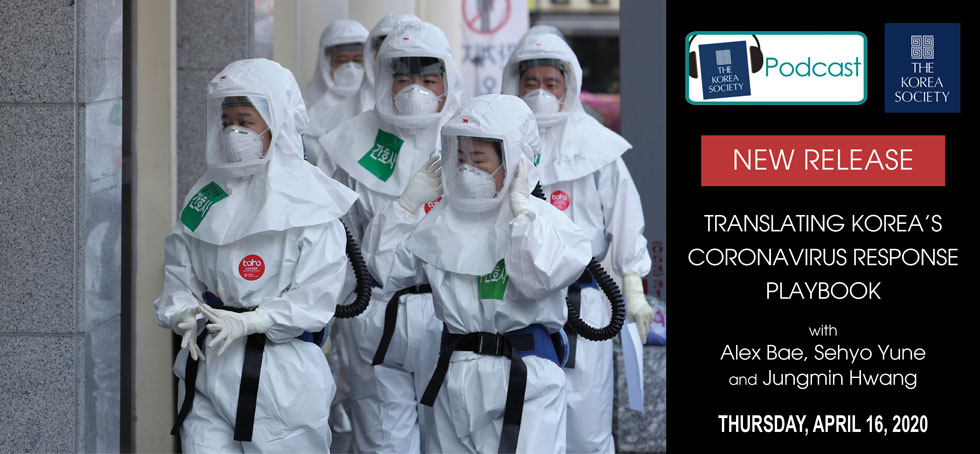
Podcast: Translating Korea’s Coronavirus Response Playbook

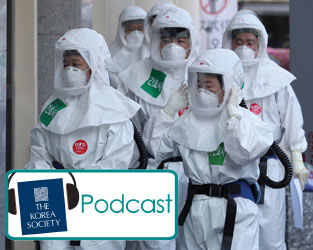
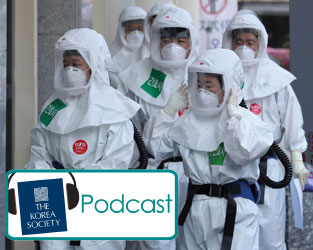
South Korea’s coronavirus response has been lauded for its integration of new technologies and aggressive trace-and-test measures. To help the international community understand this approach, a crowd-sourced team has translated Korea’s coronavirus playbook, a 90 page set of instructions made by the Korea Center for Disease Control advising local public health officials to plan for an array of contingencies. In this special podcast interview with Korea Society policy director Jonathan Corrado, translation team leaders Alex Bae, Sehyo Yune, and Jungmin Hwang discuss the project and the insights gained from it. The document is available to view at the team’s website here.


PODCAST
Translating Korea’s Coronavirus Response Playbook

The Korea Society
350 Madison Avenue, 24th Floor
New York, NY 10017


ABOUT THE SPEAKERS:


Alex Bae is a Ph.D. student at Princeton University in Electrical Engineering/Neuroscience. He works at Sebastian Seung’s lab in the Princeton Neuroscience Institute. His research focuses on computational neuroscience and artificial intelligence to study brain circuits.


Sehyo Yune is an internist and allergist trained at Samsung Medical Center in Seoul. Sehyo moved to the U.S. to study public health and business at Johns Hopkins University, and recently finished her research fellowship at Massachusetts General Hospital in development and implementation of machine-learning algorithms in healthcare.


Jungmin Hwang is a student at Hankuk Academy of Foreign Studies and has served as a volunteer translator for TED since 2017.


COVID-19 LESSONS FROM SOUTH KOREA: A Conversation Between Korea’s Top Coronavirus Expert Dr. Kim Woo Joo and Korea Society President Thomas Byrne

Learn how South Korea managed to bring COVID-19 under control in this recorded interview between the Korea Society’s President, Thomas Byrne, and Professor of Infectious Diseases at Korea University Guro Hospital, Dr. Kim Woo Joo. Deemed by the media as South Korea’s “most prominent coronavirus expert”, Dr. Kim explains how he and the country learned from past epidemics to mobilize the public and private sectors to combat the novel coronavirus. Tune in to learn what lessons the U.S. and other countries can glean from South Korea’s successes.


COVID-19
LESSONS FROM SOUTH KOREA:
A Conversation Between Korea’s Top Coronavirus Expert
Dr. Kim Woo Joo and Korea Society President Thomas Byrne

The Korea Society
350 Madison Avenue, 24th Floor
New York, NY 10017


ABOUT THE SPEAKER:


Kim Woo Joo, M.D., Ph.D.

Professor,
Division of Infectious Diseases, Department of Internal Medicine,
Guro Hospital, Korea University College of Medicine, Seoul, Republic of Korea
 
Professor Kim Woo Joo is a native of Korea, where he received a Doctor of Medicine (Korea University College of Medicine, 1983) and was boarded in internal medicine (Korea University Hospital, 1987). In 1990, he joined the Division of Infectious Diseases of the Korea University Guro Hospital as a Clinical Instructor and achieved the subspecialty board of adult infectious diseases in 1992. From 1996 to 1997, he served as a visiting scholar at the Division of Infectious Diseases and Clinical Microbiology at Rush-Presbyterian St. Luke’s Medical Center, Chicago, USA. Between 1999 and 2001, he worked as Chief of the Laboratory of Respiratory Viruses and the National Influenza Center at the Korea National Institute of Health (KNIH), supervising the surveillance, control, and research activities concerning influenza, measles, rubella, and mumps. While at the KNIH, Professor Kim was instrumental in the establishment of the Korean Influenza Surveillance Scheme (KISS), the first such national surveillance system for influenza. Since 2000, Professor Kim has been a member of the National Advisory Committee on Influenza. He provides advice on issues such as the identification of priority groups for influenza vaccination programs, the appropriate vaccination campaign, surveillance, burden of disease studies, and vaccine safety. Since 2007, he also has been advising on the influenza pandemic preparedness plan that the Korea Centers for Disease Control and Prevention (KCDC) is developing, as well as the research and development of the influenza pandemic vaccine. In recognition of his expertise in and contribution to the field of influenza, he was appointed as Chair of the Trans-governmental Enterprise for Pandemic Influenza in Korea (TEPIK) in 2010, designated by the Ministry of Health and Welfare. He was the president of the Korean Society of Infectious Diseases from 2014 to 2015. During the 2015 MERS-CoV outbreak in Korea, he had served as the leader of Rapid Response Team and special supervisor to the prime minister to help the government contain the outbreak within two months. In the last five years, Professor Kim has published numerous articles in international journals, including the Lancet, Journal of Infectious Diseases, Vaccine, Clinical Vaccine and Immunology, PLoS One, Human Vaccines & Immunotherapeutics, Influenza and Other Respiratory Viruses, Emerging Infectious Diseases, Epidemiology and Infection, Scientific Reports, Journal of Clinical Virology and the Journal of Medical Virology.


Geopolitics of Coronavirus: Japan and Korea

Council on Foreign Relations Senior Fellow for Japan Studies Dr. Sheila Smith and Korea Society Senior Director Dr. Stephen Noerper examine the political impact of the coronavirus outbreak in Japan and Korea, in conversation with Japan Society President and CEO Dr. Joshua W. Walker and with an introduction by Korea Society President Tom Byrne. In this live webcast program, co-hosted by the Japan Society and the Korea Society, the three discuss the domestic responses and impact of COVID-19 to date and regional implications, to include relations between the two states, Tokyo 2020 Olympics and evolving domestic realities. 


2016 03 03  korea-japan-relations  JPS-logo


Due to the novel coronavirus (COVID-19), this program will be conducted virtually. This live session will be provided free of charge at the specified date and time. A limited number of viewing links will be provided to the first people to sign up through the form by clicking the red button below. Those unable to view the live session will have the opportunity to watch the recorded video or listen to the podcast soon after. Thank you for your interest!


Geopolitics of Coronavirus: Japan and Korea

with
Sheila Smith and Stephen Noerper

Moderated by Joshua W. Walker


FRIDAY, APRIL 10, 2020 | 12 PM

The Korea Society
350 Madison Avenue, 24th Floor
New York, NY 10017


About the Speakers

Sheila A. Smith is senior fellow for Japan studies at the Council on Foreign Relations (CFR). An expert on Japanese politics and foreign policy, she is the author of Japan Rearmed: The Politics of Military Power, Intimate Rivals: Japanese Domestic Politics and a Rising China (released in Japanese as 日中 親愛なる宿敵: 変容する日本政治と対中政策), and Japan’s New Politics and the U.S.-Japan Alliance. She is also the author of the CFR interactive guide Constitutional Change in Japan. Smith is a regular contributor to the CFR blog Asia Unbound and a frequent contributor to major media outlets in the United States and Asia. Smith joined CFR from the East-West Center in 2007, where she directed a multinational research team in a cross-national study of the domestic politics of the U.S. military presence in Japan, South Korea, and the Philippines. She was a visiting scholar at Keio University in 2007-08, where she researched Japan’s foreign policy towards China, supported by the Abe Fellowship. Smith has been a visiting researcher at two leading Japanese foreign and security policy think tanks, the Japan Institute of International Affairs and the Research Institute for Peace and Security, and at the University of Tokyo and the University of the Ryukyus. Smith is vice chair of the U.S. advisors to the U.S.-Japan Conference on Cultural and Educational Interchange (CULCON), a binational advisory panel of government officials and private-sector members. She also serves on the advisory committee for the U.S.-Japan Network for the Future program of the Maureen and Mike Mansfield Foundation. She teaches as an adjunct professor at the Asian studies department of Georgetown University and serves on the board of its Journal of Asian Affairs. Smith earned her MA and PhD from the political science department at Columbia University.

Stephen Noerper is the Korea Society Senior Director for Policy and teaches graduate students on Northeast Asia and Korean Peninsula relations at Columbia University in both the School of International and Public Affairs (SIPA) and Department of Political Science. He is a senior research scholar at Columbia University’s Weatherhead East Asian Institute and a senior advisor to the United Nations program in support of cooperation in Northeast Asia. Previously, he was a senior fellow and director at the EastWest Institute, an associate professor of international relations at New York University, an adjunct professor at American University, and a visiting full professor to the National University of Mongolia–where he was a Fulbright senior scholar–and Waseda University. Dr. Noerper was an Intellibridge vice president, State Department senior analyst, and an associate and assistant professor at the Asia Pacific Center for Security Studies in Hawaii. He was an East-West Center visiting fellow and Washington representative for the Nautilus Institute for Security and Sustainable Development. The author of more than seventy publications on US policy, Korea and Northeast Asia, he has appeared widely on radio and television, to include the BBC, Bloomberg, CBC, CNN, NHK, NPR and VOA and in The Wall Street Journal and other print. He holds advanced degrees from the Fletcher School of Law and Diplomacy and London School of Economics. He is a member of the National Committee on North Korea, has received Mongolia’s State Friendship Medal and lectured across Korea, China, Russia and Japan, and has sat on several philanthropic boards.

Joshua W. Walker became President & CEO of Japan Society in December 2019. Previously, he worked at Eurasia Group, the world’s leading political risk analysis firm, where he served as global head of strategic initiatives and Japan in the Office of the President. Prior to that, he was CEO and president of the USA Pavilion of the 2017 World Expo in Astana, Kazakhstan; founding dean of the APCO Institute; and senior vice president of global programs at APCO Worldwide, a leading global strategic communications firm based in Washington, D.C. Before joining the private sector, he worked in numerous roles at various U.S. government agencies, including the State Department and the Defense Department. He is Senior Fellow at the Center for the Study of the Presidency and Congress, and professor of Leadership and the American presidency at George Mason University and the Reagan Foundation. He was also Transatlantic Fellow at the German Marshall Fund of the United States, and co-founded the Yale Journal of International Affairs. He earned a bachelor’s degree from the University of Richmond, a master’s degree from Yale University, and a doctorate from Princeton University. Dr. Walker grew up in Japan where his parents still serve as missionaries, came to the United States when he was 18, and is bicultural and bilingual.


of Interest:

Japan Fears Country on ‘Brink of the Brink’ of Virus Surge


China’s Foreign Policy and Relations on the Korean Peninsula

Orville Schell, Arthur Ross Director of the Center on US-China Relations at the Asia Society, examines developments in China’s foreign policy toward the Korean Peninsula in conversation with senior director Stephen Noerper. Schell discusses China’s commitment to denuclearization, orientation toward Pyongyang and Seoul, views on Korean unification, and the current news cycle, to include the geopolitics of the coronavirus response.

Due the novel coronavirus (COVID-19), this program will now be conducted virtually. This live session will be provided free of charge at the specified date and time. A limited number of viewing links will be provided to the first people to sign up through the form below. Those unable to view the live session will have the opportunity to watch the recorded video or listen to the podcast soon after.

This event is co-hosted by the Columbia Business School’s APEC Study Center.


China’s Foreign Policy and Relations on the Korean Peninsula
with
Orville Schell

FRIDAY, APRIL 3, 2020 | 12 PM

The Korea Society
350 Madison Avenue, 24th Floor
New York, NY 10017


ABOUT THE SPEAKER:

Orville Schell is the Arthur Ross Director of the Center on U.S.-China Relations at Asia Society in New York. He is a former professor and Dean at the University of California, Berkeley Graduate School of Journalism. Schell is the author of fifteen books, ten of them about China, and a contributor to numerous edited volumes. His most recent books are: Wealth and Power, China’s Long March to the 21st Century; Virtual Tibet; The China Reader: The Reform Years; and Mandate of Heaven: The Legacy of Tiananmen Square and the Next Generation of China’s Leaders. He has written widely for many magazine and newspapers, including The Atlantic Monthly, The New Yorker, Time, The New Republic, Harpers, The Nation, The New York Review of Books, Wired, Foreign Affairs, the China Quarterly, and The New York Times, the Washington Post, and the Los Angeles Times. Schell was born in New York City, graduated Magna Cum Laude from Harvard University in Far Eastern History, was an exchange student at National Taiwan University in the 1960s, and earned a Ph.D. (Abd) at University of California, Berkeley in Chinese History. He worked for the Ford Foundation in Indonesia, covered the war in Indochina as a journalist, and has traveled widely in China since the mid-70s. He is a Fellow at the Weatherhead East Asian Institute at Columbia University, a Senior Fellow at the Annenberg School of Communications at USC and a member of the Council on Foreign Relations. Schell is also the recipient of many prizes and fellowships, including a Guggenheim Fellowship, the Overseas Press Club Award, and the Harvard-Stanford Shorenstein Prize in Asian Journalism.


Regaining Lost Ground in the North Korean Human Rights Movement with Victor Cha and Lindsay Lloyd

CSIS Senior Adviser and inaugural holder of the Korea Chair Victor Cha and Bradford M. Freeman Director of the Human Freedom Initiative at the George W. Bush Institute Lindsay Lloyd discuss Cha’s report, Regaining Lost Ground in the North Korean Human Rights Movement, in conversation with Korea Society Senior Director Stephen Noerper.


Regaining Lost Ground in the North Korean Human Rights Movement

with
Victor Cha and Lindsay Lloyd


THURSDAY, MARCH 26, 2020 | 1 PM

The Korea Society
350 Madison Avenue, 24th Floor
New York, NY 10017


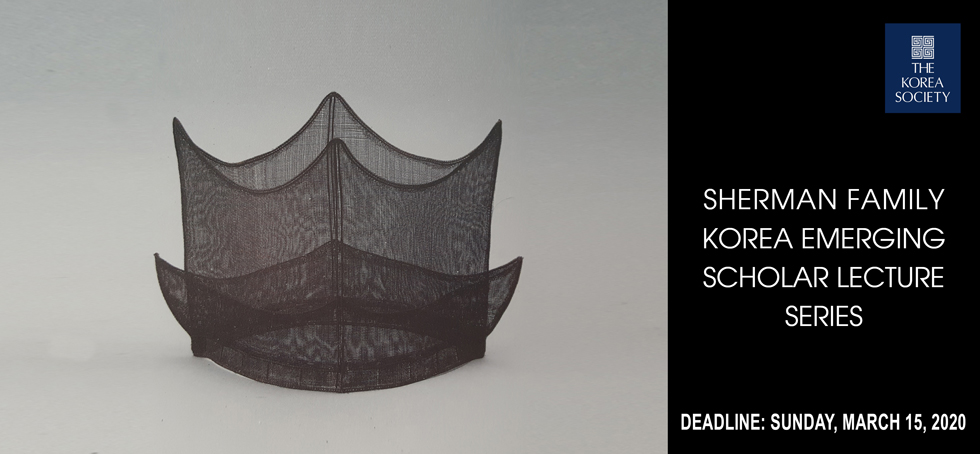
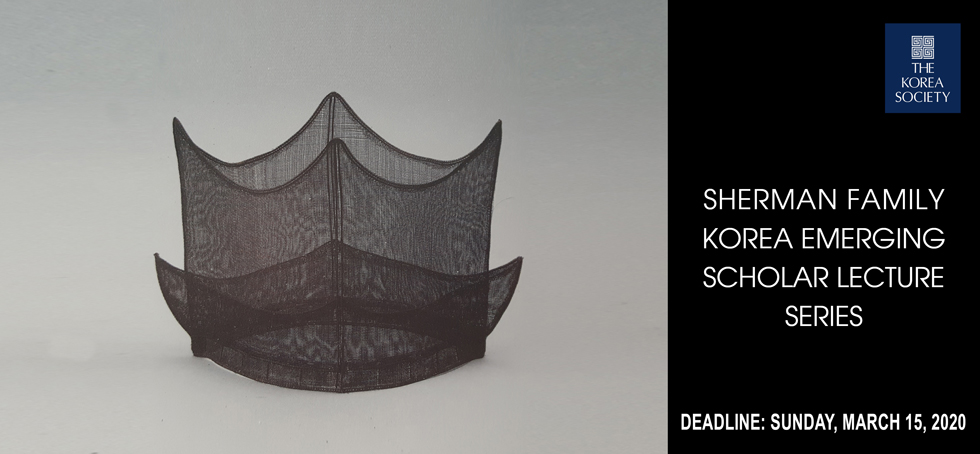
Sherman Family Korea Emerging Scholar Lecture Series 2020

Deadline: Sunday, March 15 |

The Sherman Family Korea Emerging Scholar Lecture Series aims to grow thought leadership on Korea for a new generation of US scholars and practitioners. The Korea Society welcomes applications from individuals at the Ph.D. through non-tenure track professorial levels, as well as nonprofit, public service or private sector equivalents. This annual prize recognizes an emerging scholar leading in her or his field on Korea and affords the recipient an opportunity to speak at the Korea Society.

The Society selects a prize winner annually. The recipient receives air, hotel, and a $2500 award. She or he lectures at the Society to members and guests on a convenient date.

Applicants should submit a CV, proposed lecture essay, writing sample, and two letters of recommendation from senior scholars or professionals electronically (PDF) to stephen.noerper@koreasociety.org. The application deadline is March 15 at 5 PM. The Society thanks Mr. and Mrs. Philip Sherman and family for their generous support of this initiative.


Sherman Family Korea Emerging Scholar Lecture Series Award

The Korea Society
350 Madison Avenue, 24th Floor 
New York, NY 10017


Coronavirus (COVID-19) Update


The Korea Society Coronavirus Update as of March 30, 2020:

The Korea Society is closely monitoring and following the safety precautions from the New York City and New York State Health Department and the Centers for Disease Control (CDC) regarding the novel coronavirus (COVID-19).

To ensure the health and safety of visitors and staff, the office will be closed to the public until further notice. Postponements of programs have been announced by email and can also be found on our website. The Korea Society also has launched online contents including podcast and webcast programs. Please check out our website for the online programs. Korean Language Program transitioned to on-line classes as of Monday March 16. If you have any questions, please contact our KLP Director, Jahee Yu.

The Korea Society will continue to closely monitor developments and will update our policies accordingly in a timely manner. If you have any questions, please feel free to contact us at info@koreasociety.org.

Thank you for your patience and understanding during this time.

Remember to follow our Korea Society social media channels and join to become a member today.

NYC Health Department
NYS Department of Health
CDC (Centers for Disease Control and Prevention)
Novel Coronavirus Hotline: Call 1-888-364-3065 for Information about Coronavirus.