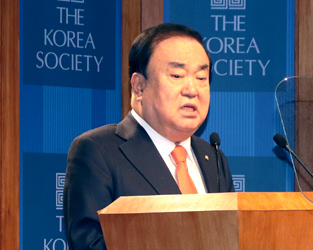
Good morning. I am Moon Hee-sang, Speaker of the National Assembly of the Republic of Korea. Mr. Thomas Byrne, President of the Korea Society,
Distinguished guests from home and abroad,
It is a great privilege and pleasure to be here.
I am particularly delighted to meet members of the Korea Society, an institution which further reinforces the ROK-U.S. alliance and the friendship and cooperation between the Republic of Korea and the United States. This year commemorates the 62nd anniversary of the Korea Society, and it would be no exaggeration to say that it has a shared history with our alliance. I would like to take this chance to express my sincere respects to you for your dedication and hard work in serving as a bridge not only between South Korea and the United States but also between our two peoples. I sincerely appreciate this meaningful opportunity to address you this morning.
The ROK-U.S. Alliance – An alliance bonded in blood and sacrifice that transcends all alliances
Leading an unprecedented delegation comprised of the highest leaders of the Korean National Assembly, including leaders of each political party, I was in Washington since February 11 until yesterday. In Washington, we met leaders of Congress, primarily Madam Nancy Pelosi, Speaker of the U.S. House of Representatives, and high-level figures in the administration with whom we shared in-depth, fruitful dialogue on reinforcing the ROK-U.S. alliance and establishing peace on the Korean Peninsula. We also spent an inspiring session with experts on issues surrounding the Korean Peninsula.
I will never forget the sentiments that overwhelmed me as we walked around the Korean War Veterans Memorial. As we paid tribute and offered flowers, I was filled with thoughts of American soldiers that had fought and died to protect our country. As we solemnly acknowledged the great nameless heroes that had fallen on foreign soil, we were engulfed with an emotion so deep that it left us trembling.
The year 2020 marks the 70th anniversary of the Korean War. In August 1950, allied forces set up the last line of defense along the Nakdong River. General Walton H. Walker issued his order, “Stand or die”. In the end, the Nakdong River defense line managed to reverse the trend of the battle, and in September that same year, the Battle of Inchon resulted in a decisive victory for allied forces.
Rising from the destructive ruins of war of the 1950s, the Republic of Korea set an unprecedented record in its achievement of industrialization. From one of the most impoverished countries in the world, it rose to become a donor country. It has become a country which enjoys a democracy with unrivaled maturity. It achieved phenomenal economic success, becoming the seventh country to accede to the 30-50 club for economies with US$30,000 in gross national income (GNI) per capita and population of 50 million.
Korean society today enjoys democracy, economic growth, and continued prosperity. We could say that it all began with the sacrifice and dedication of U.S. soldiers and UN allied forces during the Korean War.
Ladies and gentlemen,
The ROK-U.S. alliance is one bonded in blood and sacrifice. It is destined to be an alliance that transcends all alliances. The Korean people and I have not forgotten the noble sacrifice of American war veterans. There is no inkling of doubt in the lasting endurance of the alliance and friendship between our two peoples.
President Trump’s engagement policy paves the way for the Korean Peninsula Peace Process
Honorable members of the Korea Society,
Ladies and gentlemen,
It would not be overstating to say that world history moves in tandem with the history of war. Humankind experienced the full extent of the barbarism of war through the two World Wars. As for the Korean people, we had to endure the terror and despair of a fratricidal tragedy – the Korean War.
There is a saying, “Any kind of peace is better than war”. But only a year ago, the Korean people had to withstand a period of uncertainty fraught with the risk of war. The crisis on the Korean Peninsula was at its peak around the time North Korea announced its success in test launching its ICBM in July 2017.
Then, a true miracle happened. As you are well aware, the 2018 PyeongChang Winter Olympics served as a decisive turning point, transforming dark clouds of war over the Korean Peninsula into a climate of peace. Five days ago, February 9, marked exactly one year since the Winter Olympics were held in Korea. On the day before my departure for the United States, I attended a ceremony in Pyeongchang, which provided an opportunity for me to appreciate once again the meaning of ‘peace’ on the Korean Peninsula.
The first inter-Korea summit held on April 27, 2018 resulted in the announcement of the Panmunjom Declaration for Peace, Prosperity and Unification of the Korean Peninsula. Panmunjom, the world’s last fragment of the Cold War and a symbol of war became an emblem of peace. Two more summits were held in the following five months, and on June 12, the U.S.-North Korea summit was held for the first time in history. Now, the whole world is filled with anticipation in the run up to the imminent second summit between the United States and North Korea.
The full support and cooperation of the United States, China, Japan, Russia, and the international society were vital in the ongoing Korean Peninsula Peace Process.
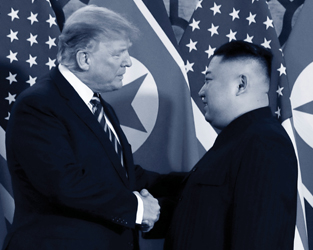
Above all, President Trump’s policy of maximum pressure and engagement played a pivotal role. I evaluate highly the United States’ bipartisan and consistent North Korean policy, and how it drew support from the international society in the form of UN Security Council sanctions. It would be no exaggeration to say it was President Trump’s decisiveness and leadership in hosting the first summit in the history of its relations with North Korea with Chairman Kim Jong-un that brought about this remarkable change.
The Korean Peninsula Peace Process is the world peace process.
Dear members,
Ladies and gentlemen,
In countless interviews home and abroad, I was asked a question on the future prospect of the Korean Peninsula Peace Process. Every time, I would reply by employing the proverb “Man-jeol-pil-dong (만절필동(萬折必東))”, which depicts the great streams of the Yellow River inevitably flowing to the east, despite many twists and turns. As such, the peace process, which may be interspersed with many ups and downs due to various political situations and dynamics in the complex world of international diplomacy, will ultimately flow toward denuclearization and peace on the Korean Peninsula due to North Korea’s desperate economic situation and international isolation caused by sanctions.
Together with this cautious optimism, we must adopt the attitude of “Ho-si-woo-haeng (호시우행(虎視牛行))”, an approach that requires the dispassionate and meticulous observation of a tiger and the steady and reliable stride of an advancing bull.
The Korean Peninsula Peace Process is literally the world peace process. It is a destination toward which South Korea, United States, and the international society should strive toward without hesitation. However, pursuing the denuclearization of North Korea and the Korean Peninsula Peace Process require the adherence of principles. First, we cannot recognize North Korea as a nuclear state, and its nuclear weapons program must be completely dismantled. Second, no country should remain hostile to North Korea, and the abolishment of its nuclear weapons program will ensure a bright future for the country. Third, our ultimate goal is the improvement of relations, peaceful co-existence, and joint prosperity among South and North Korea and the United States. Fourth, the ROK-U.S. alliance is the locomotive and password that will lead North Korea’s complete denuclearization and the Korean Peninsula Peace Process.
When Sir Edmund Hillary, the world’s first man to conquer Mount Everest, was asked how he managed to reach the summit, he answered, “One step at a time”. As such, the Korean Peninsula Peace Process will be long and tenuous. It will be a process which calls for courage and patience, and wisdom and devotion from the two Koreas and the international society.
The combination of three leaders, Trump, Moon, and Kim will double the chance of peace.
Dear members of the Korea Society,
It is my belief that the combination of three leaders, United States President Trump, North Korean leader Kim Jong-un, and South Korean President Moon Jae-in will double the possibility of achieving peace.
President Trump is renowned for his bold decision-making and negotiation skills. As for Chairman Kim, we must perceive his desperate situation. He is a leader desperately trying to take on the responsibility of feeding his people. It is not surprising that he is unable to revive the country’s economy under sanctions of the international society, and particularly, consistent, aggressive sanctions of the United States. North Korea’s only way out is to abandon its nuclear weapons and run along the tracks of peace on the Korean Peninsula. It has no other choice. Chairman Kim dedicated a considerable part of his new year’s address on the improvement of the people’s economy. This results from the recognition that economic development is a core part of maintaining his regime.
Of course, it will not be easy to achieve the immediate abolishment of North Korea’s nuclear weapons. Furthermore, I am aware of the skepticism prevalent in the United States government and society regarding North Korea’s sincerity in abandoning its nuclear weapons. However, if we recognize Chairman Kim’s sense of urgency, it may be necessary for us to see carefully the authencity of how the situation home and abroad propels North Korea in this direction. We look to the United States to play a pivotal role in guiding North Korea to become a normal state and to normalize relations with North Korea through dialogue and negotiation.
This involves President Trump and Chairman Kim, but also President Moon. If President Trump plays a determinant role in the Korean Peninsula Peace Process, President Moon undeniably serves as the essential, connecting link.
President Moon’s strengths, consistency and trust, enabled the construction of the tracks of peace during his first year in office
When the current administration in South Korea first took office, relations between the United States and North Korea, not to mention between the two Koreas, and the North Korean nuclear crisis were at their worst point. The situation was so grave that the South Korean president’s proposal to resolve relations with North Korea through dialogue actually seemed bizarre.
When President Moon first unveiled the Berlin Initiative in Germany on July 6, 2017, half of the international society was in doubt. Even North Korea criticized it as “ludicrous” and “nonsensical sophistry”. Nevertheless, his unrelenting and consistent message to North Korea managed to earn its confidence. In the process, with some exaggeration, South Korea shared information with the United States on a second-by-second basis, reinforcing our relationship of trust. South Korea and the United States stand in full agreement regarding the goals of complete denuclearization and establishment of lasting peace on the Korean Peninsula. President Moon’s strengths, consistency and trust, enabled him to construct the railway tracks for the Korean Peninsula Peace Process during the first year of his five-year term. He still has three more years ahead of him to ensure the operation of the locomotive of peace.
Diplomacy is often dubbed as an “art of possibilities”. The two Koreas and the United States are employing the highest level of diplomatic artistry to transform a possibility into reality. The three leaders are core drivers that heighten the possibility of the realization of the Korean Peninsula Peace Process.
Miracles do not happen miraculously but require joint efforts of the international society for peace
Honorable members of the Korea Society,
Given our past experiences, the achievement of the denuclearization of North Korea and lasting peace on the Korean Peninsula will truly be a miracle. South Korea’s 15th president and Nobel Peace Prize awardee Kim Dae-jung, for whom I have profound respect, once said, “Miracles do not happen miraculously”.
The Korean Peninsula Peace Process is being pursued upon the foothold of various agreements between the United States and North Korea, from the 1994 Agreed Framework to the February 29, 2012 agreement, which are based on the ROK-U.S. alliance. The peace process is feasible because it is an extension of the first inter-Korean summit of 2000 and the inter-Korean summit of 2007, which first opened the road linking the two Koreas. It is also attributable to the continued joint efforts of the international society, including the United States, Japan, China, and Russia, in establishing the Six-Party Talks. We continue to earnestly seek the joint efforts of the international society in creating the miracle of peace on the Korean Peninsula.
As Speaker of the Korean National Assembly, I am pursuing the first inter-Korean parliamentary summit for the improvement of our relations with North Korea. Having already exchanged personal letters with my counterpart, the summit meeting can be held as soon as we set the date. The second U.S.-North Korea summit is a critical factor in making this possible. I dare presume that a successful U.S.-North Korea summit will significantly raise the likelihood of Chairman Kim’s visit to Seoul, and the inter-Korean parliamentary summit may be held around that time. This is another reason why we have high expectations on the decisiveness and leadership of President Trump.
Efforts of the two Koreas to abolish North Korea’s nuclear weapons and the principle and negotiations strategy in the denuclearization process
Members of the Korea Society,
Ladies and gentlemen,
Our efforts to advance inter-Korea relations are driven by the goal of compelling North Korea to proactively improve its relations with the United States by dismantling its nuclear weapons program and building a trustworthy relationship. We continuously emphasize that, without North Korea’s abandonment of nuclear weapons, the improvement of inter-Korea relations can only be limited, and if it does abandon its nuclear arsenal, we have a strong determination to provide support and cooperate with North Korea. We persistently remind North Korea of this through various channels, including inter-Korea summits.
The essence of the Moon administration’s North Korea policy is to instill confidence in North Korea that a bright future is waiting for them. This is also the vision that President Trump put forward to North Korea time after time. If North Korea gives up its nuclear weapons, the international society will accept it as a normal state, and South Korea and the United States will completely set aside hostilities. Furthermore, security assurances for its regime will not be the only results of complete denuclearization. I believe it will lead to generous support and cooperation from South Korea, United States, and the international society so that North Korea can achieve economic growth and development.
For North Korea to completely abandon its weapons of mass destruction (WMD), however, trust is of paramount importance. Trust is the necessary and sufficient condition for nuclear dismantlement. Due to a lack of trust, however, a comprehensive agreement is not being reached on issues such as timing for the declaration of nuclear weapons programs and dismantlement of nuclear facilities. The second U.S.-North Korea summit must firmly set and renew the goal of final, fully verified denuclearization (FFVD). At the same time, both parties must build trust by agreeing on and implementing specific denuclearization measures and corresponding measures on a phase-by-phase basis. We sincerely hope that through this process, an agreement will be reached on a realistic plan which will conclusively lead to complete nuclear dismantlement.
Korea verifies the unwavering ROK-U.S. alliance through substantial contribution
Dear members,
The Republic of Korea’s commitment toward a strong ROK-U.S. alliance has been consistent and unwavering. We have worked in earnest to expand our relationship into a comprehensive alliance that encompasses fields of economy and security. Since the Korea-U.S. free trade agreement came into effect, bilateral trade increased considerably by 29.2% over the past six years. This process highlighted the fact that the United States accounts for a large part of Korea’s imports. South Korea remains the only country among the United States’ trade partners with which it has reduced its trade deficit. The drastically improved trade balance contributes to reinforcing bilateral relations.
South Korea is United States’ third largest importer of weapons based on procurement volume over the past decade. The total area of the U.S. Army Garrison Camp Humphreys in Pyeongtaek that opened last year is five times that of Central Park in New York. It is the largest overseas base in which U.S. forces are stationed and boasts world-leading facilities.
South Korea’s contribution was acknowledged by President Trump who has emphasized, several times, that the successful economic and security relationship with South Korea is part of his achievements over the past two years.
Advancing through the great ROK-U.S. alliance, cheering “You go, We go!”
Honorable members of the Korea Society,
Ladies and gentlemen,
Peace and prosperity on the Korean Peninsula will lead to peace in Northeast Asia, and this will essentially contribute to reinforcing world peace. To this end, a rock-solid ROK-U.S. alliance is a fundamental prerequisite and key factor that remains unchanged and will remain unchanged in the future.
As mentioned above, the ROK-U.S. alliance transcends all alliances. Ours is an alliance of value in which we share values of democracy and peace, freedom and equality, and justice and human rights. Ours is a global alliance which tackles all critical, global issues together. In this sense, I believe President Trump’s characterization of the ROK-U.S. alliance as a ‘great’ alliance overshadows all other modifiers.
On a personal note, my constituency is Uijeongbu City. Until recently, it was home to seven camps of US Forces in Korea. When the USFK and the Korean Army jointly participate in events, the American soldiers shout, “Kachi-Kapsida (같이 갑시다)!” while the Korean soldiers shout, “We go together!”. Today, I want to shout “You go, We go!” for the great ROK-U.S. alliance.
Let us strive for peace on the Korean Peninsula and the world through a rock-solid and unwavering ROK-U.S. alliance! Thank you for your attention.
(END)


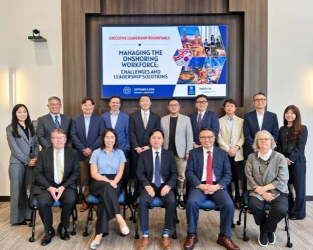














 Joel S. Wit is a Senior Fellow with Stimson and Director of 38 North. Wit is an internationally recognized expert on Northeast Asia security issues. As a U.S. State Department official, he helped negotiate the 1994 US-DPRK Agreed Framework and was subsequently in charge of its implementation until he left government in 2002, holding countless talks with North Korean officials, including the military and nuclear establishments. Since 2002, Wit has been a Senior Fellow at CSIS, a consultant to the National Academy of Science and an Adjunct Senior Researcher at Columbia University’s Weatherhead Institute for Asian Studies. Wit is a co-author (with Robert Gallucci and Daniel Poneman) of Going Critical: The First North Korea Nuclear Crisis, the winner of the American Academy of Diplomacy’s 2004 prize for best book. He has written extensively in publications ranging from Foreignpolicy.com to the New York Times and is a regular expert guest on television shows (e.g. the Lehrer Report and CNN’s The Situation Room) and radio (e.g. the Diane Rehm Show).