Rhythms to Make the Heart Beat Faster

2009 09 30 rhythms to make the heart beat faster icon

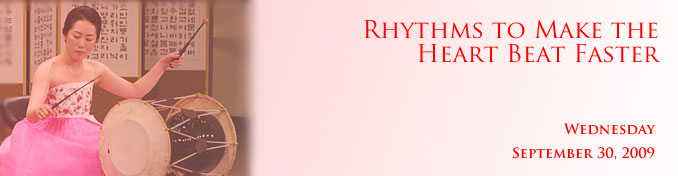
On September 30, 2009, Minji Kim, traditional percussionist, dancer, and a Republic of Korea 2009 Korean Traditional Artist-in-Residence, performed an evening of folk music on the changgo, an hourglass drum at the heart of traditional Korean music. The night’s program began with an introduction by Dr. Ju-Yong Ha, composer and ethnomusicologist, who also provided commentary before each of the three musical selections: a kayagum sanjo, a duet for haegum and changgo, and a solo percussion piece for changgo. Minji Kim was accompanied by Gee Sook Baek on the kayagum and Lee Kyung Kang on the haegum.


Dynamic Korea: Dance and Song 2009

Performed by Chae Hyang Soon Dance Company
dynamic the korea society1

Bring the rhythm and vitality of Korea’s classical dance tradition to your performing arts venue with Chae Hyang Soon Dance Company. The Korea Society is now accepting bookings for the group’s fall 2010 U.S. tour.

Handed down from generation to generation, the movements of Korea’s classical dance tradition reflect the essential rhythms of life in Korea. The exuberant yŏtt’aryŏngch’um (Taffy Peddler Dance) walks audiences through the bustling marketplaces of Korea, while meditative, deeply symbolic performances such as the hwahyŏnmu (Lotus Dance) and sŭngmu (Monk’s Dance) explore the country’s deep Buddhist roots. From the gentle, gliding grace of the opening chaech’ŏnmu (Chosŏn Court Dance) to the thunderous drumming of the closing p’unggo, the dancers and musicians of the Chae Hyang Soon Dance Company are animated by the strength and energy of the Korean tradition.

dynamic the korea society2Tour Specifications:

Period: September 16-30, 2010
Fee: Available upon request
Contents: 12 performances by 12 performers
Category: Folk Music and Dance / Religious
Time: 90 minutes

For more information, to receive a press kit with DVD or to schedule a performance at your institution, please contact Heewon Kim at The Korea Society at (212) 759-7525, ext. 355 or at heewon.ny@koreasociety.org.

Read more to view a video clip of the performance.

The Korea Society Interviews Park Chan-wook

2009 07 24 park chan wook icon

South Korean star director Park Chan-wook (JSA, Old Boy), has thrilled both critics and audiences in his native country for a decade. His “vengeance” trilogy brought international recognition, including a Cannes Film Festival Grand Prize (2008) and a Jury Prize (2009), and established Park as a virtuoso filmmaker with a thoroughly original artistic vision. On July 24, 2009, The Korea Society recorded a special interview with the director in which he spoke about his influences, his meteoric ascension into the pantheon of internationally celebrated directors, and his latest film, Thirst.

Thirst is a stylish vampire thriller with a dramatic bite, and continues Park’s exploration of the dark side of the human soul. A devout priest (Song Kang-ho, The Host) on a mission to Africa volunteers as a test subject in a vaccine trial-gone-awry. Now a vampire, he returns to Korea to endure the torments of temptation, embodied by a childhood friend’s wife (Kim Ok-bin).

Missionary Photography in Korea: Encountering the West Through Christianity


mt_ignore:missionary_exhibition.jpg

The arrival of the first Western missionaries in Korea in the late 19th century was a pivotal moment in the history of Christianity in Korea and the history of Korea as a whole. The missionaries established new religious identities and stoked early culture clashes. They also documented their mission and the society around them with early cameras. Missionary Photography in Korea: Encountering the West Through Christianity—the largest ever show of Korean missionary photographs in the U.S.—features rare images taken by missionaries in Korea between 1890 and 1940.

Taken by both Protestant and Catholic missionaries, the photographs—on display along with unique supplementary objects such as an original photo album and New Year’s calendars—offer a singular perspective on life in Korea during times of profound change. They illustrate the forging of contemporary institutions and values in the crucible of encounters with American Christian missionaries by Koreans.

The impact of early Western contact on Koreans is evident in the telltale signs of new cultural norms and new religious identities, and clues that these new ways were conflicting with long-held traditions. Less directly evident, but equally important, the images also allow the viewer to surmise how Koreans in turn had a formative impact on the missionaries, which led to intertwined personal histories that became a foundation for subsequent relations between Korea and the United States.

Drawn from four private collections and six academic archives, the images have been digitally restored and printed in a manner that retains, as far as possible, the archival quality of the images.

On May 5, 2009, Don Baker, Associate Professor in the Department of Asian Studies at the University of British Columbia, spoke about the history of Christianity and religion in Korea with Fred Carriere, The Korea Society’s Executive Vice President. The interview is in support of ‘Missionary Photography in Korea: Encountering the West through Christianity,’ an exhibition previously on display at The Korea Society Gallery.

Purchase the 184-page hardcover exhibition catalog.

2009_10_22_donald-clark

In order to better serve you, our online ordering system is now through Google Checkout.

Add items to your order by completing the form below and clicking “add to cart.” You may add multiple tickets by filling in new information and clicking “add to cart” again.

Click “Checkout” in the left sidebar to complete your order. Gmail users may use their existing accounts, or you will be asked to create a free Google account when checking out.

The purchase options below with “New Membership” include a one-year individual membership level of support to The Korea Society which grants member discounts to this item and future events, classes and programs. If purchased, New Membership information will be separately mailed to your physical address. Thank you for your support.

If you have any questions, please email or call Heewon Kim at (212) 759-7525, ext. 355.

Hardcover Exhibition Catalog, Missionary Photography in Korea


Exhibition Catalog $40.00


Missionary Photography in Korea 34 42 5 71 83

  1. Anti-TB campaign Christmas Seals (Seoul / 1930s, Norman Thorpe Collection)
  2. Western Style Clothing Shop in Korea (Chemulp’o Port/ca. 1910, Mission Photograph Collection, General Commission on Archives and History, The United Methodist Church, Madison, New Jersey)
  3. A Christian Wedding (Seoul/ca. 1920, Mission Photograph Collection, General Commission on Archives and History, The United Methodist Church, Madison, New Jersey)
  4. Catholic Foreign Mission Society of America (P’yŏngyang / 1924, Maryknoll Mission Archives)
  5. Soongsil Christian Academy’s Soccer Team Champions (P’yŏngyang / 1925, The Moffett Korea Collection, Special Collections of the Princeton Theological Seminary)
  6. Missionary Children: The Roberts Daughters (Sonch’ŏn, North Pyŏngan Province / ca. 1910, Donald Clark Collection)

Quick & Easy Korean Cooking Podcast

2009 05 07  quick-easy-cooking icon

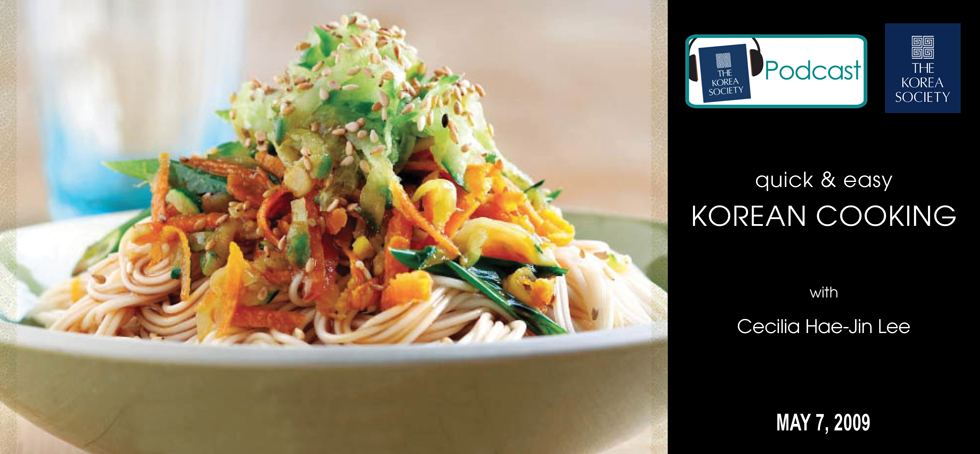
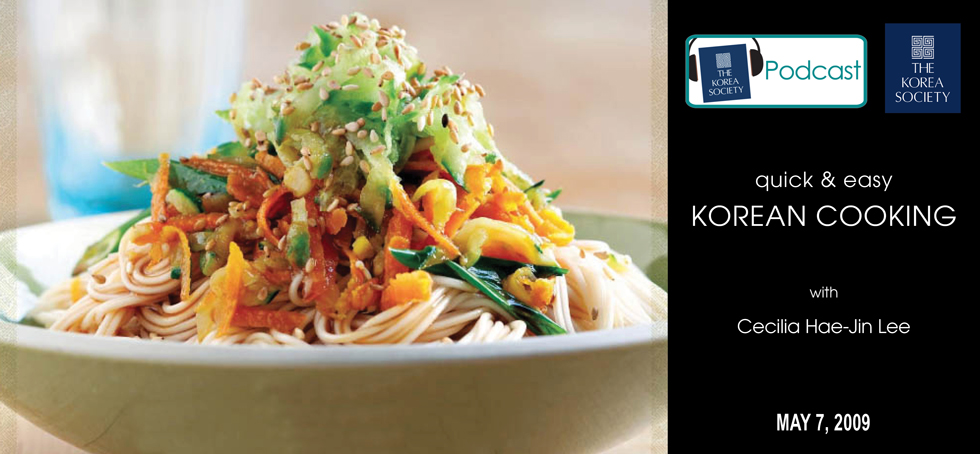
  On May 7, 2009, Cecilia Hae-Jin Lee, author of Eating Korean: From Barbecue to Kimchi, Recipes from my Home, visited The Korea Society to speak about about her latest cookbook, Quick & Easy Korean Cooking (Chronicle Books). Lee is also the author of several travel guides and her writing has been featured in Food and Wine, Eating Well, the Los Angeles Times, the Washington Post, the Whole Life Times, the Asian Pacific American Journal, and Korean Culture magazine.


The Religious Revolution in Modern Korean History

2009 05 05 ReligiousRevolutionIcon

On May 5, 2009, Don Baker, Associate Professor in the Department of Asian Studies at the University of British Columbia, spoke about the history of Christianity and religion in Korea with Fred Carriere, The Korea Society’s Executive Vice President. The interview is in support of ‘Missionary Photography in Korea: Encountering the West through Christianity,’ an exhibition previously on display at The Korea Society Gallery.

The arrival of the first Western missionaries in Korea in the late 19th century was a pivotal moment in the history of Christianity in Korea and the history of Korea as a whole. The missionaries established new religious identities and stoked early culture clashes. They also documented their mission and the society around them with early cameras. Missionary Photography in Korea: Encountering the West Through Christianity—the largest ever show of Korean missionary photographs in the U.S.—features rare images taken by missionaries in Korea between 1890 and 1940.

Taken by both Protestant and Catholic missionaries, the photographs—on display along with unique supplementary objects such as an original photo album and New Year’s calendars—offer a singular perspective on life in Korea during times of profound change. They illustrate the forging of contemporary institutions and values in the crucible of encounters with American Christian missionaries by Koreans.

The impact of early Western contact on Koreans is evident in the telltale signs of new cultural norms and new religious identities, and clues that these new ways were conflicting with long-held traditions. Less directly evident, but equally important, the images also allow the viewer to surmise how Koreans in turn had a formative impact on the missionaries, which led to intertwined personal histories that became a foundation for subsequent relations between Korea and the United States.

Drawn from four private collections and six academic archives, the images have been digitally restored and printed in a manner that retains, as far as possible, the archival quality of the images.

Purchase the 184-page hardcover exhibition catalog here.

TradINNOVAtion: New Trends in Contemporary Korean Architecture

2009 04 14 tradinnovation icon

Korea’s dizzying economic and urban growth over the past 50 years has seen the country exchange its traditional architectural landscape for Westernized office towers and apartment blocks. At the dawn of the twenty-first century, a few Korean architects are embracing buildings visibly rooted in history and synthesizing traditional forms and the demands of modern life. Architect Doojin Hwang will explain the theory, design and methodology behind the “creative restoration” changing the face of Korea’s cities.

TradINNOVAtion: New Trends in Contemporary Korean Architecture

Gallery Talk with

Doojin Hwang
Principal, Doojin Hwang Architects

Tuesday, April 14, 2009

Pojagi: Cloth, Color and Beyond

Join us for a panel discussion on the art and history of Korean wrapping cloths, or pojagi, with Lee Talbot, assistant curator of The Textile Museum; Chunghie Lee, fiber artist; and Seta K. Wehbé, assistant collection manager of the Antonio Ratti Textile Center at the Metropolitan Museum of Art. Linking pojagi aesthetics to both traditional American quilts and contemporary abstract painting, the panelists will discuss the enduring appeal of pojagi and what they reveal about the lives and times of their creators.

This lecture is organized in conjunction with Unwrapping the Secrets of Korean Textiles: An Exhibition of Pojagi , which runs through April 24, 2009 at The Korea Society Gallery. You may also be interested in the workshop sessions, Making a Pojagi, beginning February 24.


Wednesday, March 18, 2009


Gallery Talk

with

Lee Talbot
Assistant Curator of Eastern Hemisphere Collections at The Textile Museum

Seta K. Wehbé
Assistant Collection Manager of the Antonio Ratti Textile Center at the Metropolitan Museum of Art

Chunghie Lee
Artist


Korean Films Made During the Japanese Occupation


The Korea Society and The Museum of Modern Art (MoMA) are proud to present seven films from one of the earliest, and most complex, periods of Korean cinema. Recently discovered in a Chinese warehouse and restored by The Korean Film Archive, the films date from the 1930s and ’40s, a period when Korea was dominated by the dictates of Japanese colonialists. These dramas are thus uncomfortably pro-Japanese. Yet simultaneously, their rich aesthetics and formal experimentation reach beyond imperial Japanese ideology to express timeless themes of longing, loss and duty. 

The films will be shown in five programs from January 28 through February 1 at The Roy and Niuta Titus Theaters at MoMa.
All films are in Korean with English subtitles. 


Wednesday, January 28 – Sunday, February 1, 2009

Museum of Modern Art
11 W 53rd St, New York, NY 10019

Tickets may be purchased from the MoMA box office. 
Click here for more information. 
(Museum full admission includes any film for that day.)


Wednesday, Jan 28   6:00 Spring in the Korean Peninsula 8:00 Straits of Chosun
Thursday, Jan 29     8:00 Fishermen’s Fire and Volunteer
Friday, Jan 30   6:00 Angels on the Street 8:00 Sweet Dreams and Military Train
Saturday, Jan 31 1:00 Spring in the Korean Peninsula 3:00 Straits of Chosun 5:00 Angels on the Street
Sunday, Feb 1 1:00 Fishermen’s Fire and Volunteer 3:30 Sweet Dreams and Military Train  


SPRING IN THE KOREAN PENINSULA (84 min) 1941

Wednesday, January 28 | 6 PM
Saturday, January 31 | 1 PM

Directed by Lee Byeong-Il. Starring Kim Il-Hae, Seo Wol-Young and Kim So-Young. A film adaptation of a traditional Korean tale, Spring in the Korean Peninsula is a backstage romance between a director and an actress that falls into crisis when the director is jailed.


STRAITS OF CHOSUN (75 min) 1943

Wednesday, January 18 | 8 PM
Saturday, January 31 | 3 PM

Directed by Park Ki-Chae. Starring Nam Seung-Min, Moon Yae-Bong and Kim Shin-Jae. Made at the height of World War II, when Japanese censorship was at its tightest, Straits of Chosun tells the bittersweet story of a husband and wife separated by war. 


FISHERMAN’S FIRE (52 min) 1939

Thursday, January 29 | 8 PM
Sunday, February 1 | 1 PM

Directed by Ahn Chul-Yeong. Starring Park Hak, Nah Woong and Park Jung-Kyeong. Following a fisherman’s daughter as she moves from her seaside village to bustling Seoul and is quickly beset by shady characters, Fisherman’s’ Fire is about the things you lose when you lose your home. 


VOLUNTEER (55 min) 1941

Thursday, January 29 | 8 PM
Sunday, February 1 | 1 PM

Directed by Ahn Seok-Young. Starring Choi Woon-Bong, Moon Yae-Bong and Lee Keum-Ryong. A simple Korean farmer’s son who aches to leave the countryside behind and fight for Imperial Japan finally gets his chance when colonial authorities enact a draft.


ANGELS ON THE STREET (73 min) 1941

Friday, January 30 | 6 PM
Saturday, January 31 | 5 PM

Directed by Choi In-Kyu. Starring Kim Il-Hae, Moon Yae-Bong and Kim Shin-Jae. Notably realistic for its era in depicting the gritty poverty of contemporary Seoul, Angels on the Street is the story of a man struggling to set up an orphanage for the city’s street kids.


SWEET DREAMS (46 min) 1936

Friday, January 30 | 8 PM
Sunday, February 1 | 3:30 PM

Directed by Yang Ju-Nam. Starring Cho Taek-Won, Moon Yae-Bong and Yoo Sun-Ok. Korean cinema’s first talkie, Sweet Dreams nearly left audiences speechless with its scandalous melodrama about a wife who abandons her family to live with another man.


MILITARY TRAIN (66 min) 1938

Friday, January 30 | 8 PM
Sunday, February 1 | 3:30 PM

Directed by Seo Kwang-Jae. Starring Wang Pyeong and Moon Yae-Bong. Won-jin passes information about a Japanese military train to resistance fighters, putting the life of his best friend, the engineer, in danger in this hybrid of a spy thriller and a pro-Japanese morality play. 



Encountering North Korea Through Its Art

2008 12 04  EncounteringNKThroughArt icon
Image
Gallery Talk

with

 
Jane Portal
Matsutaro Shoriki Chair of the Art of Asia, Oceania and Africa, Museum of Fine Arts, Boston.

Thursday, December 4, 2008

We might think that we know about North Korea – it has been so much in the news recently, presenting a nuclear threat to the region. But in fact we know very little about the country. In the 19th century, the undivided country was called the hermit kingdom. Since 1953, the South has become accessible and widely known, while the North has remained a hermit, with very few tourists being allowed to travel there to find out what it is really like. Perhaps one form of evidence which would help us understand the north better is through its art. Jane Portal was very privileged to be able to travel to Pyongyang in 2001 and 2002 as a result of the establishment of diplomatic relations between the UK and the DPRK. At that time she started to collect a variety of contemporary works for the British Museum.

This lecture is in conjunction with the gallery exhibit North Korean Images at Utopia’s Edge, on view at The Korea Society Gallery through December 12, 2008.

Above print:
Happiness (1990), Hwang Chol-Ho
Linoleum Print (Ed. 1 of 5)
25 (H)” x 21¾ (W)”

A young boy gives his father, a miner, his report card from school.