Contemporary Korean Choreographers
International DUMBO Dance Festival: Contemporary Korean Choreographers
October 19 – 25, 2005
In association with WHITE WAVE, a Brooklyn-based performance, teaching and rehearsal hub, The Korea Society presented the first annual International DUMBO Dance Festival. Marking an exciting departure from the usual presentation of traditional Korean performing arts, the Festival featured seven up-and-coming young Korean choreographers/dancers who are active not just in Korea but worldwide. These artists performed eleven highly varied, contemporary routines that were grouped into two separate programs and performed on six occasions at the John Ryan Theater in Brooklyn from October 19 to October 23.
The Artists and their works
Jung Young-Doo (Korea)
Craving for More
Choreographed by: Jung Young-Doo
Danced by: Jung Young-Doo & Son Yea-Ran
Music by: Lee Kot-Byul (Korean Fiddlist)
Costume by: Doo Dance Theater
We always try to move up and crave for more. How many of us could be satisfied with what we already have? Most of us live anxiously worrying about love, work, dreams to fulfill and so on. The complicated movements paradoxically suggest peace and harmony of life to the audience. By taking a step down from our restless lives, we may be happier. Breathtaking movement by two dancers is a wonderful feat to experience the endless flow of delicate emotion. It will direct the audience to look back on their lives. Craving for More has received awards from the 2004 Yokohama Dance Collection Solo & Duo Competition, the Yokohama Red Brick Warehouse Number1, the Laureat du Prix de L’Ambassade de France pour jeunes choregraphes and the Yokohama Arts Foundation.
Incompatible Yet One
Choreographed by Jung Young-Doo
Danced by Jung Young-Doo, Kim Nam-Keon & Kwak Go-Eun
Music by: Maurice Ravel
Costume by: Sim Young-Sim Jung
Young-Doo’s work has been seen at Seoul International Dance Festival’s Contemporary Korean Dances by Young Artists as well as in Australia, Japan, Hong Kong, Singapore, and Taiwan. His awards include the 2004 Yokohama Dance Collection Solo & Duo Competition Grand-Prize and Special Award.
Lee Tae-Sang (Korea)
Rush
Choreographed by: Lee Tae-Sang
Danced by: Lee Tae-Sang, In Jung-Ju, Byeon So-Yeon & Lee Kyung-Joon
Coustume by: Lee Tae-Sang
Lighting by: Lee In-Yeon
Rush can be compared to a needle in one’s body. In the piece, Lee Tae-Sang expresses the danger and limitation of being in modern society and examines the meaning of identity. Rush was premiered in The 22nd International Modern Dance Festival (Modafe2003).
Lee Tae-Sang was awarded the Best Choreographer at the 2005 Dance Festival for the Critics’ Choice of Young Artists and has been seen at ImPulsTanz in Austria and Dusseldorf Tanzhaus in Germany. Tae-sang Lee has collaborated on works with Akram Khan and Jeremy Nelson.
Lee Kyung-Eun (Korea)
Between
Collaboration by: Lee Kyung-Eun & Saito Eiji
Danced by: Lee Kyung-Eun & Saito Eiji
Prop, Music by: Lee Kyung-Eun & Saito Eiji
Costume by: SSAMZIE
Between is a co-production of Theater ZERO in Korea and the AOYAMA Theatre in Tokyo. It premiered in November, 2004 at the Korea/Japan Dance Festival. It was also presented at the 5th Seoul Performing Arts Festival in Seoul and the Korea/Japan Dance Contact in Tokyo (2005).
Off Destiny
Choreographed by: Lee Kyung-Eun
Danced by: Lee Kyung-Eun
Music by: J. S. Bach
Costume by: Lee Kyung-Eun
Off Destiny was choreographed and developed from Lee Kyung-Eun’s composition workshop at the Montpellier Dance Festival in 2002. The piece is an attempt to use the rhythm within, and external music was used only at critical and necessary moments.
Lee Kyung-Eun was the winner of the choreography contest of The 8th International Solo-Tanz-Theater Festival, Stuttgart and toured 5 major cities with the work. She was also awarded Best Choreographer at the 2003 Dance Festival for the Critics’ Choice of Young Artists. She received 2nd Grand Atelier Choregraphes-Compositeurs at the Royaumont Foundation.
Kim Yun-Jung (Germany)
Farewell Images
Choreographed & Danced by: Kim Yun-Jung
Music by: Tekn Kim
Lighting design by: Eric vanden Dungen
Voices: Kim Hyojung, Ahn Hyejung and Kim Eun-jung
Farewell Images was performed at the Dance Museum (Seoul), Aoyama Theater (Tokyo), Frankfurt Book Fair 2005 and toured cities around Germany including Aachen, Munster and Dusseldorf.
8 Days
Choreographed by: Kim Yun-Jung
Danced by: Kim Yun-Jung, Han Chang-Ho & Lee Youngil
Music by: Kim Tekn
Costume by: Lee Hyemin
Film & stage design by: Ha Sungok
Lighting design by: Lee Boman
8 Days was invited to KUNSTSTIFTUNG NRW (NORD RHEIN WESFALLEN) and Seoul Perfuming Arts Festival and received financial support from the City of Dusseldorf, the Stiftung Kunst und Kultur and LG Electronics.
Kim Yoon-Jung, based in Dusseldorf, Germany, has presented work in Korea with the Whang Mi Sook Dance Company and the Yang Jung Soo Contemporary Dance Company; and in Europe with Mary Fulkerson, Joao da Silva Jr., Charlotte Zerbey, Marcus Grolle and with the Russian choreographer Olga Pona.
CHA Jin-Yeob (England)
Fragments
Choreographed by: Hofesh Shechter
Danced by: Cha Jin-Yeob & Hofesh Shechter
Music by: Hofesh Shechter, Eric Idle and J.S. Bach
Fragments premiered at the Kuopio Dance Festival in Finland, June 2003 and then toured the UK, Italy, Portugal, Switzerland and Poland, where the piece won first place in a choreography competition. It presents an insight into a couple’s life inside the noise of their culture. A rich sound track is the centerpiece through soft and intense moments that investigate the nature of the couple’s relationship under the pressure of inner and outer voices.
Volupte
Choreographed by: Cha Jin-Yeob & Hofesh Shechter
Danced by: Cha Jin Yeob
Music by: Hofesh Shechter
Volupte premiered at The Korean World Dance Stars Festival in July 2005. The work explores the edge, the delicate point, and the fragile moment where the individual loses the world of definitions and dives into an ocean of unexplainable sensation.
Cha Jin-Yeob received the best choreographer award in The Korean Choreography Festival in 2002. She worked with Dance Energy Company in Munich, Germany and for Micha Purucker from 1999 through 2003. Currently, she is a member of Edge, the post graduate company of LCDS, and is also working in London with choreographer Hofesh Shechter.
Nam Young-Ho (France)
Porte D’ame (Gate of Soul)
Choreographed by: Nam Young-Ho
Danced by: Nam Young-Ho and Christelle Delhaye
Music by: Christelle Delhaye
Costume by: Judith Chaperon
Lighting by: Thierry Lenain
This piece was created with the support of the Dance of all Senses Festival, in Falaise, Normandie, the French Ministry for Culture and Communication, the Languedoc-Roussillon Council, the Montpellier City Council, and the Herault Council. Gate of Soul is a peaceful duet for two females, a dancer and a musician (cello), inspired by the philosophy of Tao.
The Rascalou-Nam Dance Company was founded in 1998 in Montpellier, France by co-artistic directors Nam Young-Ho and Francois Rascalou. Since its inception, the company has performed amazing works in both domestic and international arenas. Her work has been invited to the 2005 Montpellier Dance Festival.
Kim Eun-Jeong (Korea)
Monghwan
Choreographed by: Kim Eun-Jeong
Danced by: Kim Eun-Jeong and Han Chang-Ho
Music by: Seo Jung-Min (p’ansori vocalization) and Lee Hwa-Yeon (Korean zither)
Monghwan (Bitter Dream) paints a daydream by depicting a pair of lovers on a yellow mat. As the sound of a love song from the story of Chunhyang and the sorrowful wail of a Korean zither engulf them, they express the border of coexistence between reality and unreality. They navigate as if the broken ship of life floats on the ocean.
Kim Eun-Jeong has perform at Tanz Messe in Dusseldorf, Germany, supported by Korea World Dance Center, Switzerland’s Theater Winterthur 2004 and at Agora Theater in Tokyo, Japan.
The choreographers and dancers were chosen by Young Soon Kim, the curator of the Festival, who also is WHITE WAVE’s artistic director. In picking performers, Kim attempted to achieve something more than just capturing the rhythms and movements of Korea. As all the artists she selected for the Festival either have planted their Korean roots in foreign soil or at least performed extensively abroad, she wanted to highlight how in the process of establishing their careers they have created singular, cross-cultural performances.
Following their performances in Brooklyn, the dancers went on the road for a final performance on October 25 at St. Lawrence University in Canton, New York.





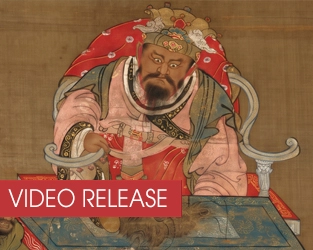


 Gods, Demons and Generals: Icons of Korean Shamanism


 This exhibition examined the changing social realities of Korean society from the 1950s to the 1990s through a selected reading of Korea’s most popular comic books. Featuring the works of 17 of the best-known artists, the exhibition offered a running commentary that reflected the lives of ordinary people—at once joyful, satirical and penetrating. What shines through these works most prominently is an engaged and vigorous civil society in Korea, continuously challenging and energizing the status quo in whimsical and provocative ways. By so doing, they play an important role in characterizing and distinguishing the culture, sensibility and sentiment of modern Korea.