
North Korea
-
The Choco Pie-ization of North Korea
Wednesday, January 15, 2014 | 12:00 PM- About the Speaker Title: The Choco Pie-ization of North Korea
- About the Speaker: 2014-01-15 12:00:00
- Event Name: Members $10 | Guests $20 |
- Event Time: ../tickets/2014/2014_01_15__choco-pie__ticket.html
- Event Content: itms://itunes.apple.com/us/podcast/choco-pie-ization-north-korea/id210903888?i=230645186&mt=2
- Event Link: <p dir="ltr" style="text-align: justify;"><span style="color: #000000; line-height: 1.3em;"><span id="docs-internal-guid-4c1fb5e7-fd4f-8733-26b4-137d43d0c746"><strong>Jin Joo Chae</strong>, a South Korean artist working with printmaking and mixed media installation. A graduate of Columbia School of the Arts and Hongik University in Seoul, Chae has exhibited in the United States, Europe, and throughout Asia. She is an accomplished printmaker and has participated in international print exhibitions and biennials, including at the International Print Center New York in Fall 2013. Her works are in the collection of the Tokyo Metropolitan Art Museum and Sakima Art Museum in Okinawa.</span>PBS, PRI, CNN, ABC, NBC, CBC, NECN, Al Jazeera, etc.</span></p> <p dir="ltr" style="text-align: justify;"><span style="color: #000000;"> </span></p>
- Custom HTML field content: About the Speaker
- Third Tab: http://traffic.libsyn.com/koreasociety/2014-01-15_ChocoPie-ization.mp3
Join dynamic contemporary artist Jin Joo Chae in this Studio Korea session. Jin Joo Chae employs printmaking and mixed media and is concerned with American coverage of the tense dynamics between North and South Korea. Using fragile and fragrant media--newspaper and screen-printed chocolate--she manipulates dominant political narratives to suggest more complex and physically embodied realities. Playful modes and materials are subverted to suggest a helplessness and desire for transformation. The Choco... Read More -
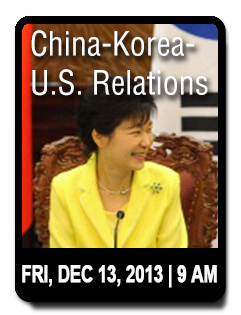
China-Korea-U.S Relations A Robert Scalpino Memorial Dialogue
Friday, December 13, 2013 | 9:00 AMKorea’s President and her advisors speak of hope for enhanced trilateral relations among Korea, the United States and China. 2013’s historic summits between Obama and Park, Obama and Xi, and Park and Xi revealed a growing complementarity of positions vis-a-vis North Korea and common calls for denuclearization. How does Korea navigate space among its great ally and great neighbor, balancing political-security and economic realities? How do domestic political determinants influence foreign policy in this area for... Read More -

Ouster in North Korea Leaves World Watching
Wednesday, December 11, 2013 | 11:00 AM- Custom HTML field content: About the Speaker
- Registration Form: AUDIO
- Summit External URL: <p><iframe width="270" height="54" scrolling="no" src="//www.thetakeaway.org/widgets/ondemand_player/#file=http%3A%2F%2Fwww.thetakeaway.org%2Faudio%2Fxspf%2F335726%2F;containerClass=takeaway"></iframe></p>
On December 11th, 2013, Ambassador Thomas Hubbard, chairman of the Korea Society, appeared on Public Radio International's The Takeaway. He discussed the significance of North Korean leader Kim Jong-Un ousting his uncle and mentor Jang Song-thaek from office with host John Hockenberry. http://www.thetakeaway.org/story/ouster-north-korea-leaves-world-watching/ Read More -
The Two Koreas Release with Robert Carlin
Tuesday, December 10, 2013 | 5:30 PM- About the Speaker Title: The Two Koreas Release with Robert Carlin
- About the Speaker: 2013-12-10 17:30:00
- Event Name: Members $10 | Guests $20 | Students $5 |
- Event Time: ../tickets/2013/2013_12_10__TwoKoreas-RCarlin__ticket2.html
- Event Link: <p dir="ltr" style="text-align: justify;"> </p> <p dir="ltr" style="text-align: justify;"><span style="color: #000000;"><strong>Robert Carlin</strong> is a Visiting Fellow at Stanford University’s Center for International Security and Cooperation, and co-chair of the National Committee for North Korea. From 2002-2006 he was political advisor to the Executive Director of the Korean Peninsula Energy Development Organization (KEDO), a multinational consortium formed to carry out several key provisions of the 1994 US-DPRK Agreed Framework. He led numerous KEDO negotiating teams to the DPRK, and was on the last KEDO ship to leave the North in January 2006, carrying the final contingent of KEDO employees and contractors back to South Korea.</span></p> <p dir="ltr" style="text-align: justify;"> </p> <p dir="ltr" style="text-align: justify;"><span style="color: #000000;">From 1989-2002, Carlin was chief of the Northeast Asia Division of the State Department’s Bureau of Intelligence and Research. From 1993-2002, he served concurrently as senior advisor to the chief US negotiator to US-DPRK talks, and attended all of the major negotiations with the North Koreans during that period. From 1971-1988, he was an analyst with the CIA. Carlin has visited North Korea over 30 times. His last visit was in November 2010 as part of a small group from Stanford that was taken to see the North’s uranium enrichment facility at Yongbyon.</span></p> <p dir="ltr" style="text-align: justify;"> </p> <p style="text-align: justify;"> </p> <p dir="ltr" style="text-align: justify;"><span style="color: #000000;"><strong><span id="docs-internal-guid-5a1dcc64-ebd4-533c-aea0-f5703a864e69"></span><br /></strong></span></p>
- Custom HTML field content: About the Speaker
Korea uber-analyst and author Bob Carlin discusses on the day of its re-release what many consider the foremost book on modern Korea, Don Oberdorfer’s The Two Koreas. Carlin wrote the updated forward, bringing this arresting publication, loved by university students, business leaders and public alike, to a new generation of readers. Carlin discusses the changes on the Korean Peninsula since the publication’s initial release, the publication’s continued relevance, and his labor of love saluting Van Fleet awardee... Read More -
The Korean Peninsula and Strategic Risk with Bruce Klingner
Thursday, November 14, 2013 | 5:30 PM- About the Speaker Title: The Korean Peninsula and Strategic Risk
- About the Speaker: 2013-11-14 17:30:00
- Event Name: Members $10 | Guests $20 | Students $5 |
- Event Time: ../tickets/2013/2013_11_14__StrategicRisk-klinger__ticket.html
- Event Content: https://itunes.apple.com/us/podcast/shifting-balance-forcing-change/id210903888?i=184962511
- Event Link: <p dir="ltr" style="text-align: justify;"><span style="color: #000000;"><strong>Bruce Klingner</strong> is the senior research fellow for Northeast Asia in The Heritage Foundation's Asian Studies Center. Klingner’s analysis and writing about North Korea, South Korea, Japan and related issues are informed by his 20 years working at the Central Intelligence Agency and the Defense Intelligence Agency. From 1996 to 2001, Klingner was CIA’s deputy division chief for Korea, responsible for the analysis of political, military, economic and leadership issues for the president of the United States and other senior U.S. policymakers. In 1993-1994, he was the chief of CIA's Korea branch, which analyzed military developments during a nuclear crisis with North Korea.</span></p> <p dir="ltr" style="text-align: justify;"><span style="color: #000000;">Klingner, who joined Heritage in 2007, has testified before the House Foreign Affairs Committee, the Senate Select Committee on Intelligence and the House Permanent Select Committee on Intelligence.</span></p> <p dir="ltr" style="text-align: justify;"><span style="color: #000000;">He is a frequent commentator in U.S. and foreign media, including television news programs for ABC, CBS, Fox, CNN, MSNBC, BBC, Bloomberg and C-Span. His articles and commentary have appeared in major American publications such as The New York Times, The Washington Post, The Wall Street Journal, The Los Angeles Times, USA Today, Christian Science Monitor, Newsweek and Fortune, as well as in overseas outlets such as The Financial Times, Chosun Ilbo, Joongang Ilbo, Kyodo News and Nikkei Weekly.</span></p> <p dir="ltr" style="text-align: justify;"><span style="color: #000000;">Klingner is a distinguished graduate of the National War College, where he received a master's degree in national security strategy in 2002. He also holds a master's degree in strategic intelligence from the Defense Intelligence College and a bachelor's degree in political science from Middlebury College in Vermont.</span></p> <p dir="ltr" style="text-align: justify;"><span id="docs-internal-guid-5a1dcc64-db56-ae70-0873-41fe75dc61a3" style="color: #000000;">He is active in Korean martial arts, attaining third-degree black belt in taekwondo and first-degree black belt in hapkido and teuk kong moo sool.</span></p>
- Custom HTML field content: About the Speaker
- Third Tab: http://traffic.libsyn.com/koreasociety/2013-11-14_KoreanPeninsulaStrategicRiskBruceKlingner.mp3
Heritage Senior Research Fellow in Northeast Asia and blog-force Bruce Klingner opines on recent challenges on the Korean Peninsula and implications for those assessing strategic risk on the Peninsula and in Northeast Asia. Klingner is a former intelligence official, Intellibridge executive and Eurasia Group analyst, and is a frequent voice on Capitol Hill and in the media. Klingner offers a Studio Korea audience insight into how to analyze North Korea, identify tripwires, and weigh Chinese and other changes on... Read More -
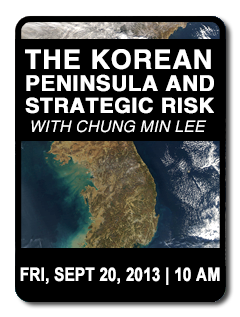
The Korean Peninsula and Strategic Risk
Friday, September 20, 2013 | 10:00 AM- About the Speaker Title: The Korean Peninsula and Strategic Risk
- About the Speaker: 2013-09-20 10:00:00
- Event Name: Members $10 | Guests $20 | Students $5 |
- Event Time: ../tickets/2013/2013_09_20__StrategicRisk-CMLee__ticket.html
- Event Content: itms://itunes.apple.com/us/podcast/challenges-to-building-stability/id210903888?i=168362849
- Event Link: <p dir="ltr" style="text-align: justify;"><span style="color: #000000;" data-mce-mark="1"><strong>Chung Min Lee</strong> is the current Korean Ambassador for International Secuirty. Previously, he was the Dean and Professor of International Relations, Graduate School of International Studies, Yonsei University. Dr. Lee concurrently served as a member of the President’s Foreign Policy Advisory Council and the Presidential Committee on Future & Vision. He was also an advisor to the Prime Minister’s Office, the Ministry of National Defense, the Ministry of Unification, the Foreign Policy and Unification Committee of the National Assembly and other government agencies. </span></p> <p dir="ltr" style="text-align: justify;"><span style="color: #000000;" data-mce-mark="1">Dr. Lee was a visiting professor at the Lee Kuan Yew School of Public Policy, National University of Singapore (2005–2007), the Graduate Research Institute for Policy Studies, Tokyo (2004–2005), a policy analyst at the RAND Corporation (1995–1998), and a visiting research fellow at the National Institute for Defense Studies, Tokyo (1994–1995). Dr. Lee also served as a research fellow at the Sejong Institute, Seoul (1989–1994) and the Institute for Foreign Policy Analysis, Cambridge, Massachusetts (1985–1988). </span></p> <p dir="ltr" style="text-align: justify;"><span style="color: #000000;">Dr. Lee received his MALD and his PhD from the Fletcher School of Law and Diplomacy, Tufts University in 1988 and his BA in political science from Yonsei University in 1982. For over twenty years, Dr. Lee has written extensively on various aspects of East Asian security including strategic developments on the Korean peninsula. His research covers international and Asian security and defense planning, WMD proliferation, crisis management, and intelligence. Dr. Lee has lived in ten countries and is a citizen of the Republic of Korea.</span></p> <p dir="ltr" style="text-align: justify;"><span style="color: #000000;">Dr. Lee is a member of the IISS (London) and a member of the board of the Seoul Forum for International Affairs (SFIA).</span></p> <p dir="ltr" style="text-align: justify;"><span><br /><span style="font-weight: bold;"></span></span></p> <p dir="ltr"><span style="color: #800000;">[Of interest: <a href="http://www.lowyinterpreter.org/post/2013/06/02/Shangri-La-missile-defence.aspx"></a><a href="http://www.lowyinterpreter.org/post/2013/06/02/Shangri-La-missile-defence.aspx"><span style="color: #800000;">http://www.lowyinterpreter.org/post/2013/06/02/Shangri-La-missile-defence.aspx</span></a></span></p> <p dir="ltr" style="text-align: justify;"><span style="color: #800000;"><span id="docs-internal-guid-5a1dcc64-a208-e1c2-178b-ace15898ae00"><br /><a href="http://csis.org/publication/pacnet-24-real-lessons-north-koreas-ongoing-threats"></a><a href="http://csis.org/publication/pacnet-24-real-lessons-north-koreas-ongoing-threats"><span style="color: #800000;">http://csis.org/publication/pacnet-24-real-lessons-north-koreas-ongoing-threats</span></a></span>]</span></p>
- Custom HTML field content: About the Speaker
- Third Tab: http://traffic.libsyn.com/koreasociety/2013-09-20_KoreanPeninsulaStrategicRiskAmbChungMinLee.mp3
Korea’s Ambassador for International Security, the Honorable Chung Min Lee, addresses changes on the Korean Peninsula, recent challenges from North Korea, attendant market impacts, and the evolving investment climate for U.S. and international business. This special Studio Korea session lends insight into immediate security concerns, as well as mid and long-term opportunities and challenges. Lee served as a senior campaign advisor to now-President Park Geun-hye and was a Dean and professor at Yonsei... Read More -
Journey to North and South Korea
Thursday, July 18, 2013 | 6:30 PM- About the Speaker Title: Journey to North and South Korea
- About the Speaker: 2013-07-18 18:30:00
- Event Name: Explorer/ YPN and above: FREE | Members $10 | Non-members $20
- Event Time: ../tickets/2013/2013_07_18__north-south-korea__ticket.html
- Event Link: <p style="text-align: justify;"><strong>Mark Edward Harris</strong> has traveled and photographed in more than 80 countries. He is the author of several books, including <span style="font-style: italic;">Inside Iran</span>, <span style="font-style: italic;">Inside North Korea</span>, <span style="font-style: italic;">Mark Edward Harris: Wanderlust , Faces of the Twentieth Century - Master Photographers & Their Work, </span>and his photographs have appeared in <span style="font-style: italic;">Life, GEO, Stern, Playboy, American Photo, B&W, Condé Nast Traveler</span>, the <span style="font-style: italic;">New York Times</span>, <span style="font-style: italic;">Times of London, Los Angeles Times Magazin</span>e, and numerous other publications.<a href="http://www.markedwardharris.com/"> </a><a href="http://www.markedwardharris.com">www.MarkEdwardHarris.com</a></p>
- Custom HTML field content: About the Speaker
In commemoration of the 60th anniversary of the Korean War armistice, award-winning photographer Mark Edward Harris has published North Korea and South Korea, books that capture the two drastically different realities of the divided peninsula. Thursday, July 18, 2013 6:00 PM | Registration and Refreshments6:30 PM | Gallery Talk and Q & A Journey to North and South Korea with Mark Edward HarrisPhotographer Read More -

Northeast Asia Regional Review
Friday, June 14, 2013 | 10:00 AM- About the Speaker Title: Northeast Asia Regional Review
- About the Speaker: 2013-06-14 10:00:00
- Event Name: NCAFP Members & The Korea Society FREE
- Event Time: https://docs.google.com/a/koreasociety.org/spreadsheet/viewform?formkey=dE1qUkFoT2daOHoxeHFrd3FCamgyc3c6MA#gid=0
- Event Content: itms://itunes.apple.com/us/podcast/challenges-to-building-stability/id210903888?i=161235062
- Event Link: <p dir="ltr" style="text-align: justify;"><span style="color: #000000;"><strong>Donald S. Zagoria</strong> is Senior Vice President at the National Committee on American Foreign Policy. The Forum runs four major track II dialogues on regional security issues in the Asia-Pacific. Prior to joining the NCAFP, Professor Zagoria was a consultant during the Carter Administration to both the National Security Council and the East Asian Bureau of the State Department. He has also worked for the RAND Corporation and taught courses on United States foreign policy and the international relations of East Asia at Hunter College for many years. Professor Zagoria is also actively associated with the East Asian Institute of Columbia University, has been a member of several Columbia University study groups and is actively involved with the Asia Society and the Council on Foreign Relations in New York. He has written or edited four books and more than 300 articles on relations among the great powers in the Asia-Pacific region. Professor Zagoria earned his BA at Rutgers University and his M.A. and Ph.D. at Columbia University.</span></p> <p style="text-align: justify;"><span style="color: #000000;"><b style="font-weight: normal;"> </b></span></p> <p dir="ltr" style="text-align: justify;"><span style="color: #000000;"><strong>Evans J.R. Revere</strong> is senior director with the Albright Stonebridge Group, providing strategic advice to clients with a specific focus on Korea, China, and Japan. From 2007-2010, Revere served as President and CEO of The Korea Society. Fluent in Chinese, Korean, and Japanese, Revere retired from the Foreign Service in 2007 after a distinguished career as one of the U.S. Department of State's top Asia experts. He won numerous awards during his career, which included service as the principal deputy assistant secretary and acting assistant secretary of state for East Asian and Pacific Affairs, and deputy chief of mission and charge d'affaires of the U.S. Embassy in Seoul. Revere has extensive experience in negotiations with North Korea. Revere graduated with honors from Princeton University with a degree in East Asian Studies. He is a veteran of the U.S. Air Force and a member of the Council on Foreign Relations.</span></p> <p style="text-align: justify;"><span style="color: #000000;"><b style="font-weight: normal;"> </b></span></p> <p dir="ltr" style="text-align: justify;"><span style="color: #000000;">The <strong>Honorable Winston Lord</strong> currently serves as Co-Chairman of the International Rescue Committee. For three decades, Ambassador Lord has been at the center of U.S.-China relations. As Special Assistant to the National Security Advisor, he accompanied Henry Kissinger on his secret visit to China and President Nixon on his historic opening in the early 1970’s, as well as subsequent trips by President Ford and Dr. Kissinger. From 1985-1989, he served as Ambassador to Beijing under President Reagan and Bush. From 1993-1997, he was Assistant Secretary of State in charge of all East Asian policy, including China, under President Clinton. Lord’s other key government assignments were as the State Department Director of Policy Planning 1973-1977, and in the Defense and State Departments in the 1960’s. In between governmental posts, Ambassador Lord has headed a variety of private organizations related to international affairs-as President of the Council on Foreign Relations 1977-85, as well as Chairman of the National Endowment for Democracy and Chairman of the Carnegie Endowment National Commission on America and the New World in the early 1990s. Ambassador Lord earned a B.A. from Yale (magna cum laude) and an M.A. from the Fletcher School of Law and Diplomacy (first in the class). He has received several honorary degrees, the State Department’s Distinguished Honor Award and the Defense Department’s Outstanding Performance Award.</span></p> <p><span style="color: #000000;"> <strong>Of Interest:</strong></span></p> <p><span style="color: #000000;"> </span></p> <p style="text-align: justify;"><span style="color: #000000;"><strong><span style="color: #800000;"><a href="http://csis.org/files/publication/Pac1338A.pdf"><span style="color: #800000;">Sunnylands: The Obama-Xi Summit</span></a></span> by Stephen Noerper, Senior Vice President of The Korea Society </strong></span></p>
- Podcast URL: <p style="text-align: justify;"><span style="color: #000000; font-size: 14pt;"><b>Northeast Asia Regional Review</b></span></p> <p style="text-align: justify;"><span style="color: #000000;">with</span></p> <p style="text-align: justify;"><span style="color: #000000;"><strong>Donald S. Zagoria</strong>, Senior Vice President, National Committee on American Foreign Policy</span></p> <p style="text-align: justify;"><span style="color: #000000;"><strong>Evans Revere</strong>, Senior Fellow, Brookings Institution</span></p> <p style="text-align: justify;"><span style="color: #000000;"><strong>Ambassador Winston Lord</strong>, Co-chairman, International Rescue Committee</span></p> <p style="text-align: justify;"><span style="color: #000000;"><strong>Ambassador Mark Minton</strong>, President, The Korea Society (Moderator)</span></p> <p style="text-align: justify;"> </p> <p style="text-align: justify;"><span style="color: #000000;"><b>AMBASSADOR MINTON: (Moderator)</b></span></p> <p style="text-align: justify;"><span style="color: #000000;">Good morning everyone, and welcome to The Korea Society. I'm President Mark Minton. On May 16, the National Committee on American Foreign Policy and The Korea Society jointly sponsored a quadrilateral meeting of distinguished academics and former government officials from the United States, China, the Republic of Korea and Japan. I believe that was an especially fruitful session. We discussed many of the problems in Northeast Asia and also the relationship between and among the countries involved. For us, at least, it was a suitable introduction to the rather rapid pace of high-level diplomacy that has subsequently taken place. Just a short time ago we had a Republic of Korea-United States summit in Washington, D.C. Madam Park Geun-hye, the President of the Republic of Korea, had her first meeting with President Obama. Shortly after that was the China-U.S. summit in California. On the 27th of this month will be the Republic of Korea-China summit in Beijing.</span></p> <p style="text-align: justify;"><br /><span style="color: #000000;"> I'm sure all of you in this distinguished audience were hopeful, as we were, that there would be a North-South Korean engagement last week to try to repair a very frayed relationship. If this had taken place, it would have been the first meaningful, high-level interaction of cabinet ministers between North and South Korea in six years. Unfortunately, but not surprisingly, that meeting did not take place. It was canceled because of a disagreement over protocol. Regardless, all of these events have made this an especially fruitful time to take a closer look at relationships in Northeast Asia and some of the issues that the participant countries and international community are attempting to resolve.</span></p> <p style="text-align: justify;"><br /><span style="color: #000000;"> We have gathered together today a distinguished panel to discuss some of these issues. Ambassador Winston Lord needs no introduction. He is a former ambassador to China, former director of the policy planning staff at the State Department, former assistant secretary of state for East Asian Pacific Affairs, and accompanied Nixon and Kissinger to China. Ambassador Lord will focus on the recent China-U.S. summit. Dr. Donald S. Zagoria, senior vice president of the National Committee on American Foreign Policy, is a frequent contributor to our programs here at The Korea Society and a most distinguished East Asian specialist. He's taught at Hunter College and Columbia University, along with being a consultant to the National Security Council and State Department on Northeast Asian issues. Finally, we have an old friend, Evans Revere. Evans had a long and distinguished diplomatic career which focused on China, Japan and Korea. He's former director of the Office of Korean Affairs in the State Department, former principal deputy assistant secretary for East Asia and was also, for quite some time, acting assistant secretary of state for East Asian and Pacific Affairs. He is currently a senior director with the Albright Stonebridge Group in Washington. He served prior as president of The Korea Society.</span></p> <p style="text-align: justify;"> </p> <p style="text-align: justify;"><span style="color: #000000;">I would like to start by asking Dr. Zagoria to provide a regional overview based on these recent high-level meetings--a very productive Track II quadrilateral meeting.</span></p> <p style="text-align: justify;"> </p> <p style="text-align: justify;"><span style="color: #000000;"><b>DONALD ZAGORIA:</b></span></p> <p style="text-align: justify;"><span style="color: #000000;">I would like to take this opportunity to thank The Korea Society for co-hosting that meeting along with today. Now, we have arranged this meeting in such a way that my two colleagues, Win Lord and Evans Revere, will be doing the difficult work. The two biggest problems in Asian security today have to do with the rise of China and North Korea. I will begin with a regional overview.</span></p> <p style="text-align: justify;"><br /><span style="color: #000000;"> Madam Park, the new President of South Korea, has aptly characterized the present regional situation in East Asia as the "Asian Paradox." My understanding is that while visiting the White House, she lectured to President Obama for some time on the nature of this paradox. That paradox represents the fact that we're talking about a region that is booming economically. We have the first, second and third largest economies in the world (the United States, China and Japan), along with South Korea (now the fifteenth largest economy in the world), in addition to several emerging new powers (such as Indonesia, India, and several countries in Southeast Asia). This has generated an extraordinarily dynamic economic situation. That's the good news—the booming economies. The bad news (and this is the other side of the paradox) is the geopolitical tensions in the region. I'll just take a moment to enumerate those as they're very numerous and very worrisome.</span></p> <p style="text-align: justify;"><br /><span style="color: #000000;"> First there is the inevitable friction between the rising power China and the dominant power the United States—what Graham Allison of Harvard has called the "Thucydides Trap.” The Thucydides Trap (all of you historians will understand immediately) has to do with the origins of the Peloponnesian War and the explanation by Thucydides that the war was largely caused by the rise of Sparta and the fear this caused in Athens at the time.</span></p> <p style="text-align: justify;"><br /><span style="color: #000000;"> Accompanying this structural problem in U.S.-China relations are specific issues that I'm sure Ambassador Lord will go into, including the recent cyber attack issue along with a host of economic issues. Taiwan remains an issue. North Korea remains an issue. That is number one—what might be called the strategic drift that many people worry about when it comes to U.S.-China relations. Hopefully the recent summit has set in motion a process to address that.</span></p> <p style="text-align: justify;"><br /><span style="color: #000000;"> The second major source of tension in the region is North Korea, which I'm sure Evans will tell, you in great detail, is determined to remain an unrestrained nuclear power, developing both nuclear weapons and missiles to carry them. In addition, North Korea has recently stated it is no longer interested in denuclearization and no longer even accepts the principle of denuclearization that it agreed to in earlier meetings in 2005 and 2007. This declaration has the potential to not just threaten North Korea's neighbors, but also to disrupt the entire anti-proliferation regime that has so carefully been crafted by us in recent years.</span></p> <p style="text-align: justify;"><br /><span style="color: #000000;"> The third problem is the lingering tension between Japan and South Korea. Territorial issues and different historical factors have been a source of particular concern to the United States, because those two countries are our allies and we would like to see greater trilateral security cooperation. That remains on hold as long as these tensions persist.</span></p> <p style="text-align: justify;"><br /><span style="color: #000000;"> Fourth are territorial and maritime issues in the South China and East China seas that involve both China and Japan. This is one set of frictions. China and several Southeast Asian countries (Vietnam and the Philippines particularly) is another set of frictions. Then there is what many have come to call an "assertive China," determined to protect what it refers to as its "core interests." I would add to this list an absence of any formal regional security architectures (such as NATO in Europe) plus growing nationalisms throughout the region.</span></p> <p style="text-align: justify;"><br /><span style="color: #000000;"> This is a very dangerous and volatile mix. Those of us with a sense of history point to the fact that we don't want to see Asia repeat the experience of twentieth century Europe—when a combination of power rivalries, rival nationalisms and territorial disputes led to two disruptive world wars. We're still living with the consequences of that.</span></p> <p style="text-align: justify;"><br /><span style="color: #000000;"> I have a long list here about how to resolve the paradox, but let me make a couple of very quick points. First, there is a real success story in Asia, and that's the Taiwan-China relationship. If we were convening this meeting ten or fifteen years ago, Taiwan would have been one of the top flash points in the region. How was that worked out?</span></p> <p style="text-align: justify;"><br /><span style="color: #000000;"> To put it shortly and sweetly, there was a political accommodation between pragmatic leaders on the mainland and in Taiwan (and particularly since Ma Ying-jeou was elected president in 2008). These leaders were determined to bridge the gap between them. Many of the most fundamental problems are still there, but they have managed to ease tensions significantly: signing sixteen agreements, including an economic agreement. This is the type of political accommodation process I urge the United States, China, Japan, Korea and the rest of Southeast Asia to address.</span></p> <p style="text-align: justify;"> </p> <p style="text-align: justify;"><span style="color: #000000;"><b>MARK MINTON:</b></span></p> <p style="text-align: justify;"><span style="color: #000000;">Thank you, Dr. Zagoria. Ambassador Lord?</span></p> <p style="text-align: justify;"> </p> <p style="text-align: justify;"><span style="color: #000000;"><b>AMBASSADOR LORD:</b></span></p> <p style="text-align: justify;"><span style="color: #000000;">I can sum up the U.S-China summit with a historical anecdote. During the mid-1970s, Dr. Kissinger met with Zhou Enlai (I was at that meeting). Kissinger asked Zhou Enlai how he would describe the impact of the French Revolution, and he responded that it was too soon to tell. Now, if we can't understand the impact of the French Revolution after 200 years, it would be hard to understand the impact of a summit held only two weeks ago. That is my basic point and I could stop right here.</span></p> <p style="text-align: justify;"><br /><span style="color: #000000;"> It <i>is</i>, in fact, too early to tell. We'll have to see how relations unfold over the coming months and years, beginning this July with strategic and economic dialogues. Officials on both sides are spinning the summit outcome, and I think we should guard against either euphoria or cynicism. As to the so-called expert commentators in the media, I recall the old saying: "Those who know what really happened aren't talking, and those who are talking don't really know what happened." In all seriousness, let's not make premature judgments either by way of cynicism or euphoria.</span></p> <p style="text-align: justify;"><br /><span style="color: #000000;"> I believe all of us on this panel were happy this meeting took place. The National Committee along with Evans, Don, and I have called for precisely this kind of informal, shirt-sleeve remote location for these summits. We want to talk strategically, and get rid of the entourages, the scripts and the talking points. I was disappointed that the meeting only lasted fifty minutes. The rest of the time they sat across the table from each other which I believe defeats the purpose. And fifty minutes with interpreters means only twenty-five minutes of discussion.</span></p> <p style="text-align: justify;"><br /><span style="color: #000000;"> That really was disappointing to me. I am pleased that Xi has invited Obama back for a similar type of informal meeting within the next six months or so, at a date not specified. In addition, they will meet again at various regional and international conferences. In the meantime, I'm sure they will stay in constant touch by phone.</span></p> <p style="text-align: justify;"><br /><span style="color: #000000;"> I believe there are two central purposes for this kind of meeting: personal chemistry and strategic intentions. The importance of personal chemistry should not be exaggerated. Obviously nations act on the basis of national interest regardless of whether the leaders like each other or not, but it's not unimportant either. They're not going to establish mutual trust. They will hopefully establish mutual comprehension or credibility. Should there be a crisis, then they can get on the phone and make sure that some macho ship commanders aren't getting us into World War III. Or if there is a logjam on negotiations, they can hopefully make the kind of breakthrough that their subordinates are unable to accomplish.</span></p> <p style="text-align: justify;"><br /><span style="color: #000000;"> Although I would not dismiss the value of personal chemistry, it's impossible to tell how this went. They're not going to spin it and say they love each other. That wouldn't be credible. They're not going to make it appear as if Obama landed two jabs and Xi a couple of upper cuts. That wouldn't be much of a spin, either. It seems like they got along pretty well. In any event, personal relations are necessary, but insufficient.</span></p> <p style="text-align: justify;"><br /><span style="color: #000000;"> You also need a sense for each other's strategic goals and red lines. Here, again, it's tough to judge. I would like to know how Xi responded when Obama asked him what he means by the renaissance of the Chinese Dream, and whether that is a deserved natural historical impulse given China's size and growth, or whether it is something nationalistic and worrisome; what Mr. Xi means by resetting great power relations and what Mr. Xi means about avoiding the Thucydides Trap.</span></p> <p style="text-align: justify;"><span style="color: #000000;"> </span></p> <p style="text-align: justify;"><span style="color: #000000;">And I'd like to know what Obama said when Xi presumably asked him if he wanted to accept the rise of China or, in fact, wanted to try to keep China down. And what Obama meant by this rebalancing towards Asia. Is that containment? Again, on balance, let's not be prematurely cynical. I hope they had the kind of discussions which could more constructively frame future discussions on other issues and help make progress against this kind of strategic backdrop.</span></p> <p style="text-align: justify;"><br /><span style="color: #000000;"> In the remaining time I have, let me quickly go through specific issues. The one concrete outcome (and they weren't looking for concrete outcomes) was an agreement on a certain aspect of climate change. I think this is helpful as the issue of energy and the environment is a major area of mutual interest—particularly with the increase in energy production by the United States and China's concerns about pollution. We can build positive momentum in our relationship and work towards resolving the world's climate problem.</span></p> <p style="text-align: justify;"><br /><span style="color: #000000;"> North Korea I'll leave to Evans Revere except to say that the conventional wisdom is that progress was made. I'll be very interested to hear Evans's view. I have felt for some time that China is part of the problem and not the solution. They've made some tactical adjustments. Leaning on North Korea has led them back to talks with the South Koreans (there is a current logjam on that) and led them to back off from their bellicosity. They are frustrated with North Korea and it's hurting some of China's own interests. I think it's a tactical shift, not a fundamental one. They're still too worried about instability, regime collapse, and a unified Korea on their border with American troops. I don't think this act will be a strategic shift. They're a safety net for North Korea and they let the pressure off North Korea.</span></p> <p style="text-align: justify;"><br /><span style="color: #000000;"> On cyber warfare, the conventional wisdom is the other way around—that no progress was made. Here I would guard against the conventional wisdom. You can't expect the Chinese to get up and say, "Mea culpa." We now have a working group set up and both sides are willing to at least talk about the fact there is a problem. I wouldn't rule out future progress on that.</span></p> <p style="text-align: justify;"><br /><span style="color: #000000;"> This is a difficult and extremely complex issue. We don't have time to go into it now, but I may have some time during the Q&A session to distinguish what we're doing from what the Chinese are doing. We're totally different societies. Mr. Snowden (who is currently in Hong Kong) is a traitor. He is not only hurting our national security on terrorism, but he's hurting our ability to lean on China. They will use this as propaganda to cloud over the issues of who's doing what to whom.</span></p> <p style="text-align: justify;"><span style="color: #000000;"> </span></p> <p style="text-align: justify;"><span style="color: #000000;">Maritime disputes presumably have come up. There are two kinds of maritime problems. The first are bilateral ones we have with the Chinese (particularly whether we can operate within the 200 mile economic zone). International law says we can, and China doesn't like that. The good news is that the Chinese are now patrolling our economic zone, and that may help us lower the tension on this issue.</span></p> <p style="text-align: justify;"><br /><span style="color: #000000;"> The other maritime problem is the one Don mentioned—the East and South China seas. The Chinese are being aggressive. Xi was in charge of this policy even before he became president. It seems to me to fit his general nationalistic bent. I'm very concerned about an accident drawing us into a conflict there. We have treaty commitments, of course, with both Japan and the Philippines.</span></p> <p style="text-align: justify;"><br /><span style="color: #000000;"> As to Taiwan, the good news is that it wasn't talked about much in the meeting and, as Don said, this would have been a major issue in the past. Things are in pretty good shape. The Chinese have spun to their audience that they were as tough on arms sales as they were on maritime disputes. We expect that kind of spin.</span></p> <p style="text-align: justify;"><br /><span style="color: #000000;"> We should touch on economics. The cyber war has become a huge issue. I'm glad Obama was able to lay out concrete evidence of China's involvement. Other equally disturbing issues include intellectual property theft, but there are some positive signs we can get into. We should encourage Chinese foreign investment, relax some of our export controls and promote the development of technology consistent with transparency and security.</span></p> <p style="text-align: justify;"><br /><span style="color: #000000;"> One issue that was barely addressed, if at all, was human rights and democracy. This is a glaring omission and it has been this way for four and a half years under Obama. Just as the summit ended, the Chinese sentenced the brother-in-law of imprisoned Nobel Prize winner Liu Xiaobo to eleven years. His wife, Liu Xia, is currently under house arrest. This serves as a symbol of the increasing repression taking place. Xi shows no signs of political reform and indeed is cracking down harder. He's even praising Mao and railing against Western values.</span></p> <p style="text-align: justify;"><br /><span style="color: #000000;"> This is a concern because we can't allow this to dominate our agenda with China, but it can't be ignored, either. Obama's been ignoring addressing the issue because it's in our national interest to have a more open China. We can't be arrogant. The resolution must come from the Chinese, but addressing it serves security and other interests while reflecting our values and encouraging Chinese reform. It's in China's own self-interest. Until this problem shows some progress (and I see no evidence of this in coming years) there's going to be a ceiling on our relationship and that will complicate all concrete issues I've discussed. Thank you.</span></p> <p style="text-align: justify;"> </p> <p style="text-align: justify;"><span style="color: #000000;"><b>MARK MINTON:</b></span></p> <p style="text-align: justify;"><span style="color: #000000;">Thank you, Ambassador Lord. Evans Revere?</span></p> <p style="text-align: justify;"> </p> <p style="text-align: justify;"><span style="color: #000000;"><b>EVANS REVERE:</b></span></p> <p style="text-align: justify;"><span style="color: #000000;">Thank you. It's good to be back. I've been asked to talk a bit about the Korean Peninsula. When you discuss the situation on the Peninsula there's always a mixture of good news and bad news. I'll start with the good news, which Mark has already alluded to, and that is that President Park had an excellent visit to Washington, D.C. a few weeks back. I had the pleasure and honor of participating in a number of the events connected with the visit, and I came away deeply impressed with the way the visit was managed on the U.S. side as well as the Korean side. I was particularly impressed by the way President Park managed her speeches, her remarks, and her various interactions both on the substantive front but also on the symbolic front. I think this was a real step forward in U.S.-ROK relations.</span></p> <p style="text-align: justify;"><br /><span style="color: #000000;"> I was very comforted to see that the chemistry between the two presidents was extremely good. Just in advance of her visit to Washington, I did an interview with a reporter who asked me what I felt would the most important thing to come out of this summit meeting between the two presidents—whether that be coordination on Korea or Japan or China. I said, "The most important thing is the personal relationship that the two presidents will form or not form, as the case may be."</span></p> <p style="text-align: justify;"><br /><span style="color: #000000;"> I came away from this summit very impressed at the way the two presidents connected. There's clearly a tremendous sense of admiration between the two. There's one photograph, in particular, that was on the front page of the <i>New York Times</i> showing the two presidents seated next to each other in the Oval Office. That photograph really said it all about the level of connectivity between the two.</span></p> <p style="text-align: justify;"><br /><span style="color: #000000;"> President Park's remarks were uniformly excellent. Her speech to the Joint Session of Congress, if you have not seen it, is really a must-read. It's very eloquent with a very thoughtful set of remarks. It's very clear she is a leader: a woman of tremendous vision and foresight. Both her vision for the bilateral relationship, relations with North Korea and for the region at large came through very clearly in that set of remarks and others that she delivered. Overall, I think the visit certainly reinforced the considerable strength of the U.S.-ROK alliance and got the relationship between the two countries and the two presidents off to a very good start. She came across personally as a very calm and thoughtful leader and someone who was unusually able to mix both firmness and vision.</span></p> <p style="text-align: justify;"><br /><span style="color: #000000;"> In her visit, the issue of relations with the North came up, as we all expected it would, and she emphasized her effort to try to reestablish dialogue with North Korea under the rubric of her <i>trustpolitik</i> effort to reach out to the North. That, as I think Mark alluded to, had inspired some hope that relations with North Korea would get back on a more positive track. Those hopes, unfortunately, have been quickly and somewhat predictably dashed, I would say. As we've also seen, in recent weeks (and this gets into the bad news area of the Korean Peninsula) the North Koreans are making increasingly personal remarks about President Park and the ROK. That's never a good sign.</span></p> <p style="text-align: justify;"><br /><span style="color: #000000;"> Earlier in Madam Park's term, the North Koreans greeted the new ROK president, the second term of the Obama administration, the new Chinese leader and the new Japanese leader with an almost unprecedented outburst of rhetoric and threats. Some of these threats were general, some of them rather specific; but all of them much more severe than almost anything we've ever heard coming out of Pyongyang. This is saying a lot for those of you who have been following the rhetoric over the years.</span></p> <p style="text-align: justify;"><br /><span style="color: #000000;"> Among the various threats that North Korea made were very specific threats to use their nuclear weapons, specifically against the United States. I was reminded, as things began to calm down, that perhaps one of the most important takeaways of this very rough patch we've been through with North Korea is remembering that North Korea is the only country in the world that has vocally and repeatedly threatened to use nuclear weapons. That's a very dubious distinction and it's a very disturbing one.</span></p> <p style="text-align: justify;"><br /><span style="color: #000000;"> The good news is that a combination of U.S.-ROK coordination and firmness helped calm the troubled waters that North Korea was stirring up in recent months, and there has been, indeed, a calming of the rhetoric. We're not hearing the almost daily breast-beating threats coming out of Pyongyang. I think there are several reasons why things have calmed down, including the fact that the U.S. and ROK were working in lockstep and very clear and firm about how they would respond to a physical provocation as opposed to a rhetorical provocation from North Korea.</span></p> <p style="text-align: justify;"><br /><span style="color: #000000;"> Another reason I believe things have calmed down includes the fact that North Korea, by the very nature of its economy which is always shaky at best, cannot physically sustain the level of military mobilization that it engaged in earlier this year. This is a country of 23 million people with a military of over 1 million people under arms. Its very shaky economic foundation makes it unable to keep up the level of military mobilization it had to maintain during the height of this crisis.</span></p> <p style="text-align: justify;"><br /><span style="color: #000000;"> In addition, when late April and early May come around every year, one of the most important tasks of North Korean soldiers is to go out into the fields and help the farmers. If they don't, the North Korean people are going to eat even less than they normally do in September, October and November. This was another incentive for the North Koreans to begin to ratchet down the rhetoric and ratchet down the temperature, if you will, on the Korean Peninsula.</span></p> <p style="text-align: justify;"><br /><span style="color: #000000;"> There's another very practical reason, as well. With the freezing of the Kaesong Industrial Project and the withdrawal of South Korean managers and North Korean workers, the North Koreans had to forego a pretty substantial income stream that comes out of the Kaesong project. Some estimates put the number as high as $90-100 million dollars a year earned by North Korea from that facility at Kaesong. Shutting it down not only put 53,000 North Koreans out of work, but 200,000 plus family members with no income to sustain themselves. That was another incentive bringing the North Koreans down to earth and back to reality.</span></p> <p style="text-align: justify;"><br /><span style="color: #000000;"> Of course, the North Koreans are also concerned about alienating China, a major source of aid and sustenance. China, I think, has been quietly and in its own way pressuring the North Koreans—urging them to get back to the table and urging them to reduce the level of tensions on the Korean Peninsula. I think the Chinese efforts behind the scenes have been helpful. Building on a point that Ambassador Lord mentioned a little bit earlier, I would tend to agree with him. I think that the Chinese shift—in terms of being willing to put more pressure on North Korea and be more critical privately and publicly of North Korea—is more tactical than it is strategic. At the end of the day, I do not believe that the fundamental Chinese strategic calculus on the Korean peninsula has changed. China sees the continued existence of North Korea—even a problematic and troublesome North Korea—as better than a North Korea that goes out of business. We can talk about that more during the Q&A period.</span></p> <p style="text-align: justify;"><br /><span style="color: #000000;"> As I said before, the good news is there has been a calm coming over a very troubling situation on the Korean peninsula. As you've seen in recent weeks, North Korea has reached out to Japan. There were some discussions by a representative of the prime minister who traveled (secretly he thought) to Pyongyang only to be filmed by the AP and others who were on the tarmac when he arrived. Nothing much seems to have come out of those discussions, but I would not be surprised to see them continue at some point in the coming months. The abductee issue is a very sensitive one in Japan. I think the Japanese are likely to come back to the table at some point to try to continue those discussions.</span></p> <p style="text-align: justify;"><br /><span style="color: #000000;"> We've also seen the visit to Beijing of senior North Korean representative Vice Marshal Choe Ryong Hae, one of the core inner circle members of the elite in Pyongyang. Choe traveled to China for various reasons, one of which may have been to try to secure Chinese acceptance of a visit by Kim Jong-un to Beijing. That visit has been rumored for quite some time, but doesn't seem to be in the cards anytime soon. This tells you something about Chinese receptivity to North Korea these days.</span></p> <p style="text-align: justify;"><br /><span style="color: #000000;"> If you look at some of the photographs that came out of the visit of Vice Marshal Choe to Beijing, you see some very interesting body language suggesting that both sides were rather uncomfortable with each other. The fact that a very senior North Korean military officer made a point of wearing his uniform and hat in meetings with every single one of his Chinese counterparts, but when he was ushered into the presence of the Chinese leader took hat and uniform off and wore his civilian clothes, apparently at Chinese insistence, was a very nice touch by Beijing, I thought.</span></p> <p style="text-align: justify;"><br /><span style="color: #000000;"> The North Koreans have also reached out in an effort to try to restart the Kaesong project and to have dialogue and other issues with South Korea. I think that's rather predictable for the reasons that I've mentioned. As a rule, after a period of ramping up tensions, the North Koreans always like to reengage with their various adversaries (including the South, the Japanese and the United States) in an effort to see what they can do to be rewarded for ramping down tensions. And so, here we are, right on schedule seeing this happen again; except we obviously had a bump in the road over a protocol issue the other day. Anybody in this room who's ever negotiated with the North Koreans (as I have for more hours than I care to remember) knows that protocol issues are a critical component of North Korean strategy at every meeting, and I think the ROK did the right thing by refusing to play the game this time.</span></p> <p style="text-align: justify;"><br /><span style="color: #000000;"> Will the North Koreans reach out to us in the way that they've reached out to the other players? That's a big question. The stumbling block to any resumption of U.S.-DPRK talks is the fact that the North Korean position (stated privately to me and others in this room as well as publicly) is that there is no longer a basis for a denuclearization discussion. The North Korean position is that they are over that. They are not going to talk about getting rid of their nuclear weapons any longer. Denuclearization is no longer their goal and even the principle of denuclearization is something that the North Koreans have recently become unwilling to commit themselves to.</span></p> <p style="text-align: justify;"><br /><span style="color: #000000;"> And since the United States position is that we're prepared to talk with the North Koreans as long as the discussion deals with denuclearization, you see we have a problem here. The North Koreans may want to talk about a peace treaty or a peace regime or removal of U.S. troops from the Korean Peninsula, but they do not want to talk about denuclearization. This is, indeed, a problem.</span></p> <p style="text-align: justify;"> </p> <p style="text-align: justify;"><span style="color: #000000;">One of the more interesting things to come out of the U.S.-China summit is that both countries reaffirmed the fact that they are committed to denuclearization of the Korean Peninsula and that they are committed to the resumption of dialogue about denuclearization—which puts the United States and China somewhat at odds with the current stated North Korean position. So, we have an issue here. How that's going to be resolved is perhaps something we can discuss during the Q&A period.</span></p> <p style="text-align: justify;"><br /><span style="color: #000000;"> I would like to say just a couple of words about another issue that Don Zagoria alluded to earlier, and that is the troubling relationship between Tokyo and Seoul. I continue to be very concerned with the fact that the two major allies of the United States in that region are at loggerheads and continue to be at loggerheads over historical, territorial and other issues. This is very troubling. It's a very unhelpful situation. It's a situation that I don't think, at the end of the day, is in the interests of either of those two countries and it's not in the interest of the United States either.</span></p> <p style="text-align: justify;"><br /><span style="color: #000000;"> We cannot defend the Republic of Korea without the use of our bases and the cooperation of our Japanese allies. For that matter, we cannot defend Japan without the cooperation of our Korean friends. It is, therefore, in everybody's interest to try to put some of these differences behind us and get back on the same page, and I'm hoping that can happen. The current situation between Tokyo and Seoul, I think, only works to the advantage of North Korea, and one can well imagine how Beijing views the fact that America's two strongest and closest allies in Northeast Asia are more often at each other's throats than they are on the same page. This is not a good situation.</span></p> <p style="text-align: justify;"><br /><span style="color: #000000;"> Let me just close by saying there's a mixture of good news and bad news on the China issue. I'd like to again stress the fact that I think China's shift is an interesting tactical one, but at the end of the day I don't think it's a strategic one. I do believe that some of the Chinese rhetoric and some of the specific actions have assisted in nudging North Korea back in a more helpful direction. But at the end of the day, we have a major problem before us—that all of the countries in the region seem to be willing to talk to North Korea; but North Korea is saying we'll talk to anybody as long as the subject is not denuclearization. That is fundamentally an unacceptable position, and so have a major issue before us.</span></p> <p style="text-align: justify;"> </p> <p style="text-align: justify;"><span style="color: #000000;"><b>MARK MINTON:</b></span></p> <p style="text-align: justify;"><span style="color: #000000;">I mentioned that in a few days there will be a Republic of Korea-China summit in Beijing. I wonder if perhaps Ambassador Lord and Evans Revere could talk to the symbolic and substantive importance of this summit. There are a number of interesting things about it. For the first time, we have two new leaders of the Republic of Korea and China involved in a summit. It's also a tradition to have the United States be the first summit held with a new Korean leader and the second being held with Japan. In this case Japan is being bypassed, if I can put it that way, and the second summit is with China.</span></p> <p style="text-align: justify;"><br /><span style="color: #000000;"> It's also interesting that the Chinese leadership will be meeting with President Park before a summit between the relatively new North Korean leader and new Chinese leader. In the background, of course, we know that China in recent years has acquired, because of North Korean belligerence and intransigence towards its other neighbors, perhaps the highest degree of exclusive leverage outside of Pyongyang that it's ever had. And, of course, China has, for a number of years, been the Republic of Korea's number one trading partner. So, there's a lot of importance attached to this summit. I wonder if you could, Ambassador Lord, maybe speak to the Chinese side's expectations and Evans to the Korean side's expectations, please.</span></p> <p style="text-align: justify;"> </p> <p style="text-align: justify;"><span style="color: #000000;"><b>AMBASSADOR LORD:</b></span></p> <p style="text-align: justify;"><span style="color: #000000;">First, a quick segue. You mentioned Japan. There's some concern by Japan that while Abe was invited to have a one-day working affair with President Obama, Chinese President Xi had a two-day informal summit meeting in California. That was followed up, as you pointed out, by South Korea having their second summit with China and not with Japan. Japan already has an inferiority complex about its decline in the world, which Abe is trying to reverse. I think we have to pay close attention to our relations with Japan, because they're absolutely crucial; and I share Evans's concern about the South Korean-Japanese tensions. This is a really serious problem. I think that point has to be kept in mind.</span></p> <p style="text-align: justify;"><br /><span style="color: #000000;"> Now, with respect to China hosting this summit, they're going to straddle as they always have. As you just mentioned, they have tremendous economic interests with South Korea. As Evans and I have both said, they're not going to walk away from North Korea. The rhetoric may be more balanced, but they provide to North Korea something like 90 percent of the energy and 50 percent of the food. Even as they've been saying they're going to follow UN sanctions against North Korea, which they've promised before, they continue to dilute and undercut those sanctions. They're building a bridge across the North Korean border, and that's going to continue. They're still worried, as I said earlier, about a unified Korea with potential American troops.</span></p> <p style="text-align: justify;"><br /><span style="color: #000000;"> Having said that, the Chinese are increasingly frustrated with North Korea. First, there is the real danger of war breaking out. In past crises and also in the most recent ones, we have advised China to remind their North Korean friends that not only will there be a response if there's a military action like there was a couple of years ago, but it will be a disproportionate response.</span></p> <p style="text-align: justify;"><br /><span style="color: #000000;"> Secondly, there's some talk in both Japan and South Korea of a need to have their own nuclear weapons. I don't believe it, frankly. Nevertheless, it ought to make the Chinese a little nervous. This is clearly not in China's interest, but it's fueled by North Korea's posture.</span></p> <p style="text-align: justify;"><br /><span style="color: #000000;"> Thirdly, the American rebalancing is about much more than an increase in our military presence in Asia and it's not all directed at China. It's because Asia is the most important region for us. There are many diplomatic regional institutions and economic dimensions beyond the military. Having said that, North Korean provocations are fueling response in the region (as well as China's assertiveness) and a buildup of alliances and exercises and exchanges. This can't be in China's interest, either. So for all these reasons, North Korea is undercutting China's national interest. That's another reason it will be somewhat more balanced than it has been in the past. I think they will give a friendly reception to Park, but I don't think you're going to see any major change in their posture.</span></p> <p style="text-align: justify;"> </p> <p style="text-align: justify;"><span style="color: #000000;"><b>MARK MINTON:</b></span></p> <p style="text-align: justify;"><span style="color: #000000;">Evans?</span></p> <p style="text-align: justify;"> </p> <p style="text-align: justify;"><span style="color: #000000;"><b>EVANS REVERE:</b></span></p> <p style="text-align: justify;"><span style="color: #000000;">I second everything Ambassador Lord just said. Mark asked me to speak about expectations of the upcoming ROK-China summit. Let me give you an American take on things—that it's going to be fascinating from a number of perspectives to see a Korean President in Beijing speaking to the Chinese leadership in fluent Chinese. In addition to her excellent English, she also speaks Chinese very well. I'll be interested to see how the Chinese react to that.</span></p> <p style="text-align: justify;"><br /><span style="color: #000000;"> Beyond that there are, all around, new leaders we're dealing with here. President Park's predecessor, President Lee, had a proper but occasionally difficult relationship with the Chinese. I think one of the greatest steps forward in Chinese-ROK relations has already taken place, and this invitation was offered and accepted. I think the bilateral relationship between Beijing and Seoul is already in a better place, and I think that's a good thing.</span></p> <p style="text-align: justify;"><br /><span style="color: #000000;"> In going to Beijing, I think President Park has an opportunity to take advantage of the ongoing tactical shift by China with respect to the Korean Peninsula, and to use this opportunity to try to get China to engage in some new and expanded thinking about the future of the Korean Peninsula. I think it's very important that the Chinese leadership begin to do what many Chinese scholars are already doing, which is looking at the end game on the Korean Peninsula and getting the Chinese leadership to understand that North Korea is, at the end of the day, not a sustainable entity. The Chinese leadership needs to begin thinking about what the future of that Peninsula will look like when the day finally comes that North Korea, one way or the other, leaves the scene.</span></p> <p style="text-align: justify;"><br /><span style="color: #000000;"> The President of the ROK needs to make the case in Beijing that North Korea is increasingly a strategic liability for China. The level of tensions that North Korea creates, its determination to keep and even expand its nuclear weapons and missile capabilities, the very troublesome behavior that we've seen from North Korea in recent months, its threat to use nuclear weapons and all of those things necessarily require a very strong and very clear response by the United States, the ROK and others in the region. Part of that response is a military response, which is certainly not in China's interest.</span></p> <p style="text-align: justify;"><br /><span style="color: #000000;"> A fundamental point that I think needs to be made by President Park is a point that I believe President Obama has made to the Chinese—that the North Koreans are not their friends. On paper they may be an ally of China's, but they are not doing China or China's security environment any good. I'm fairly confident that President Park will make those points.</span></p> <p style="text-align: justify;"><br /><span style="color: #000000;"> There is a growing economic people-to-people social relationship between the ROK and China. If you look at the trade numbers and the mutual exchange of visitors and delegations, there's a tremendously lively relationship right now between the PRC and the ROK. That's a good thing. And another collateral message that needs to be conveyed to the Chinese by President Park is that this is the future. This is what the Korean Peninsula's relationship with China could look like in a much broader and more significant way. I think that would be a message that would be reassuring to Beijing.</span></p> <p style="text-align: justify;"><span style="color: #000000;"> </span></p> <p>At the end of the day, I think the President of the ROK needs to plant the seed in the mind of the Chinese leadership that there is a different future for the Korean Peninsula: one that would contribute in a significant way to peace and stability in Northeast Asia, and contribute to China's own strategic interests in Northeast Asia. I hope, from an American's perspective that, that message is conveyed.</p> <p> </p> <p><b>MARK MINTON:</b></p> <p>Dr. Zagoria, do you have any final thoughts?</p> <p> </p> <p><b>DONALD ZAGORIA:</b></p> <p>I just want to make one point about China's role in the Korean Peninsula. Now, this China-South Korea summit is taking place before a China-North Korea summit. That message will not be lost in Pyongyang. Moreover, there have been other messages that have been sent by the Chinese recently. Foreign Minister Wang Yi has said they can't accept troublemakers on their doorstep. Although he didn't mention Pyongyang by name, I think the point came across quite clearly as to whom who he was referring. When Vice Marshal Choe was in Beijing, the Chinese kept saying “denuclearization, denuclearization, denuclearization.” Vice Marshal Choe did not repeat those words. Now we have the China-South Korea summit.</p> <p><br /> My point is that yes, it's true that the Chinese are not ready to throw North Korea under the bus, but I don't expect China <i>to</i> throw North Korea under the bus. China, however (and this is a very important point) is adopting a more balanced policy between North Korea and South Korea. A DPRK delegation was recently in Beijing, and now there's going to be a summit with the ROK President. A more balanced policy between the North and the South, to the extent that China adopts it, is good for peace and stability in the Korean Peninsula. It suggests to both Koreas that China has an important stake in peace and stability in the Peninsula, as do we. I don't think this should be lost in the shuffle.</p>
- Custom HTML field content: About the Speakers
- Third Tab: http://traffic.libsyn.com/koreasociety/2013-06-14_NortheastAsiaRegionalReview.mp3
Following on the historic Obama-Xi summit in California, in anticipation of the late June Xi-Park summit, and in marking the 60th anniversary of the end of the Korean War, The Korea Society hosts several prominent voices on Asia. The National Committee on American Foreign Policy's Don Zagoria, Evans Revere, Ambassador Winston Lord and The Korea Society President, Ambassador Mark Minton (Moderator), address Northeast Asia relations today. The speakers share perspectives on the recent China-U.S. summit and... Read More -
June Summits
Saturday, June 8, 2013 | 12:00 PM- Custom HTML field content: About the Speaker
On June 7 and 8, U.S. President Barack Obama and China’s President Xi Jinping met in Southern California to discuss bilateral and regional issues, including cooperation on dealing with North Korea. In late June, Xi welcomes Korean President Park Geun-hye to Beijing for a PRC-ROK summit. In recent months, The Korea Society has hosted a number of relevant programs in New York City and nationally. June 14 featured a discussion on regional relations with experts Don Zagoria, Evans Revere, Winston Lord... Read More -

Shifting Balance, Forcing Change
Thursday, May 23, 2013 | 5:00 PM- About the Speaker Title: Shifting Balance, Forcing Change
- About the Speaker: 2013-05-23 17:30:00
- Event Name: Studio Korea: Be part of a live studio audience for special recording sessions. Members FREE | Non-members $10
- Event Time: ../tickets/2013/2013_05_23__ShiftingBalance__ticket.html
- Event Content: https://itunes.apple.com/us/podcast/shifting-balance-forcing-change/id210903888?i=159959773
- Event Link: <p dir="ltr" style="text-align: justify;"><span style="color: #000000;"><strong>Walter L. "Skip" Sharp</strong> is a retired<a href="http://en.wikipedia.org/wiki/United_States_Army"><span style="color: #000000;"> United States Army</span></a> four-star<a href="http://en.wikipedia.org/wiki/General_(United_States)"><span style="color: #000000;"> general</span></a>, who last served as the Commander,<a href="http://en.wikipedia.org/wiki/United_Nations_Command_(Korea)"><span style="color: #000000;"> United Nations Command</span></a>, Commander, ROK-US Combined Forces Command and Commander,<a href="http://en.wikipedia.org/wiki/United_States_Forces_Korea"><span style="color: #000000;"> U.S. Forces Korea</span></a> from June 3, 2008 to July 14, 2011. He previously served as the<a href="http://en.wikipedia.org/wiki/Director_of_the_Joint_Staff"><span style="color: #000000;"> Director of the Joint Staff</span></a> from 2005 to June 2008. He retired from the Army in July 2011. General Sharp was born in<a href="http://en.wikipedia.org/wiki/Morgantown,_West_Virginia"><span style="color: #000000;"> Morgantown, West Virginia</span></a> while his father was fighting in the<a href="http://en.wikipedia.org/wiki/Korean_War"><span style="color: #000000;"> Korean War</span></a>. As a child he moved among many cavalry posts until he went to the<a href="http://en.wikipedia.org/wiki/United_States_Military_Academy"><span style="color: #000000;"> United States Military Academy</span></a> in 1970. General Sharp graduated from West Point in 1974 and was commissioned an Armor officer. He has earned a Master of Science degree in Operations Research and System Analysis from<a href="http://en.wikipedia.org/wiki/Rensselaer_Polytechnic_Institute"><span style="color: #000000;"> Rensselaer Polytechnic Institute</span></a> and is a graduate of the Armor Basic Course, the Field Artillery Advanced Course, the Command and General Staff College, and the Army War College.</span></p> <p dir="ltr" style="text-align: justify;"><span style="color: #000000;">General Sharp’s command positions include Armor Company Commander with 1st Battalion, 67th Armor, 2nd Armored Division, Fort Hood, Texas; Squadron Commander 1st Squadron, 7th U.S. Cavalry, 1st Cavalry Division, Fort Hood Texas; Regimental Commander 2nd Armored Cavalry Regiment, Fort Polk, Louisiana; Assistant Division Commander for Maneuver<a href="http://en.wikipedia.org/wiki/2nd_Infantry_Division_(United_States)"><span style="color: #000000;"> 2nd Infantry Division</span></a>, Camp Red Cloud, South Korea; and Division Commander,<a href="http://en.wikipedia.org/wiki/3rd_Infantry_Division_(United_States)"><span style="color: #000000;"> 3rd Infantry Division</span></a>, Fort Stewart, Georgia. He commanded troops in Desert Shield and Desert Storm, Operation Uphold Democracy in Haiti, and SFOR’s Multinational Division (North) in Bosnia. General Sharp has served in the Directorate of Combat Developments at<a href="http://en.wikipedia.org/wiki/Fort_Knox,_Kentucky"><span style="color: #000000;"> Fort Knox, Kentucky</span></a>, the Armor/Anti-Armor Special Task Force, and the Armored System Modernization Office at the Pentagon. He had four assignments at the Pentagon on the Joint Staff. He was the Deputy Director, J5 for Western Hemisphere/Global Transnational Issues; the Vice Director, J8 for Force Structure, Resources, and Assessment; the Director for Strategic Plans and Policy, J5; and the Director of the Joint Staff.</span></p>
- Podcast URL: <p dir="ltr" style="text-align: justify;"><span style="font-size: 14pt;"><strong><span style="color: #000000;">Shifting Balance, Forcing Change</span></strong></span></p> <p dir="ltr" style="text-align: justify;"><span style="color: #000000;">with</span></p> <p dir="ltr" style="text-align: justify;"><span style="color: #000000;">General (Ret.) Walter “Skip” Sharp, former Commander, UNC/CFC/USFK</span></p> <p dir="ltr" style="text-align: justify;"><span style="color: #000000;"><span style="color: #000000;">Moderated by Dr. Stephen Noerper, Senior Vice President, The Korea Society</span><span style="color: #000000;"></span></span></p> <p style="text-align: justify;"><span style="color: #000000;"><b style="font-weight: normal;"><br /><span style="color: #000000;"></span></b></span></p> <p dir="ltr" style="text-align: justify;"><strong><span style="color: #000000;">DR. STEPHEN NOERPER:</span></strong></p> <p dir="ltr" style="text-align: justify;"><span style="color: #000000;">Welcome to The Korea Society and welcome to <span style="color: #000000;">Studio Korea</span>. I’m Stephen Noerper, senior vice president of The Korea Society. Our special guest today is Gen. Walter "Skip" Sharp. General Sharp who most recently served as commander of the United Nations Command, commander of the ROK-U.S. Combined Forces Command and commander of U.S. Forces Korea. He now serves as a senior analyst, observer and wise counsel. We are delighted to have him at The Korea Society. General, welcome.</span></p> <p dir="ltr" style="text-align: justify;"><span style="color: #000000;">I would like to start our discussion by talking about some of the changes occurring in Northeast Asia. We have new administrations in Seoul, Tokyo and Beijing and a second Obama administration in Washington. What do you make of the political shifts taking place and how they will impact Northeast Asia, especially North Korean challenges?</span></p> <p style="text-align: justify;"><span style="color: #000000;"><b style="font-weight: normal;"> </b></span></p> <p dir="ltr" style="text-align: justify;"><strong><span style="color: #000000;">GENERAL WALTER "SKIP" SHARP:</span></strong></p> <p style="text-align: justify;"> </p> <p dir="ltr" style="text-align: justify;"><span style="color: #000000;">First of all, I wish to thank you and The Korea Society for inviting me here to talk about some of the very important issues facing Northeast Asia today.</span></p> <p dir="ltr" style="text-align: justify;"><span style="color: #000000;">I believe the U.S.-Northeast Asia relationship is reaching an inflection point, and how things shape up over the next year or two will most likely affect our relationship over the long term. As you pointed out, new leaders have been elected throughout the region, and these leaders bring with them a fresher set of global goals and strategies for their respective countries. President Xi talks about "the Chinese dream." Prime Minister Abe talks about having "a normal country," with a new constitution and renaming Japan's self-defense force as a military force. President Park talks about "trust politik" and the "Asian paradox”— where Northeast Asian countries are economically interdependent yet at the same time trying to overcome long-term regional animosities.</span></p> <p dir="ltr" style="text-align: justify;"><span style="color: #000000;">President Obama is dealing with changes in the top leadership of his administration. As you pointed out, we are pivoting towards Asia; but the long-term goal for all countries is still a work in progress. Then there is Kim Jong Un; a young and inexperienced leader threatening the United States and its allies with rhetoric about developing ballistic missiles and a nuclear weapons capability.</span></p> <p dir="ltr" style="text-align: justify;"><span style="color: #000000;">If we are to have any success reshaping interactions and overcoming the many problems North Korea brings to the table; the United States, the Republic of Korea, China and Japan will need to change its policy to one that moves forward—one that addresses human rights, freedom, democracy and hopefully making a change in the most dangerous element, which is North Korea.</span></p> <p style="text-align: justify;"><span style="color: #000000;"><b style="font-weight: normal;"> </b></span></p> <p dir="ltr" style="text-align: justify;"><strong><span style="color: #000000;">STEPHEN NOERPER:</span></strong></p> <p dir="ltr" style="text-align: justify;"><span style="color: #000000;">You mention the state of tremendous flux and need for cooperation in the face of some very large problems. Could you share with us your thoughts on the challenges North Korea poses— in particular over the course of the last six months—and how those challenges play out relative to Kim Jong Un's consolidation of leadership?</span></p> <p style="text-align: justify;"><span style="color: #000000;"><b style="font-weight: normal;"> </b></span></p> <p dir="ltr" style="text-align: justify;"><strong><span style="color: #000000;">WALTER SHARP:</span></strong></p> <p dir="ltr" style="text-align: justify;"><span style="color: #000000;">There are many parts to this equation. North Korea has the fourth largest military in the world. It has the largest artillery force in the world. Seventy percent of their military is deployed along the Demilitarized Zone. It has over 800 ballistic missiles. There was the sinking of the Cheonan in 2010 that killed several sailors and the attack on Yeonpyeongdo that killed both Marines and civilians. North Korea has conducted three successful nuclear tests. The Taepodong missile put a satellite into space. Kim Jong Un has abrogated the armistice and threatened the United States by saying he wants to become a nuclear weapon-capable power. Although I believe many of these provocations are being made for reasons similar to those of his father; the rhetoric is much louder and his actions far more dangerous than in the past. Why do I believe he is doing this? To get the attention of a variety of audiences.</span></p> <p dir="ltr" style="text-align: justify;"><span style="color: #000000;">First off, he wants to convince both the Republic of Korea and the United States that North Korea is so strong that we shouldn't even consider challenging him. Each cycle of provocation is then followed by a request for food and other types of aid. Presidents Lee, Obama and Park have all maintained a strong position, refusing to give aid simply because bad actions by North Korea have temporarily stopped. They insist North Korea clearly shows a move towards denuclearization along with a cessation of all provocative acts. We've been very consistent with this stand for the last five or six years. I believe Kim Jong Un has determined that if he is going to continue provocative actions, they will have to be stronger than in the past. I am convinced they will not work.</span></p> <p dir="ltr" style="text-align: justify;"><span style="color: #000000;">The other external audience is China. Kim Jong Un is very concerned about the relationship between North Korea and China. After the recent missile launch and nuclear test, China has been much more forceful in telling North Korea to change its ways, and I believe they could do even more. They could cut off all fuel aid going into North Korea. They have severed some of their banking relationship. Kim Jong Un has to give serious thought as to how the audience in China will respond to his behavior going forward.</span></p> <p dir="ltr" style="text-align: justify;"><span style="color: #000000;">Kim Jong Un should be concerned about North Korea's population—its people. In the past, these provocations have always been a means to convince the people of North Korea that they have enemies out there—including the United States and the Republic of Korea—and that in order to face that enemy, North Korea has to have a military-first policy and the people have to makes sacrifices in order to maintain that strong military.</span></p> <p dir="ltr" style="text-align: justify;"><span style="color: #000000;">The provocative acts have demonstrated to North Korea's population that they do have a strong military. They can sink a ship or attack an island. Despite those acts, information from the outside world is slowly getting to the population of North Korea through CDs and cell phones. At this point, it's a very minimal amount of information; but I think one of Kim Jong Un's greatest fears is that his people will start to learn more about human rights and freedom. That brings us back to his belief that stronger provocations are necessary in order to coalesce the people of North Korea and to try to maintain control over them.</span></p> <p dir="ltr" style="text-align: justify;"><span style="color: #000000;">I believe these challenges combined point to a future in the next several years of even stronger and much more dangerous provocations. It is our job to make sure that, that escalation is controlled.</span></p> <p style="text-align: justify;"><span style="color: #000000;"><b style="font-weight: normal;"> </b></span></p> <p dir="ltr" style="text-align: justify;"><strong><span style="color: #000000;">STEPHEN NOERPER:</span></strong></p> <p dir="ltr" style="text-align: justify;"><span style="color: #000000;">North Korea sent Vice Marshall Choe as an emissary or envoy on behalf of Kim Jong Un. He received a polite but restrained response. Chinese analysts and others are suggesting that North Korea has overstepped its bounds with China. Do you have any thoughts on how that will play out? Does this indicate a change in China's desire to provide continued support to North Korea?</span></p> <p style="text-align: justify;"><span style="color: #000000;"><b style="font-weight: normal;"> </b></span></p> <p dir="ltr" style="text-align: justify;"><strong><span style="color: #000000;">WALTER SHARP:</span></strong></p> <p dir="ltr" style="text-align: justify;"><span style="color: #000000;">Our hope is that Vice Marshall Choe was told that North Korea has to move towards a path of denuclearization, stop these provocative acts and that there will be even stronger sanctions to come if that isn't the course North Korea wishes to take. I believe cutting off financial resources from the Bank of China made a huge difference, along with China's unwillingness to talk to the leadership of North Korea. We hope that's what he hears when he visits China. My hope is that the United States, the Republic of Korea, Japan, and China start discussions seeking ways to bring about reunification.</span></p> <p dir="ltr" style="text-align: justify;"><span style="color: #000000;">President Park is talking about reunification far more [than past South Korean leaders]. Hopefully a dialogue can be started that might help answer questions such as where U.S. troops would be stationed on the Peninsula, how refugees would be taken care of, and how North Korean mineral rights and property rights would be accounted for. My hope is that China will realize that reunification could not only protect their vital national interests but also enhance them. It could remove the nuclear threat from their doorstep. It could also, if done correctly, lessen their concern about having to deal with thousands upon thousands of incoming refugees from North Korea.</span></p> <p dir="ltr" style="text-align: justify;"><span style="color: #000000;">I advocate the start of a discussion focused around what the end state of a reunified Peninsula would look like more than in broad terms but really define some of the specifics. If we could develop a clearer vision about the goals and benefits to reunification, we would have a better chance of reaching that end state than we have had in the past.</span></p> <p style="text-align: justify;"><span style="color: #000000;"><b style="font-weight: normal;"> </b></span></p> <p dir="ltr" style="text-align: justify;"><strong><span style="color: #000000;">STEPHEN NOERPER:</span></strong></p> <p dir="ltr" style="text-align: justify;"><span style="color: #000000;">That's very compelling in its forward-leaning approach—that we move beyond crisis management. That is the mode we've been in in direct response to therhetoric coming from North Korea. What aspects do you see that would drive China, Japan, Korea and the United States to interact with each other?</span></p> <p style="text-align: justify;"><span style="color: #000000;"><b style="font-weight: normal;"> </b></span></p> <p dir="ltr" style="text-align: justify;"><strong><span style="color: #000000;">WALTER SHARP:</span></strong></p> <p dir="ltr" style="text-align: justify;"><span style="color: #000000;">What we've been doing in the past is pushing for gradual change in North Korea but focusing almost entirely on stability. The longer-term focus on stability with hope of gradual change, unfortunately, has given Kim Jong Il and now Kim Jong Un the time to develop nuclear capability and ballistic missile capability. It has allowed them to continue to threaten, attack and kill South Koreans, particularly in 2010. From that perspective, time has been on the side of North Korea. I've come to believe that it's time to force a change in North Korea, and I think more and more countries are beginning to understand this. We cannot allow what is referred to as the status quo to continue. The status quo is not a level playing field because of the increasingly dangerous capabilities North Korea has to do harm to others.</span></p> <p dir="ltr" style="text-align: justify;"><span style="color: #000000;">We need to start taking the idea of reunification seriously. It's also time to educate and inform the people of North Korea. I'm not talking about propaganda. I'm talking about educating the population about what freedom is, about what human rights are, and about how much of the world believes in these principles. I recently reviewed the thirty articles of the UN Convention of 1948 that defined human rights. I had a hard time finding even one article that I believe North Korea is observing. There are estimates of over 200,000 prisoners in labor camps. Twenty-five percent of North Korean children have stunted growth because of malnutrition. Well over half the population has no idea where their next meal will come from. These human rights violations are something that really must be dealt with.</span></p> <p dir="ltr" style="text-align: justify;"><span style="color: #000000;">The United States, the Republic of Korea and China should develop policies and strategies that will enable us to educate the people of North Korea about freedom and human rights. The military and the leadership need to be educated, as well. This will require much thought and dialogue about the future of a united Korea, including what happens to the military after reunification. It's time to start these talks so that both the people and the military of North Korea understand their options. In order to have the opportunity to talk about reunification, we need to start getting information to the people of North Korea.</span></p> <p dir="ltr" style="text-align: justify;"><span style="color: #000000;">From a military perspective, I believe in the [Combined] Counter-Provocation Plan. I'm convinced it will give both Presidents Obama and Park several strong options should Kim Jong Un decide to make another attack similar to that of 2010. Should North Korea perform a similar aggressive action as they did in 2010 (or even launch another ballistic missile) I advocate that the UN consider a Chapter VII, Article 42 resolution allowing a military force to stop a country from violating a resolution by the Security Council.</span></p> <p dir="ltr" style="text-align: justify;"><span style="color: #000000;">I believe that combining these elements together will start to force a change in North Korea. We need to continue to try to convince Kim Jong Un that there is another way—that should he stop these actions, the world is ready to help him. Unfortunately, I don't believe he's going to take that option. I do not think we should let another decade pass with only the "hope" that this will change. We need to alter our strategy in order to force change.</span></p> <p style="text-align: justify;"><span style="color: #000000;"><b style="font-weight: normal;"> </b></span></p> <p dir="ltr" style="text-align: justify;"><strong><span style="color: #000000;">STEPHEN NOERPER:</span></strong></p> <p dir="ltr" style="text-align: justify;"><span style="color: #000000;">In conclusion, I'd like to talk about your role as honorary chairman of the 60th Anniversary of the Korean War Committee and ask you to say a few words about the 60th anniversary of the armistice and end of the Korean War. I'd also like to hear your thoughts on the U.S.-Korea alliance and the enduring nature of our shared sacrifice.</span></p> <p style="text-align: justify;"><span style="color: #000000;"><b style="font-weight: normal;"> </b></span></p> <p dir="ltr" style="text-align: justify;"><strong><span style="color: #000000;">WALTER SHARP:</span></strong></p> <p dir="ltr" style="text-align: justify;"><span style="color: #000000;">A couple of years ago, Congress directed the Department of Defense to create a standing committee whose purpose was to honor Korean War veterans for the 60th anniversary of the end of the Korean War. I was selected as the honorary chairman for that committee and am very grateful to have the opportunity to be a part of this.</span></p> <p dir="ltr" style="text-align: justify;"><span style="color: #000000;">The first thing the committee looks to do is honor all of the Korean War veterans, thanking them for their service and their sacrifice to our country. A second goal of the committee is to educate the citizens of the United States (as well as the rest of the world) on the positive impact those sacrifices had for Korea, and to demonstrate how far Korea has been able to come not just economically, but in terms of human rights, democracy and education. None of these things would have happened if it had not been for the sacrifice of our veterans sixty years ago.</span></p> <p dir="ltr" style="text-align: justify;"><span style="color: #000000;">The committee, along with a great many supporters, has been going around the country speaking at reunions. There's a wiki site that discusses the history of the Korean War. We're about to have a display commemorated that will be part of the Pentagon Tour. It will document the progress and sacrifices made. There will be many major events, with the final one taking place here in the United States on July 27 of this year—sixty years after the signing of the armistice. The event will be held at the Korean War Memorial on the National Mall in Washington, DC. I invite all Korean War veterans and their family members to join us. We expect between 10,000 and 12,000 veterans, and we'll have some great speakers.</span></p> <p dir="ltr" style="text-align: justify;"><span style="color: #000000;">The legacy of Korean War veterans is the ROK-U.S. alliance. From a military perspective, we have a unique relationship that enables us to work well together as military partners. Nowhere else does the United States have as close a military alliance combined against a threat like North Korea as we do with South Korea. Economically, we now have the Free Trade Agreement. Socially, a huge number of students from the Republic of Korea attend school in the United States. It is a truly great alliance as well as a very important alliance in a very important region of the world.</span></p> <p style="text-align: justify;"><span style="color: #000000;"><b style="font-weight: normal;"> </b></span></p> <p dir="ltr" style="text-align: justify;"><strong><span style="color: #000000;">STEPHEN NOERPER:</span></strong></p> <p dir="ltr" style="text-align: justify;"><span style="color: #000000;">Those are very wise and wonderful words and we here, at The Korea Society, are very grateful. The Korea Society dates back fifty-six years and was founded by five veterans of the Korean War. I would like to take this opportunity to invite our studio audience, kisteners and viewers for a special commemoration on July 23. We will be transforming our studio into a 1953 set with a vintage radio and the like. We will have veterans present; many will be boarding buses the next day for the events in Washington leading up to July 27.</span></p> <p dir="ltr" style="text-align: justify;"><span style="color: #000000;">I would ike to thank our viewers watching this live stream program as well as those who access our programs through YouTube. Please subscribe to our YouTube channel and visit us at koreasociety.org. Thank you, General Sharp, for sharing your time with us today.</span></p> <p style="text-align: justify;"><span style="color: #000000;"><b id="docs-internal-guid-25f0fffa-1aee-dd71-0c49-9c54f5b20abc" style="font-weight: normal;"><br /><span style="color: #000000;">[End]</span></b></span></p>
- Custom HTML field content: About the Speaker
- Third Tab: http://traffic.libsyn.com/koreasociety/2013-05-23_Shifting_Balance_Forcing_Change_Gen_Sharp.mp3
- Registration Form: Studio Korea @ The Korea Society
- Summit External URL: <p><img src="images/icons/2013/studio_korea-logo.jpg" width="238" height="142" alt="studio korea-logo" /></p> <p>Be part of a live audience for special recording sessions. Delve into the day’s headlines, dialogue with special guests from policy, finance, research, academe, international organizations, and the media, and determine new trends, priorities, and approaches in and toward East Asia and the Korean Peninsula.</p>
General (Ret.) Walter “Skip” Sharp calls for enhanced international cooperation and coordination to shift the strategic balance in Northeast Asia and force change in North Korea. As Honorary Chair of the 60th Anniversary of the Korean War Commemoration Committee, he reflects on shared sacrifice and upcoming observances to commemorate the end of the War. {youtubegalleryid=7,4} Thursday, May 23, 2013 5:00 PM | Registration5:30 PM | Discussion with General Walter L. Sharp, former Commander of U.S.... Read More