Stephen Noerper:
Good afternoon and welcome. It’s wonderful to see so many familiar faces among our policy and corporate supporters as well as a number of new visitors today. We have a packed house for an extraordinary discussion that will cap off the year and will lean forward with some positive outlook on kickstarting negotiations.
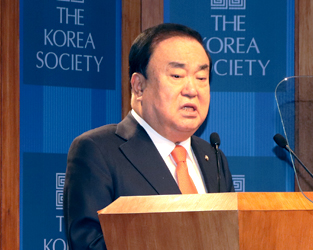
We will examine as well some of the complexities with eminent scholar David Kang and with Ambassador Thomas Hubbard. We look forward to ending the year and picking up on the note that was left by President Moon Jae-in when he addressed the Korea Society, Council on Foreign Relations and Asia Society earlier in the fall.
Those of you who were with us on December 6 heard a rather sobering assessment from some friends of ours with the Brookings Institution and the Center for Strategic and International Studies (CSIS). This session is designed to extend that discussion, provide some positive bent and look at opportunities for forward movement.
Again, we would like to welcome all of you. We would especially like to welcome Nick Bratt and Phil Sherman, our board members, and the Deputy Consul General and his entire team of 15 from the Republic of Korea Consulate. They have had the very hard job, in 2018, of convincing a lot of people. It’s been an extraordinary effort and we here at the Korea Society are very admiring of all that they do to put out the good word on Korea. As an American independent, non-profit organization, the Korea Society certainly benefits from partnerships, and the diplomats here help us to better understand where the Republic of Korea is going.
Today we have David Kang who is an eminent professor. He is the author of several books, including most recently this year the re-release of Nuclear North Korea, a book that he wrote with Victor Cha, who’s often on our stage. That is as important now in 2018 as it was in its initial release in 2003. That’s out through Columbia University Press, and we highly recommend it. David is also the director of the Korean Studies Institute at the University of Southern California (USC). It does a tremendous amount and is one of the highlights of Korean studies on the West Coast of the United States.
We have Ambassador Thomas Hubbard, familiar to many of you as the chairman of The Korea Society and Senior Director for Asia at McLarty Associates. Ambassador Hubbard is a longtime and distinguished career diplomat who served as our ambassador in both the Philippines and the Republic of Korea.
And moderating our discussion today is our president, Thomas Byrne. Tom served with Moody’s and has been president, here since August of 2015. We’ve introduced a number of new programs, and those of you who follow our policy, economics and finance discussions know that we’ve had a heady steam, largely the result of Tom’s guidance and leadership. He will facilitate the discussion today.
We thank you, again. A very Merry Christmas, Happy Hanukkah, and Happy New Year. Tom, over to you.
Thomas Byrne:
Thanks, Stephen. We’re all here to take another assessment of where we stand with the extraordinary developments of this past year: South Korea’s engagement with North Korea and also the US’s engagement with North Korea. This is really a follow-up to the speech that President Moon Jae-in made when he was here for the UN General Assembly in September. He made that, as Stephen Noerper said, at the Council on Foreign Relations. This was an event at the Korea Society as well as the Asia Society — I see Danny Russel is here — co-hosted along with the Council on Foreign Relations.
I’d like to repeat some of the points that President Moon made. Maybe this could prompt some reaction and discussion from you, David, and also from Tom Hubbard.
President Moon started off by noting, as we all recognize, that it was really a remarkable turn of events when Kim Jong Un gave his New Year’s speech a year ago. Stepping back, if this were 2017, I think none of us could have imagined what would unfold this year.
But President Moon went even further than calling it remarkable. He called it a miraculous development that’s happening on the Korean Peninsula. And what he was referring to was the establishment of a permanent peace regime on the Korean Peninsula through the complete denuclearization of North Korea.
He also said he hoped that once a complete and verified denuclearization has taken place, then North Korea could focus on economic development and that would mean some sort of North-South economic program set-up — maybe a funding set-up — but all of this is preconditioned on denuclearization, and verifiable denuclearization from North Korea.
He also said that for this denuclearization to take place — for North Korea to actually go ahead with this — that the hostile state of the relationship between North and South Korea has to end. He talked about security guarantees. President Moon also talked about the necessity for some sort of end-of-war declaration. A political declaration.
At the same time he stressed that all these remarkable changes that had taken place through September were achieved based on what he called the “rock-solid” ROK-US alliance. He went on to say that, furthermore, even after a peace treaty is signed and even after reunification, the ROK-US alliance should remain in place in order to continue to uphold peace and stability in the Northeast Asian region. With that as a primer, David why don’t you try to work that in or just go ahead with your prepared statements?
David Kang:
I’ll take a minute or two and provide an overview. I think that’s fine. I also think it’s funny that there was a reference to the Brookings-CSIS thing. It was a little more skeptical.
I was just in DC for a week of meetings with various officials and a think tank, and as you probably know, the mood in the Beltway is extremely skeptical. They think that Moon is eager and perhaps too eager to change things.
One of the reasons I’m on the West Coast and not in the Beltway is because I have a totally different perspective. The real question is this: ‘Is this, by chance, a totally unprecedented opportunity where we can do something? Or is this just same old, same old? We know they’re lying and they’re trying to get something from us, etc.’ The conventional wisdom is very much that there’s nothing really new, here. It’s just another ploy. It’s another way in which they’re trying to set up the United States or get away with something.
I tend to think that this is actually, in many ways, a historic opportunity that we’ll get once in a generation. I think there was one in the mid-nineties that we managed to fumble away. Everybody did. We have a new leader in South Korea, we have a leader in North Korea, and we have a president in the United States; all three of whom are willing to do things that none of their previous leaders have been able to even conceive of or consider.
Does that mean we’ll get there? I’m not sure whether we will or not. But this is an opportunity to take a step back from where we were, and I think all of us would prefer to be where we are this year, in December, as opposed to where we were last year, in December.
So in many ways, the question is whether we have a strategy for going forward?
I’m happy to expand on this if you want. I think Kim Jong Un has a very clear strategy and he knows what he’s doing. I’m happy to explain that. This is not something where he woke up last January and said, “OK, let’s go to the Olympics. Who wants to go? I need a skier. Two skiers. Who skis?” They clearly knew what they were going to do. It was clearly long-planned. Moon Jae-in has clearly spent 10 years thinking about what he would have done differently or what he would do differently if he were president.
I think the real question is does the United States have a strategy?
I think some in our administration do. As we all know, it’s not clear whether President Trump shares the way that many of the policy-making establishment wants to go. We found out just yesterday with Syria. I think the real question is, ‘Does the United States have a strategy for actually moving forward and taking this ball wherever it is today and moving it down the path a little bit farther?’
I think we’ll find out, but I think that’s really the question. How are we going to move forward, because I think both sides of the Korean Peninsula are ready to try and move and I think the question is, ‘Can the US meet them in some manner?’
Byrne:
Tom, is this an historic opportunity? An opportunity for a breakthrough, perhaps, or the same old game?
Thomas Hubbard:
First let me say that David, we’re very glad to have you here right now.
Kang:
I should have said thank you for having me.
Hubbard:
We’re glad to have you, here, on the East Coast because I think we do here, on the East Coast, need some bucking up. The mood certainly has been very skeptical. I’m glad to hear you because I’m inclined to agree that we have an opportunity now that we have not had in the past with three unusual leaders.
In Kim Jong Un, I think we have a continuation of the North Korean dictatorship, but we do seem to have, in Kim Jong Un, a leader who cares about the people. He does seem to be trying to do something that will uplift the Korean people, but I do think he still wants to have his nuclear weapons, too. The question is, ‘Can he be persuaded to give up those weapons in the interest of the betterment of his people?’
I think in Moon Jae-in we have a very different person, too; someone who, as you say, has been thinking about this for a long time. He has a strategy. He had the courage to pick up on the initial moves that Kim Jong Un made to try to turn it into something.
And finally we have President Trump. In the midst of all the skepticism; willing and kind of eager to take a chance and wanting to keep this going.
So I think we probably have a better chance now than we have had in the past, but I think the chances of moving forward to the denuclearization of North Korea are still very slim and is certainly a long-term prospect.
I think we were reminded today that Kim Jong Un isn’t really lying. He’s willing to have denuclearization of the Korean Peninsula and the entire area. And part of that in his mind, as we saw in a statement put out by the government press this morning, is when he says denuclearization he means full denuclearization and elimination of any US nuclear threat to him on the Korean Peninsula or in the region. That obviously is a step that is going to be very hard to do.
I’m a little less optimistic this morning after reading that, now that he’s been very explicit in what he means by this, until now, undefined denuclearization. I’m really not sure where we pick up and go from here, but I do have the sense, despite all the skepticism in Washington, that at least until this morning people were planning on another Trump-Kim Jong Un meeting in the early months of next year.
It was also disappointing that Kim Jong Un hasn’t managed to get to Seoul as he had promised to do this year, but I think we’ll have another round of feeling each other out and I do think we have a better chance now than we have in the past. As you said, we certainly have to feel a lot better this December than we did last December, whereas we’re now talking about talks – and how we get back to talks – instead of talking about the threat of war.
The good news is that in more than a year there has been no North Korean testing of nuclear weapons or ballistic missiles. My question is, ‘How long this can last if we don’t get back into some kind of process?’ One of the disappointing things is, up until now the North Koreans have really been willing only to talk at the very top level and it’s going to be hard to get to productive discussions with that attitude.
Byrne:
When I woke up I read the same news in which the Korean Central News Agency defined what they meant by denuclearization, meaning elimination of the threat from the US and probably the nuclear umbrella in the alliance that the US made with Japan. I wonder whether this is really news. Shouldn’t this have been discussed at Pompeo’s visit or Moon’s visit? Is this really news? It’s news to us, but is it news to the US government and the South Korean government? Didn’t they know when they entered into this process of engaging North Korea summit talks that this is North Korea’s starting position? Is that a surprise, David?
Kang:
No, it’s not a surprise. I don’t think there’s anything new in this. We wrote our book – which makes a great Christmas gift, by the way, and Mom will love it – 15 years ago and the same issues were on the table then as they are today, so I don’t think it’s really a surprise.
North Korea has always said this would not be a unilateral disarmament. What that means is maybe more specific today than it was yesterday, but it was unrealistic to think that North Korea would simply let a boat back up into Wonsan Harbor and they would just load up all the nukes and then say, “OK, we’re done with it.” This was always going to be a mutual process.
The question from the American side was always, ‘What will we do in response? What is going to be on the table from our side?’ This administration has not made this clear yet. What is on the table and what’s not? They might have done it again, privately or something else, but certainly publicly it’s not clear. And the North Koreans have consistently said, “This will not be a one-way process,” so what they said today isn’t that surprising.
The other small thing I’ll say is it points out how unrealistic either of these goals is. We all know there is no possible way – whatever it’s called now (FFVD) – the final, fully verified denuclearization of North Korea. They could let inspectors into every bedroom and look under every bed and in every closet, and we’ll still think he’s got some hidden. And they could always start over. It will never be completely irreversible. They can always start over.
And the same thing for the United States. There’s no way that we can promise not to ever threaten North Korea, because of course we can. We’re the United States with a massive military. Of course, we can always change our mind. So the question is how we get beyond the unrealistic to something that moves us from here and moves us in the right direction. I think that’s a much more realistic goal, which is to move back a little bit as opposed to saying, “Here’s the end goal and if we don’t get there right away, I’m walking away.”
Byrne:
Then what would be those steps?
Kang:
I think we’re seeing some of those steps right now. Again, one of the interesting things is a year without missile and nuclear tests. That’s huge. Why did we care? Because it was a year without missile and nuclear tests. I’ll make a prediction. If North Korea doesn’t test anymore, I think the air for any kind of real pressure goes out of the balloon. I really think those are the provocations that we care about, and if they just stop right now and stand still, it will be very hard to get a lot of enthusiasm or momentum for any more coercive steps on the American side.
There’s things they could do. They could do a little bit. They’re already doing stuff in terms of conventional weapons. And if you think about it, when was most of the killing that went on in the last 50 years? It was conventional. It was Northern Limit Line. I mean, that’s huge. That stuff is boats out there shooting each other up and 20 people die. That’s massive; to actually make some progress on the Northern Limit Line and the maritime or the DMZ, which are steps back.
Byrne:
President Moon in his speech mentioned that it’s significant that there has been no testing of either missiles or nuclear weapons and that shows that some progress has been made. But couldn’t you look at it from the other side? It’s making a virtue out of necessity because whenever North Korea did test, it faced ever-tightening sanctions. And there’s one thing I think we do know; that North Korea doesn’t like the sanctions. Visible trade with China collapsed in 2018. There must be some economic pressure being felt in North Korea.
So I don’t know. Virtue out of necessity or is this really a significant step? Tom, what do you think about that?
Hubbard:
I think it’s significant. That is the biggest problem and the biggest concern. Sure, the North Koreans said in stopping their testing that they didn’t need to test anymore. They already had their deterrent. I don’t think that’s quite true. They do need to test to improve their capability, but I think it’s symbolically very important that they stop.
Indeed, I think you pointed to a dilemma; that, in fact, I think the North Koreans will soon realize that so long as they’re not testing, they’re not getting our attention. And going back, in fact, to one of their statements, I think even that statement this morning talked about the US seemingly falling back into the Obama policy of strategic patience. At some point they’re going to knock on our door, again.
I do think, also, that while we all thought we knew what the North Koreans meant by denuclearization, I’m not sure President Trump did and certainly his public posture didn’t suggest that in any way. Now that the emperor has publicly declared that he has no clothes, we have to see where we go. I think it does complicate the circumstance.
Byrne:
President Moon aspired to have a declaration to the end of the Korean War by the end of this year. Do you think we’ll get it and if we do what are the implications or are there any unintended bad consequences from something like this that would affect the alliance? Tom, why don’t you start?
Hubbard:
Obviously it’s not going to happen this year.
Byrne:
We still have 10 days.
Hubbard:
Exactly. Frankly, it’s something I think we ought to seriously think about. The North Koreans, over the course of the year, have rearranged their priorities. Originally when President Moon was here, everybody thought, “Well, the first thing to do is declare the end of the war,” and the North Koreans at some point said, “No, that’s not really important. What we really want is to get rid of the sanctions.” And that came out in today’s statement, as well.
I think that particular issue has become a lesser priority as the year’s gone on. We needed something that President Moon would like to have. I think this has been a blow to him – not getting the meeting in Seoul and not getting a declaration of the end of the war.
Byrne:
How important is a declaration to the end of the war?
Kang:
We view this stuff in two ways that tend to be a little contradictory or just in different ways. One is it’s all symbolic so it’s meaningless. On the other hand, “You can’t do that! If all of it is meaningless, then who cares?”
You’re giving them a victory. I tend to think the symbolism really matters. I don’t think it’s the end-all. First of all, the thing to remember about almost all of this is this is negotiating. This is what countries do. This is what people do, is setting out some lines. Maybe you mean it. Maybe you don’t. That’s why you engage in diplomacy in the first place, is to find out what they really care about and what they don’t.
I think the symbolism of trying to end the hostility between the two sides on the Korean Peninsula is enormous. You can always build the guard posts. The image shown earlier of the two military men shaking hands is incredible. That’s very powerful and I think that can really matter in terms of setting a tone by which you can try and have both sides try and take other steps. I think that symbolism can really matter.
But at the same time, you can always rebuild and add more mines, etc. I think these are part of a larger package. Because here’s the other thing. The nuclear weapons won’t matter if we’re not worried about the other country. If we’re not worried about North Korea. We tend to put nukes first, but it’s an entire relationship. We tend to think, “If we get rid of the nukes, then we’ll worry about the rest of the relationship.”
In some ways, if you fix the rest of the relationship, then the nuclear weapons don’t matter. There’s a lot of countries that have nuclear weapons that we’re not particularly worried about. Frankly, even China. For all of the headbutting that we’re doing with China, we’re not worried about a nuclear exchange with China because we know it’s not going to happen. So there’s ways in which you can work on all of these different things without necessarily having to prioritize them.
Byrne:
But I understood there’s one thing different with North Korea and that’s the risk of proliferation of the nuclear weapons. I think we’re more concerned with North Korea than we are with, say, China.
Kang:
Sure.
Byrne:
That would add urgency to getting denuclearization, right?
Hubbard:
I do think the proliferation issue is an important one and it’s particularly important in Northeast Asia because it is such a center of nuclear activity and potential hostility. Certainly the implications for Japan and for South Korea are very strong if North Korea continues and permanently becomes a nuclear power.
But then you get to the question of how do you stop that? How do you get there? My own view on it is that with North Korea, we absolutely have to retain denuclearization as our goal. We have to keep trying to get there even though it will take a very long time and a lot of negotiations to achieve it.
Byrne:
David, you said that Kim Jong Un has a strategy. That he actually is a rational leader and maybe one of the most rational leaders that we have looking at what’s going on in the world. President Moon’s strategy, I understand, for engagement is: First, establish a peace regime and then develop a prosperous Korean Peninsula – or at least raise the standard of living of North Korea. Then, at some remote stage, you get reunification, not through absorption by South Korea, but by a merger of sorts, a confederation or whatnot. Does Kim Jong Un share the same vision or is his strategy more political than economic? What’s his long-term vision for the Korean Peninsula?
Kang:
My take on Kim Jong Un is that he’s clearly concerned about his regime’s survival, so it’s fundamentally a political strategy. And one of the reasons that I think it’s different is that he’s a different leader in a different place than either his father or his grandfather. It’s just the way the world works.
He has a 40-year regime, assuming he lives that long. He’ll rule until he’s 70. He needs a strategy for 40 years. It’s a different type of calculus that he has to make than if it’s very short term. And this is why I say I think he’s got a strategy. This is not something where he’s just worried about tomorrow.
And if you think about it, what is the strategy that’s going to allow him to survive? And this is why I think it’s actually a very clear strategy. If you go to January 1, 2017 and his New Year’s Day speech; “This is the year that we are going to achieve our long-desired goal.”
And you know what? All year they did. Sixty tests — bam, bam, bam, bam, bam. Nuclear tests, long and short-range, all the way into November. Into December. Things we never thought they would do. They don’t test in the winter. Oh, they did. We went berserk. Tests, sanctions, threats. Indirect offers to talk, etc.
January 1, 2018 was, “We’ve achieved our desired goal. Let’s talk.” Again, I don’t think it was like December 29 that he woke up and said, “Let’s do this.” Clearly, they decided somewhere back in 2016, and I think there’s a lot of other evidence that it’s longer than that.
And they probably said this as they’re sitting around in their Council of Deliberations or whatever else. “We’ve done a slow-motion nuclearization for 20 years. Stop us before it happens.” And they take a little step here and a little step there and they haven’t done it. And we’ve gotten nowhere. We’re still in the same place from their perspective. “The Americans aren’t meeting us.”
Instead of saying, “Stop us before we do it. Let’s march up the hill and see what they do. We can always march back down the hill, but if not we can stop here,” which is exactly what they did. Now they’ve got it. Again, it’s not as good as they’d like, but they have a deliverable nuclear weapon and they’re at the top of the hill.
And they said, “OK, we’ll be willing to walk back down the hill if you want,” but it’s a different strategy and I can see why you would end up with that strategy. And the question they clearly asked themselves was, “Americans are going to go berserk. Can we deal with the sanctions?” They clearly said, “Yes, and here’s our offering. This is what we’re going to do.”
This is not at all clear when you’re back in 2015 whether that was a better strategy than what they are currently doing. I can see a very clear strategy that has an economic component and a military component, but it’s about long-term regime survival.
Byrne:
Do you think Kim Jong Un was surprised by the ratcheting up of sanctions in 2016 by the UN and also by the US?
Kang:
I don’t. A lot of people think he was surprised. I don’t see how you could be surprised by that. They’d already been sanctioned an extraordinary number of times. The idea that this time they won’t get worse – if we do stuff much worse – and then they would say the Americans aren’t going to ratchet up and make it worse; to me that’s not realistic.
If it was a conscious strategy: “We are going to test, and we are going to do all this stuff, and it’s going to be paced out this way, and we’re going to nuclear test, ICBM test, etc.” Of course the Americans are going to go berserk. You have to say that probably they’re going to respond.
Byrne:
Were they surprised that China signed on to all the sanctions in the UN?
Kang:
I don’t think so. And there’s a lot of indication right now that China superficially went along and now the shelves are full of stuff again on the border regions. We’ll find out. I think they have a strategy. “Can we deal with it?” The answer was probably yes. Not that it will be great, but they could deal with it.
Hubbard:
Could I ask David a question as a follow-up? Everything you outline is a strategy vis-à-vis the United States and that could have been planned although, of course, they had no idea they were going to get the gift of Trump, which I think was a good thing.
Kang:
I don’t think anybody expected that.
Hubbard:
But they also could not expect the gift of movement – that Park Geun-hye would have fallen the way she did and he came on – and so they’ve had to deal with some variables along the way.
Kang:
And that’s why I think it was even more of a deliberate strategy, because they couldn’t have said, “Well, we’re going to get a progressive president in.” That you couldn’t have predicted. So they decided on this strategy even knowing that there was probably a more hard-line government in the South and a typical American president.
The thing that probably surprised everyone was how three leaders came together in this way. Nobody could have predicted a Singapore summit.
Byrne:
Getting back to the strategy. It seems to me you’re saying that the long-term objective of this strategy is just regime survival.
Kang:
Fundamentally.
Byrne:
Isn’t it more than that?
Kang:
Oh, yes, there’s more than that, but that’s the basic goal. The thing that we’ve always said is there’s two sides to this coin, that North Korea can never reform because once they open up their economy, everyone will leave. But there’s a lot of evidence that a lot of authoritarian dictatorships reform their economies and become fabulously wealthy, like China, without the regime falling. It’s not at all clear. Cuba hasn’t fallen, yet. There’s Vietnam. There are a lot of authoritarian governments.
Part of it is, ‘Well, they can never reform.’ On the other hand, if they don’t change, they really are in trouble as they get poorer and poorer, and I think, again, there was a decision looking forward. It’s never clear if that’s the right decision; but, you could make an argument for, “We can reform our economy, make people better off, and we can still retain power.”
Byrne:
I think authoritarian governments can reform, but is North Korea authoritarian or totalitarian? I mean, China didn’t reform when it had a cult of personality under Mao. It had to make that big transition into the Deng Xiaoping-led government and not a cult of personality.
Tom, how do you see North Korea’s long-term strategy? Can they achieve their regime survival without denuclearization and without economic development?
Hubbard:
I think Kim Jong Un’s strategy is to try to do that. I think he continues to want to have his cake and eat it. To be able to have his deterrent, and within that, to develop. I think that is the trick for all of us. I see Danny Russel. Bob Carlin’s back there. We’ve been at this for 25 years.
And for that entire 25 years, the premise has been that at some point the North Koreans can be persuaded that their own security, their survival, etc. depends on abandoning nuclear weapons, opening up, etc. and it hasn’t happened in those 25 years. I don’t think they’ve accepted that point, yet, and that’s the real challenge ahead.
Byrne:
Will there be a second summit with President Trump and Kim Jong Un? And if there is, what can we expect from it? Perhaps more than the June summit?
Hubbard:
My sense from everything I hear in Washington is that we are counting on a second summit. That the president wants it and that we’re likely to find some way to have it. And I do hope and expect that that summit in South Korea, somewhere, will happen early in the year, too. I think we’ll have another round but we’ve got a lot to work through.
Byrne:
If it was a year ago and we were sitting here on December 20 and I asked you where you thought we’d be a year from now, can you imagine what your response would have been? Where do you think we’ll be a year from now starting from today, December 20, 2018?
Kang:
No one could have predicted a year ago that we’d be where we are today. So given that caveat…
Byrne:
Is there a risk we’ll be back to where we were a year ago?
Kang:
I don’t think it can get as bad. Here are some of the things that I think have changed no matter what. I think one of the first things that has changed – and this, again, I think is Kim Jong Un’s strategy – is I think what he tried to do early on in his rule, like 2012 or 2013, is show the world that he was a normal guy.
He did things that no North Korean leader ever did. We saw his pretty wife and he’d show us various pictures. We never saw them before. Or his sister, etc. We saw his wife. We saw him going to basketball games. And I understand that he didn’t want Rodman. He wanted someone else first, but Rodman was the only one. He was trying to show, “I’m a normal guy.”
Byrne:
He wanted Michael Jordan.
Kang:
Is that [true]?
Byrne:
Rodman said so.
Kang:
The point is I think he tried a lot of things and everything he did we all laughed at and said, “How strange!” But I think that was part of, “I’m a normal guy.”
I think during the summits and the meetings – particularly for South Koreans having him talk, seeing him on TV, and hearing him speak – he was relentlessly polite to Moon who’s like 20 or 30 years older. He’s incredibly polite the way he speaks to him. The one thing that’s changed is it’s harder to sustain the crazy man thesis. I think that’s gone. Too many people have seen it. They may not like what he’s doing, but the idea that this is just some crazy man I think is gone. So we’re in a different place today than we were.
Could it go back to being as bad as it was? It obviously could, but, again, I think that as long as North Korea doesn’t test, I think it will be very hard to go back to where we were, no longer how long they drag their heels or drag it out.
Byrne:
So you would predict the status quo for another year or would you predict a breakthrough be achieved?
Kang:
Here’s the other thing. I think Moon has a strategy and I think Moon has a bunch of other smaller things that they want to do. The one thing that I’ve heard from people in the Moon administration was they thought what Roh Moo-hyun did wrong 10 years ago was too many big things and not enough small, incremental things. And that’s why they have the de-mining and the guard posts and the Northern Limit Line.
So there’s some real progress that can be made even while you go for the home run, and I think there’s still some more things, there, that they’re trying to do. The rail line – they want a third survey. So I think South Korea has a strategy, and you can hear this from the talking points.
Moon had one audience in this speech, here. He’s talking to Americans. US-ROK! He clearly wants the Americans on his side. He wants to let Americans know he’s not going to sell out the Americans. So he’s got a strategy in place.
I think there’ll be some small progress forward. I think Trump wants the meeting. Whether he gets it is up for prediction.
Byrne:
Tom, what’s the risk of us falling back to where we were a year ago?
Hubbard:
I think this next year will be one of ups and downs and probably more dramatic ups and downs then we had this year. It was all kind of up from the low base last year and I do think we’re going to have to get back into more regular discussions. I think there’s bound to be a lot of acrimony. I think we’ll probably see, still in this coming year, more progress in North-South relations than in US-DPRK relations, and that will bring with it challenges in maintaining our solidarity.
We haven’t said much. I do think it’s significant that Biegun, our envoy, made such a big deal of talking about alleviating some of the restrictions on travel and humanitarian assistance. It’s a natural thing to do. It’s something our humanitarian organizations want. It makes a lot of sense.
But he did kind of offer it up in a special statement as he was going to the ROK and, of course, we were met by this brick in the face by the North Koreans. I don’t know how that goes, but I think our side is looking for ways to keep this going. Biegun has made a big deal of this new working group we have. He’s in Seoul right now as part of that.
I think this is going to be a year of hard work and a lot of ups and downs. We have a lot going on in the United States that can affect our president’s attitudes and our approach to the whole thing.
Byrne:
Thank you, all, for the interesting discussion and I thank the two experts, here, for sharing your knowledge and insights.
Audience:
[Applause] [End]


















 Dr. S. Heijin Lee is Assistant Professor at New York University, focusing on Transnational Feminist Cultural Studies; Asian/American Studies; Gender and Sexuality Studies; Digital Media and Popular Culture. Dr. Lee’s research explores the imperial routes of culture and media. In addition to her book, The Geopolitics of Beauty, which maps plastic surgery in South Korea, Asia, and Asian America, Lee is co-editing two anthologies. Dr. Lee’s works include Other Pop Empires, Bollywood to Hallyuwood, and Fashion and Beauty in the Time of Asia, which tracks fashion and beauty as formations of Asian modernities. Lee has been published in Women and Performance: Journal of Feminist Theory and Frontiers: Journal of Women’s Studies. She earned her Ph.D. in American Studies and Certificate in Women’s Studies from the University of Michigan; a M.A. in Asian American Studies from the University of California, Los Angeles; and a B.A. in Ethnic Studies/Spanish at the University of California, Berkeley.
  Lai Frances, whose real name is Allyza Umali, is freelance journalist and producer whose work has been featured in Billboard, Allure, PopCrush, KpopStarz, The Boombox, and many more media outlets. A self-proclaimed Kpop girl group enthusiast, Lai can be found on panels at KCON and New York Comic Con while contributing to podcasts and digital projects on arts, entertainment, and culture. Frances earned a B.A. in Journalism and Video Production from Rutgers University-Newark with a focus on music, entertainment and multimedia journalism.
